Introduction
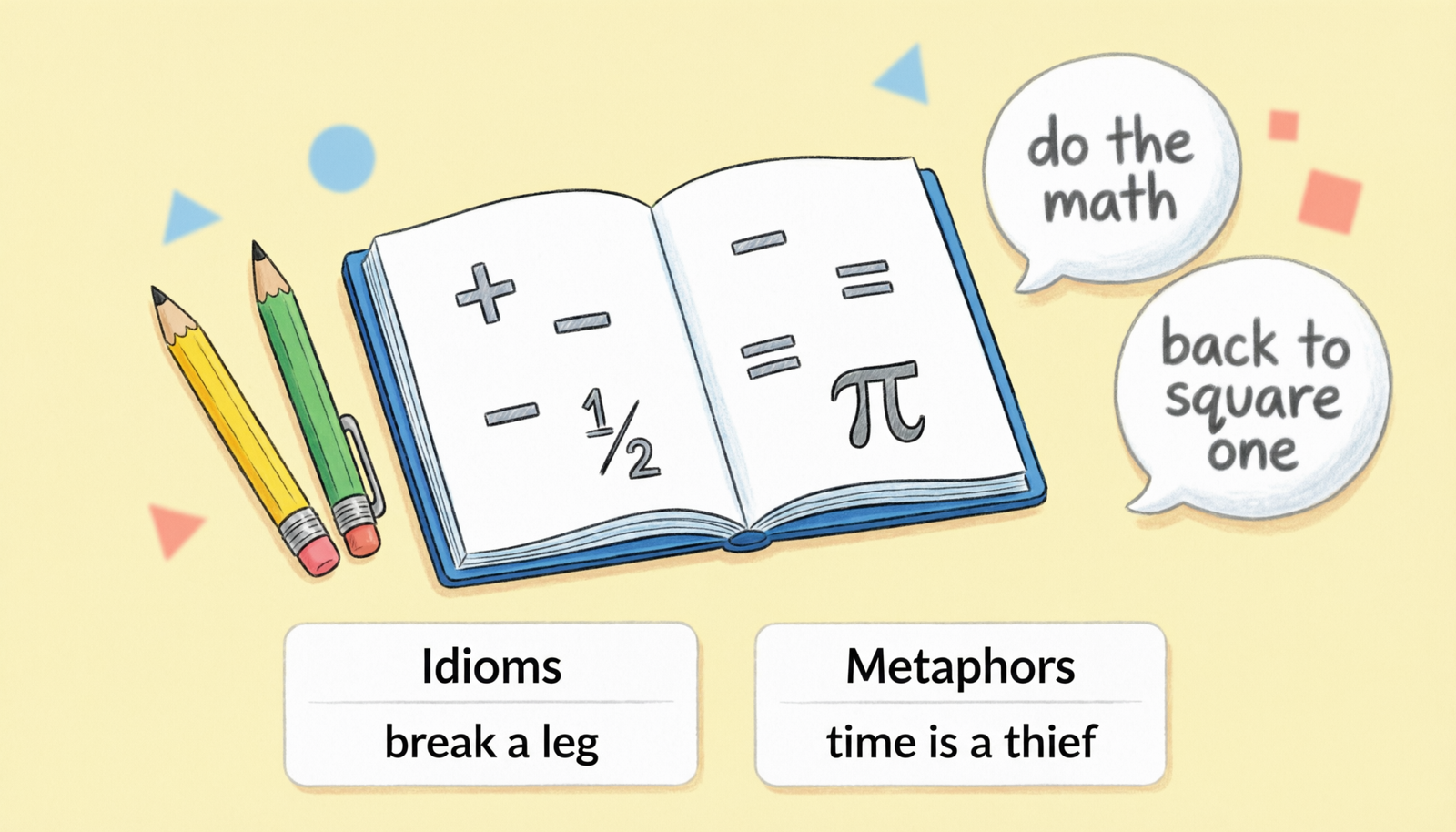
Math has its own language, but people also use math words in everyday expressions. Phrases like “do the math,” “add fuel to the fire,” “back to square one,” and “it all adds up” do not always talk about real numbers. They often use math-related language to explain life, choices, problems, effort, or logic.
This is where many students, writers, and ESL learners get confused. Some math expressions are idioms, while others work more like metaphors. Both can make writing more interesting, but they do not work in exactly the same way.
The simple difference is this: an idiom is a fixed phrase whose meaning is different from the literal words, while a metaphor compares one thing to another without using “like” or “as.” An idiom often belongs to everyday speech. A metaphor often creates an image or idea in the reader’s mind.
For example, “back to square one” is an idiom. It means starting again, not literally returning to a square. “Life is an equation” is a metaphor. It compares life to a math equation to suggest that choices, problems, and solutions connect.
Understanding this difference helps you use figurative language more clearly in essays, stories, speeches, and everyday English.
What an Idiom Means
An idiom is a common expression with a meaning that does not come directly from the individual words. Native speakers understand the phrase because they have heard it before, not because the words explain the meaning literally.
For example, “do the math” does not always mean solve a math problem. In everyday English, it can mean “think logically” or “look at the facts.”
The purpose of an idiom is to make language sound natural, expressive, and familiar. Idioms often carry cultural meaning, so they can feel confusing to ESL learners.
A short natural example:
If we spend more than we earn, we will go broke. Do the math.
Here, “do the math” means “understand the obvious conclusion.”
Idioms get confused with metaphors because many idioms began as images or comparisons. However, an idiom usually has a fixed meaning that people already know.
What a Metaphor Means
A metaphor is a figure of speech that describes one thing as another thing. It does not use “like” or “as.” Instead, it creates a direct comparison.
For example, “Math is a language” is a metaphor. Math is not literally a spoken language like English or Spanish, but the phrase suggests that math has symbols, structure, rules, and meaning.
The purpose of a metaphor is to help readers understand an idea by connecting it to something familiar. Writers use metaphors to make abstract ideas easier to imagine.
A short natural example:
Her mind was a calculator during the exam.
This metaphor means she solved problems quickly and accurately. Her mind was not literally a calculator.
Metaphors get confused with idioms because some idioms also use figurative meaning. The key difference is that a metaphor creates a comparison, while an idiom usually works as a known expression.
Idiom vs Metaphor: The Core Difference
An idiom depends on a phrase people already recognize. A metaphor depends on comparison.
When someone says “back to square one,” they use an idiom. The phrase has a known meaning: start again from the beginning.
When someone says “failure was his classroom,” they use a metaphor. The sentence compares failure to a classroom because failure taught him something.
In simple terms:
Idioms are fixed expressions. Metaphors are direct comparisons.
This matters because idioms often sound casual and conversational, while metaphors often feel more creative, poetic, or descriptive.
Quick Comparison Table
| Point | Idiom | Metaphor |
|---|---|---|
| Definition | A fixed expression with a meaning different from its literal words | A direct comparison between two different things |
| Scope | Usually a common phrase used in everyday speech | Can be common, original, literary, poetic, or informal |
| Purpose | To sound natural, expressive, or conversational | To explain, describe, or deepen an idea through comparison |
| Length | Often short phrases | Can be short, extended, or part of a full paragraph |
| Structure | Usually fixed wording | More flexible and creative |
| Meaning | Learned as a whole phrase | Understood through comparison |
| Use in writing | Good for informal writing, dialogue, explanations, and natural expression | Good for essays, stories, speeches, poetry, and creative descriptions |
| Example | “It all adds up.” | “Math is the skeleton of science.” |
How Idioms Work
Idioms work because the phrase has a shared meaning. You cannot always understand an idiom by translating each word.
Take the math-related idiom “it all adds up.” Literally, adding up means calculating numbers. Figuratively, it means something makes sense when all the facts come together.
Example:
Her story seemed strange at first, but after I heard the details, it all added up.
The speaker does not mean they solved an addition problem. They mean the situation became logical.
Many idioms use words from math, school, numbers, money, games, sports, or daily life. Math idioms often connect to logic, balance, calculation, risk, planning, or starting over.
Common math-related idioms include:
- Do the math meaning understand the facts
- Back to square one meaning start again
- It all adds up meaning it makes sense
- By the numbers meaning done carefully or according to rules
- Put two and two together meaning figure something out
- A numbers game meaning success depends on quantity or probability
- Six of one, half a dozen of the other meaning two choices are basically the same
These phrases help speakers express ideas quickly and naturally.
How Metaphors Work
Metaphors work by saying one thing is another thing. They do not usually have one fixed dictionary-like meaning. Instead, readers understand the connection through imagination and context.
For example:
A difficult problem is a locked door.
This metaphor compares a problem to a locked door. It suggests that the problem blocks progress and needs the right key or method.
In math-related writing, metaphors often describe learning, logic, problem solving, intelligence, confusion, or structure.
Examples:
Algebra is a puzzle.
This suggests algebra requires patterns, pieces, and patience.
Numbers are the building blocks of science.
This suggests numbers support larger ideas, just as blocks support a building.
Her solution was a bridge between theory and practice.
This suggests her solution connected two separate ideas.
A metaphor can be original. Unlike an idiom, it does not have to be a phrase everyone already knows.
Key Differences in Simple Language
The easiest way to separate idioms and metaphors is to ask one question:
Is this a known expression, or is it making a direct comparison?
If it is a common fixed phrase, it is probably an idiom.
Example:
We are back to square one.
This means the progress has been lost, and the person must start again.
If it directly describes one thing as another, it is probably a metaphor.
Example:
This project is a maze of numbers.
This compares the project to a maze to show confusion or complexity.
Another key difference involves flexibility. Idioms usually do not change much. If you change too many words, the phrase may sound wrong. For example, native speakers say “back to square one,” not usually “back to rectangle one.”
Metaphors are more flexible. A writer can create a new metaphor, such as “The formula was a flashlight in a dark room.”
Can Idioms and Metaphors Overlap?
Yes, idioms and metaphors can overlap.
Some idioms are metaphorical because they began as comparisons. “Back to square one” likely connects to board games or numbered steps, so it creates an image of returning to the beginning. But today, people use it as a fixed idiom.
Another example is “put two and two together.” It comes from simple arithmetic, but in everyday English it means to understand something from clues. It has a figurative meaning, so it can feel metaphorical. Still, because it is a fixed common expression, we usually call it an idiom.
This overlap explains why students often feel confused. A phrase can be figurative, common, and image-based at the same time. The best label depends on how the phrase works in the sentence.
A helpful rule:
Call it an idiom when the phrase has a familiar fixed meaning. Call it a metaphor when the sentence creates a direct comparison.
Examples of Idioms for Math
Below are useful idioms for math, numbers, logic, and problem solving. These expressions do not always refer to real math.
1. Do the math
Meaning: Think about the facts and reach the logical answer.
Example:
If the rent is higher than your monthly income, do the math.
2. It all adds up
Meaning: The facts make sense together.
Example:
His explanation sounded odd at first, but now it all adds up.
3. Back to square one
Meaning: Start again from the beginning.
Example:
The experiment failed, so the team went back to square one.
4. Put two and two together
Meaning: Understand something by connecting clues.
Example:
When I saw the empty cake box, I put two and two together.
5. A numbers game
Meaning: A situation where success depends on quantity, statistics, or probability.
Example:
Job hunting can feel like a numbers game because you may need to apply many times.
6. By the numbers
Meaning: Done carefully, exactly, or according to rules.
Example:
The coach wanted the drill done by the numbers.
7. Six of one, half a dozen of the other
Meaning: Two choices are almost the same.
Example:
Taking the bus or train will take about the same time. It is six of one, half a dozen of the other.
8. Crunch the numbers
Meaning: Calculate carefully, especially before making a decision.
Example:
We need to crunch the numbers before buying a new car.
9. Balance the books
Meaning: Make financial records correct; sometimes also means make things fair.
Example:
The accountant stayed late to balance the books.
10. Count on someone
Meaning: Depend on someone.
Example:
You can count on Maya to help with the project.
Examples of Metaphors for Math
These examples use math-related ideas as metaphors. They are not necessarily fixed idioms.
1. Math is a language
Meaning: Math has symbols, rules, and meaning, like a language.
Example:
Math is a language that helps scientists describe the universe.
2. An equation is a balance scale
Meaning: Both sides of an equation must stay equal.
Example:
Think of an equation as a balance scale; whatever you do to one side, you must do to the other.
3. Numbers are building blocks
Meaning: Numbers support larger ideas and systems.
Example:
Numbers are the building blocks of every financial plan.
4. A formula is a recipe
Meaning: A formula gives steps or ingredients for reaching a result.
Example:
A formula is a recipe for solving a problem.
5. A problem is a puzzle
Meaning: A problem has pieces that must fit together.
Example:
This geometry question is a puzzle, but each clue helps.
6. Fractions are slices of a whole
Meaning: Fractions show parts of something complete.
Example:
Fractions are slices of a whole, which makes them easier to picture.
7. Graphs are maps of data
Meaning: Graphs help people see patterns and direction.
Example:
A graph is a map of data, showing where the numbers rise and fall.
8. Logic is the engine of math
Meaning: Logic powers mathematical thinking.
Example:
Logic is the engine of math because it drives every proof.
Idioms vs Metaphors in Literature and Writing
Writers use idioms and metaphors for different effects.
Idioms often make dialogue sound natural. A character who says “do the math” sounds direct and conversational. A character who says “we are back to square one” sounds familiar and practical.
Metaphors often create stronger imagery. A writer might say, “His mind was a maze of unfinished equations.” This sentence does more than explain confusion. It gives the reader a picture of mental overload.
In essays, idioms can make writing more approachable, but too many idioms can sound informal. Metaphors can make an essay more vivid, but unclear metaphors can confuse the reader.
For example:
Informal idiom:
The results did not add up.
Stronger metaphor:
The results were loose threads in a pattern that refused to hold.
Both sentences show confusion, but they create different tones.
Use idioms when you want natural expression. Use metaphors when you want deeper description.
Idioms vs Metaphors for Students and ESL Learners
Students and ESL learners should learn idioms carefully because idioms often do not translate word for word.
For example, “put two and two together” may confuse a learner who expects a math answer. The phrase actually means to understand something from clues.
Metaphors can also confuse learners, but they usually give more context. If someone says, “math is a puzzle,” the comparison is easier to understand because puzzles and math both involve solving.
Here is a simple learning method:
First, check whether the phrase is common and fixed. If it is, learn it as an idiom.
Second, check whether the phrase compares one thing to another. If it does, it may be a metaphor.
Third, look at the context. Context often tells you whether the speaker means real math or figurative meaning.
For ESL writing, idioms can sound natural, but they can also sound awkward if used incorrectly. Metaphors give more creative freedom, but they need clear logic.
Common Mistakes and Confusion
One common mistake is treating every figurative phrase as a metaphor. Idioms are figurative, but not all idioms are metaphors.
Another mistake is reading idioms literally. If someone says “it all adds up,” they may not mean arithmetic. They may mean the facts make sense.
Students also confuse metaphors with similes. A metaphor says one thing is another thing. A simile compares using like or as.
Metaphor:
Math is a ladder to clearer thinking.
Simile:
Math is like a ladder to clearer thinking.
Another common mistake is using idioms in formal writing without thinking about tone. “Do the math” may sound too casual in an academic essay. A better formal version might be “The evidence leads to a clear conclusion.”
Writers should also avoid mixed metaphors. For example, “The equation was a bridge that unlocked the door and planted a seed” combines too many images. One clear metaphor works better.
When to Use Idioms and When to Use Metaphors
Use idioms when you want your writing or speech to sound natural, familiar, or conversational.
Good places to use idioms:
- Dialogue
- Blog posts
- Informal essays
- Personal writing
- Explanations for general readers
- Speeches with a friendly tone
Example:
After three failed attempts, we were back to square one.
Use metaphors when you want to explain an idea more vividly or creatively.
Good places to use metaphors:
- Literature
- Poetry
- Speeches
- Descriptive essays
- Teaching explanations
- Creative nonfiction
Example:
Each formula was a key that opened another door in the problem.
In school writing, use both carefully. Idioms can make writing sound human, but too many can feel casual. Metaphors can make writing powerful, but unclear metaphors can distract from the main point.
Related Terms People Often Confuse with Idioms and Metaphors
Simile
A simile compares two things using “like” or “as.”
Example:
Solving the problem was like finding the missing piece of a puzzle.
This is not a metaphor because it uses “like.”
Analogy
An analogy explains one idea by comparing it to another in more detail.
Example:
An equation works like a balance scale because both sides must stay equal.
Analogies often help with teaching.
Figure of Speech
A figure of speech is a broad category that includes idioms, metaphors, similes, personification, hyperbole, and more.
Both idioms and metaphors are figures of speech.
Cliché
A cliché is an overused expression. Some idioms can become clichés when writers use them too often.
Example:
At the end of the day, it all adds up.
This may sound tired if the writer does not use it with care.
Symbol
A symbol is an object, image, or idea that represents something deeper.
Example:
A calculator in a story might symbolize logic, pressure, school, or precision.
Hyperbole
A hyperbole is an exaggeration.
Example:
I have a million math problems to finish.
The speaker does not literally have one million problems.
Conclusion
Idioms and metaphors both make language more expressive, but they work in different ways. An idiom is a fixed phrase with a meaning that people learn as a whole. A metaphor is a direct comparison that helps readers understand or imagine an idea.
For math-related language, idioms such as “do the math,” “back to square one,” and “it all adds up” help people talk about logic, evidence, and problem solving in everyday English. Metaphors such as “math is a language,” “a formula is a recipe,” and “graphs are maps of data” help explain ideas through comparison.
The easiest rule is simple: use idioms for familiar expressions and metaphors for clear comparisons. When you understand that difference, you can read more accurately, write more naturally, and explain ideas with greater confidence.
FAQs
What are idioms for math?
Idioms for math are expressions that use math-related words but often have figurative meanings. Examples include “do the math,” “it all adds up,” “back to square one,” and “put two and two together.”
Is “do the math” an idiom?
Yes. “Do the math” can literally mean calculate something, but as an idiom, it means look at the facts and reach the obvious conclusion.
Is “math is a language” an idiom or a metaphor?
“Math is a language” is a metaphor. It compares math to language because both use symbols, rules, and meaning.
What is the main difference between an idiom and a metaphor?
An idiom is a common fixed phrase with a figurative meaning. A metaphor is a direct comparison between two different things.
Can an idiom also be a metaphor?
Yes, sometimes. Some idioms began as metaphorical images. However, if the phrase has become a fixed expression with a known meaning, people usually call it an idiom.
Are idioms good for ESL learners?
Yes, idioms help ESL learners understand natural English. However, learners should study idioms in context because the meaning often differs from the literal words.
Should I use math idioms in formal writing?
Use them carefully. Math idioms can make writing clear and natural, but some sound informal. In academic writing, choose a more formal phrase when needed.