Introduction
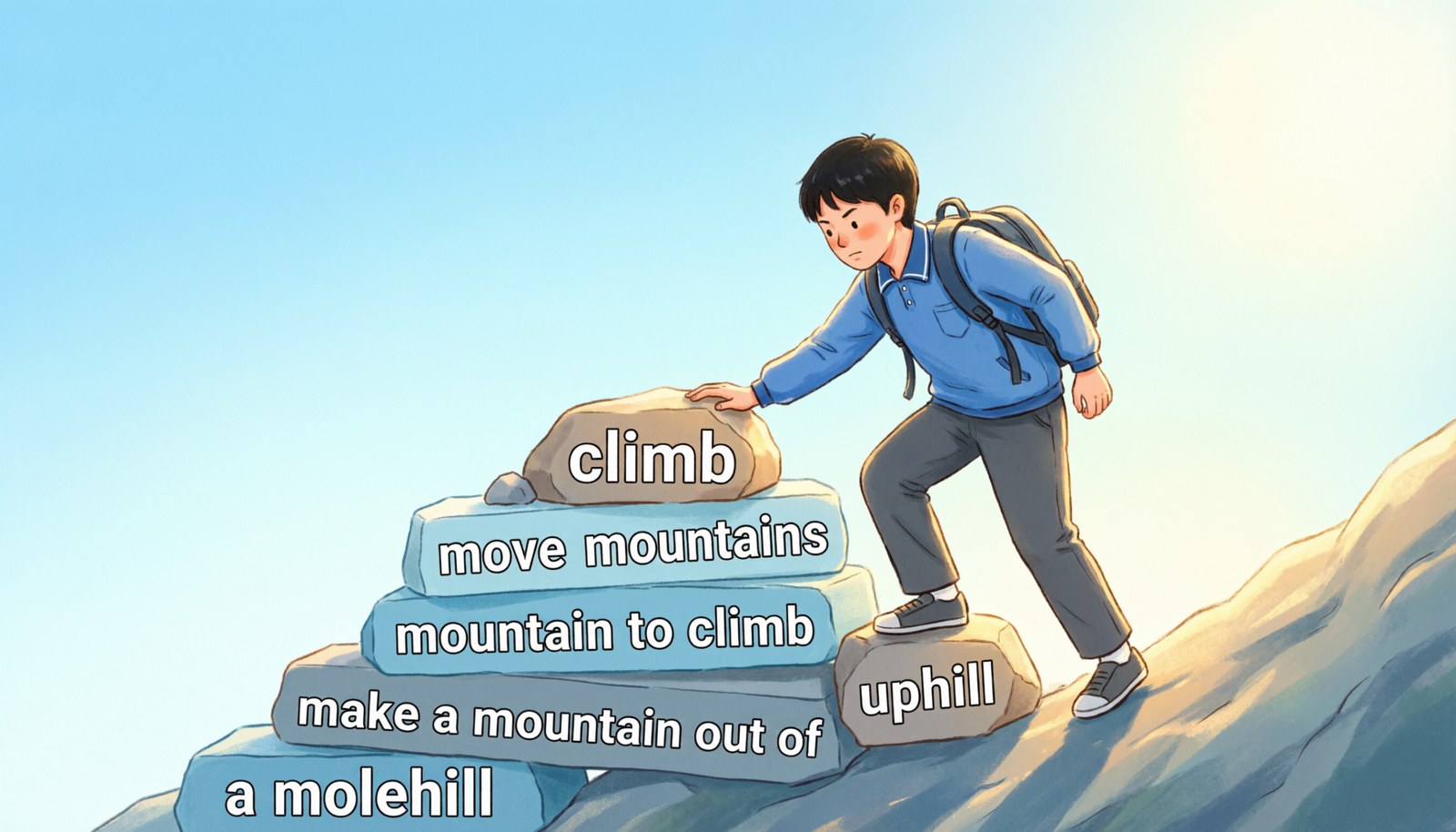
People often search for idioms for mountains because they want strong expressions for challenge, success, ambition, beauty, strength, or life’s difficult journeys. Mountains appear often in English because they naturally suggest height, effort, distance, danger, and achievement.
But learners can easily confuse mountain idioms with mountain metaphors. They both use mountain-related language, and both can make writing more vivid. The difference is simple: an idiom is a fixed expression with a commonly understood meaning, while a metaphor is a creative comparison that describes one thing as another.
For example, “make a mountain out of a molehill” is an idiom. English speakers recognize it as a set phrase meaning someone is exaggerating a small problem. But “Her grief was a mountain” is a metaphor. The writer compares grief to a mountain to show that it feels huge, heavy, and difficult to overcome.
This guide explains mountain idioms, mountain metaphors, their differences, their overlap, and how students, writers, and ESL learners can use them correctly.
What Mountain Idioms Mean
A mountain idiom is a fixed or common expression that uses mountain-related words but has a meaning beyond the literal image.
Simple definition: A mountain idiom is a phrase about mountains that usually means something else.
Purpose: Mountain idioms help speakers describe difficulty, exaggeration, ambition, achievement, or emotional pressure in a familiar way.
How it works: The phrase has a meaning that English speakers understand as a whole. You usually cannot understand it by translating each word separately.
Short example:
Don’t make a mountain out of a molehill.
This means: Do not turn a small problem into a much bigger problem.
Why it gets confused with metaphor: Many idioms began as figurative images, so they can feel metaphorical. However, an idiom works mainly because people already know the expression.
What Mountain Metaphors Mean
A mountain metaphor is a comparison that describes something as a mountain, or uses mountain imagery to show size, difficulty, strength, distance, or importance.
Simple definition: A mountain metaphor compares one thing to a mountain without using “like” or “as.”
Purpose: Mountain metaphors help writers create strong images and emotional meaning.
How it works: The writer uses the idea of a mountain to describe something else. The phrase may be original, poetic, or personal.
Short example:
The final exam was a mountain in front of him.
This means the exam felt large, difficult, and intimidating.
Why it gets confused with idiom: Some mountain metaphors sound similar to idioms because they use symbolic language. The difference is that metaphors do not need to be fixed phrases.
Mountain Idioms vs Mountain Metaphors: The Core Difference
The core difference is this:
A mountain idiom is a commonly used expression with an established meaning. A mountain metaphor is a comparison that uses mountain imagery to describe something.
An idiom depends on shared language. A metaphor depends on comparison and imagination.
For example:
Idiom:
She made a mountain out of a molehill.
Meaning: She exaggerated a small problem.
Metaphor:
Fear stood before him like a mountain.
Meaning: His fear felt huge and hard to face.
The idiom has a standard meaning. The metaphor creates a fresh image.
Quick Comparison Table
| Point | Mountain Idiom | Mountain Metaphor |
|---|---|---|
| Definition | A fixed expression using mountain-related words | A comparison using mountain imagery |
| Scope | Narrower and more set | Broader and more creative |
| Purpose | To express a familiar idea quickly | To create vivid meaning or emotion |
| Length | Often short and fixed | Can be short, extended, or poetic |
| Structure | Usually a known phrase | Flexible structure |
| Meaning | Often not literal | Usually symbolic or descriptive |
| Use in writing | Good for natural speech, essays, and informal writing | Good for creative writing, speeches, poetry, and analysis |
| Example | “Make a mountain out of a molehill” | “Her ambition was a mountain she kept climbing” |
How Mountain Idioms Work
Mountain idioms work because English speakers understand the whole phrase as a unit. The words may create an image, but the meaning comes from common usage.
Take this idiom:
Move mountains
Literal meaning: To physically move mountains.
Idiomatic meaning: To achieve something extremely difficult.
Example:
With enough support, the team can move mountains.
The phrase does not mean the team will actually move land or rocks. It means they can do something that seems almost impossible.
Mountain idioms often use mountains to suggest:
- Big problems
- Major effort
- Great achievement
- Overreaction
- Obstacles
- Strength
- Persistence
These meanings feel natural because mountains are large, difficult to climb, and hard to change.
How Mountain Metaphors Work
Mountain metaphors work through comparison. A writer takes qualities of a mountain and applies them to another subject.
A mountain can suggest:
- Size
- Strength
- Distance
- Loneliness
- Challenge
- Beauty
- Stability
- Danger
- Spiritual height
- Personal growth
Example:
His silence was a mountain between them.
This does not mean a real mountain stood between two people. It means the silence created emotional distance.
A metaphor gives the reader an image. It helps the reader feel the meaning instead of only understanding it logically.
Key Differences in Simple Language
Mountain idioms and mountain metaphors both use figurative language, but they work differently.
A mountain idiom is already part of the language. You learn it as a phrase.
A mountain metaphor is more flexible. You can create one yourself.
A mountain idiom often has one common meaning.
A mountain metaphor can have different meanings depending on context.
Or, A mountain metaphor works especially well in descriptive, literary, or emotional writing.
So, if you say “make a mountain out of a molehill,” you use an idiom. If you say “This problem is a mountain,” you use a metaphor.
Can Mountain Idioms and Mountain Metaphors Overlap?
Yes, they can overlap.
Many idioms are metaphorical because they use comparison or imagery. For example, “move mountains” is both idiomatic and metaphorical. It does not mean literally moving mountains. It uses the mountain as a symbol of something difficult.
However, not every metaphor is an idiom.
Example:
Her regret was a cold mountain inside her chest.
This is a metaphor, but it is not a common idiom. It sounds poetic and original.
The best way to tell the difference is to ask:
Is this a fixed expression that many people already know?
If yes, it is probably an idiom.
Is this a creative comparison made for this sentence?
If yes, it is probably a metaphor.
Examples of Mountain Idioms
Below are useful idioms for mountains, with meanings and natural examples.
1. Make a Mountain Out of a Molehill
Meaning: To exaggerate a small problem.
Example:
I know the mistake is annoying, but don’t make a mountain out of a molehill.
This idiom works well when someone reacts too strongly to a minor issue.
2. Move Mountains
Meaning: To do something extremely difficult or impressive.
Example:
She would move mountains to protect her children.
This phrase shows strong effort, love, determination, or commitment.
3. Climb the Mountain
Meaning: To face a major challenge step by step.
Example:
Learning English may feel hard at first, but you can climb the mountain one lesson at a time.
This phrase can work as an idiom or a metaphor, depending on context.
4. The Mountain to Climb
Meaning: A difficult task or challenge ahead.
Example:
The company still has a mountain to climb before it becomes profitable.
This expression often appears in business, sports, education, and personal growth writing.
5. Mountains of Work
Meaning: A very large amount of work.
Example:
I came back from vacation to mountains of work.
This phrase uses “mountains” to show quantity.
6. As Old as the Hills
Meaning: Very old.
Example:
That joke is as old as the hills.
This idiom does not use the word “mountain,” but it belongs to the same landscape-based group of expressions.
7. Over the Hill
Meaning: Past one’s best age, strength, or ability.
Example:
He jokes that he is over the hill, but he still runs faster than most people.
Use this carefully. It can sound humorous, but it can also sound rude if used about someone else.
8. King of the Mountain
Meaning: The person or group in the strongest or most successful position.
Example:
After winning three championships, the team became king of the mountain.
This phrase suggests dominance, victory, or being at the top.
9. Reach the Summit
Meaning: To reach the highest point of success or achievement.
Example:
After years of practice, she reached the summit of her career.
This can be literal, idiomatic, or metaphorical.
10. A Mountain of Evidence
Meaning: A very large amount of proof.
Example:
The report included a mountain of evidence against the decision.
This expression often appears in academic, legal, journalistic, and argumentative writing.
Examples of Mountain Metaphors
Mountain metaphors can feel more creative than idioms. Writers use them to build mood, meaning, and emotional weight.
1. The Problem Was a Mountain
Meaning: The problem felt huge and difficult.
Example:
At first, the project was a mountain, but the team handled it one task at a time.
2. Her Ambition Was a Mountain
Meaning: Her goals were high, strong, and difficult to reach.
Example:
Her ambition was a mountain that kept rising as she climbed.
3. Grief Became a Mountain
Meaning: Grief felt heavy, large, and hard to move past.
Example:
After the loss, grief became a mountain she carried everywhere.
4. The Truth Stood Like a Peak
Meaning: The truth was clear, high, and impossible to ignore.
Example:
By the end of the trial, the truth stood like a peak above every excuse.
5. His Pride Was a Cliff
Meaning: His pride was dangerous, hard, or emotionally steep.
Example:
His pride was a cliff no apology could climb.
6. Hope Rose Like a Mountain at Dawn
Meaning: Hope felt powerful, beautiful, and growing.
Example:
After months of failure, hope rose like a mountain at dawn.
This example uses “like,” so it is technically a simile, not a metaphor. Still, it uses mountain imagery in a similar way.
7. The Silence Between Them Was a Mountain Range
Meaning: Emotional distance separated them.
Example:
After the argument, the silence between them was a mountain range.
This metaphor works well in fiction and personal essays.
Mountain Idioms vs Mountain Metaphors in Literature and Writing
In literature, mountain language often carries symbolic meaning. Writers use mountains to show struggle, growth, isolation, danger, spiritual searching, or achievement.
A mountain idiom gives writing a familiar, natural sound.
Example:
The hero had a mountain to climb before he could earn forgiveness.
This phrase feels clear and accessible.
A mountain metaphor can create a stronger literary effect.
Example:
Forgiveness waited at the summit, hidden in snow and silence.
This sentence does not use a fixed idiom. It builds an image that readers interpret through context.
In essays, idioms can make writing sound natural, but too many idioms may weaken academic tone. In creative writing, metaphors can add depth, but too many dramatic metaphors can make prose feel heavy.
Good writers choose based on purpose. If they want clarity, they may use an idiom. If they want emotion, symbolism, or atmosphere, they may use a metaphor.
Mountain Idioms vs Mountain Metaphors for Students and ESL Learners
For students and ESL learners, mountain idioms can be tricky because the literal words do not always explain the real meaning.
For example, “make a mountain out of a molehill” may confuse a learner who does not know what a molehill is. A molehill is a small pile of earth made by a mole. The idiom compares a tiny pile to a huge mountain, so it means exaggerating a small problem.
Metaphors can also confuse learners, but they are often easier to understand from context.
Example:
The exam was a mountain.
Even if the learner has never seen that exact sentence, they can guess that the exam was difficult.
Here is a simple learner rule:
Use idioms when you know the phrase is common and appropriate.
Use metaphors when you want to create your own image.
For exams and classroom writing, explain the meaning clearly if the phrase may confuse readers.
Common Mistakes and Confusion
Mistake 1: Taking Idioms Literally
Incorrect understanding:
He moved mountains means he physically moved mountains.
Correct understanding:
It means he achieved something very difficult.
Mistake 2: Calling Every Mountain Phrase an Idiom
Not every phrase with “mountain” is an idiom.
Example:
The mountain was covered in snow.
This is literal language, not an idiom.
Mistake 3: Confusing Idioms with Metaphors
Make a mountain out of a molehill is an idiom because it is a fixed phrase.
My fear was a mountain is a metaphor because it compares fear to a mountain.
Mistake 4: Overusing Idioms in Formal Writing
Idioms can make writing lively, but too many idioms may sound casual.
Less formal:
We have a mountain to climb, but we’ll move mountains if we need to.
More formal:
The project presents a major challenge, but the team has the resources to complete it.
Mistake 5: Creating Confusing Metaphors
A metaphor should make meaning clearer, not harder.
Confusing:
His idea was a mountain of birds inside a clock.
Clearer:
His idea was a mountain: impressive, but difficult to approach.
When to Use Mountain Idioms and When to Use Mountain Metaphors
Use mountain idioms when you want to express a common idea in a natural, familiar way.
Good situations for mountain idioms:
- Everyday conversation
- Blog writing
- Speeches
- Informal essays
- Motivational writing
- Clear explanations
Example:
Don’t make a mountain out of a molehill. We can fix the issue quickly.
Use mountain metaphors when you want to create a vivid image or emotional effect.
Good situations for mountain metaphors:
- Poetry
- Fiction
- Personal essays
- Descriptive writing
- Literary analysis
- Speeches with strong imagery
Example:
The truth rose before him, a mountain he could no longer ignore.
In simple terms, idioms help readers understand quickly. Metaphors help readers imagine deeply.
Related Terms People Often Confuse with Them
Simile
A simile compares two things using “like” or “as.”
Example:
The problem was like a mountain.
This differs from a metaphor because a metaphor says something is something else.
Metaphor:
The problem was a mountain.
Symbol
A symbol is an object, place, or image that represents a bigger idea.
Example:
A mountain may symbolize ambition, difficulty, freedom, or spiritual growth.
A mountain can work as a symbol in an entire story, not just one sentence.
Allegory
An allegory is a story with a deeper meaning. Characters, places, or events represent larger ideas.
Example:
A story about climbing a mountain may represent a person’s journey toward wisdom, success, or self-discovery.
A metaphor can appear in one sentence. An allegory usually shapes a whole story.
Hyperbole
Hyperbole means exaggeration for effect.
Example:
I have mountains of homework.
This phrase exaggerates the amount of homework. It may also work idiomatically because “mountains of” commonly means “a lot of.”
Literal Language
Literal language means exactly what the words say.
Example:
We climbed the mountain before sunrise.
This means people actually climbed a real mountain.
Conclusion
Mountain idioms and mountain metaphors both make English more expressive, but they do not work in the same way. A mountain idiom is a familiar expression with a commonly accepted meaning, such as “make a mountain out of a molehill” or “move mountains.” A mountain metaphor uses mountain imagery to describe something in a creative or symbolic way, such as “Fear was a mountain in his path.”
For students and ESL learners, the easiest rule is this: idioms are learned phrases, while metaphors are comparisons. Idioms help you sound natural. Metaphors help you write with imagination and emotional depth.
When you understand the difference, you can use mountain expressions with more confidence, whether you are writing an essay, learning English, revising a story, or trying to describe life’s biggest challenges.
FAQs
1. What are idioms for mountains?
Idioms for mountains are common expressions that use mountain-related words to express ideas such as difficulty, exaggeration, success, effort, or a large amount of something. Examples include “move mountains,” “make a mountain out of a molehill,” and “a mountain to climb.”
2. Is “make a mountain out of a molehill” an idiom or a metaphor?
It is an idiom because it is a fixed expression with a known meaning. It also uses metaphorical imagery, but people mainly understand it as a common idiom meaning someone is exaggerating a small problem.
3. What does “move mountains” mean?
“Move mountains” means to achieve something extremely difficult or to make a great effort. For example, “She would move mountains for her family” means she would do almost anything to help them.
4. What is the difference between a mountain idiom and a mountain metaphor?
A mountain idiom is a common phrase with an established meaning. A mountain metaphor is a creative comparison that describes something as a mountain or uses mountain imagery. Idioms are fixed; metaphors are more flexible.
5. Can mountain idioms be used in essays?
Yes, but use them carefully. Mountain idioms can make an essay sound natural and clear, especially in introductions or informal writing. In formal academic writing, direct language may work better.
6. What is an example of a mountain metaphor?
An example of a mountain metaphor is “The problem was a mountain she had to climb.” This compares the problem to a mountain to show that it feels large and difficult.
7. Are mountain idioms useful for ESL learners?
Yes. Mountain idioms are useful because they appear in everyday English, books, speeches, and articles. ESL learners should study their meanings as whole phrases instead of translating each word separately.