Introduction
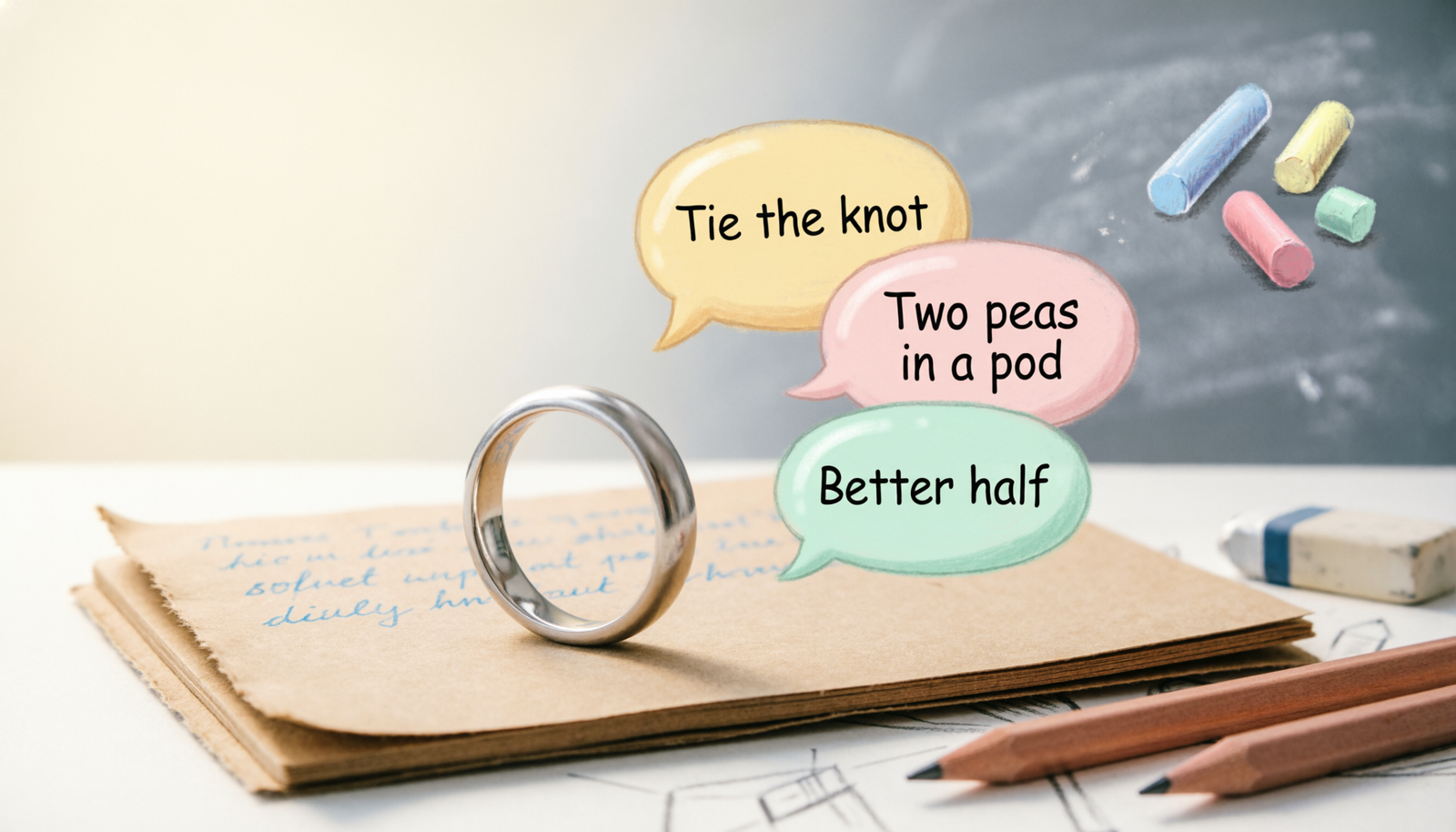
Marriage gives English speakers many colorful ways to talk about love, commitment, partnership, conflict, family life, and long-term relationships. That is why learners often search for idioms for marriage when they want phrases that sound natural, expressive, and easy to use.
But one common confusion appears quickly: are marriage phrases like tie the knot idioms, metaphors, or both?
The simple answer is this: an idiom has a fixed meaning that you cannot understand from the individual words, while a metaphor compares one thing to another to create a picture or deeper meaning. Some marriage expressions work mainly as idioms. Others work mainly as metaphors. A few can overlap.
For example, tie the knot is an idiom meaning “get married.” A phrase like marriage is a journey is a metaphor because it compares marriage to a journey. Both phrases use figurative language, but they work in different ways.
This guide explains idioms and metaphors through marriage-related examples, so students, writers, and ESL learners can understand the difference and use each one correctly.
What Idioms Mean
An idiom is a fixed expression with a meaning that differs from the literal meaning of its words.
In marriage language, tie the knot does not mean someone is tying a real knot. It means someone is getting married. English speakers understand the expression as a whole.
Simple definition:
An idiom is a phrase whose real meaning comes from common usage, not from the exact words.
Purpose:
Idioms make speech sound natural, familiar, and expressive.
How it works:
You learn an idiom as a complete phrase. You usually cannot change its words much without making it sound strange.
Short example:
“They are going to tie the knot next spring.”
Why it gets confused with metaphor:
Many idioms started from images or comparisons. Because they sound visual, learners sometimes think every idiom is a metaphor.
What Metaphors Mean
A metaphor describes one thing as if it were another thing. It does not use “like” or “as.” Instead, it creates a direct comparison.
In marriage language, marriage is a partnership can work as a metaphor when it presents marriage as a shared business-like or team-like relationship. Marriage is a garden is also a metaphor because it suggests that marriage needs care, patience, and growth.
Simple definition:
A metaphor is a direct comparison that helps readers understand an idea in a deeper or more vivid way.
Purpose:
Metaphors help writers explain feelings, relationships, and abstract ideas through images.
How it works:
A metaphor takes qualities from one thing and applies them to another.
Short example:
“Their marriage was a bridge between two families.”
Why it gets confused with idiom:
Some metaphors become common phrases over time. When people use them repeatedly with a fixed meaning, they may start to feel idiomatic.
Idioms vs Metaphors: The Core Difference
The core difference is simple: idioms depend on accepted meaning, while metaphors depend on comparison.
An idiom works because people already know what the phrase means. A metaphor works because the reader sees a connection between two ideas.
For example:
“They tied the knot.”
This is an idiom. It means they got married.
“Their marriage is a strong foundation.”
This is a metaphor. It compares marriage to a foundation that supports something larger.
The idiom gives a common expression. The metaphor creates an image.
Quick Comparison Table
| Point | Idiom | Metaphor |
|---|---|---|
| Definition | A fixed phrase with a non-literal meaning | A direct comparison between two things |
| Scope | Usually narrow and phrase-based | Broader and more flexible |
| Purpose | Makes language sound natural and familiar | Creates imagery, meaning, and emotional depth |
| Length | Often short | Can be short or extended |
| Structure | Usually fixed wording | Flexible wording |
| Meaning | Learned through usage | Understood through comparison |
| Use in writing | Good for natural dialogue and casual explanation | Good for description, poetry, essays, and storytelling |
| Marriage example | “They tied the knot.” | “Marriage is a lifelong journey.” |
How Idioms Work
Idioms work as ready-made expressions. Native speakers use them without analyzing each word.
When someone says, “They are getting hitched,” they do not mean two people are being attached to a vehicle. The phrase simply means they are getting married. It sounds casual and conversational.
Marriage idioms often appear in everyday speech, entertainment, advice columns, wedding writing, and informal storytelling. They help writers express a familiar idea quickly.
Here are a few common marriage idioms:
Tie the knot
Meaning: to get married
Example: “They tied the knot in a small beach ceremony.”
Get hitched
Meaning: to get married
Example: “My cousin got hitched last weekend.”
Pop the question
Meaning: to propose marriage
Example: “He popped the question during their vacation.”
Walk down the aisle
Meaning: to get married, especially in a wedding ceremony
Example: “She will walk down the aisle in June.”
Settle down
Meaning: to begin a stable life, often with marriage or family
Example: “After years of traveling, he finally settled down.”
Idioms can sound natural, but they also need the right tone. Get hitched sounds casual. Tie the knot sounds friendly and common. Walk down the aisle sounds more wedding-focused.
How Metaphors Work
Metaphors work by creating a mental picture. They do not simply name an action. They help readers feel or understand an idea more deeply.
For marriage, metaphors often describe commitment, trust, conflict, teamwork, growth, or emotional connection.
For example:
“Marriage is a journey.”
This metaphor suggests that marriage has stages, challenges, progress, and shared direction.
“Their marriage was a garden.”
This suggests that love needs care, patience, attention, and time to grow.
“Trust is the foundation of marriage.”
This compares trust to a foundation because it supports the relationship.
Unlike idioms, metaphors do not always have fixed wording. A writer can shape them in many ways:
- “Their marriage was a garden they watered every day.”
- “Their marriage had deep roots.”
- “Their love bloomed after years of patience.”
These examples all build on the same general image, but each one creates a slightly different feeling.
Key Differences in Simple Language
Idioms and metaphors both use figurative language, but they do different jobs.
An idiom gives a common phrase with a known meaning. You usually memorize it.
A metaphor creates a comparison. You usually interpret it.
An idiom often sounds conversational. A metaphor often sounds descriptive or literary.
An idiom can lose its image because people use it so often. Many people say tie the knot without thinking about an actual knot. A metaphor usually keeps the image active in the reader’s mind.
For ESL learners, this difference matters. If you translate an idiom word for word, it may not make sense. If you translate a metaphor, the comparison may still work, but the style may change.
Can Idioms and Metaphors Overlap?
Yes, idioms and metaphors can overlap.
Some idioms began as metaphors. Tie the knot likely connects marriage with the image of binding or joining. That image feels metaphorical. But in modern English, the phrase works mainly as an idiom because speakers use it as a fixed expression meaning “get married.”
A phrase can also feel metaphorical in one context and idiomatic in another.
For example:
“They tied the knot.”
This works as an idiom.
“Their promises tied a knot between two families.”
This works more like a metaphor because the writer uses the image of tying to create symbolic meaning.
So the category depends on how the phrase works in the sentence. If the phrase has a fixed common meaning, it functions as an idiom. If it creates a fresh comparison, it functions as a metaphor.
Examples of Idioms for Marriage
Below are practical idioms for marriage with meanings and natural examples.
1. Tie the knot
Meaning: to get married
Example: “They decided to tie the knot after five years together.”
This is one of the most common idioms for marriage. It sounds friendly and widely understood.
2. Get hitched
Meaning: to get married
Example: “They got hitched in Las Vegas.”
This idiom sounds casual. It works well in informal writing and conversation.
3. Pop the question
Meaning: to ask someone to marry you
Example: “He popped the question at their favorite restaurant.”
This idiom refers to a marriage proposal, not the wedding itself.
4. Walk down the aisle
Meaning: to get married in a wedding ceremony
Example: “She always dreamed of walking down the aisle in her grandmother’s dress.”
This phrase connects directly to the wedding ceremony.
5. Settle down
Meaning: to start a stable, committed life, often through marriage or family
Example: “They moved to the countryside and settled down.”
This idiom can relate to marriage, but it can also mean becoming calmer or more responsible.
6. Make an honest woman/man of someone
Meaning: to marry someone, especially after a long romantic relationship
Example: “After ten years together, he joked that it was time to make an honest woman of her.”
Use this idiom carefully. It can sound old-fashioned and may feel sexist in modern contexts.
7. Take the plunge
Meaning: to make a big decision, often marriage
Example: “After years of dating, they finally took the plunge.”
This idiom suggests courage before a major life step.
8. The honeymoon is over
Meaning: the easy or exciting beginning has ended
Example: “After the first year, the honeymoon was over and real responsibilities began.”
This idiom can describe marriage, work, politics, or any situation where the early excitement fades.
Examples of Metaphors for Marriage
These examples describe marriage through comparison rather than fixed idiomatic meaning.
1. Marriage is a journey
Meaning: marriage involves growth, change, challenges, and shared direction
Example: “Marriage is a journey, and every year teaches the couple something new.”
This metaphor works well in essays, speeches, and reflective writing.
2. Marriage is a garden
Meaning: marriage needs care, patience, and regular attention
Example: “Their marriage was a garden, full of beauty because they cared for it daily.”
This metaphor suits emotional or poetic writing.
3. Marriage is a bridge
Meaning: marriage connects people, families, cultures, or lives
Example: “Their marriage became a bridge between two very different worlds.”
This metaphor works well when discussing family, culture, or compromise.
4. Trust is the foundation of marriage
Meaning: trust supports the whole relationship
Example: “Without honesty, the foundation of their marriage began to crack.”
This metaphor uses the image of a building.
5. Marriage is a team
Meaning: both partners must cooperate and support each other
Example: “A healthy marriage is a team, not a competition.”
This metaphor works well in advice writing.
6. Marriage is a mirror
Meaning: marriage reveals your strengths, weaknesses, habits, and emotional patterns
Example: “Their marriage became a mirror that showed them who they really were.”
This metaphor sounds thoughtful and literary.
7. Marriage is an anchor
Meaning: marriage can provide stability, safety, and emotional grounding
Example: “In difficult years, their marriage was an anchor.”
This metaphor creates a strong emotional image.
8. Marriage is a dance
Meaning: marriage needs rhythm, balance, movement, and cooperation
Example: “Their marriage was a dance of patience, humor, and compromise.”
This metaphor works beautifully in creative writing.
Idioms vs Metaphors in Literature and Writing
Writers use idioms and metaphors for different effects.
Idioms help dialogue sound natural. A character might say, “So, when are you two tying the knot?” That line sounds casual and realistic. It tells us something about the speaker’s tone and relationship with the couple.
Metaphors help writing feel deeper and more vivid. A narrator might say, “Their marriage was a house built during a storm.” This metaphor suggests pressure, danger, effort, and survival. It does more than state that the marriage was difficult.
In literature, metaphors often carry themes. A marriage described as a cage suggests restriction. A marriage described as a harbor suggests safety, A marriage described as a battlefield suggests conflict. These choices shape how readers understand the relationship.
Idioms usually do not carry that much symbolic weight unless the writer uses them in a fresh or ironic way.
Idioms vs Metaphors for Students and ESL Learners
Students and ESL learners often confuse idioms and metaphors because both move away from literal meaning.
A helpful rule is this:
Ask whether the phrase has a fixed meaning or creates a comparison.
If the phrase has a fixed meaning that people commonly memorize, it is probably an idiom.
Example:
“They tied the knot.”
Meaning: They got married.
If the phrase compares marriage to something else, it is probably a metaphor.
Example:
“Marriage is a journey.”
Meaning: Marriage has progress, challenges, and shared movement.
For ESL learners, idioms usually need more memorization. You cannot always guess their meanings. Metaphors require interpretation, but they often make sense once you understand the comparison.
For students, the safest way to explain the difference in class is:
An idiom is a known expression. A metaphor is a comparison.
Common Mistakes and Confusion
Mistake 1: Calling every figurative phrase a metaphor
Not every non-literal phrase is a metaphor. Tie the knot is figurative, but it works mainly as an idiom because it has a fixed common meaning.
Mistake 2: Translating idioms word for word
ESL learners sometimes translate idioms directly from their first language. This can create confusing or unnatural English. It is better to learn common English idioms as complete phrases.
Mistake 3: Using casual idioms in formal writing
Phrases like get hitched may sound too informal in essays, reports, or serious articles. In formal writing, use get married instead.
Mistake 4: Making metaphors too mixed
A mixed metaphor combines images that do not fit together.
Weak example:
“Marriage is a journey that needs watering every day.”
This mixes journey and garden images. A better sentence would choose one image:
“Marriage is a journey that requires patience.”
Or:
“Marriage is a garden that needs daily care.”
Mistake 5: Thinking idioms and metaphors never overlap
Some idioms have metaphorical roots. The key is to look at how the phrase functions now.
When to Use Idioms and When to Use Metaphors
Use idioms when you want your English to sound natural, conversational, and familiar.
Good uses for marriage idioms:
- casual conversation
- dialogue
- blog writing
- wedding captions
- informal storytelling
- ESL vocabulary practice
Example:
“They finally tied the knot after years together.”
Use metaphors when you want to explain marriage in a vivid, emotional, or thoughtful way.
Good uses for marriage metaphors:
- essays
- speeches
- poetry
- fiction
- relationship advice
- literary analysis
- reflective writing
Example:
“Their marriage was a bridge built from patience and trust.”
Use plain language when clarity matters most.
Example:
“They got married in 2022.”
This sentence has no idiom or metaphor, but it is clear and direct. Strong writing often mixes plain language, idioms, and metaphors depending on purpose.
Related Terms People Often Confuse with Idioms and Metaphors
Simile
A simile compares two things using “like” or “as.”
Example:
“Their marriage was like a steady flame.”
A metaphor would say:
“Their marriage was a steady flame.”
Symbol
A symbol is an object, person, place, or image that represents a bigger idea.
Example:
“A wedding ring can symbolize commitment.”
Figure of speech
A figure of speech is a broad category for non-literal language. Idioms, metaphors, similes, hyperbole, and personification all belong under this larger group.
Cliché
A cliché is an overused phrase or idea.
Example:
“Love conquers all.”
Some marriage idioms and metaphors can become clichés if writers use them too often without adding fresh detail.
Proverb
A proverb is a short traditional saying that gives advice or wisdom.
Example:
“A happy wife is a happy life.”
Use proverbs carefully because some sound outdated, stereotypical, or too informal for modern writing.
Conclusion
Idioms and metaphors both help us talk about marriage in expressive ways, but they do not work the same way.
An idiom is a fixed expression with a common meaning. Tie the knot, pop the question, and get hitched are idioms related to marriage.
A metaphor is a direct comparison. Marriage is a journey, marriage is a garden, and trust is the foundation of marriage are metaphors because they help readers understand marriage through images.
For students and ESL learners, the easiest rule is this: idioms are learned phrases; metaphors are comparisons. Writers can use idioms to sound natural and metaphors to create deeper meaning. Once you understand the difference, marriage language becomes easier to read, write, and use with confidence.
FAQs
What are some common idioms for marriage?
Common idioms for marriage include tie the knot, get hitched, pop the question, walk down the aisle, settle down, and take the plunge. Each phrase has a meaning related to marriage, proposals, weddings, or commitment.
Is “tie the knot” an idiom or a metaphor?
Tie the knot is mainly an idiom. It means “to get married.” The phrase may have a metaphorical image behind it, but modern English speakers use it as a fixed expression.
Is “marriage is a journey” an idiom?
No. Marriage is a journey is a metaphor. It compares marriage to a journey to suggest progress, challenges, learning, and shared direction.
Can an idiom also be a metaphor?
Yes, some idioms can have metaphorical origins or imagery. However, if people use the phrase as a fixed expression with a known meaning, it usually functions as an idiom.
Which is better for writing, idioms or metaphors?
It depends on your purpose. Use idioms for natural and conversational writing. Use metaphors when you want imagery, emotion, or deeper meaning.
Are marriage idioms good for ESL learners?
Yes, marriage idioms help ESL learners understand real English conversation, wedding language, movies, articles, and everyday speech. Learners should study them as complete phrases rather than translate them word by word.
What is the easiest way to tell an idiom from a metaphor?
Ask this question: does the phrase have a fixed common meaning, or does it compare one thing to another? A fixed common phrase is usually an idiom. A direct comparison is usually a metaphor.