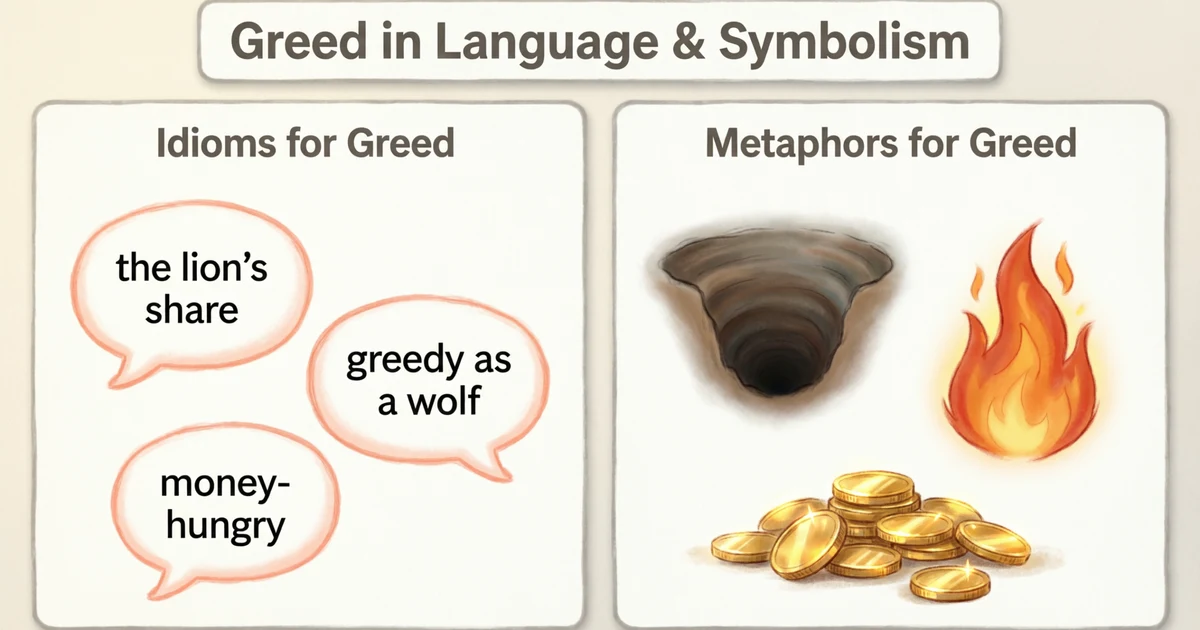
Greed is a strong human emotion, so writers often describe it with figurative language instead of plain words. That is why phrases like “money-hungry,” “have sticky fingers,” “want the whole pie,” and “his greed was a bottomless pit” feel more powerful than simply saying someone wants too much.
Still, many students, writers, and ESL learners get confused when they search for idioms for greed. Some expressions are true idioms. Others are metaphors. Both can describe selfish desire, but they do not work in exactly the same way.
The simple difference is this: an idiom is a fixed expression with a meaning you cannot always guess from the individual words, while a metaphor describes one thing as another to create a strong comparison.
For example, “money talks” works like an idiom because it is a common fixed phrase meaning money has influence. “Greed is a bottomless pit” is a metaphor because it compares greed to a pit that never fills.
Both can help you write about greed, but knowing the difference helps you choose the right expression for essays, stories, speeches, and everyday English.
What Idioms Mean
An idiom is a common phrase whose meaning is different from the literal meaning of its words. Native speakers often understand idioms automatically because they have heard them many times.
For greed, idioms usually describe someone who wants too much money, power, food, attention, or advantage.
A simple example is:
He wanted the lion’s share of the profits.
This does not mean he wanted the part of the profit owned by a lion. It means he wanted the largest part for himself.
Simple definition of idioms
An idiom is a fixed expression with a special meaning understood by common use.
Purpose of idioms
Idioms make language sound natural, colorful, and familiar. They can also express judgment quickly. When you say someone wants “the lion’s share,” readers understand that the person wants more than others.
How idioms work
Idioms work because speakers share their meanings through repeated use. You usually learn them as complete phrases, not word by word.
Short natural example
She always wants the biggest slice of the cake.
This can mean she literally wants more cake, but in context it can also mean she wants more than her fair share.
Why idioms get confused with metaphors
Many idioms began as metaphors. For example, “the lion’s share” uses the image of a powerful animal taking the biggest part. Over time, the phrase became common and fixed, so people now treat it as an idiom.
What Metaphors Mean
A metaphor is a figure of speech that describes one thing as if it were something else. It does not usually use like or as. Instead, it creates a direct comparison.
For greed, metaphors often turn desire into an image: a hunger, a monster, a fire, a disease, a pit, or a chain.
A simple example is:
His greed was a bottomless pit.
This does not mean greed is literally a hole in the ground. It means his desire could never be satisfied.
Simple definition of metaphors
A metaphor is a direct comparison that says one thing is another thing to show meaning, feeling, or similarity.
Purpose of metaphors
Metaphors help readers feel or imagine an idea. Greed is invisible, but a metaphor can make it visible.
How metaphors work
Metaphors connect two different things. The reader notices the shared quality. If greed is a fire, the shared idea may be destruction, spreading, or being hard to control.
Short natural example
Greed burned through the family like a wildfire.
This metaphor shows greed as something dangerous and destructive.
Why metaphors get confused with idioms
Some metaphors become common phrases. When a metaphor becomes fixed in everyday language, people may start using it as an idiom. That overlap makes the two terms confusing.
Idioms vs Metaphors: The Core Difference
The core difference is simple:
Idioms are fixed expressions with commonly accepted meanings. Metaphors are comparisons that create meaning through imagery.
An idiom often asks, “What does this phrase mean in normal use?”
A metaphor asks, “What comparison does this image create?”
For example:
Idiom:
He has sticky fingers.
Meaning: He steals or is likely to steal.
Metaphor:
Greed wrapped its hands around him.
Meaning: Greed controlled him like a physical force.
The idiom is a known expression. The metaphor is an image created by the writer.
Quick Comparison Table
| Point | Idioms for Greed | Metaphors for Greed |
|---|---|---|
| Definition | Common fixed expressions with special meanings | Direct comparisons that describe greed through imagery |
| Scope | Narrower because idioms are set phrases | Broader because writers can create new metaphors |
| Purpose | To sound natural, familiar, and expressive | To create strong images, emotion, or deeper meaning |
| Length | Usually short phrases | Can be short, long, or extended |
| Structure | Often fixed wording | More flexible wording |
| Meaning | Learned through usage and context | Understood through comparison |
| Use in writing | Good for dialogue, informal writing, explanations, and examples | Good for poetry, stories, essays, speeches, and serious description |
| Example | “He wanted the lion’s share.” | “His greed was a bottomless pit.” |
How Idioms Work
Idioms work through shared understanding. A person learning English may not understand an idiom by translating each word. That is why idioms can confuse ESL learners.
Take this phrase:
He is money-hungry.
The person is not physically hungry for money. The phrase means he strongly wants money, often in a selfish or excessive way.
Many idioms for greed use images of food, animals, hands, pockets, and wealth. These images work because greed often feels like taking, grabbing, swallowing, or keeping too much.
Common idiom patterns for greed include:
Taking more than one deserves:
He wants the lion’s share.
Loving money too much:
She worships the almighty dollar.
Stealing or taking unfairly:
He has sticky fingers.
Being selfish with wealth:
They are sitting on a pile of money.
Idioms often sound natural in everyday English, but they may not fit every type of writing. In formal essays, use them carefully and explain them if your reader may not know the phrase.
How Metaphors Work
Metaphors work by creating a mental picture. They do not depend on being common expressions. A writer can create a fresh metaphor to describe greed in a new way.
For example:
Greed was the engine behind his choices.
This metaphor compares greed to an engine. It suggests that greed powered his actions.
Here are a few common metaphor patterns for greed:
1-Greed as hunger:
His greed could never be fed.
2-Greed as fire:
Greed burned away his kindness.
3-Greed as a monster:
A monster of greed grew inside him.
4-Greed as a disease:
Greed infected the company from the top down.
5-Greed as a pit:
Her greed was a hole no success could fill.
Metaphors can feel more literary than idioms. They help writers express tone, theme, and character motivation.
Key Differences in Simple Language
Idioms and metaphors can both describe greed, but they help readers in different ways.
An idiom gives you a ready-made phrase. It is useful when you want clear, natural English. For example, “He wanted the lion’s share” quickly tells readers that someone wanted the biggest portion.
A metaphor gives you an image. It is useful when you want emotional force or creative description. For example, “Greed was a bottomless pit” shows that the person’s desire could never be satisfied.
Idioms are usually easier to use in conversation. Metaphors are often stronger in creative writing, speeches, and essays.
The biggest clue is structure. If the phrase is fixed and commonly recognized, it is probably an idiom. If the phrase creates a comparison, especially one the writer could change or extend, it is probably a metaphor.
Can Idioms and Metaphors Overlap?
Yes, idioms and metaphors can overlap.
Many idioms are metaphorical because they use images. “The lion’s share” is an idiom, but it also has a metaphorical origin. It suggests a powerful creature taking the biggest portion.
“Money is the root of all evil” is often used as a proverb-like expression, but it also works metaphorically because it compares money to a root from which evil grows.
The overlap happens because figurative language does not always fit into one neat box. A phrase can be common enough to act like an idiom and image-based enough to feel metaphorical.
For students, the best approach is this:
If the expression is fixed and commonly used, call it an idiom.
If the main effect comes from a comparison, call it a metaphor.
Or, If both are true, explain both.
Examples of Idioms for Greed
Here are useful idioms and idiomatic expressions related to greed, selfishness, and wanting too much.
1. The lion’s share
Meaning: The largest part of something.
Example:
The manager took the lion’s share of the credit.
This idiom often suggests unfairness, especially when one person takes more than others.
2. Money-hungry
Meaning: Extremely eager to get money.
Example:
The story shows a money-hungry businessman who forgets his family.
This phrase describes greed directly and works well in essays and character descriptions.
3. Greedy guts
Meaning: A person who wants too much, especially food or rewards.
Example:
Don’t be such a greedy guts; leave some for everyone else.
This expression sounds informal and sometimes childish, so avoid it in serious academic writing.
4. Have sticky fingers
Meaning: To steal or have a habit of taking things.
Example:
Everyone knew he had sticky fingers around the cash drawer.
This idiom connects greed with theft or dishonesty.
5. Want it all
Meaning: To desire everything, often without considering others.
Example:
She did not just want success; she wanted it all.
This phrase is simple, natural, and easy for ESL learners to understand.
6. Grab what you can
Meaning: To take as much as possible while there is a chance.
Example:
The corrupt officials grabbed what they could before leaving office.
This phrase suggests selfish action and moral weakness.
7. Feather one’s own nest
Meaning: To use a position or opportunity to make oneself richer.
Example:
The politician used public money to feather his own nest.
This idiom works well when greed involves corruption or abuse of power.
8. Have one’s hand in the till
Meaning: To steal money from an organization or employer.
Example:
The accountant had his hand in the till for years.
This idiom is more specific than general greed. It points to financial dishonesty.
9. Sell one’s soul
Meaning: To give up one’s values for money, power, or success.
Example:
He sold his soul for a higher position in the company.
This idiom connects greed with moral compromise.
10. Worship the almighty dollar
Meaning: To care too much about money.
Example:
The novel criticizes people who worship the almighty dollar.
This expression strongly criticizes a money-centered attitude.
Examples of Metaphors for Greed
Metaphors for greed often sound more dramatic and creative than idioms. They help writers show the emotional or moral effect of greed.
1. Greed is a bottomless pit
Meaning: Greed can never be satisfied.
Example:
His greed was a bottomless pit; no amount of success filled it.
This metaphor works well in essays, fiction, and moral discussions.
2. Greed is a fire
Meaning: Greed spreads, consumes, and destroys.
Example:
Greed burned through the company until trust turned to ash.
This metaphor creates a strong image of damage.
3. Greed is a monster
Meaning: Greed can control a person and make them harmful.
Example:
A monster of greed woke inside him when he saw the inheritance.
This metaphor works well in stories and character analysis.
4. Greed is a disease
Meaning: Greed spreads and corrupts people or systems.
Example:
Greed infected the boardroom and weakened every decision.
This metaphor fits social, political, and business writing.
5. Greed is a chain
Meaning: Greed traps a person.
Example:
His greed became a chain he carried everywhere.
This metaphor shows that greed can hurt the greedy person too.
6. Greed is a hungry animal
Meaning: Greed keeps demanding more.
Example:
Inside her, greed paced like a hungry animal.
This image gives greed movement and danger.
7. Greed is a shadow
Meaning: Greed follows or darkens a person’s actions.
Example:
A shadow of greed followed every generous word he spoke.
This metaphor works when someone pretends to be kind but acts selfishly.
8. Greed is poison
Meaning: Greed slowly damages relationships, values, or communities.
Example:
Greed poisoned the friendship they had built for years.
This metaphor is clear and emotionally strong.
Idioms vs Metaphors for Greed in Literature and Writing
In literature, greed often appears as a character flaw, a theme, or a cause of conflict. Writers use both idioms and metaphors to show how greed changes people.
Idioms help make dialogue sound realistic. A character might say:
“He just wants the lion’s share.”
That sounds natural in conversation. It tells readers how one character judges another.
Metaphors help build theme and mood. A narrator might say:
“Greed spread through the town like smoke under a door.”
This sentence feels more literary. It suggests that greed moves quietly and affects many people.
In essays, idioms can make writing clear, but too many idioms may sound casual. Metaphors can make analysis deeper, but unclear metaphors may confuse readers.
For example, in a literature essay, you might write:
The character’s greed becomes a bottomless pit, showing that his desire grows stronger even after he gains wealth.
This works because the metaphor connects directly to the character’s development.
In a story, you might write:
By the end, his hunger for gold had eaten every gentle part of him.
This metaphor gives greed an emotional shape.
Idioms vs Metaphors for Students and ESL Learners
For students and ESL learners, idioms can be harder than metaphors because idioms often cannot be translated word for word.
For example, “feather one’s own nest” may confuse a learner at first. The phrase literally sounds like a bird building a nest, but it means someone uses their position to gain wealth or comfort for themselves.
Metaphors can also confuse learners, but they often become easier when you identify the comparison.
In “greed is a fire,” the comparison is clear. Fire burns and spreads. Greed can also spread and destroy. The connection helps you understand the meaning.
A useful study method is to ask two questions:
For idioms: What does this fixed phrase mean in common English?
For metaphors: What two things are being compared?
Students should also notice tone. Some idioms sound informal, such as “greedy guts.” Some metaphors sound serious or poetic, such as “greed was a bottomless pit.”
Common Mistakes and Confusion
Mistake 1: Thinking every figurative phrase is an idiom
Not every creative phrase is an idiom. “Greed was a wildfire” is a metaphor, not a fixed everyday expression.
Mistake 2: Translating idioms word for word
Idioms often lose meaning in direct translation. “Have sticky fingers” does not literally mean a person’s fingers are sticky. It means the person steals.
Mistake 3: Calling every idiom a metaphor
Some idioms use metaphorical images, but the label depends on how the phrase works. If the expression is fixed and commonly understood, it functions as an idiom.
Mistake 4: Using informal idioms in formal essays
Phrases like “greedy guts” may sound too casual for school essays. Use clearer wording such as “selfish,” “money-hungry,” “driven by greed,” or a stronger metaphor.
Mistake 5: Creating metaphors that do not make sense
A metaphor needs a clear connection. “Greed was a glass window” may confuse readers unless the context explains the comparison.
Mistake 6: Overusing figurative language
Too many idioms or metaphors can make writing feel crowded. Choose one strong expression instead of stacking several together.
When to Use Idioms and When to Use Metaphors
Use idioms for greed when you want natural, familiar language. They work well in dialogue, informal explanations, short examples, and everyday writing.
Use an idiom when you want to say something quickly:
He wanted the lion’s share.
Use a metaphor for greed when you want readers to imagine greed more deeply. Metaphors work well in stories, poems, speeches, essays, and character analysis.
Use a metaphor when you want emotional impact:
His greed was a bottomless pit.
In academic writing, use both carefully. An idiom can make a point clear, but a metaphor can support deeper analysis. Make sure your reader understands your meaning.
A simple rule helps:
Use an idiom for common expression.
Use a metaphor for creative comparison.
Or, Use plain language when clarity matters most.
Related Terms People Often Confuse With Idioms and Metaphors
Simile
A simile compares two things using like or as.
Example:
His greed spread like fire.
This is not a metaphor because it uses like.
Proverb
A proverb is a short traditional saying that gives advice or expresses a general truth.
Example:
Money is the root of all evil.
People may use this when discussing greed, but it works more like a moral saying than a simple idiom.
Cliché
A cliché is an overused expression. Some idioms become clichés when writers use them too often.
Example:
Money talks.
This phrase can still work, but it may feel predictable if the writing needs freshness.
Symbol
A symbol is an object, person, place, or image that represents a larger idea.
Example:
A pile of gold may symbolize greed in a story.
A symbol can support a metaphor, but it is not the same thing.
Personification
Personification gives human qualities to non-human things or abstract ideas.
Example:
Greed whispered in his ear.
Greed cannot literally whisper, so the sentence gives greed a human action.
Allegory
An allegory is a story with a deeper symbolic meaning. A whole story can represent greed, corruption, or moral failure.
For example, a tale about people fighting over treasure may serve as an allegory about human greed.
Conclusion
Idioms and metaphors both help writers talk about greed in a stronger and more memorable way. The difference lies in how they work.
An idiom is a fixed expression with a commonly understood meaning, such as “the lion’s share” or “have sticky fingers.” A metaphor creates a direct comparison, such as “greed is a bottomless pit” or “greed burned through the family like a fire.”
Idioms usually sound natural and familiar. Metaphors often feel more creative, emotional, or literary. Sometimes they overlap because many idioms began as metaphors. Still, students and writers can separate them by asking one simple question: Is this a fixed phrase, or is it mainly creating a comparison?
Once you understand that difference, you can use idioms for clarity and natural expression, and metaphors for depth, imagery, and stronger writing.
FAQs
1. What are idioms for greed?
Idioms for greed are common expressions that describe wanting too much money, power, food, attention, or advantage. Examples include “the lion’s share,” “money-hungry,” “have sticky fingers,” and “feather one’s own nest.”
2. What is a metaphor for greed?
A metaphor for greed compares greed to something else, such as fire, hunger, a monster, poison, or a bottomless pit. For example, “His greed was a bottomless pit” means his desire could never be satisfied.
3. What is the difference between an idiom and a metaphor?
An idiom is a fixed phrase with a special meaning known through common use. A metaphor is a direct comparison that describes one thing as another. Idioms depend on shared meaning, while metaphors depend on imagery and comparison.
4. Is “money-hungry” an idiom or a metaphor?
“Money-hungry” works like an idiomatic expression because people commonly use it to describe someone who strongly wants money. It also has a metaphorical idea because it compares desire for money to hunger.
5. Is “greed is a bottomless pit” an idiom?
No, “greed is a bottomless pit” is mainly a metaphor. It compares greed to a pit that can never be filled. It may sound familiar, but its main effect comes from comparison.
6. Which is better for writing, idioms or metaphors?
It depends on your purpose. Use idioms when you want natural and familiar language. Use metaphors when you want stronger imagery, emotion, or literary effect.
7. Why do ESL learners confuse idioms and metaphors?
ESL learners often confuse them because both are types of figurative language. Also, many idioms contain metaphorical images. The easiest way to tell them apart is to check whether the phrase is fixed and commonly used or whether it mainly creates a comparison.