People often search for idioms for great when they want stronger, more interesting ways to say that something is excellent, impressive, successful, or admirable. Instead of repeating words like “great,” “amazing,” or “excellent,” writers and speakers can use figurative language to make their meaning sound more natural and expressive.
Two common tools for this are idioms and metaphors. They can both describe greatness, but they do not work in the same way.
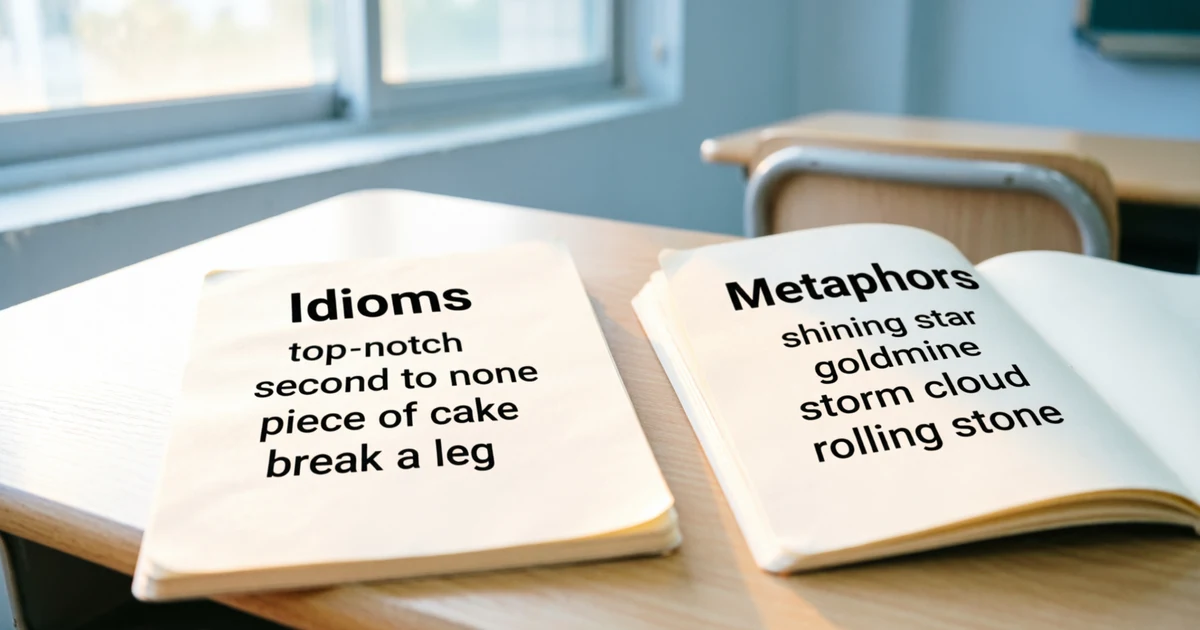
An idiom is a fixed expression with a meaning that usually cannot be understood word by word. For example, “top-notch” means excellent or of very high quality. A metaphor compares one thing to another directly to create a strong image. For example, “She is a shining star” means she stands out because of her talent or success.
The core difference is simple: an idiom is a commonly used phrase with a fixed meaning, while a metaphor is a comparison that creates an image or idea. Some idioms contain metaphorical ideas, so they can overlap. Still, they serve different purposes in writing, speaking, and learning English.
This guide explains the difference clearly, gives natural examples, and helps students, writers, and ESL learners choose the right expression when they want to describe something as great.
What Idioms Mean
An idiom is a phrase or expression whose meaning is different from the literal meaning of its individual words. Native speakers often use idioms in everyday conversation, informal writing, stories, speeches, and even professional communication when the tone allows it.
When we talk about idioms for great, we mean common expressions that describe something as excellent, impressive, successful, or high quality.
For example:
“That performance was top-notch.”
The phrase top-notch does not literally mean something placed at the highest notch. It means excellent or first-rate.
Simple definition of idioms
An idiom is a fixed phrase that has a special meaning understood by common use.
Purpose of idioms
Idioms help language sound natural, colorful, and familiar. They often make praise feel more lively than plain adjectives.
How idioms work
Idioms work because speakers share an accepted meaning. You usually learn them as complete phrases, not by translating each word separately.
Short natural example
“Her presentation was out of this world.”
This means her presentation was extremely good, not literally outside the planet.
Why idioms get confused with metaphors
Many idioms started as comparisons or images, so they can feel metaphorical. However, idioms become fixed expressions over time, while metaphors can be more flexible and original.
What Metaphors Mean
A metaphor is a figure of speech that describes one thing as another thing. It does not use “like” or “as.” Instead, it creates a direct comparison to help readers understand a quality, feeling, or idea more vividly.
When we use metaphors for greatness, we often compare a great person, idea, achievement, or object to something powerful, rare, bright, valuable, or impressive.
For example:
“His mind is a goldmine of ideas.”
This does not mean his mind is literally a mine filled with gold. It means his mind contains many valuable ideas.
Simple definition of metaphors
A metaphor is a direct comparison that describes one thing as another to create meaning or imagery.
Purpose of metaphors
Metaphors help writers explain abstract ideas, add emotional force, and make descriptions memorable.
How metaphors work
A metaphor transfers qualities from one thing to another. If someone says “She is a powerhouse,” they transfer the idea of strength, energy, and impact to that person.
Short natural example
“The new library is the heart of the school.”
This means the library is central and important, not literally a human heart.
Why metaphors get confused with idioms
Some metaphors become popular and turn into fixed expressions. When people use them again and again with a commonly accepted meaning, they may function like idioms.
Idioms vs Metaphors: The Core Difference
The main difference between idioms and metaphors lies in fixed meaning versus direct comparison.
An idiom has a meaning that people already know because the phrase belongs to the language. A metaphor creates meaning by comparing one thing to another. Idioms often sound familiar. Metaphors can sound familiar or original, depending on how the writer uses them.
For example:
Idiom: “That restaurant is top-notch.”
Meaning: The restaurant is excellent.
Metaphor: “That restaurant is a hidden jewel.”
Meaning: The restaurant is valuable, special, and not widely known.
Both can praise something as great. The idiom gives a familiar expression of quality. The metaphor creates an image of value and discovery.
Quick Comparison Table
| Point | Idiom | Metaphor |
|---|---|---|
| Definition | A fixed expression with a meaning different from the literal words | A direct comparison between two things |
| Scope | Narrower because it usually depends on common usage | Broader because writers can create new metaphors |
| Purpose | To sound natural, expressive, and conversational | To create imagery, meaning, and emotional effect |
| Length | Often short phrases | Can be short, extended, or developed across a paragraph |
| Structure | Usually fixed or semi-fixed | Flexible and creative |
| Meaning | Usually learned as a complete expression | Understood through comparison |
| Use in writing | Useful in dialogue, informal writing, articles, and practical examples | Useful in poetry, fiction, essays, speeches, and vivid description |
| Example | “The movie was a cut above the rest.” | “The movie was a firework of color and emotion.” |
How Idioms Work
Idioms work through shared meaning. English speakers understand idioms because they have heard them many times in similar situations. The words may not explain the meaning directly, but the phrase carries a known idea.
For example, “a cut above the rest” means better than others. The expression does not ask the reader to imagine a literal cut. Instead, it works as a fixed phrase for superiority.
Idioms for great often express:
- high quality
- strong success
- impressive skill
- outstanding performance
- special value
- superiority over others
Common idioms for great include:
Top-notch
Meaning: excellent or very high quality.
Example: “The service at the hotel was top-notch.”
Out of this world
Meaning: extremely good or impressive.
Example: “The dessert was out of this world.”
A cut above the rest
Meaning: better than others in the same group.
Example: “Her design was a cut above the rest.”
Second to none
Meaning: the best; not worse than anything else.
Example: “Their customer support is second to none.”
The cream of the crop
Meaning: the best person or thing in a group.
Example: “These students are the cream of the crop.”
Idioms can make praise feel natural, but learners should use them carefully. Some idioms sound formal, some sound casual, and some may feel too strong for ordinary situations.
How Metaphors Work
Metaphors work by transferring meaning from one thing to another. A writer chooses an image that carries the quality they want to express.
For greatness, metaphors often use images connected to:
- light
- height
- gold
- royalty
- power
- nature
- stars
- treasure
- fire
- strength
For example:
“Her talent is a bright flame.”
This metaphor suggests energy, beauty, warmth, and intensity. It does more than say “her talent is great.” It shows the reader how that greatness feels.
Metaphors can be simple or extended.
A simple metaphor may be one sentence:
“He is a giant in the field of medicine.”
An extended metaphor may continue across several lines or paragraphs:
“Her leadership became the compass for the team. When the project grew confusing, everyone looked to her direction. She did not just manage the work; she helped people find the path forward.”
Here, the metaphor compares leadership to a compass and develops that idea.
Key Differences in Simple Language
Idioms and metaphors can both make language more expressive, but they help readers in different ways.
An idiom usually gives a familiar phrase. It often sounds conversational. You use it when you want natural English that many people already understand.
A metaphor creates a picture in the reader’s mind. It often sounds more creative, literary, or emotional. You use it when you want the reader to feel or imagine the meaning.
Think of it this way:
Idioms are phrases people already use. Metaphors are comparisons people can create.
For example:
Idiom: “This phone is top-notch.”
This sounds clear, natural, and familiar.
Metaphor: “This phone is a pocket-sized command center.”
This creates a stronger image and suggests power, usefulness, and control.
Both can describe something great, but the effect differs.
Can Idioms and Metaphors Overlap?
Yes, idioms and metaphors can overlap.
Many idioms contain metaphorical images. For example, “cream of the crop” is an idiom, but it also uses a metaphor. It compares the best people or things to cream, which rises above the rest and represents the richest part.
Another example is “head and shoulders above the rest.” This idiom means much better than others. It also creates a visual metaphor of someone standing taller than everyone else.
The overlap can confuse students because one expression may fit both categories in some ways. The best way to separate them is to ask two questions:
Is this a fixed expression people commonly use?
Then it is likely an idiom.
Does it describe one thing as another to create an image?
Then it is likely a metaphor.
Some phrases can be both. In that case, explain the role it plays in context.
Examples of Idioms for Great
Here are useful idioms that can mean great, excellent, impressive, or outstanding.
1. Top-notch
Meaning: Excellent or very high quality.
Example: “The teacher gave a top-notch explanation.”
This idiom works well in everyday English, reviews, school writing, and professional comments.
2. Out of this world
Meaning: Extremely good or amazing.
Example: “The food at the wedding was out of this world.”
This phrase sounds enthusiastic and slightly informal.
3. A cut above the rest
Meaning: Better than others.
Example: “Her essay was a cut above the rest.”
Use this idiom when comparing one thing with a group.
4. Second to none
Meaning: The best; equal to or better than everything else.
Example: “His dedication is second to none.”
This idiom sounds strong and confident.
5. The cream of the crop
Meaning: The best part of a group.
Example: “The final team included the cream of the crop.”
This idiom often describes people, selections, or top-quality things.
6. First-rate
Meaning: Excellent in quality.
Example: “They gave us first-rate advice.”
This phrase works well in both formal and informal contexts.
7. Head and shoulders above the rest
Meaning: Clearly much better than others.
Example: “That design is head and shoulders above the rest.”
This idiom uses a visual image of height to show superiority.
8. Worth its weight in gold
Meaning: Extremely valuable or useful.
Example: “A good editor is worth her weight in gold.”
This idiom praises usefulness or value rather than general greatness.
9. The real deal
Meaning: Genuine, impressive, and truly good.
Example: “After that performance, everyone knew she was the real deal.”
This phrase sounds natural in modern conversation.
10. Knock it out of the park
Meaning: To do something extremely well.
Example: “He knocked it out of the park with his speech.”
This idiom comes from baseball and works well for achievements, presentations, and performances.
Examples of Metaphors for Great
Metaphors for greatness often create stronger images than ordinary praise. Here are natural examples.
1. She is a shining star
Meaning: She stands out because of her talent, success, or personality.
Example: “In the school play, Maya was a shining star.”
2. His idea was a goldmine
Meaning: His idea was full of value and possibility.
Example: “That business plan was a goldmine of creative solutions.”
3. The team became a powerhouse
Meaning: The team became strong, successful, and influential.
Example: “After months of training, the team became a powerhouse.”
4. Her voice was pure velvet
Meaning: Her voice sounded smooth, rich, and beautiful.
Example: “When she sang, her voice was pure velvet.”
5. The project was a masterpiece
Meaning: The project was skillfully made and impressive.
Example: “Their final science model was a masterpiece.”
6. He is a giant in his field
Meaning: He is highly respected and important in his profession.
Example: “The professor is a giant in modern physics.”
7. The performance was a firework display
Meaning: The performance felt bright, exciting, and full of energy.
Example: “Her dance was a firework display of movement and emotion.”
8. The book is a treasure chest
Meaning: The book contains many valuable ideas or stories.
Example: “For young writers, this book is a treasure chest.”
9. Her leadership was a compass
Meaning: Her leadership gave direction and guidance.
Example: “During the crisis, her leadership was a compass for the whole team.”
10. The invention was a bridge to the future
Meaning: The invention connected the present to new possibilities.
Example: “The new technology became a bridge to the future.”
Idioms vs Metaphors in Literature and Writing
In literature, writers use both idioms and metaphors, but metaphors usually carry more artistic weight.
Idioms can make dialogue sound natural. A character might say, “That plan is the real deal,” and readers understand the speaker’s tone quickly. Idioms can reveal personality, culture, mood, and level of formality.
Metaphors often build deeper meaning. A writer might describe a character as “a lighthouse in a season of storms.” This metaphor suggests guidance, safety, strength, and hope. It does not just tell us the character is great. It helps us feel why the character matters.
In essays and school writing, idioms can add natural expression, but too many idioms may weaken the style. Metaphors can strengthen analysis, description, and argument when they fit the topic.
Compare these two sentences:
With an idiom:
“Her final speech was top-notch.”
With a metaphor:
“Her final speech was a spark that lit the whole room.”
The idiom gives clear praise. The metaphor gives praise and creates a vivid image.
Idioms vs Metaphors for Students and ESL Learners
Students and ESL learners often confuse idioms and metaphors because both forms use non-literal language. The difference becomes easier when you focus on how each expression behaves.
An idiom usually has a fixed form. You cannot change its words too much. For example, “out of this world” means excellent, but you would not usually say “outside of this planet” to mean the same thing. The idiom works because people recognize the exact phrase.
A metaphor gives more creative freedom. You can create your own metaphor if the comparison makes sense. For example, you can say:
“Her confidence was a steady drumbeat.”
This metaphor may not be a common fixed phrase, but readers can understand the comparison. It suggests confidence that feels strong, steady, and noticeable.
For ESL learners, idioms require memorization and context. Metaphors require interpretation. Both improve English, but they need different learning strategies.
To learn idioms, study the full phrase with examples.
To understand metaphors, ask what qualities the two things share.
Common Mistakes and Confusion
Mistake 1: Translating idioms word by word
Many idioms do not make sense through direct translation. For example, “top-notch” does not literally mean a physical notch at the top. It means excellent.
Better approach: Learn idioms as complete expressions.
Mistake 2: Calling every figurative phrase a metaphor
Not every non-literal phrase is a metaphor. Idioms, similes, hyperbole, personification, and symbols also use figurative language.
For example, “out of this world” is usually an idiom. It may feel imaginative, but its common meaning comes from repeated use.
Mistake 3: Using idioms in the wrong tone
Some idioms sound casual. For example, “knocked it out of the park” works well in conversation, reviews, and speeches, but it may sound too informal in a serious academic essay.
Mistake 4: Overusing metaphors
One strong metaphor can improve writing. Too many metaphors can confuse readers, especially if the images do not match.
Weak example:
“Her essay was a diamond, a rocket, a sunrise, and a thunderstorm.”
Better example:
“Her essay was a clear window into a difficult topic.”
Mistake 5: Mixing metaphors badly
A mixed metaphor combines images that do not work together.
Confusing example:
“His idea was a shining star that opened the door to success.”
A star does not open a door, so the image feels awkward.
Better example:
“His idea opened the door to success.”
When to Use Idioms and When to Use Metaphors
Use idioms when you want language that sounds natural, familiar, and conversational.
Idioms work well in:
- everyday speech
- dialogue
- blog writing
- reviews
- informal essays
- captions
- classroom examples
- friendly professional writing
Example:
“Your work on this project was first-rate.”
Use metaphors when you want language that sounds vivid, creative, emotional, or memorable.
Metaphors work well in:
- poetry
- stories
- speeches
- descriptive writing
- personal essays
- literary analysis
- creative introductions
- strong conclusions
Example:
“Your work became the backbone of the whole project.”
Use an idiom for quick, familiar praise. Use a metaphor when you want the reader to imagine the quality behind the praise.
Related Terms People Often Confuse with Idioms and Metaphors
Simile
A simile compares two things using like or as.
Example:
“Her performance was like a burst of sunlight.”
A metaphor says one thing is another. A simile says one thing is like another.
Hyperbole
Hyperbole means deliberate exaggeration for effect.
Example:
“That was the greatest meal in the history of the world.”
The speaker does not mean this literally. They exaggerate to show strong praise.
Cliché
A cliché is an expression that has become overused.
Example:
“Best thing since sliced bread.”
This phrase means something is great, but it may sound tired if used too often.
Figurative Language
Figurative language is the broad category that includes idioms, metaphors, similes, hyperbole, personification, and more.
Idioms and metaphors both belong to figurative language.
Symbol
A symbol is a person, object, image, or action that represents a larger idea.
Example:
A crown may symbolize power, greatness, or authority.
A symbol can appear in a metaphor, but it is not the same thing as a metaphor.
Conclusion
Idioms and metaphors both help us move beyond plain words like great, excellent, and amazing. They make English more expressive, but they work in different ways.
An idiom is a fixed expression with a commonly understood meaning. Phrases like “top-notch,” “second to none,” and “a cut above the rest” help speakers describe greatness in natural, familiar English.
A metaphor is a direct comparison that creates an image or deeper meaning. Sentences like “She is a shining star” or “His idea was a goldmine” help writers show greatness through imagination and comparison.
The easiest way to remember the difference is this: idioms are learned phrases, while metaphors are meaningful comparisons. Some expressions can overlap, but the distinction becomes clear when you look at structure, purpose, and context.
For students and ESL learners, idioms build natural fluency. For writers, metaphors build imagery and emotional impact. When you understand both, you can describe greatness with more precision, confidence, and style.
FAQs
1. What are some common idioms for great?
Common idioms for great include top-notch, out of this world, a cut above the rest, second to none, first-rate, the cream of the crop, and the real deal. These expressions describe something as excellent, impressive, or better than average.
2. Is “top-notch” an idiom or a metaphor?
Top-notch usually works as an idiom because it is a fixed expression meaning excellent or high quality. It may have an image behind it, but most speakers use it as a familiar phrase rather than a fresh comparison.
3. Is “a shining star” an idiom or a metaphor?
A shining star is usually a metaphor when it describes a person who stands out because of talent, success, or beauty. It compares the person directly to a star.
4. Can an idiom also be a metaphor?
Yes. Some idioms contain metaphorical ideas. For example, “the cream of the crop” is an idiom because it has a fixed meaning, but it also uses a metaphorical image to suggest the best part of a group.
5. Which is better for essays: idioms or metaphors?
It depends on the essay. Idioms can work in informal essays or examples, but formal academic writing usually needs careful use of idioms. Metaphors can strengthen essays when they clarify an idea, but they should not make the writing unclear or overly dramatic.
6. Why do ESL learners find idioms difficult?
ESL learners often find idioms difficult because the meaning does not always come from the individual words. A phrase like “out of this world” means extremely good, but a learner may misunderstand it if they translate it literally.
7. How can I choose between an idiom and a metaphor?
Choose an idiom when you want a familiar and natural expression. Choose a metaphor when you want a vivid image or a more creative description. For quick praise, use an idiom. For deeper description, use a metaphor.