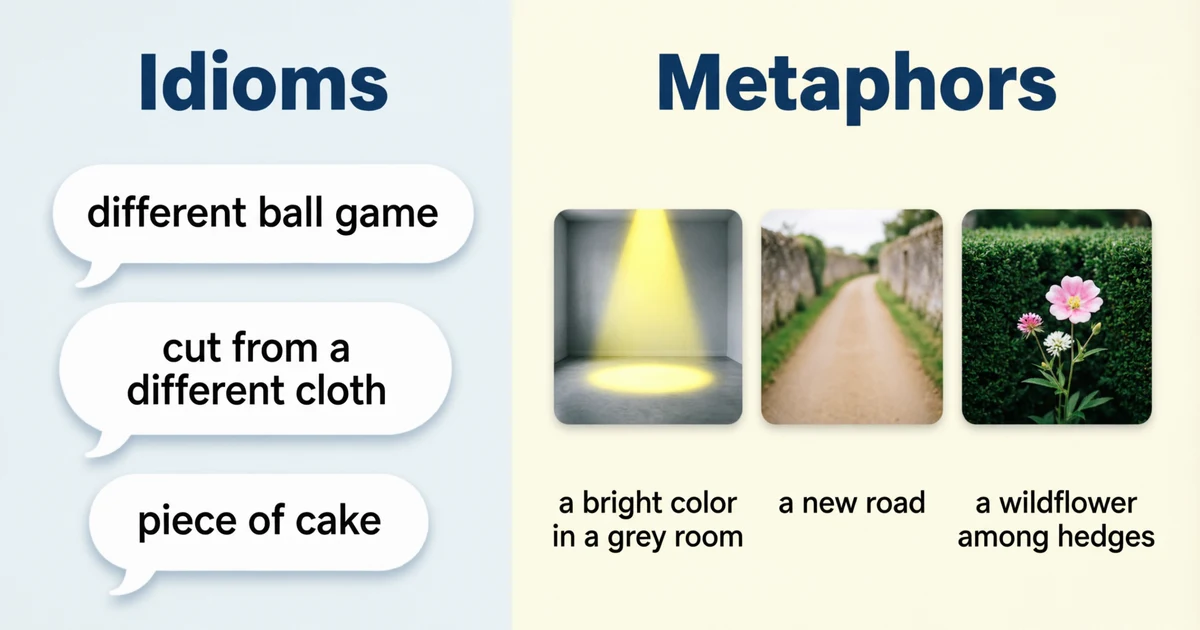
English has many creative ways to describe something as different. You can say something is “a whole different ball game,” “a horse of a different color,” or “a breath of fresh air.” These expressions make writing more colorful, but they can also confuse students, writers, and ESL learners.
The main confusion often comes from two terms: idioms and metaphors.
An idiom is a fixed expression whose meaning usually cannot be understood from the individual words. A metaphor compares one thing to another by saying it is something else, often to create a clearer or stronger image.
The core difference is simple: an idiom is a commonly used expression with a learned meaning, while a metaphor is a comparison used to create meaning or imagery. Some idioms contain metaphors, but not every metaphor is an idiom.
When people search for idioms for different, they usually want useful expressions that mean unusual, unique, changed, separate, or not the same. This article explains those idioms, compares them with metaphors, and shows how to use both correctly.
What Idioms Mean
An idiom is a phrase with a meaning that differs from the literal meaning of its words. Native speakers understand idioms because they have heard them many times, not because each word explains the meaning directly.
For example, “a whole different ball game” does not usually refer to sports. It means a situation has changed so much that it now needs a new way of thinking.
Purpose: Idioms help speakers sound natural, expressive, and familiar with everyday English.
How idioms work: They work as ready-made phrases. You usually should not change their wording too much because the expression may sound strange or lose its meaning.
Short example:
“Moving from school to university is a whole different ball game.”
Why idioms get confused with metaphors: Many idioms began as figurative comparisons. Since they often create images, learners may think all idioms are metaphors. Some are, but idioms depend more on fixed common usage than on fresh comparison.
What Metaphors Mean
A metaphor is a figure of speech that describes one thing as another thing to show a similarity. It does not use “like” or “as.” Instead, it makes a direct comparison.
For example, “Her ideas were a breath of fresh air” compares her ideas to fresh air. The meaning is that her ideas felt new, pleasant, and different.
Purpose: Metaphors help writers create strong images, explain abstract ideas, and make language more memorable.
How metaphors work: They transfer meaning from one thing to another. The reader understands one idea through the qualities of another idea.
Short example:
“His style was a bright spark in a room full of copies.”
Why metaphors get confused with idioms: Some metaphors become so common that people start using them as fixed expressions. When that happens, they can also function like idioms.
Idioms vs Metaphors: The Core Difference
The easiest way to separate idioms and metaphors is to look at fixed meaning and comparison.
An idiom works because the phrase has a commonly accepted meaning. A metaphor works because it compares two things to create meaning.
For example, “a horse of a different color” is an idiom that means something is a different matter or a different type of thing. You usually learn it as a set expression.
But “His opinion was a new road through old thinking” is a metaphor. It compares an opinion to a road to suggest that it offers a new direction.
So, when you use idioms for different, you often use familiar phrases. When you use metaphors for different, you create or choose comparisons that show uniqueness, contrast, change, or originality.
Quick Comparison Table
| Point | Idiom | Metaphor |
|---|---|---|
| Definition | A fixed phrase with a non-literal meaning | A direct comparison between two unlike things |
| Scope | Usually narrower because the phrase is already set | Broader because writers can create new metaphors |
| Purpose | To sound natural, expressive, or conversational | To create imagery, emotion, or deeper meaning |
| Length | Often a short phrase | Can be a phrase, sentence, paragraph, or extended idea |
| Structure | Usually fixed wording | Flexible and creative |
| Meaning | Learned through common usage | Understood through comparison |
| Use in writing | Good for informal, persuasive, or natural writing | Good for creative, literary, descriptive, and analytical writing |
| Example | “That’s a whole different ball game.” | “Her voice was a new color in the room.” |
How Idioms Work
Idioms work through shared understanding. A speaker says a phrase, and the listener recognizes its accepted meaning.
Take the idiom “cut from a different cloth.” Literally, it refers to fabric. Figuratively, it means someone has a different character, nature, or quality from others.
Example:
“She is cut from a different cloth; she handles pressure calmly.”
This idiom works because English speakers connect “cloth” with the material or nature of a person. The phrase does not simply describe clothing. It describes personality.
Idioms for different often express one of these meanings:
- something belongs to another category
- someone acts unlike others
- a situation has changed completely
- something feels unusual or fresh
- two things do not match or compare easily
Idioms can make writing sound more fluent, but they need care. Some idioms sound informal, old-fashioned, or regional. ESL learners should use common idioms first before using rare ones.
How Metaphors Work
Metaphors work by helping readers understand one thing through another thing.
If you write, “The new teacher was a lighthouse in a dull classroom,” you do not mean the teacher was literally a lighthouse. You mean the teacher brought guidance, brightness, and a different kind of energy.
Metaphors for different often show contrast through images such as light, color, roads, seasons, voices, or patterns.
Example:
“Her design was a splash of color in a grey market.”
This metaphor suggests that her design stands out because it feels fresh, lively, and different.
Unlike idioms, metaphors do not always need to be familiar. Writers can create original metaphors as long as the comparison feels clear and natural.
Key Differences in Simple Language
Idioms and metaphors both use figurative language, but they do not work in the same way.
An idiom is something people already say. You learn its meaning as a phrase.
A metaphor is a comparison. You understand it by seeing how one thing connects to another.
An idiom can sound natural in conversation:
“This job is a whole different ball game.”
A metaphor can sound more creative or literary:
“This job is a new mountain with sharper edges.”
Idioms usually help with fluency. Metaphors usually help with imagery. Idioms often feel social and familiar. Metaphors often feel descriptive, symbolic, or artistic.
Can Idioms and Metaphors Overlap?
Yes, idioms and metaphors can overlap.
Some idioms are metaphorical because they compare one idea to another. For example, “cut from a different cloth” works like a metaphor. It compares a person’s character to fabric.
Another example is “a breath of fresh air.” This phrase can work as both an idiom and a metaphor. As an idiom, it means someone or something feels new, pleasant, and different. As a metaphor, it compares that person or thing to fresh air.
The overlap happens because language changes over time. A creative metaphor may become popular. After people repeat it for many years, it can become an idiom.
Still, the difference remains useful:
An idiom depends on common usage. A metaphor depends on comparison.
Examples of Idioms for Different
Here are practical idioms that can describe difference, uniqueness, change, or contrast.
1. A whole different ball game
Meaning: A completely different situation.
Example: “Running a small blog is one thing, but managing a large news site is a whole different ball game.”
2. A horse of a different color
Meaning: A different matter or a separate issue.
Example: “I can help with editing, but designing the whole website is a horse of a different color.”
3. Cut from a different cloth
Meaning: Different in character, quality, or personality.
Example: “Unlike the others, Maya is cut from a different cloth.”
4. March to the beat of a different drum
Meaning: To behave, think, or live in a way that differs from most people.
Example: “He has always marched to the beat of a different drum.”
5. Stand out from the crowd
Meaning: To be clearly different or better than others.
Example: “Her simple design helped the brand stand out from the crowd.”
6. Break the mold
Meaning: To be different from the usual type or pattern.
Example: “The film broke the mold by telling the story from the villain’s point of view.”
7. A breath of fresh air
Meaning: Something refreshingly new or different.
Example: “The new manager was a breath of fresh air.”
8. Worlds apart
Meaning: Completely different from each other.
Example: “Their teaching styles are worlds apart.”
9. Like chalk and cheese
Meaning: Very different from each other. This idiom is common in British English.
Example: “The two brothers are like chalk and cheese.”
10. In a league of its own
Meaning: Much better or very different from others in the same category.
Example: “That restaurant is in a league of its own.”
Examples of Metaphors for Different
Metaphors can describe difference in a more imaginative way. These examples are not all fixed idioms. They work because they create clear comparisons.
1. “Her idea was a new road through old ground.”
This metaphor suggests that her idea created a new direction in a familiar area.
2. “His voice was a bright color in a grey room.”
This shows that his voice felt noticeable, fresh, or emotionally different.
3. “The new policy was a sharp turn in the company’s road.”
This metaphor presents change as a turn in a journey.
4. “She was a wildflower in a garden of trimmed hedges.”
This describes someone who feels natural, free, and different from controlled surroundings.
5. “The project became a new chapter for the team.”
This metaphor shows a major change or fresh beginning.
6. “His thinking was a window in a wall.”
This suggests that his ideas opened a new possibility where others saw limits.
7. “The song was a different season.”
This metaphor suggests a complete change in mood, tone, or feeling.
8. “Her answer was a spark in a pile of dry facts.”
This shows that her answer brought energy, originality, or life.
Idioms vs Metaphors in Literature and Writing
In literature, idioms and metaphors serve different purposes.
Writers use idioms to make dialogue sound natural. A character who says, “That’s a whole different ball game,” may sound practical, casual, or modern. Idioms can reveal background, personality, region, or tone.
Metaphors often carry deeper meaning. A writer might describe a character as “a wildflower in a city of concrete.” This does more than say the character is different. It suggests freedom, softness, isolation, and contrast.
Idioms usually work best when you want clarity and natural expression. Metaphors work best when you want imagery, emotion, symbolism, or theme.
A student writing an essay might use an idiom in a personal reflection. A poet or novelist might choose a metaphor to create a stronger image. A speechwriter might use both: an idiom for connection and a metaphor for impact.
Idioms vs Metaphors for Students and ESL Learners
For students and ESL learners, idioms can be harder at first because their meanings are not always logical. If you hear “a horse of a different color,” the words may seem strange unless someone explains the phrase.
Metaphors can also be difficult, but they often become easier when you identify the comparison. Ask yourself: What two things does the sentence connect? What qualities transfer from one thing to another?
Here is a simple method:
When you see an idiom, ask:
“Is this a common phrase with a special meaning?”
When you see a metaphor, ask:
“What is being compared to what?”
For example:
“She is cut from a different cloth.”
This is an idiom because it is a common fixed expression. It also has a metaphorical idea.
“She is a rare thread in a plain fabric.”
This is a metaphor because it creates a direct comparison. It is not a standard idiom.
ESL learners should learn common idioms as complete phrases. Writers should learn metaphors as a creative tool for comparison.
Common Mistakes and Confusion
One common mistake is treating every figurative phrase as a metaphor. Idioms, similes, personification, symbols, and clichés can all use non-literal language, but they are not the same.
Another mistake is changing idioms too much. For example, “a whole different ball game” sounds natural. But “a completely separate football game of life” does not work as the same idiom.
Learners also sometimes use idioms in formal writing where a clearer phrase would work better. In an academic essay, “These theories are worlds apart” may sound acceptable in some contexts, but “These theories differ significantly” may sound more precise.
Writers may also create metaphors that confuse readers. A metaphor should make an idea clearer, not harder to understand. If the image feels forced, choose a simpler comparison.
When to Use Idioms and When to Use Metaphors
Use idioms when you want your writing or speech to sound natural, conversational, and familiar.
Good places for idioms include:
- dialogue
- blog writing
- informal essays
- speeches
- personal reflections
- casual explanations
Example:
“Starting a business after college is a whole different ball game.”
Use metaphors when you want to create a fresh image, explain an idea deeply, or add emotional force.
Good places for metaphors include:
- stories
- poems
- speeches
- descriptive writing
- literary analysis
- personal essays
- creative introductions
Example:
“Starting a business after college was a steep bridge into unknown weather.”
Choose an idiom for fluency. Choose a metaphor for imagery. Use both carefully when you want natural language and creative impact.
Related Terms People Often Confuse with Idioms and Metaphors
Simile
A simile compares two things using “like” or “as.”
Example:
“They are like chalk and cheese.”
This example also connects to idiomatic language because “like chalk and cheese” is a common expression.
Cliché
A cliché is an overused expression. Some idioms become clichés when writers use them too often.
Example:
“Think outside the box.”
This phrase may still communicate meaning, but it can sound tired in strong writing.
Proverb
A proverb is a short traditional saying that gives advice or wisdom.
Example:
“Variety is the spice of life.”
This saying uses metaphor, but it works mainly as a proverb.
Symbol
A symbol is an object, person, place, or image that represents a larger idea.
Example:
“A locked door may symbolize separation or difference.”
Analogy
An analogy explains one idea by comparing it with another, often in more detail than a metaphor.
Example:
“Learning a new language is like moving to a new city. At first, every street feels unfamiliar.”
Conclusion
Idioms and metaphors both help us talk about difference in more expressive ways, but they work differently.
An idiom is a common phrase with a learned meaning. Expressions like “a whole different ball game,” “cut from a different cloth,” and “worlds apart” help speakers describe difference naturally.
A metaphor is a direct comparison. It helps writers show difference through images, such as “a wildflower in a garden of trimmed hedges” or “a bright color in a grey room.”
Some idioms contain metaphors, so the two can overlap. Still, idioms depend on common usage, while metaphors depend on comparison. Once you understand that difference, you can use both with more confidence in writing, speaking, literature, and everyday English.
FAQs
1. What are idioms for different?
Idioms for different are common expressions that describe something as unusual, changed, separate, unique, or unlike something else. Examples include “a whole different ball game,” “cut from a different cloth,” “worlds apart,” and “a horse of a different color.”
2. What is the difference between an idiom and a metaphor?
An idiom is a fixed expression with a special meaning. A metaphor is a direct comparison between two unlike things. Some idioms are metaphorical, but not all metaphors are idioms.
3. Is “a whole different ball game” an idiom or a metaphor?
It is mainly an idiom. It means a situation is completely different from another one. It also has a metaphorical background because it compares a changed situation to a different game.
4. Is “cut from a different cloth” an idiom?
Yes. “Cut from a different cloth” is an idiom that means someone has a different nature, character, or quality from others. It also works metaphorically because it compares personality to fabric.
5. Can I use idioms in academic writing?
You can use some idioms in academic writing, but use them carefully. Formal writing often needs clear and direct language. Instead of “These ideas are worlds apart,” you might write “These ideas differ significantly.”
6. Are metaphors better than idioms?
Metaphors are not better than idioms. They simply serve a different purpose. Idioms help language sound natural and familiar. Metaphors create imagery, emotion, and deeper meaning.
7. What is a simple metaphor for different?
A simple metaphor for different is: “She was a bright color in a grey room.” It means she stood out because she felt unique, lively, or unlike the people around her.