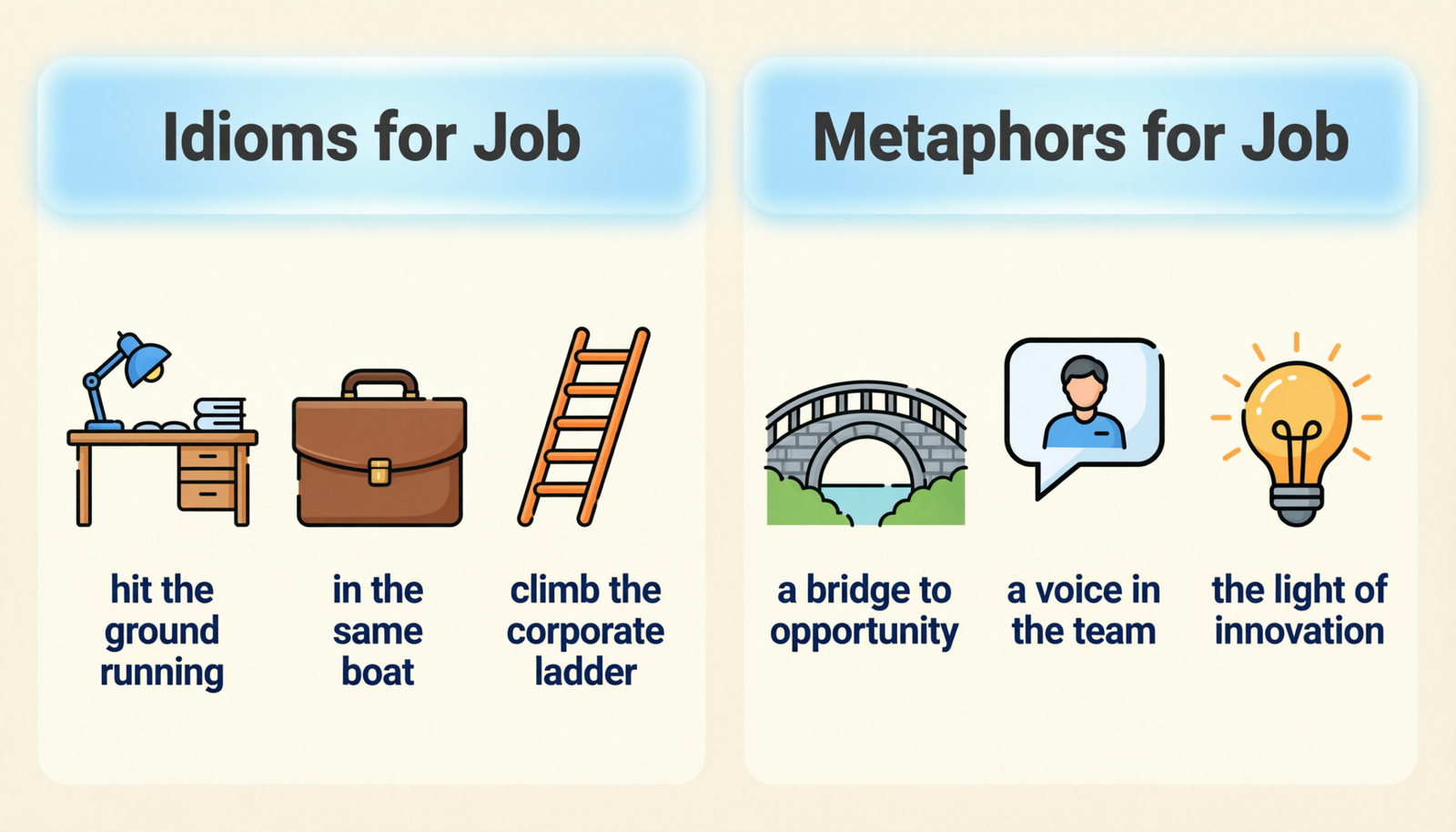
Introduction
People often search for idioms for job when they want better ways to talk about work, careers, interviews, success, stress, or daily office life. But many learners also mix up idioms and metaphors, especially because both can make language more colorful.
Here is the simple difference: an idiom is a fixed expression whose meaning is not obvious from the individual words. A metaphor compares one thing to another without using “like” or “as.”
For example, “learn the ropes” is an idiom about learning how a job works. “My job is a battlefield” is a metaphor because it describes work as a place of conflict or pressure.
Both help writers and speakers describe work in a stronger way, but they do not work exactly the same. Idioms usually belong to everyday language. Metaphors often create a fresh image in the reader’s mind.
What Idioms for Job Mean
An idiom for job is a common phrase people use to talk about work, employment, tasks, careers, or workplace situations. The meaning usually cannot be understood by reading each word literally.
For example, “on the job” means while working or while learning through real work experience.
The purpose of job idioms is to make workplace language sound natural, fluent, and familiar. Native English speakers use them in conversations, emails, interviews, and business settings.
Short example:
“She learned the ropes during her first month at the company.”
This means she learned how the job worked.
Idioms get confused with metaphors because many idioms once started as images or comparisons. For example, “climb the corporate ladder” creates a picture, but people now use it as a common fixed phrase.
What Metaphors for Job Mean
A metaphor for job describes work by saying it is something else. It does not mean the job is literally that thing. Instead, it helps readers feel or understand the experience more clearly.
For example, “This job is a stepping stone” means the job helps someone move toward a better opportunity.
The purpose of a metaphor is to create meaning through comparison. A metaphor can show pressure, growth, struggle, ambition, boredom, teamwork, or success in a vivid way.
Short example:
“Her first job was a bridge to a better career.”
This means the job helped her reach a new stage in life.
Metaphors get confused with idioms because some common metaphors become fixed expressions over time. When many people use a metaphor repeatedly, it can start to feel like an idiom.
Idioms for Job vs Metaphors for Job: The Core Difference
The core difference is this: an idiom has a fixed meaning in everyday language, while a metaphor creates meaning through comparison.
An idiom often sounds natural because people already know it. A metaphor may sound more creative because the writer builds a comparison.
For example:
Idiom: “He got the axe.”
Meaning: He lost his job.
Metaphor: “Losing his job was a storm he had to survive.”
Meaning: Losing the job was emotionally difficult.
The idiom gives a quick familiar meaning. The metaphor creates a larger image and feeling.
Quick Comparison Table
| Point | Idioms for Job | Metaphors for Job |
|---|---|---|
| Definition | Fixed expressions about work with non-literal meanings | Comparisons that describe a job as something else |
| Scope | Usually narrow and phrase-based | Can be short, extended, symbolic, or thematic |
| Purpose | To sound natural, fluent, and conversational | To create imagery, emotion, or deeper meaning |
| Length | Usually a short phrase | Can be a phrase, sentence, paragraph, or full theme |
| Structure | Often fixed and hard to change | More flexible and creative |
| Meaning | Learned as a whole phrase | Built through comparison |
| Use in writing | Good for dialogue, informal writing, emails, and workplace language | Good for essays, stories, speeches, descriptions, and analysis |
| Example | “She learned the ropes quickly.” | “Her job was a ladder to independence.” |
How Idioms for Job Work
Job idioms work because English speakers recognize them as complete expressions. You do not translate each word separately. You learn the full phrase and its accepted meaning.
For example, “burn the candle at both ends” means to work too hard or stay busy from early morning until late night. It does not literally mean someone is burning a candle from both sides.
Idioms often appear in real workplace situations:
“She has been burning the candle at both ends to finish the project.”
This sounds natural because the idiom already has a known meaning.
Idioms usually depend on culture, context, and common usage. ESL learners should use them carefully because some idioms sound informal, old-fashioned, or too casual for formal writing.
How Metaphors for Job Work
Metaphors for job work by connecting work to another idea. The writer or speaker says a job is a ladder, bridge, machine, prison, battlefield, garden, race, or journey. The reader understands the comparison.
For example:
“His job became a cage.”
This does not mean the job had metal bars. It means he felt trapped, limited, or unhappy.
Metaphors can be simple or extended. A simple metaphor may fit in one sentence. An extended metaphor can continue through a whole paragraph or poem.
For example:
“Her career was a garden. Every new skill was a seed, and every challenge helped her grow.”
This metaphor connects work with growth, patience, and care.
Key Differences in Simple Language
Idioms are usually fixed. Metaphors are usually flexible.
Idioms are often common expressions. Metaphors can be original comparisons.
Idioms often help people sound fluent in everyday English. Metaphors help writers sound creative, thoughtful, or expressive.
Idioms usually have a meaning you need to learn. Metaphors often have a meaning you can figure out from the comparison.
For example, “back to the grind” is an idiom. You need to know that “the grind” refers to hard, repetitive work. But “my job is a treadmill” is a metaphor. You can understand that the person feels busy but not truly moving forward.
Can Idioms for Job and Metaphors for Job Overlap?
Yes, idioms and metaphors can overlap.
Some idioms use metaphorical images. “Climb the corporate ladder” is a good example. It is an idiom because people use it as a fixed expression. It is also metaphorical because it compares career progress to climbing a ladder.
Another example is “dead-end job.” It means a job with no future or chance of growth. It works like an idiom because it is a common phrase, but it also uses a metaphor: a road that leads nowhere.
The overlap happens because figurative language categories are not always completely separate. An expression can be idiomatic, metaphorical, or both.
The safest way to decide is to ask: Is this a common fixed phrase, or is it mainly a comparison?
If it is a fixed phrase, call it an idiom. If it creates a comparison, call it a metaphor, If it does both, explain both sides.
Examples of Idioms for Job
Here are useful idioms for job, work, and career situations.
1. Learn the ropes
Meaning: To learn how a job or task works.
Example: “It took me two weeks to learn the ropes at my new job.”
2. On the job
Meaning: While working or during real work experience.
Example: “Most of the training happens on the job.”
3. Get the axe
Meaning: To lose a job or get fired.
Example: “Several employees got the axe after the company lost money.”
4. Work your way up
Meaning: To start in a lower position and slowly reach a better one.
Example: “She worked her way up from assistant to manager.”
5. Call the shots
Meaning: To make important decisions.
Example: “The project manager calls the shots on this team.”
6. Pull your weight
Meaning: To do your fair share of the work.
Example: “Everyone must pull their weight if we want to finish on time.”
7. Back to the grind
Meaning: Return to regular, hard, or boring work.
Example: “The weekend is over, so it is back to the grind.”
8. A dead-end job
Meaning: A job with little or no chance of progress.
Example: “He left the dead-end job and started learning web design.”
9. Land a job
Meaning: To successfully get a job.
Example: “She landed a job at a software company.”
10. Bring something to the table
Meaning: To offer useful skills, ideas, or experience.
Example: “He brings strong leadership skills to the table.”
Examples of Metaphors for Job
Here are natural metaphors for job and work.
1. My job is a stepping stone
Meaning: The job helps someone move toward a better future.
Example: “This internship is a stepping stone to my dream career.”
2. Her career is a ladder
Meaning: Her career involves progress from one level to another.
Example: “Every promotion became another step on her career ladder.”
3. This job is a cage
Meaning: The job makes someone feel trapped.
Example: “After five years, his office job felt like a cage.”
4. Work is a battlefield
Meaning: Work feels stressful, competitive, or full of conflict.
Example: “For the sales team, every Monday morning was a battlefield.”
5. A job is a bridge
Meaning: A job connects someone to a new opportunity or stage of life.
Example: “Her first teaching job became a bridge to a better future.”
6. The office is a machine
Meaning: The workplace runs through systems, routines, and roles.
Example: “The office was a machine, and every employee had a part to play.”
7. His work is a mountain
Meaning: His work feels huge, difficult, or overwhelming.
Example: “The unfinished report was a mountain on his desk.”
8. Her job is a garden
Meaning: Her job requires patience, care, and growth.
Example: “Teaching was a garden where her ideas could grow.”
Idioms for Job vs Metaphors for Job in Literature and Writing
Writers use idioms and metaphors for different effects.
Idioms can make dialogue sound realistic. If a character says, “I finally landed a job,” the line sounds natural and conversational. Idioms help characters sound like real people.
Metaphors create deeper meaning. If a writer says, “His job was a cage,” the reader understands more than the basic fact that he disliked his work. The metaphor shows emotion, pressure, and limitation.
In stories, essays, and poems, metaphors often carry stronger literary value because they can develop themes. A job can become a symbol of freedom, survival, ambition, identity, or social pressure.
Idioms usually do not carry as much original imagery because readers have heard them before. Still, they can make writing clear, familiar, and lively when used well.
Idioms for Job vs Metaphors for Job for Students and ESL Learners
Students and ESL learners should learn both, but for different reasons.
Learn idioms for job to understand real English conversations, workplace emails, interviews, and business articles. Idioms like “learn the ropes,” “pull your weight,” and “land a job” appear often in everyday English.
Learn metaphors for job to improve writing, analysis, and expression. Metaphors help you describe work in a personal or creative way.
For ESL learners, idioms can feel harder because their meanings are fixed and sometimes unpredictable. You may not understand “get the axe” unless someone teaches you the phrase.
Metaphors can feel easier when the comparison is clear. If someone says, “My job is a mountain,” you can guess that the job feels difficult or heavy.
A good learning method is simple: memorize common job idioms, but practice creating your own job metaphors.
Common Mistakes and Confusion
Many learners make the mistake of treating every figurative phrase as a metaphor. That is not always correct.
Mistake 1: Calling every idiom a metaphor
“Land a job” is mainly an idiom. It does not create a strong comparison in modern use. People simply use it to mean “get a job.”
Mistake 2: Translating idioms word by word
If you translate “learn the ropes” literally, it may sound strange. The phrase means to learn the details of a task or job.
Mistake 3: Using idioms in very formal writing
Some idioms sound too casual for academic essays. For example, “get the axe” may not fit a formal report. “Lose employment” or “be dismissed” may work better.
Mistake 4: Making metaphors too confusing
A metaphor should help the reader understand your idea. If the comparison feels unclear, it weakens the writing.
Mistake 5: Mixing too many images
Do not write, “My job is a battlefield, a ladder, and a garden” in one short paragraph unless you have a clear reason. Too many metaphors can confuse readers.
When to Use Idioms and When to Use Metaphors
Use idioms for job when you want your English to sound natural, fluent, and conversational.
Good places for job idioms include:
- Everyday conversations
- Informal emails
- Job interview practice
- Business English lessons
- Dialogue in stories
- Blog posts with a friendly tone
Use metaphors for job when you want to create a strong image, explain an emotion, or add depth to writing.
Good places for job metaphors include:
- Essays
- Speeches
- Stories
- Poems
- Personal reflections
- Creative descriptions
- Literary analysis
Here is a simple rule:
Use an idiom when you want a familiar expression. Use a metaphor when you want a meaningful comparison.
Related Terms People Often Confuse With Them
Simile
A simile compares two things using “like” or “as.”
Example: “Her job was like a race.”
This differs from a metaphor because a metaphor says one thing is another thing: “Her job was a race.”
Proverb
A proverb is a short traditional saying that gives advice or wisdom.
Example: “Many hands make light work.”
This is not just an idiom or metaphor. It teaches a general lesson.
Cliché
A cliché is an overused expression.
Example: “Think outside the box.”
Some job idioms can become clichés if writers use them too often.
Symbol
A symbol is something that represents a bigger idea.
Example: In a story, an office key might symbolize responsibility, freedom, or pressure.
Analogy
An analogy explains one idea by comparing it to another in more detail.
Example: “Starting a new job is like learning a new language. At first, every rule feels strange, but slowly the patterns become familiar.”
An analogy usually explains more than a simple metaphor.
Conclusion
Idioms for job and metaphors for job both belong to figurative language, but they serve different purposes. An idiom is a fixed expression with a learned meaning. A metaphor creates a comparison that helps readers understand an idea more vividly.
For quick, natural workplace English, use idioms like “learn the ropes,” “land a job,” and “pull your weight.” For creative or thoughtful writing, use metaphors like “my job is a bridge,” “her career is a ladder,” or “the office is a machine.”
The two can overlap, especially when a common idiom uses a metaphorical image. Still, the main difference stays simple: idioms depend on common usage, while metaphors depend on comparison.
FAQs
What are idioms for job?
Idioms for job are common expressions related to work, careers, employment, and workplace situations. Examples include “land a job,” “learn the ropes,” “pull your weight,” and “back to the grind.”
What is a metaphor for a job?
A metaphor for a job describes work as something else to create meaning. For example, “This job is a stepping stone” means the job helps someone reach a better opportunity.
Are job idioms and job metaphors the same?
No. A job idiom is a fixed phrase with a known meaning. A job metaphor compares a job to something else. However, some expressions can be both idiomatic and metaphorical.
Is “climb the corporate ladder” an idiom or a metaphor?
It can be both. It is an idiom because people use it as a common fixed phrase, It is also metaphorical because it compares career progress to climbing a ladder.
Which is better for ESL learners, idioms or metaphors?
ESL learners should study both. Idioms help with real conversations and workplace English. Metaphors help with writing, reading, and deeper expression.
Can I use job idioms in formal writing?
You can use some job idioms in formal writing, but choose carefully. Informal idioms like “get the axe” may sound too casual. In formal writing, use clearer terms like “was dismissed” or “lost the position.”
What is the easiest way to tell an idiom from a metaphor?
Ask whether the phrase has a fixed common meaning or creates a comparison. If it has a fixed meaning, it is likely an idiom. If it compares one thing to another, it is a metaphor.