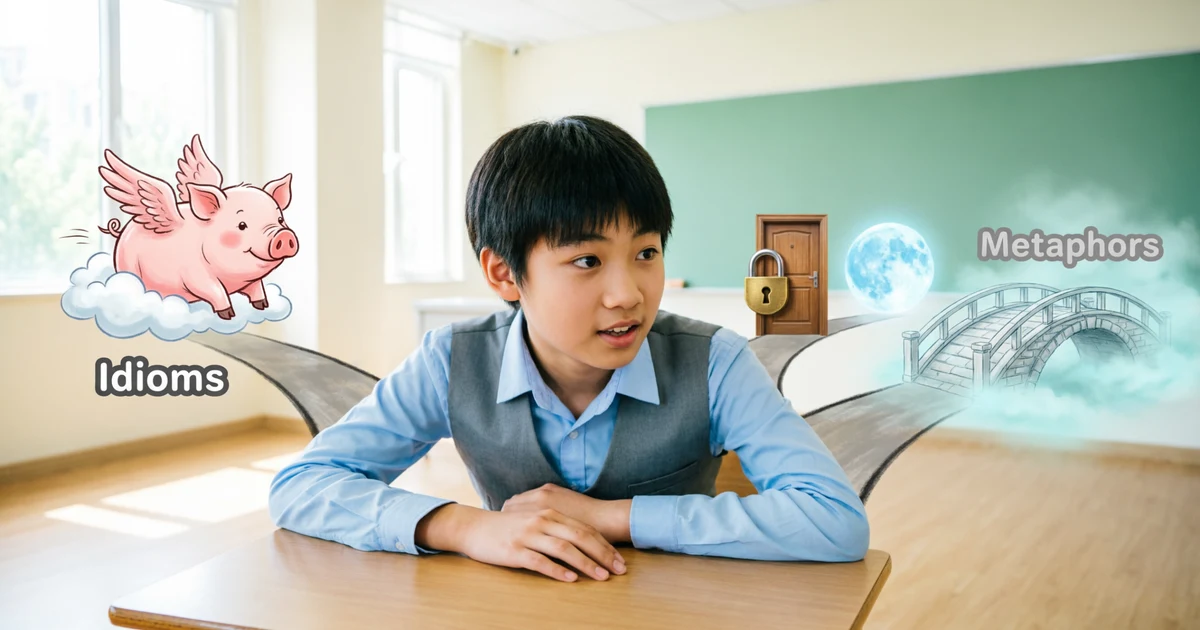
Introduction
Some ideas feel impossible from the start. Maybe a plan has no real chance, a promise sounds unrealistic, or someone expects something that simply will not happen. In English, people often express this with phrases like “when pigs fly,” “not in a million years,” or “a snowball’s chance in hell.”
These are common idioms for never going to happen. They help speakers sound natural, expressive, and sometimes funny. But learners often confuse idioms with metaphors because both use figurative language. They do not always mean exactly what the words say.
Here is the core difference early: an idiom is a fixed expression with a culturally understood meaning, while a metaphor compares one thing to another to create meaning or imagery. Some idioms contain metaphorical images, but not every metaphor is an idiom.
This article explains both terms in simple language, shows how they overlap, and gives practical examples for students, writers, and ESL learners.
What Idioms Mean
An idiom is a common phrase whose meaning is different from the literal meaning of its words.
For example, “when pigs fly” does not really talk about pigs flying through the sky. It means something will never happen.
Simple definition
An idiom is a fixed expression that people understand as a whole phrase, not word by word.
Purpose
Idioms make speech and writing sound natural, colorful, and familiar. They often express ideas quickly.
How it works
An idiom works because speakers of a language already know its accepted meaning. You usually cannot change its wording too much without making it sound strange.
Short natural example
“I’ll apologize to him when pigs fly.”
This means, “I will never apologize to him.”
Why idioms get confused with metaphors
Many idioms use strong images, such as flying pigs, snowballs in hell, or blue moons. These images can feel metaphorical, so learners often think every idiom is a metaphor.
What Metaphors Mean
A metaphor is a figure of speech that describes one thing as another thing to show a similarity.
For example, “That idea is a dead end” is a metaphor. The idea is not literally a road, but the phrase suggests it will not lead anywhere.
Simple definition
A metaphor says one thing is another thing to create meaning, comparison, or imagery.
Purpose
Metaphors help writers and speakers explain ideas in a vivid, memorable way.
How it works
A metaphor works by transferring meaning from one idea to another. It does not usually use “like” or “as.”
Short natural example
“His promise was smoke.”
This means his promise had no real substance and would disappear.
Why metaphors get confused with idioms
Some metaphors become so common that people start using them like fixed expressions. When that happens, they can feel close to idioms.
Idioms vs Metaphors: The Core Difference
The main difference is simple: idioms depend on fixed, accepted meaning; metaphors depend on comparison.
An idiom often cannot be understood by looking at each word separately. A metaphor usually invites the reader to understand a comparison.
For example:
Idiom: “That will happen when pigs fly.”
Meaning: That will never happen.
Metaphor: “That plan is a castle in the air.”
Meaning: That plan is unrealistic or imaginary.
Both can express impossibility, but they work differently. The idiom uses a fixed phrase. The metaphor creates an image of something unreal or unsupported.
Quick Comparison Table
| Point | Idioms | Metaphors |
|---|---|---|
| Definition | Fixed expressions with non-literal meanings | Comparisons that describe one thing as another |
| Scope | Usually phrase-based and culturally known | Can be a word, phrase, sentence, image, or extended idea |
| Purpose | To express meaning naturally and quickly | To create imagery, depth, or comparison |
| Length | Usually short and fixed | Can be short or extended |
| Structure | Often set wording | Flexible and creative |
| Meaning | Learned as a whole phrase | Understood through comparison |
| Use in writing | Good for dialogue, informal writing, and natural expression | Good for creative writing, analysis, poetry, and description |
| Example | “When pigs fly” | “That dream is a locked door” |
How Idioms Work
Idioms work through shared understanding. Native speakers learn them through conversation, reading, media, and culture. ESL learners often need to learn idioms separately because the literal words can mislead them.
Take the idiom “not in a million years.” A person does not mean exactly one million years. The phrase means never or absolutely not.
Examples:
“I would never sell my dog, not in a million years.”
“She’ll agree to that deal when pigs fly.”
“He has a snowball’s chance in hell of winning.”
Idioms can also show tone. Some sound funny, some sound rude, and some sound dramatic. For example, “when pigs fly” sounds playful. “a snowball’s chance in hell” sounds stronger and more informal.
How Metaphors Work
Metaphors work by building a connection between two ideas. They help the reader feel or understand something more deeply.
For example:
“That offer is a mirage.”
This metaphor compares the offer to something that looks real from a distance but disappears when you get closer. It means the offer seems possible but probably is not real.
Metaphors can describe impossible hopes, failed plans, empty promises, or unrealistic dreams.
Examples:
“His plan was a house built on sand.”
“That dream is a door with no key.”
“Their promise was a paper bridge.”
These examples do not use fixed idioms. They create fresh comparisons.
Key Differences in Simple Language
Idioms and metaphors both use figurative language, but they are not the same.
An idiom usually belongs to everyday language. People already know what it means. You learn it as a set expression.
A metaphor can be original. A writer can create a new metaphor at any time. The reader understands it by thinking about the comparison.
Here is the easiest way to remember it:
Idioms are learned expressions. Metaphors are imaginative comparisons.
If the phrase has a fixed meaning that people commonly use, it is probably an idiom. If it compares two things to create a new image, it is probably a metaphor.
Can Idioms and Metaphors Overlap?
Yes, idioms and metaphors can overlap.
Some idioms contain metaphorical images. For example, “a snowball’s chance in hell” creates an impossible image. A snowball would melt in hell, so the phrase means there is almost no chance.
That idiom also works metaphorically because it compares the chance of success to something that cannot survive.
Another example is “castle in the air.” It can work as an idiom meaning an unrealistic dream, but it also creates a metaphorical image of something beautiful with no real foundation.
So the overlap looks like this:
Some idioms are metaphorical, but not all idioms are metaphors. Some metaphors become idiomatic when people use them often enough.
Examples of Idioms for Never Going to Happen
Here are useful idioms and fixed expressions that mean something is impossible, extremely unlikely, or never going to happen.
1. When pigs fly
Meaning: It will never happen.
Example:
“He’ll clean his room without being asked when pigs fly.”
Tone: Funny, informal, sarcastic.
2. Not in a million years
Meaning: Absolutely never.
Example:
“I would not move there, not in a million years.”
Tone: Strong but common in everyday English.
3. A snowball’s chance in hell
Meaning: Almost no chance at all.
Example:
“That team has a snowball’s chance in hell of winning.”
Tone: Very informal and dramatic. Avoid it in formal writing.
4. When hell freezes over
Meaning: Never.
Example:
“He’ll admit he was wrong when hell freezes over.”
Tone: Strong, informal, and sometimes rude.
5. Once in a blue moon
Meaning: Very rarely.
Example:
“She replies to messages once in a blue moon.”
Note: This does not always mean “never.” It usually means something happens rarely.
6. Don’t hold your breath
Meaning: Do not expect it to happen soon, or at all.
Example:
“He said he’ll pay me back, but I’m not holding my breath.”
Tone: Natural and conversational.
7. That ship has sailed
Meaning: The chance is gone.
Example:
“You wanted the early discount, but that ship has sailed.”
Tone: Common in speech and writing.
8. Pie in the sky
Meaning: An unrealistic hope or promise.
Example:
“The plan sounded like pie in the sky.”
Tone: Slightly critical.
9. In your dreams
Meaning: That will not happen.
Example:
“You think I’ll lend you my car? In your dreams.”
Tone: Casual, direct, sometimes teasing.
10. Fat chance
Meaning: Very little chance.
Example:
“Fat chance he’ll arrive on time.”
Tone: Informal and sarcastic.
Examples of Metaphors for Never Going to Happen
These examples are metaphors rather than standard idioms. They express impossibility through comparison and imagery.
1. “That plan is a castle built on clouds.”
The plan sounds impressive, but it has no real support.
2. “Her promise was smoke in the wind.”
The promise has no lasting value and will disappear.
3. “His dream was a locked gate with no key.”
The dream feels unreachable.
4. “Their idea was a bridge to nowhere.”
The idea has no useful result.
5. “The offer was a mirage.”
The offer looks real but probably will not deliver anything.
6. “That hope is a paper boat in a storm.”
The hope is too weak to survive reality.
7. “The project is a road that ends at a wall.”
The project cannot move forward.
These metaphors sound more literary than everyday idioms. Writers can use them to create mood, emotion, and visual meaning.
Idioms vs Metaphors in Literature and Writing
Writers use idioms and metaphors for different reasons.
Idioms often make dialogue sound real. A character might say, “Don’t hold your breath,” because that sounds natural in conversation. Idioms can reveal personality, culture, humor, or attitude.
Metaphors usually add imagery and depth. A novelist might write, “His hope was a candle in a storm.” That line does more than say hope was weak. It creates a visual feeling.
In literature, metaphors often carry symbolic meaning. They can connect to theme, character development, or mood. Idioms usually work best when the writer wants a familiar phrase or natural speech pattern.
For formal essays, use idioms carefully. Too many idioms can make writing sound casual. Metaphors can work well in literary analysis, creative writing, and speeches, but unclear metaphors can confuse readers.
Idioms vs Metaphors for Students and ESL Learners
Students and ESL learners often struggle with idioms because the literal meaning does not help much.
For example, “when pigs fly” might confuse a learner who tries to translate each word. The real meaning comes from cultural use, not grammar.
Metaphors can also confuse learners, but they usually give more clues. If someone says, “That idea is a dead end,” you can understand the meaning by thinking about what a dead-end road does. It stops progress.
Here is a useful learning tip:
Learn idioms as full phrases. Study metaphors by asking, “What two things are being compared?”
For writing, students should use idioms when they want natural expression. They should use metaphors when they want stronger imagery or deeper meaning.
Common Mistakes and Confusion
Mistake 1: Thinking every figurative phrase is an idiom
Not every non-literal phrase is an idiom. A phrase can be a metaphor, simile, symbol, hyperbole, or proverb.
Mistake 2: Changing idioms too much
Idioms usually have fixed wording. For example, “when pigs fly” sounds natural. “when pigs are flying in the air” sounds awkward because it breaks the idiom.
Mistake 3: Using strong idioms in formal writing
Expressions like “a snowball’s chance in hell” can sound too casual or harsh for academic writing.
Mistake 4: Confusing “rarely” with “never”
“Once in a blue moon” means rarely, not always never. Use it when something can happen, but not often.
Mistake 5: Overusing metaphors
One strong metaphor can improve a sentence. Too many metaphors can make writing feel heavy or confusing.
Mistake 6: Taking idioms literally
Idioms often do not make sense word by word. Learn the whole expression and its tone.
When to Use Idioms and When to Use Metaphors
Use idioms when you want your English to sound natural, conversational, or culturally fluent.
Good situations for idioms:
- Dialogue
- Informal essays
- Blog writing
- Everyday conversation
- Humor or sarcasm
- Quick emotional reactions
Example:
“You think he’ll apologize? Don’t hold your breath.”
Use metaphors when you want to create imagery, emotion, or a deeper comparison.
Good situations for metaphors:
- Creative writing
- Speeches
- Poetry
- Literary analysis
- Descriptive paragraphs
- Persuasive writing
Example:
“His apology was a paper bridge, too weak to carry the weight of what he had done.”
Both examples suggest doubt, but they create different effects. The idiom sounds conversational. The metaphor sounds more creative and serious.
Related Terms People Often Confuse With Them
Simile
A simile compares two things using like or as.
Example:
“His chances were like a snowball in the sun.”
Hyperbole
Hyperbole uses exaggeration for effect.
Example:
“I’ve told you a million times.”
Proverb
A proverb is a short traditional saying that gives advice or wisdom.
Example:
“Don’t count your chickens before they hatch.”
Cliché
A cliché is an overused phrase or idea.
Example:
“Only time will tell.”
Symbol
A symbol is something that represents a larger idea.
Example:
A locked door can symbolize blocked opportunity.
Figurative language
Figurative language is the broad category. Idioms, metaphors, similes, and hyperbole all belong under it.
Conclusion
Idioms and metaphors both make English more expressive, but they work in different ways. An idiom is a fixed phrase with a meaning people learn as a whole expression. A metaphor creates meaning by comparing one thing to another.
For the idea of never going to happen, idioms like “when pigs fly,” “not in a million years,” and “don’t hold your breath” sound natural in everyday English. Metaphors like “that hope is a paper boat in a storm” create stronger imagery and emotional depth.
The easiest rule is this: use idioms for natural expression and use metaphors for creative comparison. When you understand both, your writing becomes clearer, richer, and more flexible.
FAQs
1. What is the best idiom for “never going to happen”?
The most common idiom is “when pigs fly.” It means something will never happen. For example, “He’ll wake up early when pigs fly.”
2. Is “not in a million years” an idiom?
Yes. “Not in a million years” is an idiomatic expression. It means absolutely never, not literally after one million years.
3. Is “when pigs fly” a metaphor?
It works mainly as an idiom, but it also uses a metaphorical impossible image. Since people understand it as a fixed phrase, it is best called an idiom.
4. What is the difference between an idiom and a metaphor?
An idiom has a fixed meaning that people learn as a whole phrase. A metaphor compares one thing to another to create meaning or imagery.
5. Can ESL learners use idioms in formal writing?
ESL learners can use idioms, but they should be careful in formal writing. Some idioms sound too casual, sarcastic, or culturally specific.
6. What is a polite way to say something will never happen?
You can say, “That seems very unlikely,” “I don’t think that will happen,” or “That outcome is not realistic.” These sound more polite than sarcastic idioms.
7. What does “don’t hold your breath” mean?
“Don’t hold your breath” means you should not expect something to happen soon, or possibly at all.