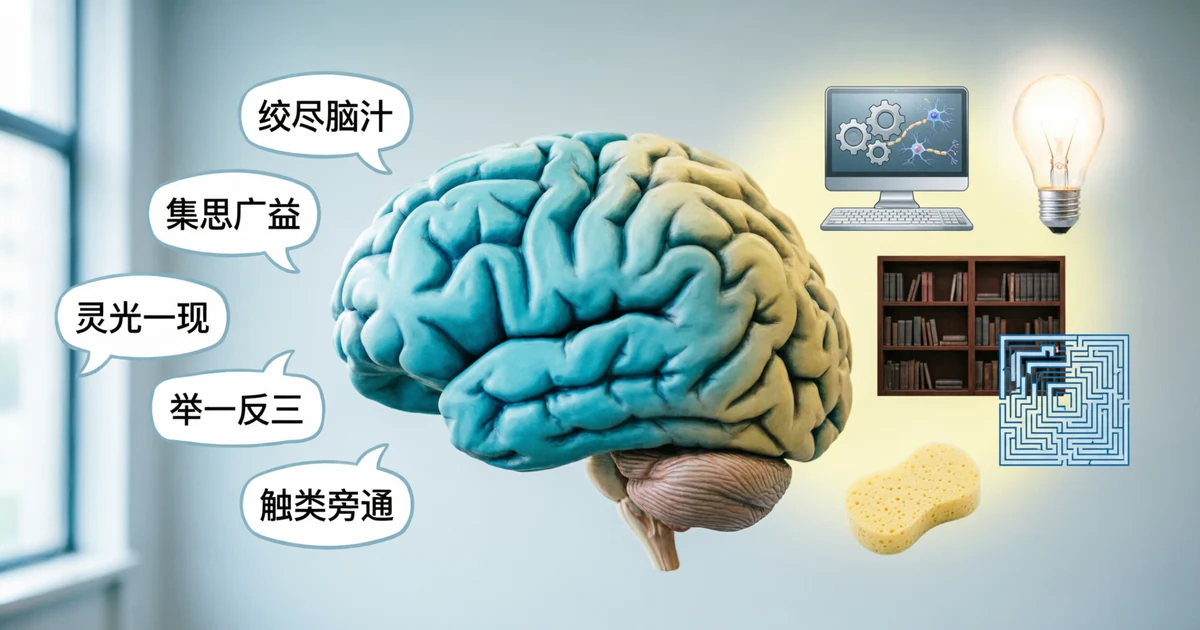
Writers and English learners often search for idioms for brain when they want creative ways to describe intelligence, thinking, memory, confusion, or decision-making. Phrases such as “pick someone’s brain,” “rack your brain,” and “brainstorm” can make everyday English sound more natural and expressive.
However, brain-related language does not always fall into the same category. Some phrases are idioms, while others work as metaphors. The two devices can look similar because both move beyond completely literal meaning, but they do not work in exactly the same way.
A brain idiom is a familiar fixed expression whose full meaning cannot always be understood from the individual words. A brain metaphor, by contrast, directly describes the brain or mind as something else, such as a computer, engine, library, or sponge.
The core difference is simple: brain idioms are established expressions used by a language community, while brain metaphors are comparisons that help readers imagine how thinking or memory works.
Understanding this distinction helps students identify figurative language, helps ESL learners use expressions naturally, and gives writers more control over tone and meaning.
What Brain Idioms Mean
A brain idiom is a commonly recognized phrase that uses the word “brain,” or an idea connected with thinking, in a nonliteral way.
For example:
I have been racking my brain all morning.
The speaker is not physically moving or damaging the brain. The phrase rack your brain means to think very hard while trying to remember or solve something.
Simple definition
A brain idiom is a fixed or familiar expression about thinking, intelligence, memory, or the mind whose intended meaning differs from its literal wording.
Purpose
Brain idioms help speakers express mental actions and experiences in a short, lively, and natural way. They often describe:
- Thinking intensely
- Asking for ideas
- Forgetting something
- Feeling confused
- Showing intelligence
- Making a decision
- Learning quickly
How brain idioms work
Most idioms depend on shared cultural and language knowledge. A learner may understand every individual word in “pick your brain” but still misunderstand the complete phrase.
The expression does not mean physically touching someone’s brain. It means asking someone to share their knowledge or ideas.
Short example
Can I pick your brain about my science project?
Why brain idioms get confused with metaphors
Many idioms began as metaphorical images. “Rack your brain,” for example, presents thinking as though the mind were being stretched or strained. Because the phrase contains an imaginative comparison, it can feel metaphorical. However, it now functions mainly as a familiar fixed expression, which makes it an idiom.
What Brain Metaphors Mean
A brain metaphor describes the brain, mind, memory, or thought process as though it were another object, system, or place.
For example:
Her brain is a library filled with historical facts.
The brain is not literally a library. The writer compares it to one to suggest that the person stores and organizes a large amount of information.
Simple definition
A brain metaphor is a direct comparison that describes the brain or mind as something else without using “like” or “as.”
Purpose
Brain metaphors help writers make invisible mental processes easier to imagine. Since people cannot directly see thoughts, memory, concentration, or creativity, metaphors give these ideas a visible form.
Writers may describe the brain as:
- A computer
- A sponge
- A machine
- A library
- A maze
- An engine
- A filing cabinet
- A crowded room
How brain metaphors work
A metaphor transfers qualities from one thing to another. When someone says, “My brain is a sponge,” the speaker transfers the sponge’s ability to absorb material to the brain’s ability to absorb knowledge.
The comparison creates meaning through association rather than through a standard fixed expression.
Short example
His brain was an engine running at full speed.
Why brain metaphors get confused with idioms
Some metaphors become so common that they begin to feel like everyday expressions. Phrases such as “my mind went blank” or “food for thought” have metaphorical imagery, but people also recognize them as conventional expressions. This overlap can make classification difficult.
Brain Idioms vs Brain Metaphors: The Core Difference
The main difference lies in how established the expression is and how it creates meaning.
A brain idiom usually has a recognized meaning that speakers learn as a complete phrase. You cannot always discover that meaning by interpreting each word separately.
A brain metaphor creates a comparison between the brain and another object or idea. A writer can invent a new brain metaphor as long as the comparison makes sense.
Consider these examples:
I need to rack my brain.
This is an idiom because English speakers recognize it as a standard expression meaning “think very hard.”
My brain is a locked attic.
This is a metaphor because the speaker directly compares the brain to a locked attic, perhaps suggesting inaccessible memories or hidden thoughts.
In simple terms:
- Idioms depend on established usage.
- Metaphors depend on comparison.
- Idioms are usually fixed.
- Metaphors can be original and flexible.
- Some idioms contain metaphorical imagery.
Quick Comparison Table
| Point | Brain Idioms | Brain Metaphors |
|---|---|---|
| Definition | Familiar expressions about thinking or intelligence with nonliteral meanings | Direct comparisons that describe the brain or mind as something else |
| Scope | A category of established figurative expressions | A broad figurative device used in speech and writing |
| Purpose | To express mental actions naturally and concisely | To create imagery and explain abstract mental processes |
| Length | Usually a short phrase or expression | Can be one phrase, one sentence, or extended across a passage |
| Structure | Often fixed or only slightly changeable | Flexible and open to original wording |
| Meaning | Learned as a complete expression | Understood through the qualities shared by two things |
| Use in writing | Common in dialogue, informal articles, conversation, and practical writing | Common in fiction, poetry, speeches, essays, and descriptive writing |
| Example | “Pick her brain before the meeting.” | “Her brain was a map of hidden possibilities.” |
| Familiarity | Usually already known within the language | May be familiar or newly created |
| Literal interpretation | Often produces a strange or incorrect meaning | Clearly presents one thing in terms of another |
How Brain Idioms Work
Brain idioms work because speakers agree on meanings that extend beyond the literal words.
Take the expression:
It slipped my mind.
Nothing physically slips out of the mind. The phrase means that someone temporarily forgot something.
The words create an image of a thought escaping, but the phrase functions as a complete unit. Native speakers usually do not pause to analyze the image. They understand the intended meaning immediately.
Fixed wording
Many idioms have a standard form. Changing important words may make them sound unnatural.
Correct:
I racked my brain for the answer.
Unnatural:
I shook my brain for the answer.
Even though “shook” might suggest mental effort, it does not belong to the established expression.
Context controls meaning
Some brain-related phrases can carry different shades of meaning depending on context.
She is the brains behind the operation.
Here, “the brains” means the person who provides the intelligence, planning, or strategy.
Use your brain.
This direct expression means “think carefully” or “use common sense.” Depending on tone, it may sound encouraging, impatient, or rude.
Grammar may change slightly
Idioms often allow limited grammatical changes:
- Rack your brain
- Racked his brain
- Racking their brains
The tense and pronoun may change, but the main structure remains recognizable.
Meaning cannot always be predicted
An ESL learner might interpret “brain drain” as a medical problem. In reality, it usually describes the movement of educated or skilled people away from a country, region, or organization.
This gap between literal words and intended meaning is a major feature of idiomatic language.
How Brain Metaphors Work
Brain metaphors work by connecting mental activity with something readers already understand.
Thoughts and memories are invisible. A metaphor turns them into an image.
For instance:
My brain is a crowded train station.
This comparison may suggest that many thoughts are arriving, leaving, colliding, or competing for attention.
Metaphors transfer qualities
A writer chooses a source image and transfers its qualities to the brain.
Consider these examples:
- The brain is a computer: processing information, storing data, following instructions
- The brain is a sponge: absorbing knowledge quickly
- The brain is a maze: containing confusion, complexity, or difficult paths
- The brain is an engine: producing energy, movement, or rapid thought
- The brain is a filing cabinet: storing and organizing memories
- The brain is a muscle: becoming stronger through practice
These comparisons are not scientifically exact in every detail. Their purpose is to highlight one useful similarity.
Metaphors can be original
Unlike most idioms, metaphors do not have to come from a familiar list.
A writer might create:
His brain was a workshop where unfinished ideas covered every table.
This metaphor is understandable even if the reader has never seen it before.
Metaphors can extend across several sentences
A metaphor may continue through a paragraph:
Her mind was a garden. New ideas appeared like seedlings, but only the strongest survived her careful attention. With patience, she turned scattered thoughts into something worth sharing.
The garden comparison develops over several connected images. This is called an extended metaphor.
Strong metaphors focus on one clear quality
A good metaphor does not need to match every feature of the thing it describes. It only needs a meaningful connection.
Calling the brain “a sponge” highlights absorption. It does not suggest that the brain is soft, wet, or used for cleaning.
Key Differences in Simple Language
Brain idioms and brain metaphors differ in several practical ways.
Brain idioms are conventional
An idiom already belongs to common language. Speakers recognize “pick your brain” as an established phrase.
A metaphor can be created by an individual writer. “Her brain was a lighthouse in the confusion” may be completely original.
Idioms have learned meanings
You often need to learn an idiom’s meaning as a complete unit.
Metaphors usually make sense by examining the comparison.
Idioms are usually short
Most brain idioms appear as short phrases:
- Brain freeze
- Brain drain
- Rack your brain
- Pick someone’s brain
- Have something on the brain
Metaphors can also be short, but they may continue for several sentences or throughout an entire poem, story, or speech.
Metaphors are more flexible
Writers can adjust, expand, or reshape metaphors.
An idiom loses its familiar effect when its core wording changes too much.
Idioms often sound conversational
Brain idioms commonly appear in speech, dialogue, blogs, workplace communication, and informal writing.
Brain metaphors frequently appear in descriptive writing, speeches, literature, poetry, psychology explanations, and educational material.
Metaphors may become idiomatic
A vivid metaphor can become common through repeated use. Once speakers treat it as a familiar expression with a stable meaning, it may begin functioning like an idiom.
Can Brain Idioms and Brain Metaphors Overlap?
Yes. Brain idioms and brain metaphors can overlap because many idioms contain metaphorical ideas.
For example:
My mind went blank.
This phrase compares the mind to an empty page, screen, or space. That makes the image metaphorical. However, “my mind went blank” is also a familiar expression meaning that someone suddenly could not remember or think of anything.
It can therefore be described as an idiomatic expression built on a metaphor.
Another example is:
That idea planted a seed in my mind.
The phrase presents an idea as a seed that can grow. The image is clearly metaphorical. Because forms of this expression appear frequently in everyday English, it may also function idiomatically.
The categories are not always completely separate. The best classification depends on how the phrase functions in context.
Ask two questions:
- Is this a familiar expression with an established meaning?
- Is the sentence directly describing one thing as another?
If the first answer is yes, the phrase likely works as an idiom. If the second answer is yes, it contains a metaphor. Both answers can sometimes be yes.
Examples of Brain Idioms
Below are useful idioms for brain, thinking, memory, and intelligence.
1. Rack your brain
Meaning: Think very hard to remember or solve something.
I racked my brain, but I could not remember his name.
2. Pick someone’s brain
Meaning: Ask someone for information, advice, or ideas.
I would like to pick your brain about starting a small business.
This expression sounds informal. In formal writing, use “ask for advice” or “seek their expertise.”
3. Brainstorm
Meaning: Produce many ideas, often with a group.
Let’s brainstorm some titles for the school magazine.
Although “brainstorm” now functions as a regular verb, its figurative origin connects mental activity with a powerful storm.
4. Brain freeze
Meaning: A sudden inability to think, or a sharp headache caused by consuming something cold too quickly.
I knew the answer, but I had a complete brain freeze during the interview.
Context tells readers whether the speaker means temporary confusion or physical discomfort from cold food.
5. Brain drain
Meaning: The loss of skilled or educated people from a place or organization.
The country is trying to reduce brain drain by creating better research jobs.
6. Have something on the brain
Meaning: Keep thinking or talking about one subject.
He has football on the brain this week.
The expression can suggest enthusiasm, worry, or obsession, depending on context.
7. The brains behind something
Meaning: The person who develops the main idea or plan.
Maya was the brains behind the successful campaign.
This idiom emphasizes intelligence or strategic contribution.
8. Use your brain
Meaning: Think carefully or apply common sense.
Use your brain before you make a final decision.
Be careful with tone. The expression can sound insulting when spoken sharply.
9. Beat your brains out
Meaning: Work or think extremely hard, often without enough success.
I beat my brains out trying to fix the coding error.
This phrase sounds informal and somewhat exaggerated.
10. Put your thinking cap on
Meaning: Prepare to think carefully.
Put your thinking caps on because this puzzle is difficult.
This lighthearted idiom often appears in classrooms and activities for children.
11. A no-brainer
Meaning: A choice or decision that is extremely easy.
Accepting the scholarship was a no-brainer.
The phrase is informal but common in conversation and casual writing.
12. Food for thought
Meaning: An idea worth considering carefully.
Her comments gave us plenty of food for thought.
The idiom treats ideas as nourishment for the mind.
13. Get your head around something
Meaning: Understand a difficult or unfamiliar idea.
It took me a while to get my head around the new grammar rule.
This expression is especially common in British English but is widely understood elsewhere.
14. Put your mind to something
Meaning: Decide to concentrate your effort on achieving something.
You can learn the skill if you put your mind to it.
15. Cross your mind
Meaning: Briefly enter your thoughts.
It never crossed my mind that the event might be cancelled.
16. Slip your mind
Meaning: Be temporarily forgotten.
I am sorry I missed the call. It completely slipped my mind.
17. Keep something in mind
Meaning: Remember or consider something.
Keep the deadline in mind while planning your research.
18. Speak your mind
Meaning: Express your honest thoughts or opinions.
She is never afraid to speak her mind.
19. Change your mind
Meaning: Make a different decision or develop a different opinion.
I planned to stay home, but I changed my mind.
20. Out of your mind
Meaning: Behaving irrationally, extremely shocked, or strongly affected by an emotion.
You must be out of your mind if you think I will climb that tower.
The phrase can sound harsh, so learners should use it carefully.
21. Lose your train of thought
Meaning: Forget what you were saying or thinking.
The interruption made me lose my train of thought.
22. Have a mind like a steel trap
Meaning: Have an excellent memory or sharp intelligence.
Our teacher has a mind like a steel trap and remembers every student’s name.
23. Two heads are better than one
Meaning: Two people working together may solve a problem more effectively than one person.
Help me check these calculations. Two heads are better than one.
This expression may also be classified as a proverb because it communicates a general piece of wisdom.
24. Know something by heart
Meaning: Memorize something completely.
She knows the entire poem by heart.
25. Put your heads together
Meaning: Work together to develop an idea or solve a problem.
We put our heads together and found a cheaper solution.
Examples of Brain Metaphors
The following examples describe the brain or mind through direct comparison.
1. The brain is a computer
His brain is a computer that processes numbers in seconds.
This metaphor emphasizes speed, storage, calculation, or logical processing.
2. The brain is a sponge
A child’s brain is a sponge, absorbing new sounds and patterns.
This comparison highlights rapid learning and absorption.
3. The brain is a library
Her brain is a library of stories, facts, and forgotten songs.
The metaphor suggests organized or extensive knowledge.
4. The brain is a maze
My brain became a maze of conflicting thoughts.
This image communicates confusion or complexity.
5. The brain is an engine
His brain was an engine that never seemed to stop.
The engine represents energy, speed, and continuous mental activity.
6. The brain is a filing cabinet
My brain is a filing cabinet, but someone has mixed up all the folders.
This humorous metaphor describes memory and difficulty retrieving information.
7. The mind is a garden
The mind is a garden, and habits are the plants we water each day.
The metaphor suggests that thoughts and habits grow through attention.
8. The brain is a muscle
Your brain is a muscle that becomes stronger with regular practice.
This common educational metaphor emphasizes improvement through effort. Biologically, the brain is not a muscle, so the comparison should not be interpreted literally.
9. The mind is a blank page
After hearing the unexpected question, my mind was a blank page.
The blank page represents an absence of ideas or memories.
10. The brain is a crowded room
By Friday evening, my brain was a crowded room full of noisy thoughts.
This metaphor expresses mental overload.
11. Memory is a camera
Her memory is a camera that captures every small detail.
The comparison highlights accurate visual recall.
12. Thoughts are traffic
My thoughts were rush-hour traffic, moving in every direction.
This metaphor creates an image of mental confusion and congestion.
13. Ideas are sparks
New ideas were sparks jumping across his mind.
The sparks suggest sudden inspiration or creative energy.
14. The mind is a prison
Fear turned his mind into a prison.
This darker metaphor suggests that thoughts or emotions have limited someone’s freedom.
15. The brain is a map
Her brain was a map showing several routes through the problem.
This metaphor highlights planning, direction, and connected knowledge.
Brain Idioms vs Brain Metaphors in Literature and Writing
Writers use brain idioms and brain metaphors for different effects.
Brain idioms in dialogue
Idioms can make dialogue sound natural and believable.
“Let me pick your brain for a minute,” Daniel said.
The expression sounds more conversational than:
“Please allow me to request information from your area of expertise.”
Idioms can also reveal personality. A relaxed character may use casual expressions such as “no-brainer,” while a formal character may avoid them.
Brain metaphors in description
Metaphors allow writers to describe internal experiences that readers cannot see.
Her mind was a hallway lined with locked doors.
This image may suggest forgotten memories, emotional barriers, secrets, or fear. The writer does not need to explain every meaning directly because the metaphor encourages interpretation.
Metaphors create tone
Different brain metaphors produce different moods.
His mind was a bright workshop.
This sounds energetic and creative.
His mind was an abandoned building.
This sounds lonely, damaged, or empty.
His mind was a battlefield.
This suggests conflict and emotional struggle.
Writers should choose an image that matches the intended tone.
Idioms improve familiarity
Idioms connect writing with everyday speech. They work well in:
- Personal essays
- Blog posts
- Dialogue
- Informal articles
- Speeches
- Friendly instructions
- Workplace communication
However, too many idioms can make writing feel crowded or clichéd.
Metaphors support themes
A repeated brain metaphor can help develop a larger theme.
A novel about memory might repeatedly describe the mind as a house. Some rooms may stay open, others may remain locked, and forgotten objects may represent buried memories. In this case, the metaphor becomes structural and thematic rather than merely decorative.
Brain Idioms vs Brain Metaphors for Students and ESL Learners
Students and ESL learners should approach these expressions in different ways.
Learn brain idioms as complete phrases
Do not memorize only the word “brain.” Record the entire expression with its meaning and an example.
For instance:
- Rack your brain: think very hard
- Pick someone’s brain: ask for their ideas
- A no-brainer: an easy decision
- Brain freeze: a temporary inability to think
- The brains behind something: the main planner
Learning the full phrase helps you use the correct grammar and word order.
Study the context
An idiom’s tone matters.
“Pick your brain” sounds friendly and informal. It may work in a conversation with a colleague but feel too casual in a highly formal academic request.
Compare:
Informal:
Can I pick your brain about the assignment?
Formal:
Could I ask for your advice about the assignment?
Do not translate idioms word for word
A literal translation into another language may sound strange or communicate the wrong idea. Instead, learn the intended meaning and find an equivalent expression in the target language when one exists.
Identify the comparison in a metaphor
When studying a brain metaphor, ask:
- What two things are being compared?
- Which quality connects them?
- What feeling or idea does the comparison create?
Example:
Her brain was a sponge.
- Brain and sponge are being compared.
- Both can absorb something.
- The sentence suggests quick learning.
Separate metaphor from scientific fact
Metaphors simplify complex ideas. “The brain is a computer” can help explain information processing, but a human brain does not function exactly like a digital computer.
Students should not treat figurative comparisons as complete scientific definitions.
Use familiar idioms before uncommon ones
ESL learners sound more natural when they use a few common expressions correctly rather than many rare idioms awkwardly.
Useful starting choices include:
- It slipped my mind.
- I changed my mind.
- Keep that in mind.
- I lost my train of thought.
- Let’s put our heads together.
- It was a no-brainer.
Common Mistakes and Confusion
Treating every brain phrase as an idiom
Not every sentence containing “brain” is idiomatic.
The human brain controls many bodily functions.
This sentence is literal.
I racked my brain for an answer.
This sentence contains an idiom.
Calling every nonliteral phrase a metaphor
Figurative language includes many categories, such as idioms, metaphors, similes, personification, hyperbole, and proverbs. A phrase can be nonliteral without functioning mainly as a metaphor.
Changing the wording of an idiom
Learners sometimes replace a word with a synonym:
Incorrect:
I collected my brain for the answer.
Correct:
I racked my brain for the answer.
Idioms usually require conventional wording.
Mixing incompatible metaphors
A mixed metaphor combines images that do not work naturally together.
Awkward:
My brain was a computer drowning in a storm of broken roads.
This sentence combines a computer, a storm, and roads without a clear relationship.
Clearer:
My brain was an overloaded computer struggling to process another command.
Using idioms in very formal writing
Idioms can sound too casual in academic, legal, scientific, or highly professional contexts.
Informal:
The solution was a no-brainer.
More formal:
The solution was the most practical and obvious choice.
Taking metaphors too literally
The metaphor “the brain is a muscle” encourages mental exercise. It does not make a biological claim that the brain consists of muscle tissue.
Confusing “brain” and “mind”
The brain is a physical organ. The mind refers more broadly to thought, awareness, memory, imagination, and emotion.
Everyday figurative language often uses the terms loosely, but scientific and philosophical writing may require a more precise distinction.
When to Use Brain Idioms and When to Use Brain Metaphors
Use brain idioms when you want language that feels familiar, concise, and conversational.
They work especially well when:
- Writing realistic dialogue
- Explaining an everyday situation
- Speaking informally
- Giving friendly advice
- Describing memory or thought quickly
- Making a blog post sound natural
Example:
I completely lost my train of thought.
Use brain metaphors when you want to create imagery, mood, symbolism, or a deeper explanation.
They work especially well when:
- Writing fiction or poetry
- Describing a mental state
- Explaining an abstract process
- Creating an emotional atmosphere
- Developing a theme
- Making an idea memorable
Example:
Anxiety turned her mind into a room where every alarm rang at once.
In many cases, the choice depends on purpose. An idiom communicates quickly. A metaphor invites the reader to imagine and interpret.
Related Terms People Often Confuse With Them
Simile
A simile compares two things using “like” or “as.”
His brain works like a computer.
A metaphor states the comparison more directly:
His brain is a computer.
Proverb
A proverb expresses general wisdom or advice.
Two heads are better than one.
This sentence may also contain figurative language, but its main purpose is to communicate a widely accepted lesson.
Personification
Personification gives human actions or qualities to a nonhuman thing or abstract idea.
My brain refused to cooperate.
The brain receives the human ability to refuse.
Hyperbole
Hyperbole uses deliberate exaggeration.
My brain is going to explode from all this homework.
The speaker does not expect a literal explosion. The statement emphasizes mental pressure.
Analogy
An analogy explains an idea through a more developed comparison.
A teacher might compare memory to a filing system, then explain how information gets stored, organized, and retrieved. This extended explanation functions as an analogy rather than a brief decorative metaphor.
Collocation
A collocation is a group of words that commonly appear together, but it does not always have a nonliteral meaning.
For example, “brain function” and “brain activity” are common collocations, but they are usually literal rather than idiomatic.
Cliché
A cliché is an expression or image that has become overly familiar through repeated use.
A metaphor such as “the mind is a battlefield” may feel powerful in the right context, but it can sound clichéd when used without fresh detail.
Conclusion
Brain idioms and brain metaphors both make language more expressive, but they serve different purposes.
A brain idiom is usually a familiar phrase with an established nonliteral meaning, such as “rack your brain,” “pick someone’s brain,” or “lose your train of thought.” Readers understand the phrase because it belongs to common usage.
A brain metaphor directly compares the brain or mind to something else, such as a computer, sponge, maze, engine, or library. It helps readers picture mental processes, emotions, memory, intelligence, or confusion.
The simplest distinction is that idioms are mainly conventional expressions, while metaphors are mainly imaginative comparisons. Some phrases can belong to both categories because many idioms developed from metaphorical images.
For students and ESL learners, the safest approach is to learn idioms as complete phrases and analyze metaphors by identifying the comparison. For writers, idioms create familiarity, while metaphors create imagery, tone, symbolism, and depth.
FAQs
What are some common idioms for brain?
Common idioms for brain and thinking include “rack your brain,” “pick someone’s brain,” “brain freeze,” “brain drain,” “the brains behind something,” and “have something on the brain.” Related mind idioms include “slip your mind,” “change your mind,” and “keep something in mind.”
Is “pick your brain” an idiom or a metaphor?
“Pick your brain” mainly functions as an idiom because it is a familiar expression meaning to ask someone for information, expertise, or ideas. It also contains metaphorical imagery because no physical picking occurs.
Is “the brain is a computer” an idiom?
No. “The brain is a computer” is primarily a metaphor. It directly compares the brain with a computer to emphasize information processing, storage, speed, or logic.
What does “rack your brain” mean?
“Rack your brain” means to think extremely hard, usually while trying to remember something, understand a problem, or find a solution.
Can an idiom also contain a metaphor?
Yes. Many idioms developed from metaphors. “My mind went blank” uses a metaphorical image of emptiness, but it also works as a familiar idiom meaning that someone suddenly could not think or remember.
Are brain idioms suitable for formal writing?
Some brain idioms may appear in general professional writing, but highly informal phrases such as “a no-brainer” may not suit academic, legal, or scientific contexts. Choose direct language when formality and precision matter.
How can ESL learners remember brain idioms?
Learn each idiom as a complete phrase, write down its meaning, study a natural example, and practise using it in context. Avoid translating the individual words literally because the complete meaning may be different.