Introduction
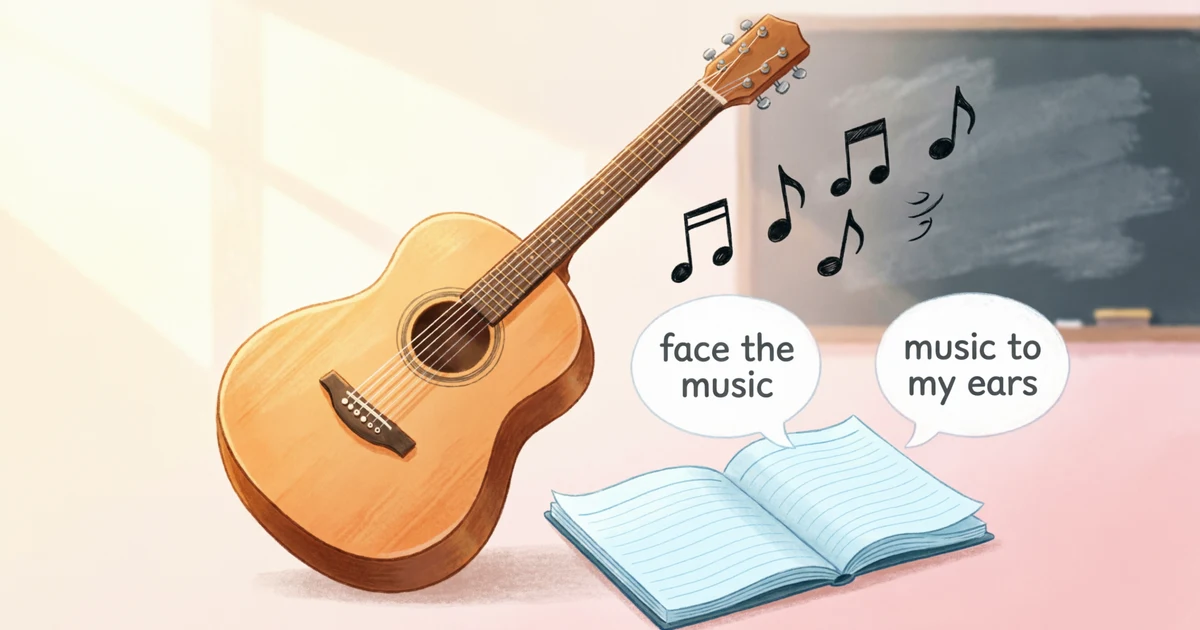
People often search for idioms for music when they want expressive phrases about songs, sound, rhythm, performance, or musical talent. Some of these phrases are true idioms, such as face the music or music to my ears. Others feel musical but work more like metaphors, such as her voice was velvet or the city had its own rhythm.
That confusion is normal. Idioms and metaphors both use figurative language, so they do not always mean exactly what the words say. The key difference is simple: an idiom has a fixed meaning understood by speakers of a language, while a metaphor creates a comparison to help readers imagine something in a fresh way.
This article explains idioms and metaphors through the topic of music. You will learn what each term means, how they differ, where they overlap, and how to use them correctly in writing, schoolwork, and everyday English.
What Idioms Mean
An idiom is a common expression whose meaning cannot always be understood from the individual words. Native speakers learn idioms as complete phrases.
For example, face the music does not mean to stand in front of a band or a speaker. It means to accept the consequences of your actions.
Simple definition:
An idiom is a fixed phrase with a special meaning.
Purpose:
Idioms make language sound natural, expressive, and familiar.
How it works:
The whole phrase carries the meaning, not each word separately.
Short natural example:
After missing the deadline, Jake had to face the music.
Why it gets confused with metaphor:
Many idioms started as imaginative comparisons, so they can sound metaphorical. However, idioms usually have meanings that speakers already know.
What Metaphors Mean
A metaphor is a figure of speech that describes one thing as another to create meaning, emotion, or imagery. Unlike an idiom, a metaphor does not need to be a fixed phrase.
For example, music is the heartbeat of the party is a metaphor. Music is not literally a heartbeat, but the comparison shows that music gives the party energy and life.
Simple definition:
A metaphor describes something as something else to show a similarity.
Purpose:
Metaphors help readers understand, feel, or picture an idea more strongly.
How it works:
A writer connects two different things directly, without using “like” or “as.”
Short natural example:
Her song was a light in the dark room.
Why it gets confused with idiom:
Both idioms and metaphors use non-literal meaning. The difference is that a metaphor often feels more creative, while an idiom usually feels like a known expression.
Idioms vs Metaphors: The Core Difference
The main difference is that idioms are fixed expressions with accepted meanings, while metaphors are comparisons that writers can create freely.
If you say music to my ears, you are using an idiom. English speakers understand that it means “something very pleasant to hear.” If you say her voice was honey, you are using a metaphor. You create a direct comparison between her voice and honey to suggest sweetness and smoothness.
So, idioms are more about shared language, while metaphors are more about creative comparison.
Quick Comparison Table
| Point | Idiom | Metaphor |
|---|---|---|
| Definition | A fixed expression with a special meaning | A direct comparison between two unlike things |
| Scope | Narrower because it depends on known phrases | Broader because writers can create new ones |
| Purpose | To sound natural, fluent, or expressive | To create imagery, emotion, or deeper meaning |
| Length | Usually a short phrase | Can be short, extended, or repeated across a text |
| Structure | Often fixed and cannot change much | Flexible and creative |
| Meaning | Usually learned as a whole phrase | Built through comparison |
| Use in writing | Good for dialogue, informal writing, and familiar expression | Good for poetry, description, essays, fiction, and speeches |
| Example | “That news was music to my ears.” | “Her voice was a silver bell.” |
How Idioms Work
Idioms work because a language community agrees on their meaning over time. The words may look strange when read literally, but the phrase carries a familiar idea.
In music-related idioms, the word “music” often stands for sound, harmony, performance, pleasure, responsibility, or emotional effect.
For example:
Face the music means accept consequences.
Music to my ears means pleasant news or a welcome sound.
Blow your own trumpet means praise yourself too much.
Play it by ear means decide what to do as the situation develops.
These expressions do not always describe real music. They use musical language to talk about life, feelings, behavior, or decisions.
Writers use idioms when they want language to feel conversational and familiar. ESL learners should learn idioms as complete phrases because translating them word by word often causes mistakes.
How Metaphors Work
Metaphors work by linking one idea to another. A writer does not say something is “like” something else. Instead, the writer says one thing is another thing.
In music writing, metaphors often describe voice, emotion, rhythm, beauty, creativity, or atmosphere.
Examples:
Her voice was velvet.
This means her voice sounded soft and smooth.
The song was a doorway to childhood.
This means the song brought back memories.
The orchestra became a storm.
This suggests power, movement, and intensity.
Metaphors can be original, poetic, simple, or extended. A writer can create a metaphor for one sentence or develop it across a whole paragraph, poem, or story.
Key Differences in Simple Language
Idioms and metaphors both go beyond literal meaning, but they do different jobs.
An idiom is usually something people already say. You learn it as a set phrase. If you change too many words, it may sound wrong. For example, music to my ears works, but a song to my ears does not have the same idiomatic meaning.
A metaphor gives you more freedom. You can create your own comparison, as long as readers can understand the connection. For example, the piano was a river of sound is not a fixed phrase, but it makes sense as a metaphor.
Idioms often help you sound fluent. Metaphors help you sound vivid, thoughtful, or artistic.
Can Idioms and Metaphors Overlap?
Yes, idioms and metaphors can overlap because many idioms contain metaphorical ideas.
For example, face the music is an idiom, but it also works metaphorically. The phrase suggests standing before a situation you cannot avoid, almost as if the “music” represents judgment, truth, or consequences.
Another example is march to the beat of your own drum. It is an idiom because speakers use it as a known expression. It also contains a metaphor because a person’s “beat” represents their personal style, values, or choices.
The overlap does not mean the two terms are the same. A phrase can have metaphorical roots and still function as an idiom if people use it as a fixed expression.
Examples of Idioms for Music
Here are common music-related idioms with simple meanings and natural examples.
1. Music to my ears
Meaning: Something very pleasing to hear.
Example:
When the teacher said the test was postponed, it was music to my ears.
2. Face the music
Meaning: Accept the results or consequences of something.
Example:
You broke the rule, so now you have to face the music.
3. Play it by ear
Meaning: Decide what to do later, depending on the situation.
Example:
We do not have a fixed plan for Saturday. We will play it by ear.
4. Blow your own trumpet
Meaning: Praise yourself or talk too much about your achievements.
Example:
I do not want to blow my own trumpet, but I worked hard on this project.
5. March to the beat of your own drum
Meaning: Live or act in your own unique way.
Example:
Maya has always marched to the beat of her own drum.
6. Strike the right note
Meaning: Say or do something in a suitable way.
Example:
His speech struck the right note with the audience.
7. Change your tune
Meaning: Change your opinion, attitude, or behavior.
Example:
He complained at first, but he changed his tune after seeing the results.
8. Ring a bell
Meaning: Sound familiar.
Example:
That singer’s name rings a bell, but I cannot remember where I heard it.
9. Call the tune
Meaning: Control a situation or make the decisions.
Example:
The manager pays for the project, so she calls the tune.
10. Fine-tune something
Meaning: Make small improvements.
Example:
We need to fine-tune the presentation before the meeting.
Examples of Metaphors for Music
These examples are not fixed idioms. They use musical imagery to create meaning.
1. Her voice was a silver bell
This metaphor suggests that her voice sounded clear, bright, and pleasant.
2. The song was a bridge to the past
This means the song connected the speaker to old memories.
3. Music was the heartbeat of the festival
This metaphor shows that music gave the festival life and energy.
4. His guitar poured sunlight into the room
This suggests warmth, happiness, and beauty.
5. The choir became a wave
This metaphor suggests a rising, powerful sound.
6. The melody was a thread pulling everyone together
This means the melody connected people emotionally.
7. The drums were thunder in the dark
This creates a strong image of loud, powerful drums.
8. Her song was a key to hidden feelings
This means the song helped reveal emotions.
9. The violin wept
This personifies the violin and suggests a sad, emotional sound.
10. The rhythm was a heartbeat under the city
This metaphor suggests that rhythm gave the city movement and life.
Idioms vs Metaphors in Literature and Writing
Writers use idioms and metaphors for different effects.
Idioms often make dialogue sound natural. If a character says, “That news was music to my ears,” the sentence feels conversational and easy to understand. Idioms can also reveal personality, culture, age, or tone. A casual speaker may use many idioms, while a formal narrator may avoid them.
Metaphors give writers more creative control. A poet might write, “The piano opened a door in the silence.” This metaphor does not come from a fixed expression. It creates an image and invites the reader to feel the moment.
In literature, metaphors often carry deeper themes. Music can represent memory, love, freedom, grief, harmony, or conflict. An idiom usually communicates a quick meaning, while a metaphor can shape the mood of a whole passage.
For example:
Idiom:
The apology was music to her ears.
Metaphor:
The apology was a soft note after years of noise.
The idiom gives a familiar meaning. The metaphor gives a more emotional and original image.
Idioms vs Metaphors for Students and ESL Learners
Students and ESL learners often confuse idioms and metaphors because both can sound indirect. A good way to tell them apart is to ask one question: Is this a common fixed phrase, or is it a creative comparison?
If the phrase appears in dictionaries and people use it the same way often, it is probably an idiom. Examples include face the music, play it by ear, and ring a bell.
If the phrase compares two things in a fresh way, it is probably a metaphor. Examples include the melody was a river, her voice was gold, and the song was a window into his heart.
For ESL learners, idioms need special attention because their meanings rarely translate word for word. For students, metaphors need careful reading because they often reveal tone, theme, and emotion.
A simple classroom rule helps:
Idiom = known phrase.
Metaphor = direct comparison.
Common Mistakes and Confusion
Mistake 1: Taking idioms literally
A learner may think face the music means looking at musicians. In real English, it means accepting consequences.
Mistake 2: Calling every figurative phrase a metaphor
Not every non-literal phrase is a metaphor. Play it by ear is an idiom, not a new comparison created by the writer.
Mistake 3: Changing idioms too much
Idioms often sound wrong when changed. Say music to my ears, not music for my ears when using the idiom.
Mistake 4: Using idioms in very formal writing
Idioms can sound casual. In academic writing, use them carefully. A metaphor may work better if you want a more serious or literary tone.
Mistake 5: Creating unclear metaphors
A metaphor should help the reader understand. If the comparison feels too random, it may confuse instead of clarify.
Mistake 6: Mixing idioms incorrectly
Some learners combine phrases by accident. For example, face the tune mixes face the music and call the tune. The correct idiom is face the music.
When to Use Idioms and When to Use Metaphors
Use idioms when you want your language to sound natural, fluent, and familiar. They work well in conversation, dialogue, blog writing, informal essays, and everyday examples.
Use idioms for quick meanings:
That feedback was music to my ears.
We will play it by ear.
He finally had to face the music.
Use metaphors when you want to create a strong image, emotional effect, or original description. They work well in poetry, fiction, speeches, personal essays, and descriptive writing.
Use metaphors for vivid meaning:
The melody was a river through the room.
Her voice was a candle in the silence.
The drums were thunder beneath our feet.
If you want fluency, choose an idiom. If you want imagery, choose a metaphor, If you want both, you can use an idiom that has metaphorical force, but make sure the phrase fits your tone.
Related Terms People Often Confuse with Idioms and Metaphors
Simile
A simile compares two things using “like” or “as.”
Example:
Her voice was like a bell.
A metaphor says her voice was a bell. A simile says it was like a bell.
Personification
Personification gives human qualities to something non-human.
Example:
The violin cried through the empty hall.
The violin cannot literally cry, but the sentence gives it human emotion.
Symbolism
Symbolism uses a person, object, sound, or action to represent a bigger idea.
Example:
In a story, a song might symbolize freedom, childhood, grief, or hope.
Hyperbole
Hyperbole uses exaggeration for effect.
Example:
I have listened to this song a million times.
The speaker does not mean exactly one million times.
Cliché
A cliché is an overused phrase or idea.
Some idioms can become clichés if writers use them too often. For example, music to my ears is useful, but it may feel predictable in creative writing.
Figurative Language
Figurative language is the broader category. Idioms, metaphors, similes, personification, and hyperbole all belong under figurative language.
Conclusion
Idioms and metaphors both make English more expressive, but they do not work in the same way. An idiom is a common fixed phrase with a special meaning, such as face the music or music to my ears. A metaphor is a direct comparison that creates imagery or deeper meaning, such as her voice was a silver bell.
For students and ESL learners, the easiest difference is this: idioms are learned phrases, while metaphors are creative comparisons. Idioms help you sound fluent and natural. Metaphors help you write with detail, emotion, and imagination.
When writing about music, you can use both. Choose idioms for familiar expression and metaphors for fresh description.
FAQs
What are idioms for music?
Idioms for music are common expressions that use music-related words but often mean something broader. Examples include face the music, music to my ears, play it by ear, and change your tune.
Is “music to my ears” an idiom or a metaphor?
Music to my ears is an idiom because English speakers use it as a fixed expression meaning something pleasant to hear. It also has a metaphorical idea, but it functions mainly as an idiom.
What is the difference between an idiom and a metaphor?
An idiom is a common phrase with a special accepted meaning. A metaphor is a direct comparison between two unlike things. Idioms depend on shared usage, while metaphors depend on comparison.
Is “face the music” a music idiom?
Yes. Face the music is a music-related idiom. It means to accept consequences, criticism, or responsibility after doing something wrong or difficult.
Can a metaphor be about music?
Yes. Writers often use music metaphors to describe feelings, memories, voices, places, and relationships. For example, the song was a doorway to the past is a metaphor about memory.
Are idioms harder than metaphors for ESL learners?
Idioms can be harder because their meanings do not always come from the individual words. ESL learners usually need to memorize idioms as complete phrases. Metaphors can also be difficult, but readers can often understand them by thinking about the comparison.
Should I use idioms or metaphors in formal writing?
Use both carefully. Idioms may sound informal or conversational, so they work best in examples, dialogue, and lighter writing. Metaphors can work well in formal and creative writing when they are clear, relevant, and not too dramatic.