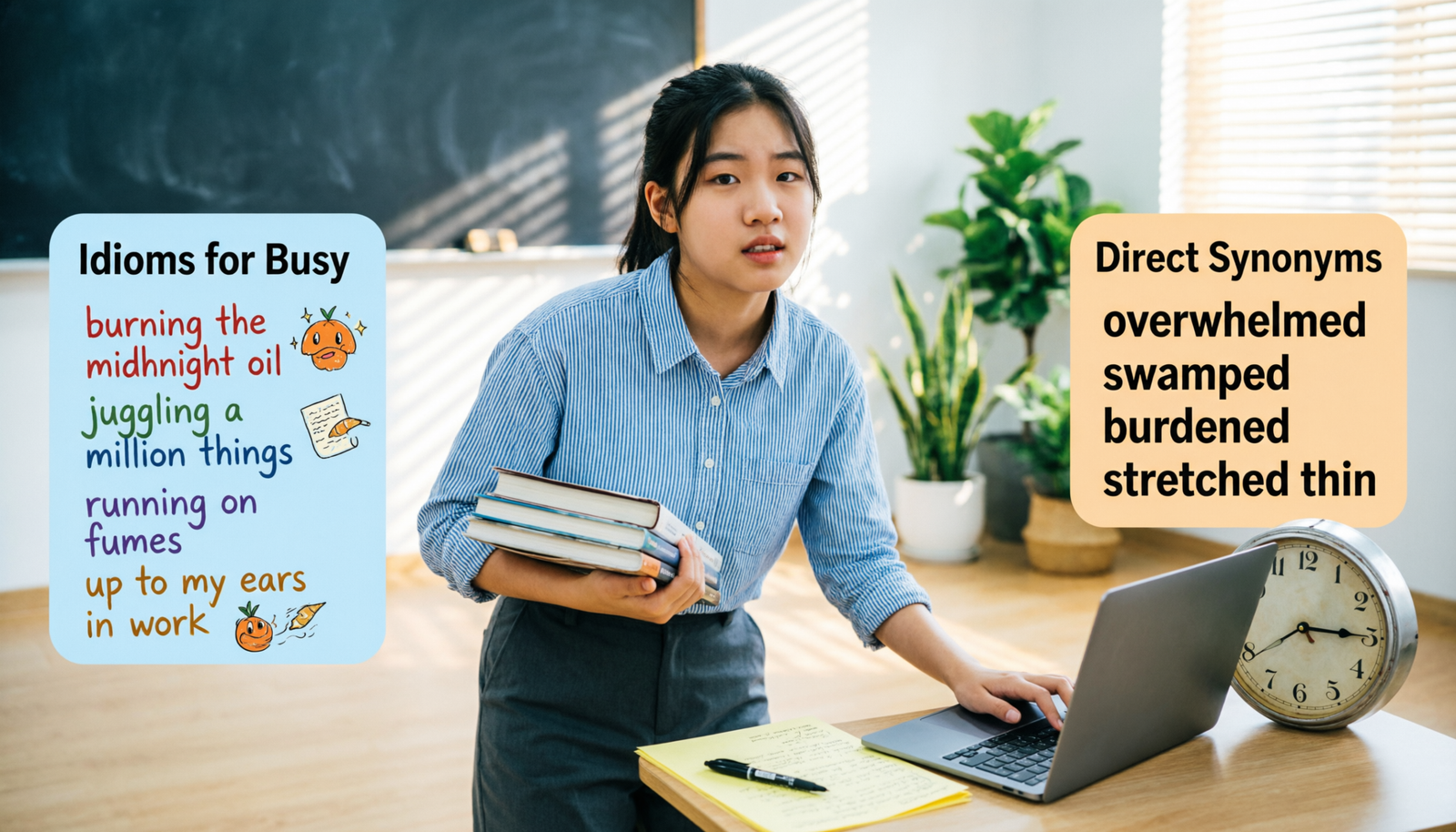
English gives us many ways to describe someone who has a lot to do. You can use a direct word such as occupied, overloaded, or unavailable, or you can choose a more colorful expression such as have a lot on your plate.
This difference creates an important distinction between idioms for busy and synonyms for busy.
A synonym usually replaces the word busy with another word that has a similar meaning. An idiom expresses the same general idea through a phrase whose meaning may not be completely literal.
For example:
- Synonym: She is occupied this afternoon.
- Idiom: She has her hands full this afternoon.
Both sentences describe busyness, but they communicate it differently. The synonym is direct and compact. The idiom sounds more expressive and conversational.
This guide explains how idioms and synonyms for busy work, where they overlap, and how students, writers, and ESL learners can choose the most natural expression.
What Idioms for Busy Mean
An idiom for busy is a fixed or commonly used expression that describes having many tasks, responsibilities, or demands.
The meaning of an idiom often differs from the literal meaning of its individual words. When someone says, “I have a lot on my plate,” they are usually not talking about food. They mean that they have many responsibilities to manage.
Simple definition
An idiom for busy is a figurative phrase used to show that someone has a large amount of work, activity, or responsibility.
Purpose
Idioms make language more vivid, natural, and emotionally expressive. They can show not only that a person is busy but also how that busyness feels.
For example, an idiom can suggest that someone feels:
- overwhelmed
- constantly active
- under pressure
- fully occupied
- unable to accept more work
How it works
The listener understands the phrase as a complete expression rather than interpreting every word literally.
Short example
I have my hands full with three projects this week.
This means the speaker is managing several demanding responsibilities.
Why idioms get confused with synonyms
Idioms and synonyms can communicate similar ideas. However, an idiom usually contains several words and creates a figurative image, while a synonym often consists of one direct word.
What Synonyms for Busy Mean
A synonym for busy is a word or phrase with the same or a closely related meaning as busy.
Common synonyms include:
- occupied
- engaged
- active
- overloaded
- unavailable
- hectic
- industrious
- preoccupied
These words do not always mean exactly the same thing. Each one describes a particular kind of busyness.
For example, occupied means that someone is currently doing something. Overloaded suggests that the person has too much to manage. Industrious describes someone who works hard and regularly.
Simple definition
A synonym for busy is a direct alternative that expresses a similar meaning to the word busy.
Purpose
Synonyms help writers avoid repetition and choose more precise language.
Instead of writing, “She was busy,” you could write:
- She was occupied.
- She was unavailable.
- She was overwhelmed.
- She was active throughout the morning.
Each choice adds a slightly different meaning.
How it works
A synonym usually replaces busy within a sentence without changing the basic sentence structure.
Short example
The manager is occupied at the moment.
Here, occupied means that the manager is currently involved in another task.
Why synonyms get confused with idioms
Some synonyms appear as multiword phrases, such as tied up or fully booked. Because they contain more than one word, learners may mistake them for idioms. The distinction depends on whether the expression communicates meaning directly or figuratively.
Idioms for Busy vs Synonyms for Busy: The Core Difference
The central difference is simple:
A synonym states busyness directly, while an idiom often describes it through a figurative or fixed expression.
Compare these examples:
- Synonym: I am overloaded with work.
- Idiom: I am up to my ears in work.
The first sentence communicates the meaning directly. The second uses an exaggerated image to show that the speaker has an extremely large amount of work.
A synonym is usually better when clarity, precision, or formality matters. An idiom works well when you want the sentence to sound conversational, vivid, or expressive.
Quick Comparison Table
| Point | Idioms for Busy | Synonyms for Busy |
|---|---|---|
| Definition | Fixed or figurative expressions that describe busyness | Words or direct phrases with meanings similar to busy |
| Scope | Usually describes a specific situation or feeling | Can describe many forms of activity or occupation |
| Purpose | Adds imagery, personality, emotion, or emphasis | Improves precision and avoids repetition |
| Length | Usually several words | Often one word, though some are short phrases |
| Structure | Often fixed and cannot be changed freely | Usually fits normal grammatical patterns |
| Meaning | May be nonliteral or figurative | Usually direct or closely related to the dictionary meaning |
| Use in writing | Common in dialogue, informal writing, fiction, and personal content | Common in formal, academic, professional, and everyday writing |
| Example | “I have a lot on my plate.” | “I am overloaded.” |
How Idioms for Busy Work
Idioms work as complete units of meaning. Their words create an image, but the intended meaning goes beyond that image.
Consider the expression:
She is juggling too many things at once.
The speaker does not necessarily mean that the woman is physically throwing objects into the air. The expression compares her responsibilities to objects that must all remain under control.
Idioms often communicate an additional layer of meaning. They can show the type or intensity of busyness.
Showing heavy responsibility
He has a lot on his plate.
This suggests that he has many tasks or responsibilities to handle.
Showing extreme workload
We are up to our ears in paperwork.
This means the group has an overwhelming amount of paperwork.
Showing continuous activity
She has been running around all day.
This suggests constant movement between tasks or places.
Showing limited availability
I am tied up until three o’clock.
This means the speaker is occupied and cannot give attention to something else.
Because idioms are often culturally specific, ESL learners should learn them as complete expressions. Changing one important word can make the phrase sound unnatural.
For example, English speakers say a lot on my plate, not usually many things on my dish.
How Synonyms for Busy Work
Synonyms replace busy while adding a more specific meaning.
The best synonym depends on what kind of busyness you want to describe.
Occupied
Occupied means currently involved in an activity.
She is occupied with a client call.
This word sounds neutral and slightly formal.
Engaged
Engaged means involved in an activity or committed to something.
The researchers are engaged in a long-term study.
It works particularly well in formal and academic contexts.
Active
Active describes someone or something involved in frequent movement or activity.
He remains active in several community groups.
It does not always mean that the person has too much work.
Overloaded
Overloaded suggests that someone has more work or responsibility than they can comfortably manage.
The support team is overloaded with requests.
This word carries a stronger negative meaning than busy.
Preoccupied
Preoccupied means mentally focused on something, often so strongly that the person pays less attention to other things.
She seemed preoccupied during the meeting.
This describes mental attention rather than a full schedule.
Unavailable
Unavailable means unable to meet, respond, or participate at a particular time.
The director is unavailable until Monday.
A person may be unavailable because they are busy, although other reasons are also possible.
Hectic
Hectic usually describes a period, schedule, day, or situation filled with hurried activity.
It has been a hectic week.
Unlike occupied, it often suggests pressure, disorder, or rushing.
Industrious
Industrious describes a hardworking and productive person.
She is an industrious student who completes every assignment carefully.
It describes a personal quality rather than a temporary schedule.
Key Differences in Simple Language
The easiest way to separate the two terms is to look at directness, structure, and tone.
Idioms are usually more figurative
An idiom may create a mental picture:
I am snowed under with assignments.
The speaker is not literally buried in snow. The phrase means that they have too much work.
A synonym usually states the situation directly:
I am overwhelmed with assignments.
Synonyms are generally more flexible
You can often change the form of a synonym:
- occupy
- occupied
- occupation
- preoccupy
- preoccupied
Idioms usually have a more fixed structure. You cannot freely replace their words without making them sound unusual.
Idioms often sound more conversational
Expressions such as have my hands full and a lot on my plate commonly appear in everyday speech.
Synonyms such as engaged, occupied, and overloaded can fit both spoken and formal written English.
Synonyms offer greater precision
The word busy can describe many situations. A carefully chosen synonym tells the reader more.
- Occupied means currently involved.
- Hectic suggests rushed activity.
- Overloaded suggests too much work.
- Industrious suggests a hardworking character.
- Preoccupied suggests mental distraction.
Idioms also communicate nuance, but they usually do so through tone and imagery rather than exact definitions.
Can Idioms and Synonyms for Busy Overlap?
Yes. Idioms and synonyms can overlap because both may communicate the same basic idea.
For example:
- I am overloaded with assignments.
- I am snowed under with assignments.
Both sentences mean that the speaker has too much work.
However, the expressions are not identical in style. Overloaded sounds direct and can fit professional writing. Snowed under sounds informal and more visual.
Some expressions sit near the boundary between idioms and ordinary synonyms.
Consider tied up:
I am tied up in meetings all morning.
The phrase has an idiomatic history because the person is not physically tied. However, it has become such a common expression for being occupied that many dictionaries and learners treat it as a standard informal synonym for busy.
Language categories sometimes overlap. The important question is not always what label the phrase receives. The more practical question is whether it sounds natural and suits the context.
Examples of Idioms for Busy
1. Have a lot on your plate
Meaning: To have many responsibilities or problems to manage.
I cannot join another committee because I already have a lot on my plate.
This expression focuses on the amount of responsibility someone carries.
2. Have your hands full
Meaning: To be completely occupied with demanding tasks or people.
Marta has her hands full with a new job and two young children.
It often suggests that the responsibilities require considerable attention.
3. Be snowed under
Meaning: To have an overwhelming amount of work.
We are snowed under with orders after the holiday sale.
This informal idiom is especially common in British English, although speakers in other regions also understand it.
4. Be up to your ears in work
Meaning: To have an extremely large amount of work.
I am up to my ears in reports this week.
The phrase uses exaggeration to emphasize the size of the workload.
5. Be tied up
Meaning: To be occupied and temporarily unavailable.
I will call you later because I am tied up right now.
It works well when explaining that you cannot respond or meet immediately.
6. Burn the candle at both ends
Meaning: To work or stay active from early morning until late at night without enough rest.
She has been burning the candle at both ends to finish the project.
This idiom describes an exhausting lifestyle, not simply a busy moment.
7. Be rushed off your feet
Meaning: To be extremely busy, often while serving customers or completing physical tasks.
The restaurant staff were rushed off their feet during lunch.
This expression is especially common in British English.
8. Run around like a headless chicken
Meaning: To move hurriedly from task to task without acting calmly or efficiently.
He spent the morning running around like a headless chicken before the event.
This idiom has a humorous but critical tone. Avoid using it in formal situations.
9. Have too many irons in the fire
Meaning: To be involved in many projects or activities at the same time.
She has too many irons in the fire and cannot focus on one goal.
The phrase can suggest ambition, but it may also imply poor focus.
10. Juggle several things at once
Meaning: To manage multiple responsibilities simultaneously.
Many students juggle classes, part-time jobs, and family responsibilities.
This expression is figurative, although it is often used naturally as an extended metaphor.
11. Be flat out
Meaning: To be working as hard or as quickly as possible.
We have been flat out preparing for the product launch.
This informal expression is common in British and Australian English.
12. Be on the go
Meaning: To remain continuously active or busy.
She has been on the go since six this morning.
It can refer to work, travel, errands, or general activity.
13. Have a full schedule
Meaning: To have appointments or activities filling most available time.
I have a full schedule until Thursday.
This phrase is more literal than many idioms, but it functions as a natural alternative to busy.
14. Be buried in work
Meaning: To have so much work that it feels overwhelming.
He is buried in paperwork at the end of every month.
The phrase creates a strong visual image of work covering the person.
15. Work around the clock
Meaning: To work continuously for a long period, including both day and night.
Engineers worked around the clock to restore the service.
The expression may involve shifts of several workers rather than one person literally working for 24 hours.
Examples of Synonyms for Busy
1. Occupied
I am occupied until the meeting ends.
Best for describing temporary involvement in another task.
2. Engaged
The professor is engaged in research this semester.
Best for formal writing about involvement in an activity.
3. Active
The organization remains active throughout the year.
Best for frequent participation or continued operation.
4. Overloaded
The department is overloaded with applications.
Best when the workload exceeds a comfortable or manageable level.
5. Overworked
Several employees felt overworked during the busy season.
Best when too much work causes strain or exhaustion.
6. Preoccupied
He was too preoccupied to notice the mistake.
Best for describing mental distraction or intense concern.
7. Unavailable
The consultant is unavailable this afternoon.
Best when focusing on a person’s inability to meet or respond.
8. Hectic
We had a hectic morning at the office.
Best for a rushed, crowded, or disorderly period.
9. Productive
It was a productive afternoon.
Best when the activity produces useful results. A productive person is active, but productive does not simply mean busy.
10. Industrious
The industrious team completed the project early.
Best for describing a hardworking habit or personal quality.
11. Committed
She is committed to several community projects.
Best when the person has promised time or effort to an activity.
12. Absorbed
He was absorbed in his work.
Best when someone gives an activity their full attention.
13. Swamped
The customer service team is swamped today.
This informal word means overwhelmed by a large amount of work. It developed from figurative language but now commonly functions as a synonym for extremely busy.
14. Booked
The photographer is fully booked this weekend.
Best for appointments, reservations, or scheduled services.
15. Hard-pressed
The hard-pressed staff struggled to meet the deadline.
Best for people facing heavy demands, limited time, or insufficient resources.
Idioms for Busy vs Synonyms for Busy in Literature and Writing
Writers choose between idioms and synonyms based on voice, tone, character, and context.
Idioms in dialogue
Idioms can make fictional dialogue sound natural.
“I would help,” Daniel said, “but I have my hands full today.”
This sounds more conversational than:
“I would help,” Daniel said, “but I am highly occupied today.”
The second sentence is grammatically correct, but it may sound unusually formal for casual conversation.
Synonyms in narration
Synonyms often give narration greater precision.
The nurses moved through the hectic emergency room.
The word hectic quickly communicates speed, pressure, and disorder.
A writer could also use an idiom:
The nurses were rushed off their feet in the emergency room.
This version sounds more conversational and focuses on the nurses’ experience.
Idioms for characterization
A character’s choice of idioms can reveal their background, age, region, or personality.
One character may say:
I am snowed under.
Another may say:
My workload has become unmanageable.
Both describe heavy work, but they create different voices.
Synonyms in formal writing
Formal reports, academic assignments, and business documents usually benefit from direct language.
Instead of:
The department has too much on its plate.
A formal report might say:
The department is managing an excessive workload.
The idiom is not incorrect, but the direct version sounds more objective and precise.
Avoiding clichés
Some busy-related idioms appear so frequently that they can feel predictable. Expressions such as burning the candle at both ends remain useful, but writers should avoid inserting them automatically.
Original description may work better:
By midnight, her unanswered emails had doubled, and three unfinished reports remained open on her screen.
This sentence shows busyness rather than simply naming it.
Idioms for Busy vs Synonyms for Busy for Students and ESL Learners
Students and ESL learners should first learn the direct meaning of busy and its common synonyms. After that, idioms become easier to understand.
Start with context
Do not memorize an idiom without a sentence. Context shows when and how native speakers use it.
Instead of learning only:
snowed under = very busy
Learn:
I cannot go out tonight because I am snowed under with homework.
Notice the prepositions
Many expressions require particular prepositions:
- occupied with a task
- engaged in an activity
- overloaded with work
- buried in paperwork
- tied up with meetings
- up to your ears in assignments
Using the wrong preposition may make an otherwise correct sentence sound unnatural.
Learn the level of formality
Some expressions suit casual conversation:
- swamped
- tied up
- snowed under
- flat out
- up to my ears
Others fit professional or academic writing:
- occupied
- engaged
- unavailable
- overloaded
- preoccupied
Learn regional differences
Certain idioms occur more often in particular varieties of English.
- Rushed off your feet is especially common in British English.
- Flat out is common in British and Australian English.
- Swamped is widely used in North American English.
- Have a lot on your plate is common across several English-speaking regions.
Most of these expressions remain understandable internationally, but frequency and tone can vary.
Do not assume every active person feels overwhelmed
A person can be busy without being stressed. Words such as overloaded, swamped, and overworked add a negative meaning.
Compare:
She is active in several clubs.
This sounds positive or neutral.
She is overloaded with club responsibilities.
This suggests that she has too much to manage.
Common Mistakes and Confusion
Treating every alternative as an exact synonym
Words related to busy are not always interchangeable.
He is industrious.
This describes his hardworking character.
He is occupied.
This describes his current situation.
Replacing one with the other may change the intended meaning.
Using idioms literally
The expression have a lot on your plate usually refers to responsibilities, not food.
In a restaurant, the sentence might have a literal meaning:
He has a lot on his plate.
Context determines whether the phrase is literal or idiomatic.
Mixing two idioms
Learners sometimes combine parts of different expressions.
Incorrect:
I have my plate full in my hands.
Natural alternatives:
I have a lot on my plate.
I have my hands full.
Use one complete expression rather than combining two.
Using an informal idiom in formal writing
A sentence such as Our finance team is up to its ears in invoices may sound too casual in a formal report.
A stronger formal version would be:
Our finance team is managing an unusually high volume of invoices.
Confusing busy with productive
Busyness describes activity or lack of free time. Productivity describes useful results.
Someone can stay busy all day without completing important work. Likewise, someone can finish a valuable task efficiently without appearing constantly busy.
Overusing idioms
Several idioms in one paragraph can make the writing feel forced.
Overloaded version:
I was snowed under, up to my ears in work, running around like a headless chicken, and burning the candle at both ends.
More natural version:
I was snowed under with work and barely had time to rest.
One strong idiom is usually enough.
Using “preoccupied” for a full schedule
Preoccupied relates mainly to thoughts.
She was preoccupied with the exam results.
It does not necessarily mean that she had many appointments or tasks.
Calling every phrase an idiom
Expressions such as full schedule and fully booked are often direct descriptions rather than strongly figurative idioms.
Not every multiword alternative to busy qualifies as an idiom.
When to Use Idioms and When to Use Synonyms
Use an idiom when you want the language to sound:
- conversational
- vivid
- personal
- humorous
- emotionally expressive
- natural in dialogue
For example:
I would love to meet, but I am snowed under this week.
Use a synonym when you need:
- clarity
- precision
- formality
- concise wording
- objective description
- controlled tone
For example:
The legal team is currently occupied with the investigation.
The audience also matters. An idiom that sounds natural to native speakers may confuse beginner-level learners or international readers. In instructions, reports, and important notices, direct wording is often safer.
Compare:
Our technicians are flat out today.
Our technicians are handling an unusually high number of requests today.
The first version sounds informal and energetic. The second gives clearer information to a broad audience.
Related Terms People Often Confuse With Them
Collocation
A collocation is a group of words that commonly appear together.
Examples include:
- busy schedule
- hectic day
- heavy workload
- fully occupied
A collocation may be literal and does not need to function as an idiom.
Metaphor
A metaphor describes one thing as though it were another.
I am drowning in paperwork.
This metaphor compares an excessive workload to drowning. When a metaphor becomes fixed and widely recognized, people may also classify it as an idiomatic expression.
Phrasal verb
A phrasal verb combines a verb with a particle or preposition.
Work has piled up.
Pile up is a phrasal verb meaning to accumulate. It can describe how work increases, but it is not a synonym for busy by itself.
Euphemism
A euphemism replaces a direct or uncomfortable statement with gentler wording.
She has a very full schedule.
This may politely imply that she does not have time to meet. The expression can soften a refusal without directly saying, “She does not want to meet.”
Hyperbole
Hyperbole is deliberate exaggeration.
I have a million things to do.
The speaker does not literally have one million tasks. The exaggeration emphasizes extreme busyness.
Slang
Slang includes very informal words and expressions associated with particular communities or periods.
I am slammed today.
Here, slammed informally means extremely busy. It may sound natural in conversation but too casual in professional writing.
Fixed expression
A fixed expression is a phrase usually repeated in the same form.
I have my hands full.
Many idioms are fixed expressions, but not every fixed expression has a figurative meaning.
Conclusion
Idioms for busy and synonyms for busy both help speakers describe activity, responsibility, and limited availability, but they work in different ways.
A synonym communicates the meaning directly. Words such as occupied, hectic, overloaded, and unavailable help writers express a particular type of busyness with precision.
An idiom uses a fixed or figurative expression. Phrases such as have your hands full, be snowed under, and have a lot on your plate make speech and writing more vivid and conversational.
Neither type is automatically better. The right choice depends on your audience, tone, and purpose. Use direct synonyms when clarity and formality matter. Choose idioms when you want personality, imagery, or a more natural conversational voice.
FAQs
What is an idiom for being very busy?
Common idioms include snowed under, up to your ears in work, rushed off your feet, and have your hands full. Each suggests a heavy or demanding workload.
What is a professional synonym for busy?
Professional alternatives include occupied, engaged, unavailable, committed, and managing a heavy workload. The best choice depends on the context.
Is “swamped” an idiom or a synonym for busy?
Swamped comes from a figurative image of being overwhelmed, but it now commonly functions as an informal synonym for extremely busy.
Does “hectic” mean the same as “busy”?
The meanings overlap, but hectic usually suggests hurried, intense, or slightly disorganized activity. A busy day does not always feel hectic.
Is “I have a lot on my plate” formal?
It is widely understood but generally conversational. In highly formal writing, use alternatives such as I have several current responsibilities or I am managing a heavy workload.
Can “occupied” always replace “busy”?
No. Occupied works when someone is currently involved in an activity. It does not fit every meaning of busy. For example, a busy road is not usually called an occupied road.
Which expression is best for saying I cannot meet someone?
For casual speech, say I am tied up or I have a lot on my plate. For professional communication, I am unavailable at that time sounds clearer and more formal.