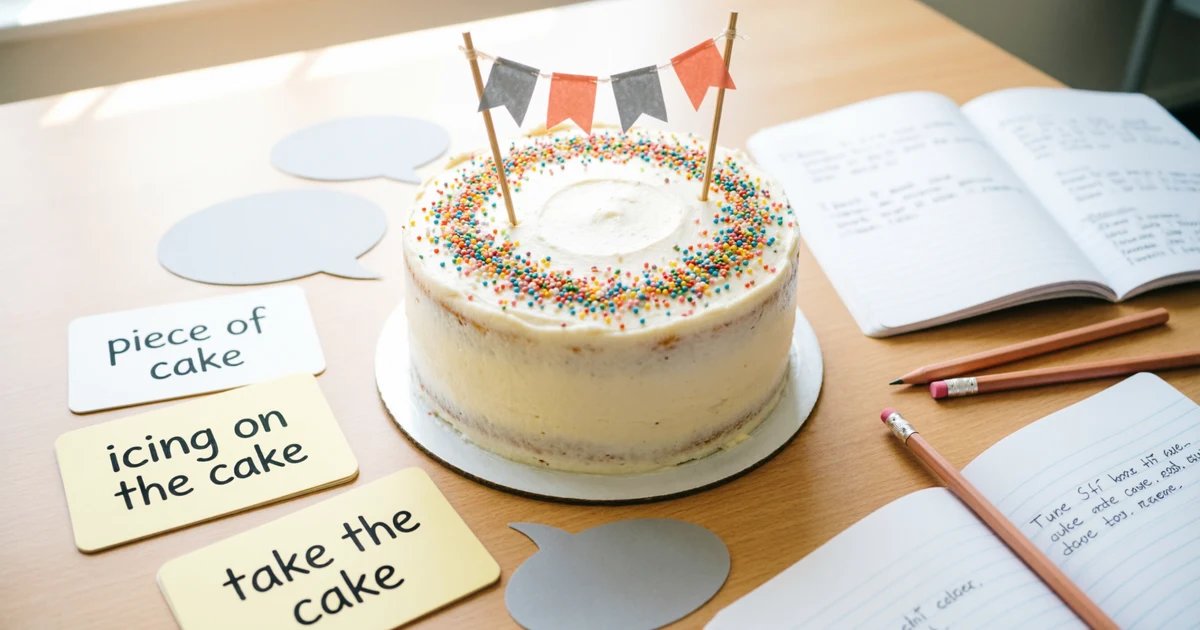
English speakers often use idioms for cake when talking about ease, success, rewards, unfair advantages, popularity, or wanting two conflicting benefits at once. Expressions such as “a piece of cake,” “the icing on the cake,” and “have your cake and eat it too” rarely refer to actual food.
This can confuse students and ESL learners. A sentence may include the word cake, but its meaning may have nothing to do with baking or eating. For example, “The exam was a piece of cake” means the exam was easy. It does not mean someone received cake during the test.
The main difference is simple:
Cake idioms use cake-related words figuratively, while literal cake expressions describe real cakes, ingredients, baking, serving, or eating.
This article explains how both types of expressions work, where they overlap, and how to use common cake idioms naturally and correctly.
What Cake Idioms Mean
A cake idiom is a fixed or commonly recognized expression that contains a cake-related word but communicates a figurative meaning.
The reader or listener usually cannot understand the intended message by interpreting every word literally.
For example:
The final assignment was a piece of cake.
This sentence means that the assignment was very easy. It does not mean the assignment was a physical slice of cake.
Purpose of cake idioms
Cake idioms help speakers express ideas in a colorful, memorable, and conversational way. They can describe:
- Something easy
- An extra benefit
- A popular product
- An outstanding example
- An unrealistic desire
- An easy victory
- A comfortable or enjoyable life
How cake idioms work
A cake idiom connects a familiar image with an unrelated idea. Cake often represents pleasure, reward, ease, or something desirable. English speakers use those associations to communicate a broader meaning.
Short example
Getting free delivery was the icing on the cake.
The speaker already liked the purchase, and free delivery made it even better.
Why cake idioms cause confusion
Learners sometimes interpret the words literally because the expressions contain familiar food vocabulary. The real meaning, however, comes from the complete phrase rather than the individual words.
What Literal Cake Expressions Mean
A literal cake expression describes an actual cake, a baking process, an ingredient, a flavour, a decoration, or an action involving cake.
For example:
She added chocolate icing to the cake.
Here, icing and cake refer to real food. The sentence does not carry a hidden figurative message.
Purpose of literal cake expressions
Literal cake language helps people communicate clearly about:
- Recipes
- Ingredients
- Baking instructions
- Cake decorations
- Flavours and textures
- Serving sizes
- Parties and celebrations
How literal cake expressions work
The words keep their ordinary dictionary meanings. A reader can understand the sentence directly without needing cultural knowledge or figurative interpretation.
Short example
He cut the birthday cake into twelve pieces.
The sentence describes a real action involving a physical cake.
Why literal expressions get confused with idioms
Many cake idioms use words that also appear in normal baking conversations. Phrases such as piece of cake and icing on the cake can be either literal or figurative depending on context.
Cake Idioms vs Literal Cake Expressions: The Core Difference
The core difference lies in meaning.
A literal expression refers directly to food:
I ate a piece of cake after dinner.
A cake idiom communicates another idea:
Fixing the loose handle was a piece of cake.
In the first sentence, piece of cake means an actual serving of cake. In the second, it means an easy task.
Cake idioms are therefore figurative and context-dependent. Literal cake expressions are direct and usually easy to interpret from the words alone.
Quick Comparison Table
| Point | Cake Idioms | Literal Cake Expressions |
|---|---|---|
| Definition | Fixed expressions with figurative meanings | Direct descriptions of real cake or baking |
| Scope | Emotions, difficulty, success, rewards, popularity and behaviour | Food, ingredients, preparation, decoration and serving |
| Purpose | To make communication vivid or expressive | To communicate factual information clearly |
| Length | Usually a short phrase or fixed expression | Can be a word, phrase, sentence or full recipe |
| Structure | Often follows a familiar wording that should not be changed much | Flexible wording based on the situation |
| Meaning | Different from the literal meanings of the individual words | Matches the ordinary meanings of the words |
| Use in writing | Dialogue, informal writing, articles, stories and speeches | Recipes, menus, instructions, reviews and descriptions |
| Example | “The interview was a piece of cake.” | “She ate a piece of cake.” |
How Cake Idioms Work
Cake idioms depend on shared cultural associations. Cake is often connected with celebrations, treats, pleasure, rewards, and desirable outcomes. These positive associations explain why cake appears in expressions about ease and added benefits.
Consider the expression:
That bonus was the icing on the cake.
A cake is already enjoyable, while icing adds sweetness and decoration. Figuratively, the idiom describes an additional advantage that improves an already positive situation.
Other cake expressions work differently. In “have your cake and eat it too,” the cake represents something a person wants to keep while also enjoying the benefit of using it. The phrase points to two desires that cannot logically exist together.
Because idioms develop through repeated use, their meanings may not follow perfect logic. Learners should study the full expression as one unit rather than translating it word by word.
How Literal Cake Expressions Work
Literal cake expressions follow normal vocabulary and grammar rules. Their meanings remain direct.
Examples include:
- Bake a cake
- Frost the cake
- Cut the cake
- A slice of chocolate cake
- A moist sponge cake
- Cake decorating tools
- A homemade birthday cake
Writers can change these phrases freely:
She baked a cake.
She baked a large vanilla cake.
She baked a large vanilla cake for her sister’s birthday.
The basic meaning remains literal in every version.
Idioms are less flexible. Changing their established wording may make them sound unnatural. English speakers say “a piece of cake,” not usually “a portion of cake,” when they mean something easy.
Key Differences in Simple Language
Cake idioms and literal cake expressions differ in several important ways.
Cake idioms have hidden meanings
The intended message goes beyond the words themselves.
Winning the first round was a piece of cake.
The sentence means winning was easy.
Literal cake expressions have direct meanings
The words describe exactly what happened.
She placed a piece of cake on my plate.
The sentence refers to real food.
Idioms often have fixed wording
Speakers usually repeat an established phrase in a familiar form.
For example, “the icing on the cake” sounds natural. Replacing it with “the frosting above the dessert” would destroy the idiomatic meaning.
Literal language allows more variation
A person can say icing, frosting, glaze, cream topping, or cake decoration, depending on the actual food.
Idioms depend heavily on context
The same phrase may be literal in one sentence and figurative in another.
I saved a piece of cake for you.
The grammar exercise was a piece of cake.
Context tells the reader which meaning applies.
Can Cake Idioms and Literal Cake Expressions Overlap?
Yes. Some expressions can function literally or idiomatically.
A piece of cake
Literal:
Ben ordered a piece of cake with his coffee.
Idiomatic:
Setting up the new printer was a piece of cake.
Icing on the cake
Literal:
The icing on the cake was made with butter and sugar.
Idiomatic:
The hotel upgraded our room, and the free breakfast was the icing on the cake.
Take the cake
Literal:
Please take the cake into the dining room.
Idiomatic:
I have heard some strange excuses, but that one takes the cake.
The idiomatic sentence means that the excuse was the most surprising, extreme, or remarkable example.
This overlap explains why context matters so much. Readers must consider the entire sentence rather than focusing only on the cake-related words.
Examples of Cake Idioms
1. A Piece of Cake
Meaning: Something very easy to do.
Example:
Once I understood the instructions, the task was a piece of cake.
When to use it: Use this informal idiom when a task requires little effort or causes no difficulty.
Common confusion: It can also describe an actual serving of cake, so context determines the meaning.
2. The Icing on the Cake
Meaning: An additional benefit that makes an already good situation even better.
Example:
She received the promotion she wanted, and the higher salary was the icing on the cake.
When to use it: Use it when something positive is added to an experience that was already satisfying.
Common confusion: In a baking context, the expression may simply refer to real icing.
3. Have Your Cake and Eat It Too
Meaning: To expect two desirable but incompatible outcomes.
Example:
You cannot spend all your savings and still expect to have your cake and eat it too.
A person who eats a cake can no longer keep the same cake. The idiom highlights an impossible or unreasonable expectation.
A common variation is:
You can’t have your cake and eat it too.
In British English, speakers may also say:
You can’t have your cake and eat it.
4. Take the Cake
Meaning: To be the most surprising, impressive, annoying, or extreme example.
Example:
All the delays were frustrating, but losing our reservation really took the cake.
The idiom can express admiration or criticism, although people often use it negatively.
5. Sell Like Hot Cakes
Meaning: To sell very quickly and in large numbers.
Example:
The concert tickets sold like hot cakes.
In American English, hotcakes commonly appears as one word, especially when referring to pancakes. The idiom is often written as either “sell like hotcakes” or “sell like hot cakes.”
6. A Cakewalk
Meaning: A very easy task, competition, or victory.
Example:
The experienced team expected the opening match to be a cakewalk.
The word comes from a historical dance competition. Today, speakers mainly use it to describe something easy.
Because the term has a specific cultural history connected with nineteenth-century American entertainment, writers discussing its origin should explain that history carefully rather than treating it as only a modern food metaphor.
7. Easy as Pie
Meaning: Extremely easy.
Example:
Using the basic editing tool is easy as pie.
Pie is not cake, but this expression often appears in discussions of cake and dessert idioms because it communicates the same idea as “a piece of cake.”
The more complete form is:
As easy as pie.
8. Cakes and Ale
Meaning: Enjoyment, pleasure, entertainment, or comfortable living.
Example:
He soon learned that life in the city was not all cakes and ale.
This expression sounds old-fashioned or literary. Modern speakers rarely use it in everyday conversation.
9. Nutty as a Fruitcake
Meaning: Very foolish, strange, or eccentric.
Example:
The character appears as nutty as a fruitcake, but he often gives sensible advice.
This informal expression can sound insulting when used about a real person. It is safer in fictional, humorous, or clearly playful contexts.
10. A Slice of the Cake
Meaning: A share of money, benefits, opportunities, or rewards.
Example:
Smaller companies also wanted a slice of the cake.
This expression is more common in British English. American English speakers are more likely to say “a piece of the pie.”
11. You Can’t Make a Cake Without Breaking Eggs
Meaning: A result may require sacrifice, effort, or an unavoidable cost.
Example:
The redesign caused temporary disruption, but you cannot make a cake without breaking eggs.
The better-known English expression is “You can’t make an omelette without breaking eggs.” The cake version is understandable, but it is not as established. Writers should prefer the omelette version unless the cake wording fits a deliberate joke or theme.
12. Want a Cake and a Penny Too
Meaning: To expect an extra benefit without accepting the normal cost.
This wording is rare, regional, or historical rather than a standard modern idiom. Learners may encounter similar expressions in older texts, but they should not treat them as common everyday English.
Examples of Literal Cake Expressions
Literal cake expressions appear in recipes, menus, instructions, reviews, and everyday conversations.
Bake a cake
We are going to bake a cake for Mia’s birthday.
Cut the cake
The couple cut the wedding cake after dinner.
A slice of cake
Would you like another slice of cake?
Frost a cake
Let the sponge cool before you frost the cake.
Decorate the cake
The children decorated the cake with fruit and sprinkles.
1-Cake batter
Pour the cake batter into a prepared pan.
2-Cake layer
Spread the filling evenly between each cake layer.
3-Cake crumbs
A few cake crumbs remained on the plate.
Homemade cake
They served homemade cake with tea.
Moist cake
The yoghurt keeps the cake soft and moist.
None of these expressions carries a necessary hidden meaning. They describe real food, ingredients, qualities, or actions.
Cake Idioms vs Literal Cake Expressions in Literature and Writing
Writers use cake idioms to make abstract ideas easier to picture. A familiar dessert can represent pleasure, simplicity, reward, abundance, or conflicting desires.
In dialogue, idioms can make a character sound natural:
“Don’t worry about the test,” Noah said. “It’ll be a piece of cake.”
In narration, an idiom can communicate attitude quickly:
The first challenge had been a cakewalk, but the second demanded all her attention.
Literal cake descriptions serve a different purpose. They can establish setting, create sensory detail, or reveal something about a character.
The warm chocolate cake filled the kitchen with the scent of cocoa and vanilla.
This sentence does not communicate an idiomatic meaning. Instead, it helps the reader imagine the scene.
Strong writers choose between idiomatic and literal language according to purpose. An idiom communicates an idea efficiently, while a literal description creates concrete detail.
Writers should also avoid overusing familiar cake idioms. Expressions such as “a piece of cake” and “icing on the cake” are clear, but they can feel predictable when repeated too often. In creative writing, a fresh description may have more impact.
Cake Idioms vs Literal Cake Expressions for Students and ESL Learners
Students and ESL learners can identify the difference by asking three questions.
1. Is the sentence really about food?
If the speaker is discussing baking, eating, serving, or buying cake, the phrase is probably literal.
I ordered a piece of cake.
This is literal.
2. Does the literal meaning make sense?
Consider this sentence:
Learning the first ten words was a piece of cake.
A person cannot literally describe vocabulary words as a piece of food. The phrase must therefore carry a figurative meaning.
3. Can the phrase be replaced with a simple idea?
Try replacing the expression:
Learning the first ten words was very easy.
Because the replacement preserves the meaning, “a piece of cake” functions as an idiom.
Learners should record idioms as complete phrases instead of separate vocabulary words. A useful note might look like this:
Idiom: a piece of cake
Meaning: very easy
Register: informal
Example: The quiz was a piece of cake.
This approach makes idioms easier to remember and use accurately.
Common Mistakes and Confusion
Interpreting every cake phrase as an idiom
Not every sentence containing cake has a figurative meaning.
She put icing on the cake.
Without additional context, this is a literal sentence.
Using “a piece of cake” in formal writing
The idiom is common and natural, but it sounds informal. In an academic report, words such as simple, straightforward, or easy to complete may suit the context better.
Informal:
The calculation was a piece of cake.
More formal:
The calculation was straightforward.
Saying “a slice of cake” to mean something easy
English speakers use “a piece of cake” idiomatically. Although a slice and a piece can describe the same food, “a slice of cake” does not normally mean an easy task.
Natural:
The assignment was a piece of cake.
Unnatural:
The assignment was a slice of cake.
Misusing “the icing on the cake”
This idiom usually describes an extra positive feature added to an already good situation.
Natural:
The holiday was wonderful, and the sunny weather was the icing on the cake.
Less natural:
The broken air conditioner was the icing on the cake.
People sometimes use the phrase sarcastically for an additional problem, but the negative meaning must be clear from context and tone.
Confusing “take the cake” with “piece of cake”
These idioms have different meanings.
- A piece of cake means very easy.
- Take the cake means to be the most remarkable or extreme example.
Compare:
The test was a piece of cake.
His excuse for missing the test really took the cake.
Mixing up “cakewalk” and “walk in the park”
Both expressions mean something easy.
The task was a cakewalk.
The task was a walk in the park.
However, cakewalk can also refer to a historical dance. Context remains important.
Using potentially insulting expressions carelessly
Expressions such as “nutty as a fruitcake” may offend someone because they question the person’s mental stability or judgement. Learners should use neutral alternatives when respect matters.
Safer alternatives include:
- Unusual
- Eccentric
- Unpredictable
- Silly
- Absurd
When to Use Cake Idioms and When to Use Literal Cake Expressions
Use cake idioms when you want to:
- Make informal speech more expressive
- Describe an easy task
- Highlight an additional benefit
- Discuss two incompatible desires
- Describe something that sells quickly
- Emphasize an extreme example
- Add humour or personality to dialogue
Use literal cake expressions when you want to:
- Explain a recipe
- Describe food
- Give baking instructions
- Review a cake
- Discuss a celebration
- Describe flavour, appearance, or texture
- Tell someone how to serve or store cake
The audience and setting also matter. Cake idioms work well in everyday conversations, blog posts, stories, speeches, and friendly messages. Literal and precise wording works better in recipes, technical instructions, school explanations, and formal reports.
Related Terms People Often Confuse With Them
Idiom
An idiom is an established expression whose full meaning differs from the ordinary meanings of its individual words.
Example:
The interview was a piece of cake.
Metaphor
A metaphor directly describes one thing as another to create a comparison.
Example:
The celebration was the icing on an unforgettable year.
This may resemble the idiom “icing on the cake,” but a writer can create a metaphor more freely. Idioms usually have recognized, conventional wording.
Simile
A simile compares two things using like or as.
Example:
The sponge was as light as a cloud.
This sentence describes the cake through comparison. It is not necessarily an idiom.
Proverb
A proverb is a traditional statement that expresses advice or a general truth.
Example:
You can’t have your cake and eat it too.
Many people classify this expression as both an idiom and a proverb because it has figurative wording and communicates a broader lesson about incompatible desires.
Collocation
A collocation is a group of words that commonly appear together.
Examples include:
- Bake a cake
- Birthday cake
- Cake batter
- Chocolate cake
- Slice of cake
These combinations sound natural, but they do not automatically have hidden meanings.
Cliché
A cliché is an expression that has become overly familiar through frequent use.
Some cake idioms may sound clichéd when writers use them repeatedly. “The icing on the cake” remains understandable, but a more original description may work better in creative prose.
Figurative language
Figurative language is the broader category that includes idioms, metaphors, similes, personification, symbolism, and other nonliteral techniques.
Cake idioms are one type of figurative language. Literal cake expressions are not figurative unless the writer gives them an additional symbolic meaning.
Conclusion
Cake idioms use familiar dessert imagery to express ideas about ease, pleasure, rewards, popularity, extreme examples, and conflicting desires. Literal cake expressions, by contrast, refer directly to real food, ingredients, baking, decorating, serving, or eating.
The easiest way to distinguish them is to examine the full context. In “I ate a piece of cake,” the phrase is literal. In “The test was a piece of cake,” it means the test was easy.
Common expressions such as “the icing on the cake,” “take the cake,” “sell like hotcakes,” and “have your cake and eat it too” can make English sound natural and expressive. Learners should study each idiom as a complete phrase, note its level of formality, and practise it in realistic sentences.
FAQs
What is the most common cake idiom?
“A piece of cake” is probably the most widely recognized cake idiom. It means that something is very easy to do.
What does “the icing on the cake” mean?
It means an extra benefit that improves an already positive situation. For example, a free upgrade may be the icing on the cake after receiving excellent service.
Is “piece of cake” always an idiom?
No. It is literal when it refers to real food and idiomatic when it means an easy task. Context reveals the intended meaning.
What does “have your cake and eat it too” mean?
It means wanting two desirable outcomes that cannot logically happen together. The expression often criticizes unrealistic expectations.
Is “easy as pie” the same as “a piece of cake”?
They have nearly the same figurative meaning. Both describe something very easy. However, “a piece of cake” works as a noun phrase, while “easy as pie” works as a comparison.
What does “take the cake” mean?
It means to be the most surprising, extreme, impressive, or annoying example. The expression may communicate praise, disbelief, or criticism depending on context.
Are cake idioms suitable for formal writing?
Most cake idioms sound informal or conversational. They may work in speeches, articles, stories, and friendly communication, but precise wording usually suits academic and professional documents better.