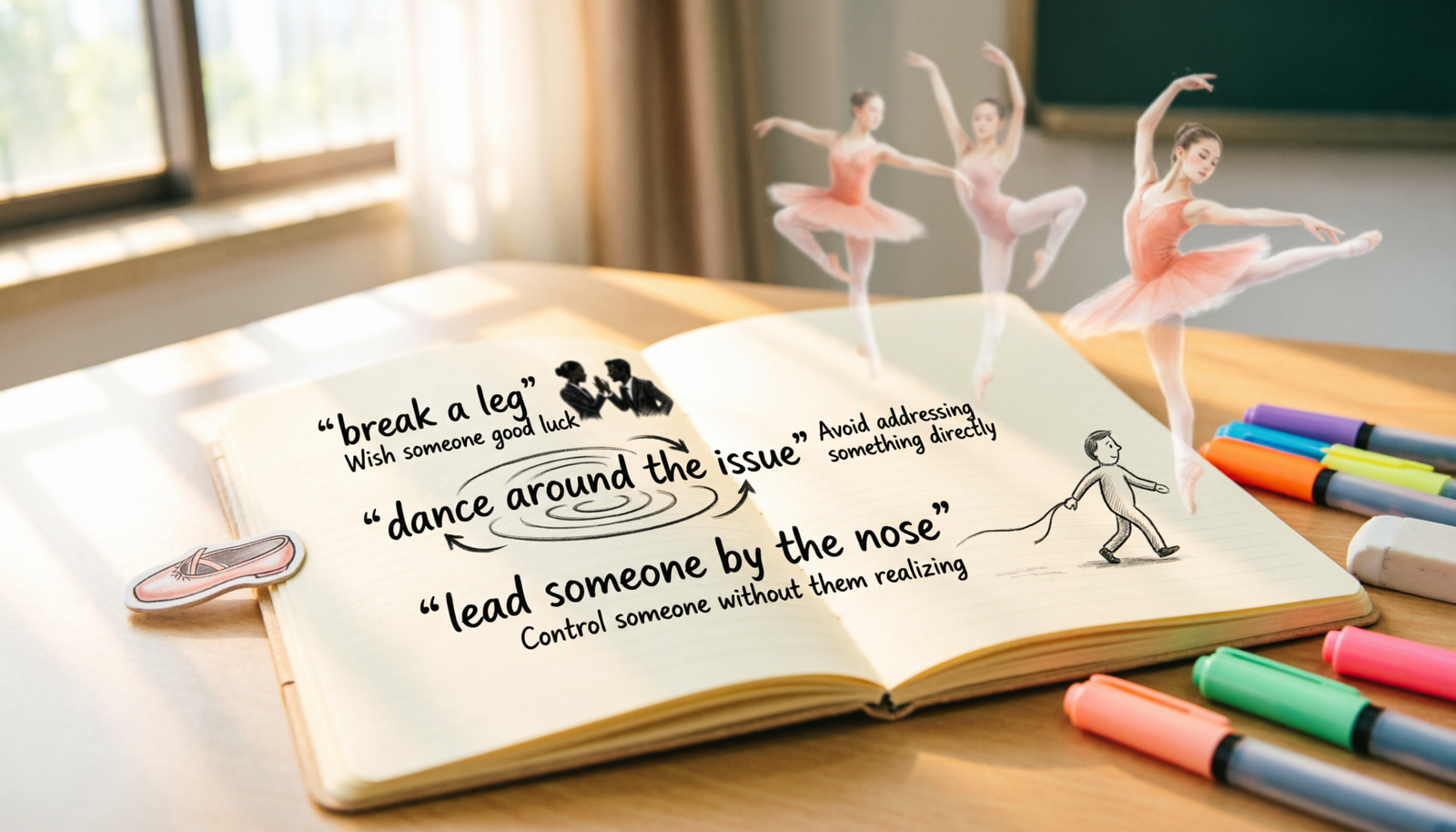
People often search for idioms for dance when they want expressive phrases for movement, rhythm, celebration, performance, confidence, or social situations. But while learning these phrases, another question often appears: are dance idioms the same as dance metaphors?
They are related, but they are not the same.
An idiom is a fixed expression with a meaning that you usually cannot understand word by word. A metaphor compares one thing to another without using “like” or “as.” Idioms are often common phrases in everyday language. Metaphors can be original, creative, poetic, or literary.
For example, “dance to someone’s tune” is an idiom. It means to do what someone else wants. “Her life was a dance of courage and fear” is a metaphor. It compares life to a dance to create a deeper image.
This guide explains idioms and metaphors through the theme of dance, so students, writers, and ESL learners can understand the difference clearly and use both with confidence.
What Idioms Mean
An idiom is a phrase whose meaning is different from the literal meaning of its words. Native speakers often use idioms naturally in conversation, writing, media, and storytelling.
The purpose of an idiom is to express an idea in a familiar, colorful, and often compact way. Idioms make language sound more natural, but they can confuse learners because the meaning is not always direct.
For example:
He had to dance to his manager’s tune.
This does not mean he literally danced. It means he had to follow his manager’s wishes or obey instructions.
Idioms get confused with metaphors because many idioms began as figurative comparisons. However, idioms usually have fixed wording and a widely understood meaning.
What Metaphors Mean
A metaphor is a figure of speech that describes one thing as another thing to show a similarity. It does not usually mean the words literally.
The purpose of a metaphor is to create a strong image, emotion, or idea. Writers use metaphors to make abstract thoughts easier to feel or understand.
For example:
Their friendship was a slow dance.
This does not mean the friendship was literally a dance. It suggests closeness, rhythm, patience, and emotional movement.
Metaphors get confused with idioms because both use non-literal language. The difference is that metaphors compare ideas, while idioms work as fixed expressions with accepted meanings.
Idioms vs Metaphors: The Core Difference
The core difference is simple: an idiom has a fixed meaning in common usage, while a metaphor creates meaning through comparison.
An idiom such as “dance to someone’s tune” already has a known meaning. You do not need to invent the meaning. English speakers understand it as “obey someone” or “act according to someone else’s wishes.”
A metaphor such as “confidence danced in her eyes” creates a fresh image. The writer compares confidence to dancing to show liveliness or joy.
So, an idiom is more like a ready-made phrase. A metaphor is more like a creative comparison.
Quick Comparison Table
| Point | Idiom | Metaphor |
|---|---|---|
| Definition | A fixed phrase with a non-literal meaning | A comparison that describes one thing as another |
| Scope | Narrower because it depends on common usage | Broader because writers can create new ones |
| Purpose | To express an idea naturally or colorfully | To create imagery, emotion, or deeper meaning |
| Length | Usually a short phrase | Can be short, extended, or thematic |
| Structure | Often fixed or semi-fixed | Flexible and creative |
| Meaning | Usually learned as a whole phrase | Understood through comparison |
| Use in writing | Good for natural speech, dialogue, and informal style | Good for creative writing, poetry, essays, and description |
| Example | “Dance to someone’s tune” | “The city was a dance of lights” |
How Idioms Work
Idioms work because a language community agrees on their meaning over time. The words may seem literal, but the real meaning comes from common usage.
Take this idiom:
Dance attendance on someone
This means to give someone a lot of attention, often too much. It sounds formal or old-fashioned, but it still appears in literary or advanced English contexts.
Idioms often carry cultural history. Some come from music, theater, dance, sports, work, or daily life. Once people repeat them often enough, they become part of the language.
With idioms for dance, the word “dance” often suggests control, movement, performance, rhythm, social pressure, or celebration. The meaning depends on the full phrase.
How Metaphors Work
Metaphors work by connecting two different ideas. They help readers understand one thing by seeing it through another thing.
For example:
The argument became a dangerous dance.
Here, the writer compares an argument to a dance. This suggests movement, tension, timing, and careful steps. The metaphor does not have one fixed dictionary-like meaning. Readers understand it through context.
Dance metaphors often suggest grace, rhythm, uncertainty, partnership, conflict, beauty, or balance. A writer can use dance as a metaphor for life, love, politics, teamwork, fear, ambition, or emotional change.
Key Differences in Simple Language
Idioms are usually phrases you learn. Metaphors are comparisons you understand.
An idiom often sounds natural because many people already use it. A metaphor may sound fresh because the writer creates it for a specific moment.
Idioms can feel conversational:
We danced around the issue all morning.
Metaphors can feel descriptive or poetic:
The truth moved through the room like music, and everyone joined its dance.
Idioms usually have a set meaning. Metaphors depend more on imagination and context.
Can Idioms and Metaphors Overlap?
Yes, idioms and metaphors can overlap.
Many idioms are metaphorical because they use an image to express an idea. For example:
Dance around the subject
This idiom means to avoid talking directly about something. It also works metaphorically because it imagines someone moving around a topic instead of facing it.
The overlap causes confusion. A phrase can be an idiom because people commonly use it with a fixed meaning. At the same time, it may contain a metaphor because it uses an image.
The safest way to decide is to ask this: Is this a common fixed phrase, or is the writer creating a comparison?
If it is a common fixed phrase, treat it as an idiom. If it creates a fresh comparison, treat it as a metaphor.
Examples of Idioms for Dance
Here are useful dance idioms with simple meanings and natural examples.
Dance to Someone’s Tune
Meaning: To do what another person wants or controls.
Example:
The team felt they had to dance to the client’s tune to keep the contract.
Dance Around the Issue
Meaning: To avoid discussing something directly.
Example:
Stop dancing around the issue and tell me what happened.
It Takes Two to Tango
Meaning: Two people share responsibility for a situation, especially a conflict or relationship.
Example:
You cannot blame only one side. It takes two to tango.
Lead Someone a Merry Dance
Meaning: To cause someone trouble, confusion, or difficulty by making them follow you around.
Example:
The missing documents led the whole office a merry dance.
Dance Attendance on Someone
Meaning: To give someone too much attention or service.
Example:
The assistants had to dance attendance on the visiting director all day.
Make a Song and Dance About Something
Meaning: To make something seem more dramatic or important than necessary.
Example:
He made a song and dance about a tiny mistake.
Dance with Death
Meaning: To face extreme danger.
Example:
The rescue workers danced with death during the storm.
Dance the Night Away
Meaning: To spend the night dancing happily.
Example:
They danced the night away at the wedding.
Examples of Metaphors for Dance
These are not fixed idioms. They use dance as a creative comparison.
Life Was a Dance
Meaning: Life moves through rhythm, change, balance, and uncertainty.
Example:
For her, life was a dance between duty and desire.
The City Danced at Night
Meaning: The city seemed lively, bright, and full of movement.
Example:
After sunset, the city danced with lights and voices.
His Words Danced Across the Page
Meaning: His writing felt lively, graceful, or energetic.
Example:
His words danced across the page with rare confidence.
Their Silence Was a Slow Dance
Meaning: Their silence felt careful, emotional, and connected.
Example:
Across the table, their silence was a slow dance of regret.
Fear Danced in Her Chest
Meaning: Fear moved inside her in a nervous or restless way.
Example:
As she stepped on stage, fear danced in her chest.
The Flames Danced in the Dark
Meaning: The flames moved like dancers.
Example:
The flames danced in the dark while the campers told stories.
Idioms vs Metaphors in Literature and Writing
In literature, idioms and metaphors serve different purposes.
Writers use idioms to make dialogue sound natural, reveal a character’s background, or create a familiar tone. A character who says “stop dancing around the issue” sounds direct and conversational.
Writers use metaphors to create imagery and emotional depth. A line like “their marriage was a dance of silence and forgiveness” does more than describe a relationship. It gives the reader a feeling.
Idioms can weaken formal writing if they sound too casual or overused. Metaphors can weaken writing if they feel forced, confusing, or mixed with unrelated images.
Good writers choose based on purpose. Use an idiom when you want natural expression. Use a metaphor when you want a vivid image or deeper meaning.
Idioms vs Metaphors for Students and ESL Learners
Students and ESL learners often struggle with idioms because the literal words do not explain the meaning.
For example, “it takes two to tango” may confuse a learner who only knows tango as a dance. The phrase actually means that two people share responsibility.
Metaphors can also confuse learners, but they usually offer more clues through context. If someone writes “her thoughts danced like shadows,” readers can imagine movement, uncertainty, or restlessness.
A helpful learning rule is this:
Learn idioms as complete phrases. Understand metaphors as comparisons.
When you study idioms for dance, do not translate each word directly. Learn the phrase, meaning, and situation together.
Common Mistakes and Confusion
One common mistake is treating every phrase with “dance” as an idiom. Some are literal.
They danced at the party is not an idiom. It means people actually danced.
Another mistake is calling every figurative phrase a metaphor. “It takes two to tango” is figurative, but it is mainly an idiom because English speakers use it as a fixed expression.
Writers also sometimes mix metaphors in confusing ways. For example:
The project was a dance, a battlefield, and a sinking ship.
This sentence throws too many images at the reader. Choose one strong image and develop it clearly.
ESL learners may also overuse idioms in formal writing. Idioms can sound natural, but too many can make writing seem casual or unclear.
When to Use Idioms and When to Use Metaphors
Use idioms when you want your English to sound natural, conversational, or familiar.
Good places for idioms include:
classroom discussions, dialogue, blog writing, personal essays, casual emails, speeches, and storytelling.
Example:
The speaker kept dancing around the question.
Use metaphors when you want to create a strong picture or emotional effect.
Good places for metaphors include:
creative writing, poetry, speeches, literary essays, descriptive paragraphs, and reflective writing.
Example:
Her dreams danced just beyond reach.
For clear academic writing, use both carefully. An idiom may help explain an idea quickly, but a metaphor may add depth if it fits the topic.
Related Terms People Often Confuse with Idioms and Metaphors
Simile
A simile compares two things using “like” or “as.”
Example:
She moved like a dancer.
This is not a metaphor because it uses “like.”
Figurative Language
Figurative language is the broad category. It includes idioms, metaphors, similes, personification, hyperbole, and more.
Idioms and metaphors both belong under figurative language.
Personification
Personification gives human actions or qualities to non-human things.
Example:
The leaves danced in the wind.
This gives leaves a human-like action.
Symbolism
Symbolism uses an object, action, or image to represent a deeper idea.
Example:
A dance in a story may symbolize freedom, romance, rebellion, or unity.
Cliché
A cliché is an overused expression.
Some idioms can become clichés if writers use them too often without freshness.
Conclusion
Idioms and metaphors both make language more expressive, but they work in different ways. An idiom is a fixed phrase with a commonly understood meaning. A metaphor compares one thing to another to create meaning, imagery, or emotion.
When you study idioms for dance, remember that many phrases with “dance” do not refer to literal dancing. “Dance around the issue” means avoid the real topic. “Dance to someone’s tune” means follow someone else’s control. These are idioms because they have accepted meanings.
A dance metaphor, on the other hand, uses dance as an image. “Life was a dance” or “fear danced in her chest” creates a picture in the reader’s mind.
For students and ESL learners, the best approach is simple: learn idioms as whole expressions, and read metaphors as creative comparisons. For writers, idioms add natural style, while metaphors add depth and imagination.
FAQs
What are idioms for dance?
Idioms for dance are fixed English expressions that use dance-related words but often mean something non-literal. Examples include “dance around the issue,” “dance to someone’s tune,” and “it takes two to tango.”
Is “dance around the issue” an idiom or a metaphor?
It is mainly an idiom because it has a common fixed meaning: to avoid talking directly about something. It also contains a metaphorical image because it imagines someone moving around a topic.
What is the difference between a dance idiom and a dance metaphor?
A dance idiom has a known meaning in everyday English. A dance metaphor uses dance as a comparison to describe another idea, feeling, or situation.
Is “life is a dance” an idiom?
No. “Life is a dance” is a metaphor. It compares life to a dance to suggest rhythm, movement, balance, or change.
Are idioms good for ESL learners?
Yes, but ESL learners should learn idioms as full phrases, not word by word. Idioms often make little sense when translated literally.
Can I use dance idioms in formal writing?
You can use them, but choose carefully. Some idioms sound conversational or informal. In formal essays, use idioms only when they make your point clearer.
What is the most common dance idiom?
One very common dance-related idiom is “it takes two to tango.” People use it to say that two people share responsibility for a situation.