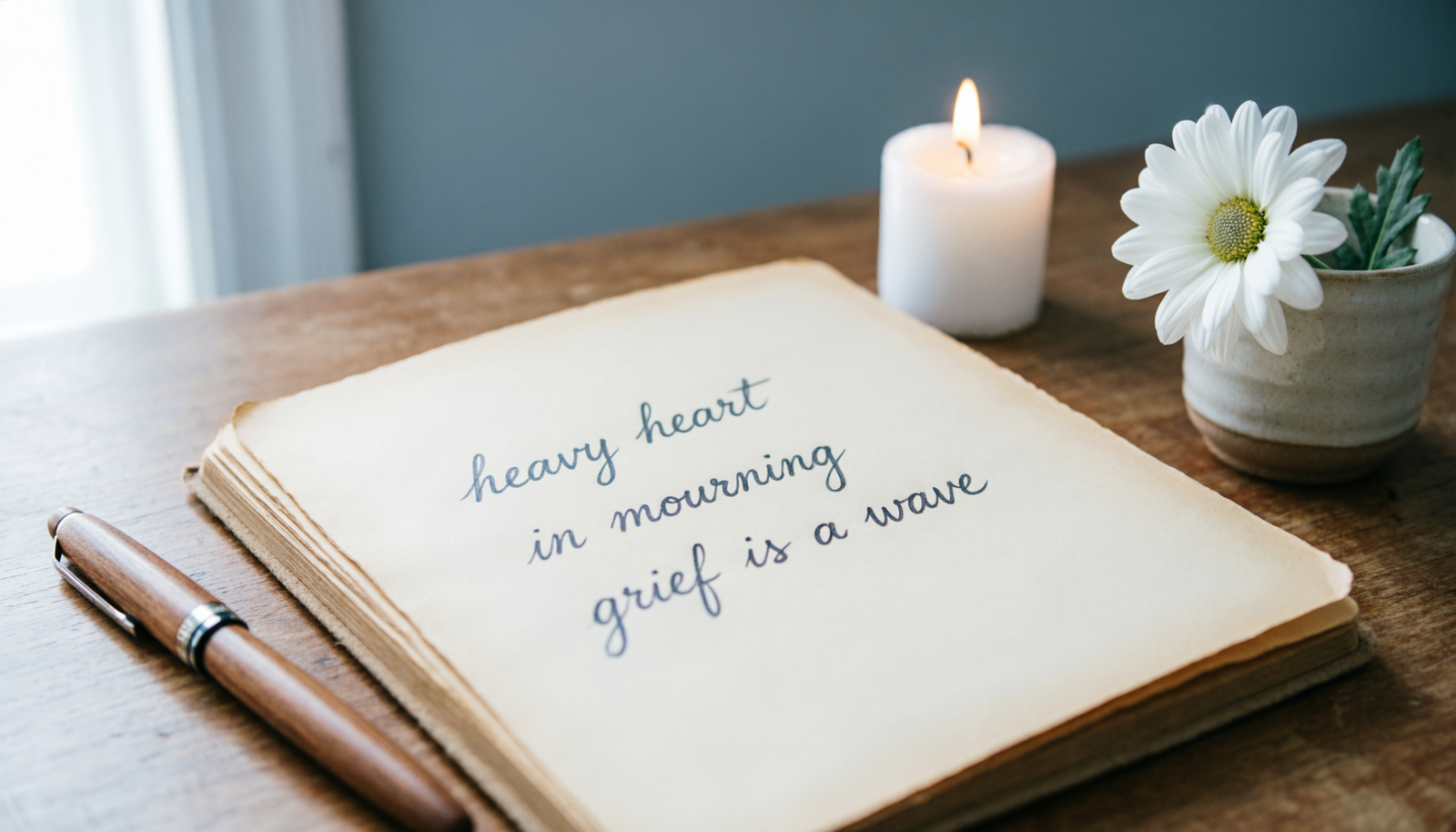
Grief is one of the hardest emotions to describe directly. When people lose someone, feel deep sadness, or go through emotional pain, plain words often feel too small. That is why English uses many idioms for grief and metaphors for grief.
These two terms often appear together because both use figurative language. However, they do not work in exactly the same way.
An idiom for grief is a fixed expression that people commonly use to talk about sadness, loss, or mourning. A metaphor for grief compares grief to something else, such as a storm, a wound, a shadow, or a heavy weight.
The simple difference is this: an idiom is a common phrase with a meaning you learn as a whole, while a metaphor is a comparison that helps readers imagine or feel grief more deeply.
For students, writers, and ESL learners, this difference matters. Idioms help you sound natural in everyday English. Metaphors help you write with emotion, imagery, and depth.
What Idioms for Grief Mean
An idiom for grief is a familiar phrase whose meaning is not always clear from the individual words. Native speakers understand the expression because they have heard it used in real conversations, stories, films, and books.
For example, “to be heartbroken” does not mean someone’s physical heart has broken. It means they feel deep emotional pain.
Simple definition
An idiom for grief is a common expression that describes sadness, loss, mourning, or emotional suffering in a fixed way.
Purpose
Idioms help people talk about grief naturally and briefly. They often soften painful topics or express strong feelings without long explanation.
How it works
An idiom works as a set phrase. You usually cannot change its words too much without making it sound strange.
Short natural example
After her father died, she was heartbroken.
Why idioms get confused with metaphors
Many grief idioms began as metaphors. For example, “carry a heavy heart” connects sadness with physical weight. Over time, expressions like this became familiar idioms.
What Metaphors for Grief Mean
A metaphor for grief describes grief by comparing it to something else without using “like” or “as.” It helps readers picture an invisible feeling through a concrete image.
For example, “Grief was a shadow that followed him everywhere” compares grief to a shadow. The sentence does not mean grief is literally a shadow. It means grief feels constant, dark, and hard to escape.
Simple definition
A metaphor for grief is a figurative comparison that shows what grief feels like through another image or idea.
Purpose
Metaphors help writers make grief more vivid, emotional, and memorable.
How it works
A metaphor transfers meaning from one thing to another. It gives grief the qualities of something readers can imagine, such as a storm, ocean, wound, prison, fog, or weight.
Short natural example
Grief became a fog around her days.
Why metaphors get confused with idioms
Some metaphors become popular and turn into common phrases. When a metaphor becomes fixed and widely used, it may also function like an idiom.
Idioms for Grief vs Metaphors for Grief: The Core Difference
The core difference is fixed meaning vs creative comparison.
An idiom for grief has a commonly accepted meaning. You learn it as a phrase. For example, “in mourning” means grieving after a loss. The phrase already belongs to everyday English.
A metaphor for grief creates or uses a comparison. It may be familiar, but it does not need to be a fixed phrase. For example, “Grief was an ocean inside him” compares grief to the ocean to suggest depth, movement, and emotional force.
So, idioms are usually more practical and conversational. Metaphors are usually more descriptive and literary.
Quick Comparison Table
| Point | Idioms for Grief | Metaphors for Grief |
|---|---|---|
| Definition | Common expressions about sadness, loss, or mourning | Comparisons that describe grief through another image |
| Scope | Narrower because idioms are fixed phrases | Broader because metaphors can be original or familiar |
| Purpose | To express grief naturally and quickly | To make grief vivid, emotional, and imaginative |
| Length | Usually short phrases | Can be a phrase, sentence, paragraph, or repeated image |
| Structure | Fixed or semi-fixed wording | Flexible comparison |
| Meaning | Often understood as a whole phrase | Understood through comparison |
| Use in writing | Good for dialogue, essays, explanations, and natural expression | Good for poetry, fiction, memoir, speeches, and emotional description |
| Example | “She was heartbroken.” | “Grief was a stone in her chest.” |
How Idioms for Grief Work
Idioms work because speakers share their meanings. You do not need to explain every word. When someone says “I’m still grieving” or “He passed away,” listeners understand the emotional meaning immediately.
Many idioms for grief use body, heart, weight, and loss imagery. These ideas feel natural because grief affects both emotions and the body. People often feel grief as tiredness, heaviness, emptiness, or pain.
Common grief idioms include:
- Heartbroken
- A heavy heart
- In mourning
- Come to terms with
- Gone too soon
- Pay respects
- Rest in peace
- Lose someone
- Break down
- Hold back tears
Idioms often make grief easier to talk about in social situations. Instead of saying something long or emotionally intense, people may say, “I’m sorry for your loss.” That phrase sounds respectful, familiar, and appropriate.
How Metaphors for Grief Work
Metaphors work by giving grief a shape. Since grief has no physical form, writers often compare it to something readers can see, touch, or feel.
For example:
- Grief is a wave.
- Grief is a wound that reopens.
- Grief is a room with no door.
- Grief is a winter that stays too long.
- Grief is a weight no one else can see.
Each metaphor highlights a different part of grief. A wave suggests grief comes and goes. A wound suggests pain and healing. Winter suggests coldness, loneliness, and time. A weight suggests emotional burden.
Strong metaphors do more than decorate writing. They help readers understand emotion through experience.
Key Differences in Simple Language
Idioms and metaphors can both describe grief, but they serve different needs.
An idiom gives you a ready-made phrase. It helps you sound natural.
A metaphor gives you an image. It helps you sound expressive.
An idiom usually belongs to everyday language. A metaphor can feel more personal, poetic, or creative.
An idiom often has a fixed meaning. A metaphor may have layers of meaning.
An idiom is usually shorter. A metaphor can grow across a whole paragraph, poem, or story.
Can Idioms for Grief and Metaphors for Grief Overlap?
Yes, idioms and metaphors can overlap.
Many idioms started as metaphors. For example, “a heavy heart” compares sadness to physical heaviness. That is metaphorical. But because English speakers use it as a fixed expression, it also works as an idiom.
Another example is “brokenhearted.” It compares emotional pain to a broken heart. Literally, the heart is not broken. Figuratively, the person feels deep pain. Since the word is common and widely understood, it functions like an idiomatic expression too.
The easiest way to decide is to ask:
Is it a fixed, common phrase?
Then it is probably an idiom.
Is it mainly creating a comparison or image?
Then it is probably a metaphor.
Some expressions can be both.
Examples of Idioms for Grief
Here are common idioms for grief with simple meanings and examples.
1. Heartbroken
Meaning: Extremely sad, usually because of loss, death, or emotional pain.
Example:
She was heartbroken after losing her grandmother.
2. A heavy heart
Meaning: Deep sadness or emotional weight.
Example:
With a heavy heart, he said goodbye to his old home.
3. In mourning
Meaning: Grieving after someone has died.
Example:
The family was in mourning after the sudden loss.
4. Come to terms with
Meaning: Slowly accept a painful reality.
Example:
It took him years to come to terms with his brother’s death.
5. Hold back tears
Meaning: Try not to cry.
Example:
She held back tears during the funeral.
6. Break down
Meaning: Lose emotional control and start crying or reacting strongly.
Example:
He broke down when he saw the old photographs.
7. Gone too soon
Meaning: Someone died earlier than expected or before their time.
Example:
Everyone said she was gone too soon.
8. Pay respects
Meaning: Show honor or sympathy after someone has died.
Example:
Friends came to pay their respects to the family.
9. Rest in peace
Meaning: A respectful phrase used for someone who has died.
Example:
Rest in peace, dear friend.
10. Sorry for your loss
Meaning: A polite expression of sympathy.
Example:
I’m so sorry for your loss.
Examples of Metaphors for Grief
Here are metaphors for grief with meanings and examples.
1. Grief is a wave
Meaning: Grief comes suddenly, rises strongly, then may fade for a while.
Example:
Grief was a wave that knocked her down without warning.
2. Grief is a wound
Meaning: Grief hurts deeply and may take time to heal.
Example:
His grief was a wound that opened every December.
3. Grief is a shadow
Meaning: Grief follows someone quietly and constantly.
Example:
After the accident, grief became a shadow at his side.
4. Grief is a weight
Meaning: Grief feels heavy and difficult to carry.
Example:
She carried grief like a stone in her chest.
5. Grief is an ocean
Meaning: Grief feels deep, powerful, and overwhelming.
Example:
He stood inside an ocean of grief and could not find the shore.
6. Grief is a locked room
Meaning: Grief can make someone feel trapped or isolated.
Example:
Her grief was a locked room no one else could enter.
7. Grief is winter
Meaning: Grief feels cold, still, lonely, and long-lasting.
Example:
After his mother died, winter settled inside him.
8. Grief is an echo
Meaning: Grief repeats memories and emotions from the past.
Example:
Every song became an echo of her absence.
Idioms for Grief vs Metaphors for Grief in Literature and Writing
Writers use idioms and metaphors differently.
Idioms make dialogue sound natural. A character might say, “I’m sorry for your loss,” because that is what real people often say. Idioms also help essays and personal reflections sound clear and familiar.
Metaphors create emotional depth. A novelist might write, “Grief moved through the house like weather,” to show how sadness affects the whole atmosphere of a scene.
In literature, metaphors often reveal a character’s inner world. Two characters may experience the same loss but describe it differently. One may feel grief as a storm. Another may feel it as silence. Those metaphors show personality, memory, and emotional state.
Idioms usually communicate grief directly. Metaphors explore it.
Idioms for Grief vs Metaphors for Grief for Students and ESL Learners
For ESL learners, idioms can be difficult because the meaning often does not match the literal words. If someone says “She has a heavy heart,” a learner may imagine a physical heart. The real meaning is emotional sadness.
The best way to learn idioms is to study them in context. Memorize the full phrase, its meaning, and the situation where people use it.
Metaphors can also challenge learners, but they work differently. With metaphors, you should look for the comparison. Ask yourself: What two things are being connected? What qualities transfer from one to the other?
For example, in “Grief is a storm,” grief connects with storm qualities: force, darkness, movement, danger, and lack of control.
Students should remember this simple rule:
Use idioms when you want natural English.
Use metaphors when you want powerful description.
Common Mistakes and Confusion
Mistake 1: Taking idioms literally
If someone says “He was brokenhearted,” they do not mean his heart physically broke. The phrase means he felt deep sadness.
Mistake 2: Calling every emotional phrase a metaphor
Not every phrase about grief is a metaphor. “In mourning” is an expression, but it does not create a strong comparison in the same way “grief is a shadow” does.
Mistake 3: Changing idioms too much
Idioms often sound wrong if you change their wording. For example, “a heavy heart” sounds natural, but “a weighty heart” does not sound like the usual idiom.
Mistake 4: Using dramatic metaphors in formal situations
A metaphor like “grief was a black ocean swallowing me” may work in poetry or memoir. It may sound too intense in a formal sympathy message.
Mistake 5: Using idioms without understanding tone
Some grief expressions fit serious situations. Others may sound too casual. For example, “break down” can describe strong emotion, but it may not fit a formal condolence note.
When to Use Idioms and When to Use Metaphors
Use idioms for grief when you want clear, natural, familiar English.
They work well in:
- Everyday conversations
- Sympathy messages
- Dialogue
- Personal essays
- ESL speaking and writing practice
- Simple explanations
Examples:
I’m sorry for your loss.
She was heartbroken.
He is still coming to terms with it.
Use metaphors for grief when you want imagery, emotion, and deeper meaning.
They work well in:
- Poetry
- Fiction
- Creative nonfiction
- Memoirs
- Speeches
- Literary analysis
- Descriptive writing
Examples:
Grief was a river running under every ordinary day.
His sadness became a house with all the lights turned off.
She carried loss like winter in her bones.
A good writer can use both. An idiom may keep a sentence natural, while a metaphor may make the emotion unforgettable.
Related Terms People Often Confuse With Idioms and Metaphors
Simile
A simile compares two things using “like” or “as.”
Example:
Grief came over him like a wave.
This is close to a metaphor, but the comparison uses “like.”
Symbol
A symbol is an object, person, place, or image that represents a larger idea.
Example:
A wilting flower may symbolize grief, death, or fading hope.
Euphemism
A euphemism softens a painful or uncomfortable idea.
Example:
“Passed away” is a softer way to say “died.”
Personification
Personification gives human qualities to non-human things.
Example:
Grief sat beside her in the quiet room.
Theme
A theme is the larger message or idea in a text.
Example:
A novel may have grief as one of its major themes.
Motif
A motif is a repeated image, phrase, or idea.
Example:
Repeated images of rain may create a grief motif in a story.
Conclusion
Idioms for grief and metaphors for grief both help people express deep sadness, but they do different jobs.
An idiom is a common expression with a learned meaning. It helps you sound natural and clear. A metaphor is a comparison that creates an image. It helps you make grief more emotional, vivid, and memorable.
The two can overlap because many idioms began as metaphors. Still, the main difference remains simple: idioms are fixed expressions, while metaphors are meaningful comparisons.
For students and ESL learners, idioms build natural fluency. For writers, metaphors build emotional power. When you understand both, you can talk about grief with more care, accuracy, and feeling.
FAQs
1. What are idioms for grief?
Idioms for grief are common English expressions used to describe sadness, loss, mourning, or emotional pain. Examples include heartbroken, a heavy heart, in mourning, and sorry for your loss.
2. What is a metaphor for grief?
A metaphor for grief compares grief to something else, such as a storm, shadow, wound, ocean, or weight. For example, “Grief was a shadow that followed her everywhere” is a metaphor.
3. What is the difference between an idiom and a metaphor?
An idiom is a fixed phrase with a commonly understood meaning. A metaphor is a comparison that describes one thing as another. Idioms often sound natural in conversation, while metaphors often create stronger imagery in writing.
4. Can an idiom also be a metaphor?
Yes. Some idioms are metaphorical. For example, “a heavy heart” is an idiom because it is a common phrase, but it also works metaphorically because it compares sadness to physical weight.
5. Are idioms for grief useful for ESL learners?
Yes. Idioms for grief help ESL learners understand real English conversations, books, films, and sympathy messages. Learners should study the full phrase, meaning, tone, and context.
6. Should I use idioms or metaphors in formal writing?
Use idioms when you need clear and natural language. Use metaphors when you need emotional description or literary style. In formal condolence writing, simple idioms often work better than dramatic metaphors.
7. What is a good grief metaphor for writing?
A strong grief metaphor depends on the feeling you want to show. “Grief is a wave” suggests sudden emotion. “Grief is a wound” suggests pain and healing, “Grief is a shadow” suggests sadness that stays nearby.