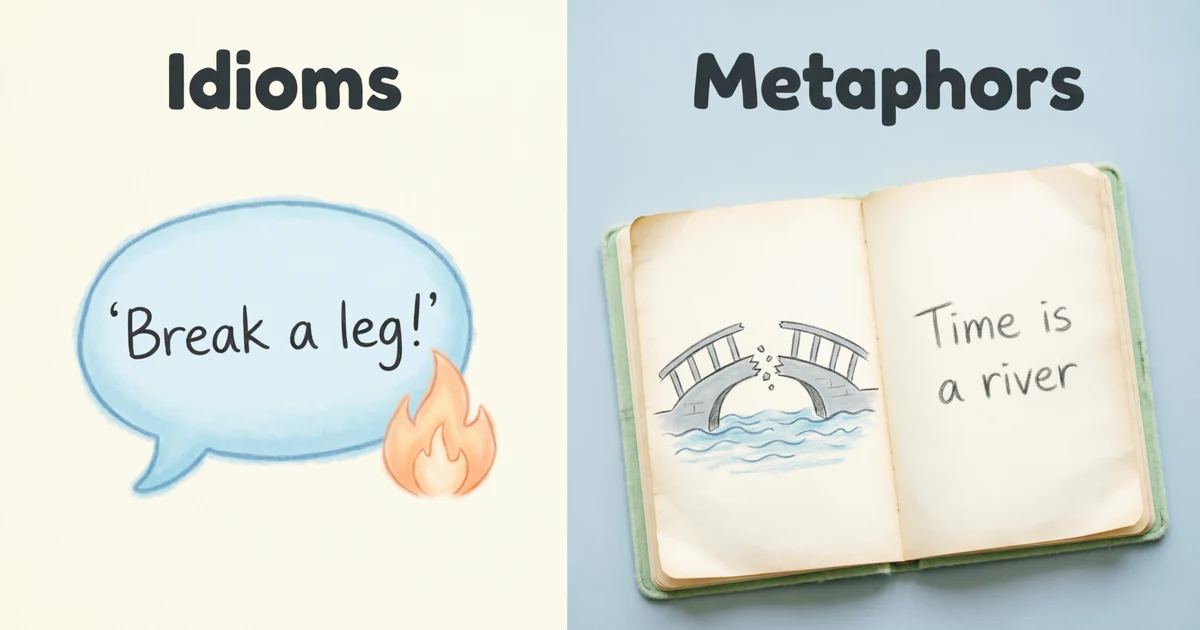
English has many ways to describe hate, dislike, anger, resentment, and strong emotional distance. Some expressions sound direct, such as “I hate it.” Others sound more colorful, such as “I can’t stand it,” “it makes my blood boil,” or “there is bad blood between them.”
This is where learners often get confused. Are these expressions idioms? Are they metaphors? Can one phrase be both?
The quick answer is this: an idiom is a fixed expression whose meaning is different from the literal words, while a metaphor compares one thing to another to create a strong image or idea. Some idioms about hate also use metaphorical language, so the two can overlap.
For example, “I can’t stand him” is an idiom because it does not literally mean you cannot physically stand near someone. It means you strongly dislike him. “Her hatred was a fire inside her” is a metaphor because it compares hatred to fire.
This article explains idioms for hate, metaphors for hate, their differences, their overlap, and how students, writers, and ESL learners can use them correctly.
What Idioms Mean
An idiom is a common expression with a meaning that you usually cannot understand by translating each word separately.
In the context of hate or dislike, idioms help people express strong feelings in a natural, conversational way.
Simple definition:
An idiom is a fixed phrase that means something different from its literal words.
Purpose:
Idioms make speech sound natural, fluent, and familiar.
How it works:
The phrase has a commonly accepted meaning. Native speakers understand it as a whole expression, not word by word.
Short natural example:
“I can’t stand that noise.”
This means the speaker strongly dislikes the noise, not that they cannot physically stand up.
Why idioms get confused with metaphors:
Many idioms use image-based language. For example, “bad blood” creates a mental picture, but people use it as a fixed phrase meaning anger, hostility, or resentment between people.
What Metaphors Mean
A metaphor is a figure of speech that describes one thing as if it were another thing. It does not use “like” or “as.” Instead, it creates a direct comparison.
When writers use metaphors for hate, they often show how hate feels, grows, spreads, or damages people.
Simple definition:
A metaphor describes something by saying it is something else.
Purpose:
Metaphors create vivid images, deeper emotion, and stronger meaning.
How it works:
A writer connects two different ideas. The comparison helps readers understand the feeling more clearly.
Short natural example:
“His hatred was a poison in the room.”
This does not mean hatred is literal poison. It means the hatred feels harmful, toxic, and dangerous.
Why metaphors get confused with idioms:
Some idioms began as metaphors. For example, “makes my blood boil” uses a physical image to describe anger or hatred. Because people repeat it as a set phrase, it works as an idiom too.
Idioms vs Metaphors: The Core Difference
The core difference is simple: idioms depend on fixed meaning, while metaphors depend on comparison.
An idiom works because people already know what the expression means. A metaphor works because it creates a meaningful connection between two ideas.
For example:
“I can’t stand her” is an idiom.
It means “I strongly dislike her.”
“Hatred was a storm in his chest” is a metaphor.
It compares hatred to a storm to show emotional violence and unrest.
Idioms are usually more common in everyday speech. Metaphors are more flexible and often appear in poetry, fiction, speeches, and descriptive writing.
Quick Comparison Table
| Point | Idioms for Hate | Metaphors for Hate |
|---|---|---|
| Definition | Fixed expressions with non-literal meanings | Direct comparisons between hate and something else |
| Scope | Usually narrower and phrase-based | Broader and more flexible |
| Purpose | To sound natural and fluent | To create imagery, emotion, and depth |
| Length | Often short phrases | Can be short or extended |
| Structure | Usually fixed wording | More open and creative |
| Meaning | Learned as a complete expression | Understood through comparison |
| Use in writing | Good for dialogue, essays, informal writing, and natural expression | Good for creative writing, analysis, speeches, and literature |
| Example | “I can’t stand him.” | “Hate was a fire eating through him.” |
How Idioms Work
Idioms work through shared meaning. People in a language community use the same phrase often enough that it develops a meaning beyond the literal words.
Take the idiom “to have bad blood.” Literally, it sounds like a medical problem. In real use, it means two people or groups have anger, hostility, or resentment between them.
Example:
“There has been bad blood between the two families for years.”
This idiom works because English speakers understand “bad blood” as emotional conflict, not literal blood.
Idioms for hate often express different levels of dislike. Some sound casual, while others sound stronger.
Examples:
“I can’t stand him.”
Meaning: I strongly dislike him.
“She has it in for me.”
Meaning: She dislikes me and may want to cause trouble for me.
“They have bad blood between them.”
Meaning: They have long-standing hostility.
“That comment rubbed me the wrong way.”
Meaning: That comment annoyed or offended me.
For ESL learners, idioms can be difficult because literal translation often fails. The best way to learn them is through context.
How Metaphors Work
Metaphors work by transferring meaning from one idea to another. A writer uses something familiar, such as fire, poison, ice, or a storm, to explain something emotional or abstract.
Hate is invisible. You cannot touch it or measure it directly. A metaphor gives it shape.
Examples:
“Hatred burned in his eyes.”
This compares hatred to fire.
“Her resentment was poison.”
This compares resentment to something harmful.
“Their silence was a wall between them.”
This compares emotional distance to a wall.
Metaphors allow writers to show hate instead of simply naming it. Instead of saying “he hated her,” a writer might say, “Every word she spoke struck sparks in him.” That image helps the reader feel the emotion.
Metaphors can be fresh and original, but they can also become common over time. When people repeat a metaphor so often that it becomes a fixed phrase, it may start to feel like an idiom.
Key Differences in Simple Language
Idioms and metaphors both use non-literal language, but they do different jobs.
An idiom is something you learn as a set expression. Its meaning usually stays the same.
A metaphor is a comparison. It may be common, or it may be completely original.
Idioms are often practical. They help you speak naturally. Metaphors are often descriptive. They help you write with emotion and imagery.
Idioms are usually narrower because they come as fixed phrases. Metaphors are broader because writers can create new ones.
For example, you probably should not change “I can’t stand him” into “I can’t sit him” or “I can’t walk him.” The idiom has fixed wording.
But with metaphors, you can create many versions:
“Hatred was a blade.”
“Hatred was a locked door.”
Or, “Hatred was a storm that never passed.”
Each metaphor creates a different feeling.
Can Idioms and Metaphors Overlap?
Yes, idioms and metaphors can overlap.
Some idioms are built from metaphorical ideas. “Makes my blood boil” is a good example. It is an idiom because people use it as a fixed expression meaning something makes them extremely angry. It is also metaphorical because it compares anger or hatred to heated blood.
Another example is “bad blood.” It is an idiom meaning hostility or resentment. It also creates a metaphorical image of emotional conflict as something unhealthy inside the body.
So the categories are not always separate. A phrase can be both an idiom and a metaphor if it has a fixed meaning and uses comparison or imagery.
The easiest way to decide is to ask two questions:
Is it a common fixed expression?
Then it is probably an idiom.
Does it compare one thing to another?
Then it is probably a metaphor.
If both answers are yes, the expression may be both.
Examples of Idioms for Hate
Below are common idioms and idiomatic expressions related to hate, dislike, resentment, and hostility.
1. Can’t stand
Meaning: To strongly dislike someone or something.
Example:
“I can’t stand people who are rude to waiters.”
This is one of the most common idioms for hate or strong dislike in everyday English.
2. Have bad blood
Meaning: To have anger, resentment, or hostility between people.
Example:
“There is bad blood between the two former business partners.”
This idiom often refers to a conflict that has lasted for some time.
3. Have it in for someone
Meaning: To dislike someone and want to criticize, punish, or harm them.
Example:
“My manager has it in for me, even when I do my work well.”
This expression can sound serious, so use it carefully.
4. Rub someone the wrong way
Meaning: To annoy or irritate someone.
Example:
“His arrogant tone rubbed me the wrong way.”
This idiom does not always mean hate. It often means irritation or dislike.
5. Make someone’s blood boil
Meaning: To make someone extremely angry.
Example:
“Seeing people bully others makes my blood boil.”
This expression often connects anger, hate, and moral outrage.
6. Not be someone’s cup of tea
Meaning: To not be something someone likes.
Example:
“Horror movies are not my cup of tea.”
This is a softer expression. It means dislike, not hate.
7. Bear a grudge
Meaning: To continue feeling anger or resentment about something.
Example:
“She still bears a grudge against him for lying to her.”
This idiom focuses more on lasting resentment than sudden hate.
8. Look daggers at someone
Meaning: To look at someone with anger or hatred.
Example:
“He looked daggers at me after the argument.”
This idiom uses a violent image, but it means an angry look, not actual violence.
9. Be at each other’s throats
Meaning: To argue angrily or show strong hostility.
Example:
“The two teams were at each other’s throats during the meeting.”
This idiom describes open conflict.
10. Take a dislike to someone
Meaning: To begin disliking someone.
Example:
“She took an instant dislike to him.”
This phrase sounds more formal than “can’t stand.”
Examples of Metaphors for Hate
Metaphors for hate often use images of fire, poison, ice, disease, darkness, weapons, storms, or walls. These images help writers show how hate feels and what it does.
1. Hate is a fire
Example:
“His hate was a fire that consumed every kind thought.”
This metaphor shows hate as hot, destructive, and hard to control.
2. Hate is poison
Example:
“Her hatred became poison in her own heart.”
This metaphor shows hate as harmful, especially to the person who carries it.
3. Hate is a storm
Example:
“Hate gathered inside him like a storm over dark water.”
This metaphor suggests emotional chaos and danger.
4. Hate is a wall
Example:
“Their hatred built a wall between the two families.”
This metaphor shows hate as separation and distance.
5. Hate is a blade
Example:
“Every bitter word became a blade.”
This metaphor connects hate with sharpness, pain, and emotional injury.
6. Hate is a shadow
Example:
“Hate followed him like a shadow he could not escape.”
This metaphor presents hate as something dark, persistent, and close.
7. Hate is a disease
Example:
“Hate spread through the town like a disease.”
This metaphor shows hate as contagious and damaging.
8. Hate is ice
Example:
“Her hate was ice in her voice.”
This metaphor suggests coldness, distance, and emotional hardness.
9. Hate is a prison
Example:
“His hatred became a prison he carried everywhere.”
This metaphor shows how hate can trap the person who feels it.
10. Hate is a seed
Example:
“One cruel comment planted a seed of hate.”
This metaphor shows hate as something that can grow over time.
Idioms vs Metaphors in Literature and Writing
In literature, idioms and metaphors serve different purposes.
Writers often use idioms in dialogue because idioms make characters sound natural. A character might say, “I can’t stand him,” because real people often speak that way. Idioms can show personality, background, mood, and relationship tension.
Metaphors do a deeper descriptive job. A narrator might say, “Hate sat between them like a locked iron gate.” This gives the reader a stronger image than “they hated each other.”
Idioms usually work best when you want naturalness. Metaphors work best when you want emotional depth.
Compare these two sentences:
“I can’t stand him.”
This sounds direct and conversational.
“His presence was a match dropped into dry grass.”
This sounds literary and image-rich.
Both can express hate, but they create different effects.
In essays, idioms can make writing sound relaxed, but too many idioms may feel informal. Metaphors can make analysis and creative writing stronger, but unclear metaphors can confuse readers.
The best writers choose the expression that matches the purpose.
Idioms vs Metaphors for Students and ESL Learners
For students and ESL learners, the main challenge is recognizing when words are literal and when they are figurative.
If you read “I can’t stand him,” do not translate it word by word. The speaker is not talking about standing up. The speaker means they strongly dislike him.
If you read “hate was a fire in her chest,” the writer does not mean there is real fire inside her body. The writer wants you to imagine the heat, pain, and danger of the feeling.
Here is a simple learning tip:
Learn idioms as complete phrases.
Understand metaphors as comparisons.
Idioms often appear in speaking, TV shows, novels, and everyday conversation. Metaphors often appear in poems, stories, speeches, and descriptive paragraphs.
For schoolwork, teachers may ask you to identify figurative language. In that case, remember that idioms and metaphors both belong to figurative language, but they are not always the same.
Common Mistakes and Confusion
Mistake 1: Thinking every idiom is a metaphor
Not every idiom works as a clear metaphor. Some idioms have unusual meanings that do not create a strong comparison.
For example, “not my cup of tea” is an idiom meaning “not something I like.” It may have an image, but most people use it as a fixed expression, not as a creative comparison.
Mistake 2: Thinking every metaphor is an idiom
A metaphor can be original. If a writer says, “His hatred was a locked room with no windows,” that is a metaphor, but it is not an idiom unless people commonly use it as a fixed phrase.
Mistake 3: Using strong idioms in the wrong tone
Some hate-related idioms sound intense. “I can’t stand him” is strong. “I hate his guts” is even stronger and very informal. In polite writing, choose softer wording.
Better for formal writing:
“She strongly disliked his behavior.”
Better for casual speech:
“She couldn’t stand his behavior.”
Mistake 4: Translating idioms directly
Idioms often do not make sense in direct translation. ESL learners should learn them through examples instead of word-for-word meaning.
Mistake 5: Mixing idiom wording
Idioms usually have fixed forms. “Makes my blood boil” works. “Makes my blood cook” does not sound natural in standard English.
When to Use Idioms and When to Use Metaphors
Use idioms when you want your English to sound natural, conversational, and fluent.
Good places for idioms:
Conversation
Dialogue
Informal essays
Personal writing
Blog posts
Natural explanations
Example:
“I can’t stand how unfair that rule is.”
Use metaphors when you want your writing to sound vivid, emotional, thoughtful, or literary.
Good places for metaphors:
Stories
Poetry
Speeches
Descriptive essays
Literary analysis
Creative nonfiction
Example:
“His hatred was a fire that left no room for peace.”
Use direct language when clarity matters most.
Example:
“She disliked him because he had betrayed her.”
Not every sentence needs an idiom or metaphor. Strong writing often mixes direct language with figurative language.
Related Terms People Often Confuse with Idioms and Metaphors
Simile
A simile compares two things using “like” or “as.”
Example:
“His hate spread like wildfire.”
This is not a metaphor because it uses “like.”
Hyperbole
Hyperbole means deliberate exaggeration.
Example:
“I hate this homework more than anything in the universe.”
The speaker exaggerates for effect.
Figurative language
Figurative language is the broad category. Idioms, metaphors, similes, personification, and hyperbole all belong to it.
Cliché
A cliché is an overused expression.
Example:
“Blinded by hate.”
This can still be useful, but it may feel predictable in creative writing.
Symbolism
Symbolism uses an object, color, person, or action to represent a deeper idea.
Example:
“In the story, the locked gate symbolizes hatred between the families.”
Symbolism can work with metaphors, but it is not the same thing.
Personification
Personification gives human qualities to non-human things.
Example:
“Hate whispered in his ear.”
Hate cannot literally whisper, so the sentence gives hate a human action.
Conclusion
Idioms and metaphors both help us talk about hate in more expressive ways, but they do not work the same way.
An idiom is a fixed expression with a meaning people understand as a whole phrase. “I can’t stand him” is an idiom because it means “I strongly dislike him.”
A metaphor is a direct comparison that creates an image or deeper meaning. “Hate was a fire inside him” is a metaphor because it compares hate to fire.
The two can overlap when a fixed idiom also uses metaphorical imagery, such as “bad blood” or “makes my blood boil.” For students and ESL learners, the safest rule is this: learn idioms as set phrases, and understand metaphors as comparisons.
When you want natural everyday English, use idioms. When you want vivid writing, use metaphors, When you want complete clarity, use direct language.
FAQs
What are idioms for hate?
Idioms for hate are common expressions that show dislike, anger, resentment, or hostility. Examples include “I can’t stand him,” “bad blood,” “have it in for someone,” and “make my blood boil.”
Is “I can’t stand him” an idiom?
Yes. “I can’t stand him” is an idiom because it does not literally mean the speaker cannot stand near him. It means the speaker strongly dislikes him.
Is “hate is poison” a metaphor?
Yes. “Hate is poison” is a metaphor because it compares hate to poison. The phrase suggests that hate harms people emotionally or morally.
Can an idiom also be a metaphor?
Yes. Some idioms also use metaphorical language. “Makes my blood boil” is an idiom because it is a fixed expression, and it is metaphorical because it connects anger or hate with heated blood.
What is the difference between an idiom and a metaphor?
An idiom is a fixed phrase with a commonly understood meaning. A metaphor is a direct comparison between two things. Idioms depend on familiar usage, while metaphors depend on comparison and imagery.
Which is better for ESL learners: idioms or metaphors?
Both are useful, but idioms are especially important for natural conversation. Metaphors help ESL learners understand literature, creative writing, and emotional descriptions.
Should I use idioms for hate in formal writing?
Use them carefully. Some idioms sound too casual or too strong for formal writing. In academic or professional writing, direct phrases like “strongly disliked,” “resented,” or “showed hostility toward” often work better.