Introduction
The word important is useful, but it can feel plain when you use it too often. Writers, students, and English learners often look for idioms for important because idioms can make writing and speech more expressive.
For example, instead of saying, “This decision is important,” you might say, “This decision carries a lot of weight.” Both sentences mean something matters, but the idiom adds more feeling and style.
This article explains idioms for important in a simple way. It also compares idioms with direct words and phrases for important, because many learners confuse the two. You will learn what idioms mean, how they work, when to use them, and how to avoid common mistakes.
What Idioms Mean
An idiom is a phrase whose meaning is not always clear from the individual words.
Simple definition: An idiom is a fixed expression with a special meaning.
Purpose: Idioms make language more natural, colorful, and expressive.
How it works: The whole phrase creates the meaning, not each word alone.
Example:
“This issue is a big deal.”
This means the issue is important, not that it is physically big.
Why it gets confused with direct phrases: Some idioms sound simple, so learners may think they work like normal word combinations. But idioms often have meanings that go beyond the literal words.
What Direct Words and Phrases for Important Mean
Direct words and phrases for important explain meaning clearly without using figurative language.
Simple definition: A direct phrase says that something matters in a clear and literal way.
Purpose: Direct language helps readers understand your point quickly.
How it works: The words mean exactly what they say.
Example:
“This is a significant decision.”
Why it gets confused with idioms: Both idioms and direct phrases can express importance. The difference is that direct phrases are clearer, while idioms often sound more conversational or expressive.
Idioms vs Direct Phrases for Important: The Core Difference
The core difference is simple: idioms express importance indirectly or figuratively, while direct phrases express importance clearly and literally.
For example:
Idiom: “This decision carries a lot of weight.”
Direct phrase: “This decision is very important.”
The idiom sounds more expressive. The direct phrase sounds clearer and more formal. Neither is automatically better. The right choice depends on your audience, tone, and purpose.
For students and ESL learners, this matters because idioms can improve fluency, but they can also create confusion if used in the wrong context.
Quick Comparison Table
| Point | Idioms for Important | Direct Words and Phrases for Important |
|---|---|---|
| Definition | Figurative expressions that mean something matters | Clear words that directly state importance |
| Scope | More expressive and conversational | Broader and easier to understand |
| Purpose | Add style, tone, and natural expression | Give clear, direct meaning |
| Length | Often short phrases | Can be single words or phrases |
| Structure | Usually fixed wording | More flexible wording |
| Meaning | Often non-literal | Usually literal |
| Use in writing | Good for informal, creative, and persuasive writing | Good for academic, business, and clear explanation |
| Example | “It carries a lot of weight.” | “It is highly important.” |
How Idioms for Important Work
Idioms for important work by using familiar images or expressions to show that something has value, influence, urgency, or serious meaning.
For example, the idiom “carry a lot of weight” uses the idea of weight to show seriousness or influence. A person’s opinion can “carry weight” if others respect it. A decision can “carry weight” if it affects many people.
Common idioms for important include:
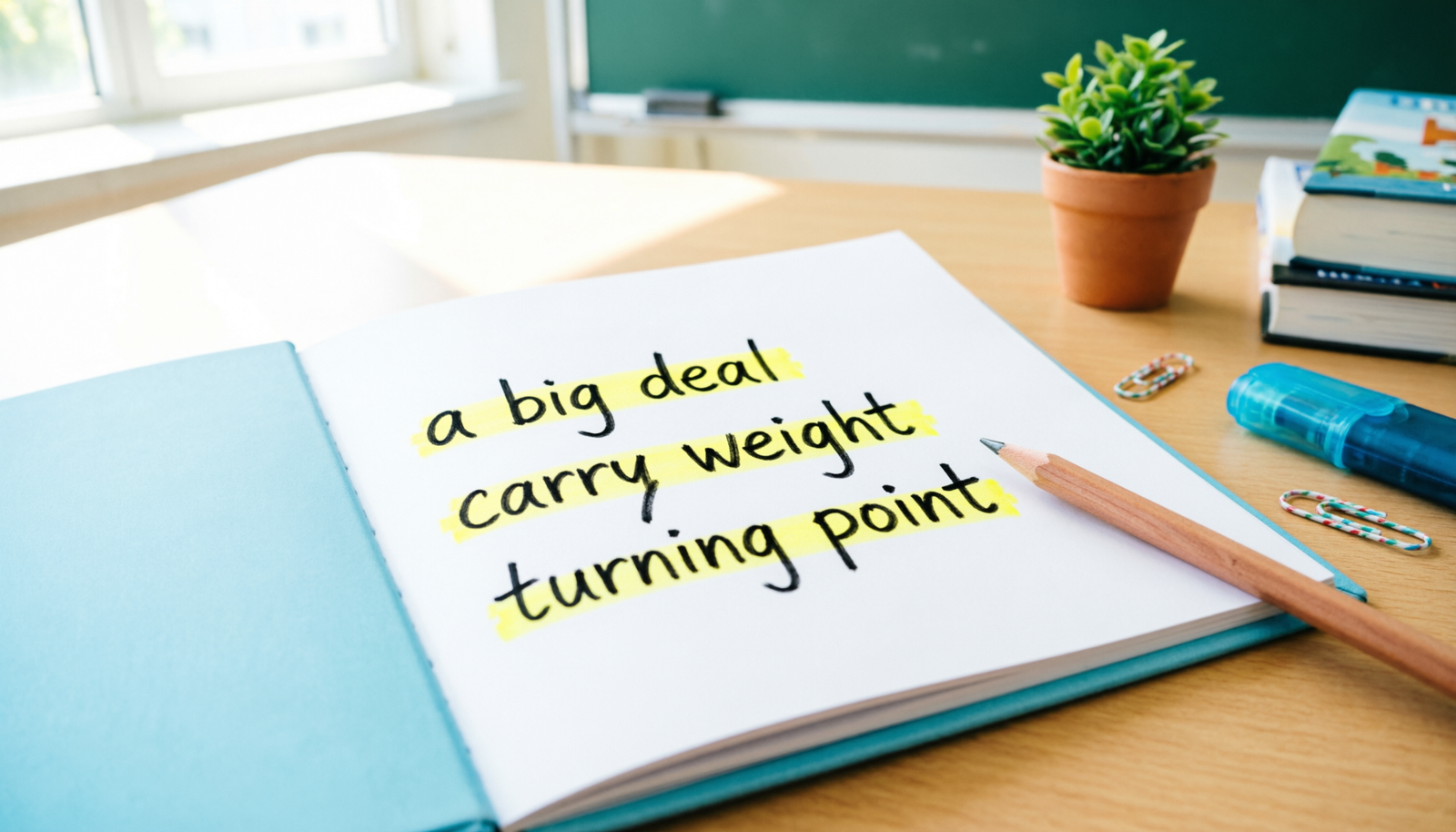
- A big deal means something is important or serious.
- Carry weight means something has influence or importance.
- Matter a great deal means something is very important.
- Of great consequence means something has serious results.
- Take center stage means something becomes the main focus.
- At the heart of the matter means something is central or essential.
- A matter of life and death means something is extremely serious or urgent.
- The key to something means the most important part of achieving it.
- A turning point means an important moment that changes what happens next.
- No small matter means something should not be treated as unimportant.
Short natural example:
“Good communication is at the heart of a strong team.”
This means good communication is central and important.
How Direct Words and Phrases for Important Work
Direct words and phrases work by naming importance clearly. They do not depend on figurative meaning.
Common direct alternatives for important include:
- significant
- essential
- vital
- crucial
- necessary
- meaningful
- major
- serious
- central
- valuable
- high-priority
- influential
- urgent
- critical
- relevant
Short natural example:
“Clear instructions are essential for this project.”
This sentence is direct. It does not use an idiom, but it still sounds strong and clear.
Direct language works best when you want accuracy. It is especially useful in essays, exams, reports, instructions, and professional writing.
Key Differences in Simple Language
Idioms for important are more colorful. Direct phrases are clearer.
An idiom can make your sentence sound more natural in conversation. A direct phrase can make your sentence easier to understand in formal writing.
For example:
Idiomatic: “This rule is no small matter.”
Direct: “This rule is very important.”
The idiom adds tone. It suggests that someone should not ignore the rule. The direct version simply states the meaning.
Another difference is flexibility. You can change direct phrases easily:
- very important
- extremely important
- important for students
- important to the company
Idioms are less flexible. You usually should not change their wording too much. For example, “carry weight” sounds natural, but “hold much heaviness” does not.
Can Idioms and Direct Phrases Overlap?
Yes, idioms and direct phrases can overlap because both can express the same idea. The difference lies in how they express it.
Consider these two sentences:
“This meeting is important.”
“This meeting is a big deal.”
Both mean the meeting matters. The first sentence is direct. The second sentence is idiomatic and more conversational.
Some expressions sit between idiom and direct phrase. For example, “high priority” is not a strong idiom, but it is more specific than simply saying “important.” “At the heart of” is more idiomatic because it uses a physical image to explain central importance.
Examples of Idioms for Important
1. A big deal
Meaning: Something important, serious, or impressive.
Example:
“Getting accepted into that program is a big deal.”
Use it in casual or semi-formal contexts. Avoid it in very formal academic writing unless the tone allows it.
2. Carry weight
Meaning: To have importance, influence, or authority.
Example:
“Her recommendation carries a lot of weight with the committee.”
This idiom works well in professional and academic contexts.
3. At the heart of the matter
Meaning: The most central or important part of an issue.
Example:
“Trust is at the heart of the matter.”
This phrase works well in essays, analysis, and speeches.
4. Take center stage
Meaning: To become the main focus.
Example:
“Safety concerns took center stage during the meeting.”
This idiom is useful when one topic becomes more important than others.
5. No small matter
Meaning: Something serious or important.
Example:
“Choosing the right college is no small matter.”
This phrase sounds thoughtful and slightly formal.
6. A matter of life and death
Meaning: Something extremely urgent or serious.
Example:
“For emergency workers, fast communication can be a matter of life and death.”
Use this carefully. It sounds dramatic, so it should match the seriousness of the situation.
7. The key to something
Meaning: The most important factor in achieving something.
Example:
“Practice is the key to fluent English.”
This idiom is common, clear, and useful for learners.
8. A turning point
Meaning: An important moment that changes the direction of events.
Example:
“The discovery became a turning point in medical research.”
This works well in history, literature, biography, and storytelling.
9. Of great consequence
Meaning: Very important because of its results.
Example:
“The judge had to make a decision of great consequence.”
This phrase sounds formal and serious.
10. Matter a great deal
Meaning: To be very important.
Example:
“Your support matters a great deal to the team.”
This expression sounds natural, warm, and sincere.
Examples of Direct Words and Phrases for Important
1. Essential
Meaning: Absolutely necessary.
Example:
“Water is essential for life.”
2. Crucial
Meaning: Extremely important to success or outcome.
Example:
“Timing is crucial in this experiment.”
3. Significant
Meaning: Important enough to notice or consider.
Example:
“The study showed a significant improvement.”
4. Vital
Meaning: necessary for life, success, or proper function.
Example:
“Sleep is vital for health.”
5. Major
Meaning: large, serious, or important.
Example:
“This is a major change in company policy.”
6. Central
Meaning: most important or closely connected to the main idea.
Example:
“Freedom is central to the poem’s meaning.”
7. High-priority
Meaning: needing attention before other things.
Example:
“This report is a high-priority task.”
8. Meaningful
Meaning: important because it has personal value or deeper meaning.
Example:
“The award was meaningful to her family.”
Idioms for Important in Literature and Writing
In literature, idioms can reveal tone, character, and emotion. A character who says, “This is a big deal,” may sound casual and modern. A narrator who says, “This was a turning point,” sounds more reflective and serious.
Writers also use idiomatic expressions to avoid flat repetition. Instead of using important again and again, they can choose expressions that match the situation.
For example:
Plain: “The letter was important to the plot.”
Stronger: “The letter became a turning point in the plot.”
The second sentence tells the reader that the letter changes the direction of the story. It does more than replace the word important.
Direct words still matter in literary analysis. If you write an essay, phrases like central theme, significant symbol, and crucial moment often work better than casual idioms.
Idioms for Important for Students and ESL Learners
Students and ESL learners should learn idioms for important because native speakers use them often in conversation, media, school discussions, and workplace communication.
However, learners should also know when not to use them. Idioms can sound natural, but they may confuse readers if the context is too formal or if the idiom does not fit the meaning.
Good learner-friendly examples include:
- This test is a big deal.
- The introduction carries a lot of weight in an essay.
- Good evidence is at the heart of a strong argument.
- This chapter marks a turning point in the story.
- Clear pronunciation matters a great deal in speaking exams.
For school writing, use idioms carefully. In an essay, “This event was a turning point” usually sounds stronger than “This event was a big deal.”
Common Mistakes and Confusion
One common mistake is using idioms in writing that needs a formal tone.
Weak for formal writing:
“The research is a big deal.”
Better:
“The research is significant.”
Another mistake is using dramatic idioms for small situations.
Too dramatic:
“Choosing a sandwich is a matter of life and death.”
Better:
“Choosing a healthy lunch matters to me.”
Learners also sometimes translate idioms directly from their first language. This can create phrases that do not sound natural in English. It is better to learn common English idioms as fixed expressions.
Another confusion comes from words like important, significant, and crucial. They are related, but they do not always mean the same thing. Important is general. Significant often means worth noticing. Crucial means something can strongly affect the result.
When to Use Idioms and When to Use Direct Phrases
Use idioms when you want your writing or speech to sound more natural, expressive, or conversational.
Good places to use idioms:
- friendly emails
- casual speech
- creative writing
- speeches
- blog writing
- dialogue
- opinion writing
Use direct phrases when you need clarity, accuracy, or formality.
Good places to use direct phrases:
- academic essays
- exams
- reports
- business writing
- instructions
- research summaries
- formal emails
Examples:
Casual:
“This interview is a big deal for me.”
Formal:
“This interview is an important opportunity for me.”
Analytical:
“This scene is central to the novel’s theme.”
Expressive:
“This scene is at the heart of the novel.”
Related Terms People Often Confuse With Idioms for Important
Synonyms
A synonym is a word with a similar meaning. Significant, vital, and crucial are synonyms of important, but they are not idioms.
Phrases
A phrase is any group of words that works together. Some phrases are idioms, but not all phrases are idioms.
Expressions
An expression is a common way of saying something. Idioms are a type of expression, but some expressions are literal.
Metaphors
A metaphor compares one thing to another without using “like” or “as.” Some idioms are metaphorical, such as “carry weight.”
Collocations
A collocation is a natural word combination, such as high priority or major issue. These are useful, but they are usually not idioms.
Formal alternatives
Formal alternatives are direct words or phrases that sound polished, such as of major importance, highly significant, or central to the argument.
Conclusion
Idioms for important help you express meaning with more style and variety. Phrases like a big deal, carry weight, at the heart of the matter, and a turning point can make your English sound more natural and expressive.
The main difference is clear: idioms show importance indirectly or figuratively, while direct words like important, essential, significant, and crucial state the meaning clearly.
For students, writers, and ESL learners, the best approach is to know both. Use idioms when tone and expression matter. Use direct phrases when clarity and formality matter. Strong English comes from choosing the right expression for the right situation.
FAQs
What are some common idioms for important?
Common idioms for important include a big deal, carry weight, at the heart of the matter, take center stage, no small matter, a matter of life and death, the key to something, and a turning point.
Is “a big deal” an idiom for important?
Yes. A big deal is a common idiom that means something is important, impressive, serious, or worth attention. It sounds natural in casual and semi-formal English.
What is a formal idiom for important?
Of great consequence, carry weight, and at the heart of the matter sound more formal than a big deal. They work well in essays, speeches, and professional writing.
What is the difference between important and significant?
Important is a general word meaning something matters. Significant often means something is important enough to notice, measure, or discuss. In academic writing, significant often sounds more precise.
Can I use idioms for important in essays?
Yes, but choose carefully. Idioms like a turning point, at the heart of, and carry weight can work well in essays. Casual idioms like a big deal may sound too informal for academic writing.
What is the best idiom for “very important”?
The best idiom depends on context. Use a matter of life and death for extreme seriousness, carry a lot of weight for influence, at the heart of the matter for central importance, and a big deal for casual importance.
Are idioms better than direct words?
No. Idioms are not always better. They add style and natural expression, but direct words are clearer. Good writers use both depending on tone, audience, and purpose.