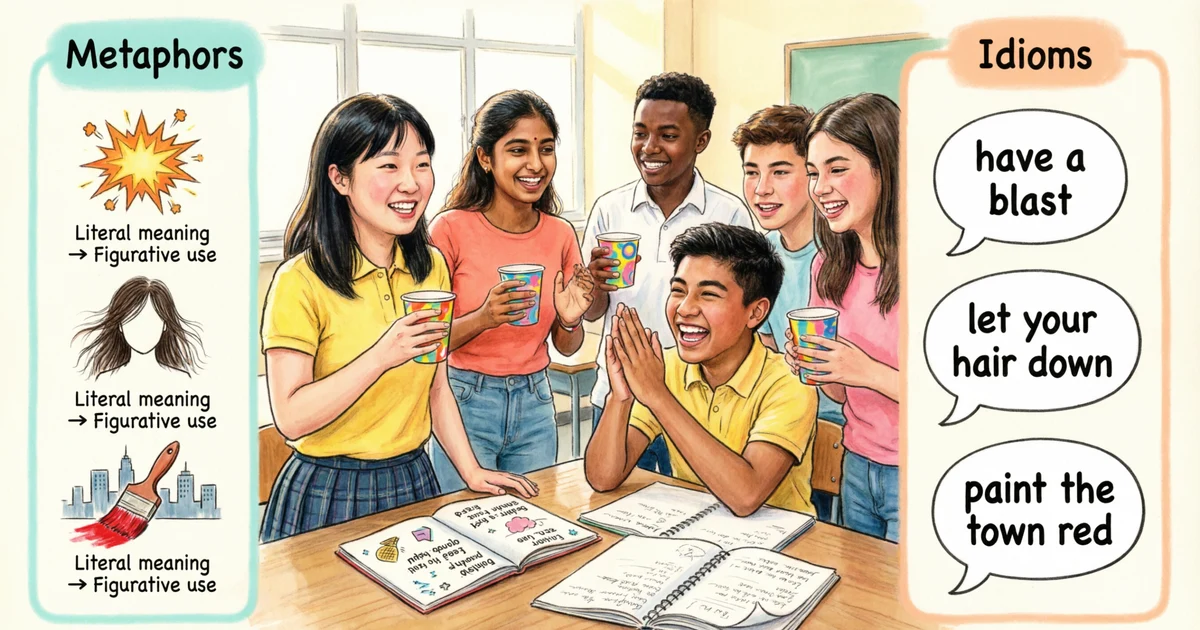
People often search for idioms for having a good time because they want more natural ways to describe fun, enjoyment, parties, celebrations, and happy social moments. Phrases like have a blast, paint the town red, and let your hair down can make English sound more colorful and fluent.
But there is one common point of confusion: are these phrases idioms, metaphors, or both?
The simple answer is this: an idiom is a fixed expression whose meaning is not always clear from the individual words, while a metaphor compares one thing to another to create a deeper image or meaning. Some idioms can include metaphorical language, but not every idiom works like a metaphor.
For example, have a blast is an idiom that means “enjoy yourself a lot.” It does not literally mean an explosion happened. A metaphor might say, The party was a spark that lit up the whole weekend, which compares the party to a spark.
This article explains the difference between idioms and metaphors using the theme of having a good time, with clear examples for students, writers, and ESL learners.
What Idioms Mean
An idiom is a common phrase or expression with a meaning that you usually cannot understand by looking at each word separately.
For example, have a blast means “to have a very enjoyable time.” A learner might think the word blast refers to an explosion, but native speakers understand the phrase as a fun, informal way to talk about enjoyment.
Simple definition
An idiom is a fixed expression with a special meaning.
Purpose
Idioms help people sound natural, expressive, and conversational.
How it works
An idiom works because a language community agrees on its meaning over time. The phrase becomes familiar through repeated use.
Short natural example
We had a blast at the concert last night.
Why idioms get confused with metaphors
Many idioms use images, exaggeration, or figurative ideas. Because of that, they can feel metaphorical, even when speakers use them as everyday expressions.
What Metaphors Mean
A metaphor is a figure of speech that describes one thing as another thing to create a strong image or idea.
A metaphor does not usually use like or as. Instead of saying something is similar to something else, it says one thing is another thing in a creative or symbolic way.
For example, The dance floor was a sea of smiles is a metaphor. The dance floor was not literally a sea. The metaphor helps readers imagine a large, happy crowd.
Simple definition
A metaphor describes one thing as another to show a shared quality.
Purpose
Metaphors help writers create meaning, emotion, imagery, and depth.
How it works
A metaphor connects two different things. It asks the reader to notice what they have in common.
Short natural example
The party was a burst of sunshine after a long week.
Why metaphors get confused with idioms
Some idioms began as metaphorical expressions. For example, let your hair down creates an image of relaxing and becoming less formal. Over time, it became a common idiom.
Idioms vs Metaphors: The Core Difference
The core difference is simple:
An idiom has a fixed meaning that people already know. A metaphor creates a comparison to help people imagine or understand something in a fresh way.
When someone says, We painted the town red, they use an idiom that means they went out and enjoyed themselves, usually in a lively way. The meaning does not come from literal painting or the color red.
When a writer says, The city became our playground, they use a metaphor. The sentence compares the city to a playground to show freedom, excitement, and fun.
So, idioms rely on shared meaning. Metaphors rely on comparison.
Quick Comparison Table
| Point | Idiom | Metaphor |
|---|---|---|
| Definition | A fixed expression with a special meaning | A comparison that describes one thing as another |
| Scope | Narrower and language-specific | Broader and used across writing, speech, and literature |
| Purpose | To sound natural, fluent, and expressive | To create imagery, meaning, or emotion |
| Length | Usually short phrases | Can be a phrase, sentence, paragraph, or whole text |
| Structure | Often fixed or hard to change | Flexible and creative |
| Meaning | Usually learned as a whole phrase | Understood through comparison |
| Use in writing | Good for dialogue, informal writing, and natural expression | Good for creative, persuasive, and literary writing |
| Example | We had a blast. | The night was a river of laughter. |
How Idioms Work
Idioms work through shared cultural and language knowledge. Native speakers learn them by hearing them again and again in real conversations, movies, books, music, and daily life.
For ESL learners, idioms can feel confusing because the literal meaning often does not help much. Take this sentence:
They let their hair down at the party.
This does not necessarily mean people physically untied their hair. It means they relaxed, acted freely, and enjoyed themselves.
Many idioms for having a good time follow this pattern. They use familiar words in a non-literal way.
Examples include:
Have a blast
Meaning: enjoy yourself a lot
Example: We had a blast at the beach.
Have the time of your life
Meaning: enjoy an experience very deeply
Example: She had the time of her life on vacation.
Let your hair down
Meaning: relax and enjoy yourself
Example: After exams, the students finally let their hair down.
Live it up
Meaning: enjoy life in an exciting or luxurious way
Example: They lived it up during their trip to New York.
Paint the town red
Meaning: go out and celebrate in a lively way
Example: It was his birthday, so we painted the town red.
Idioms often sound casual and conversational. They work well in dialogue, personal stories, captions, informal essays, and everyday speech.
How Metaphors Work
Metaphors work by making a direct comparison. They do not depend on a fixed dictionary-like phrase in the same way idioms do. Instead, they invite readers to think.
For example:
The party was a firework of laughter.
This metaphor compares the party to a firework. It suggests brightness, energy, surprise, and excitement.
A metaphor can be original, which means the writer creates it for a specific moment. Unlike many idioms, metaphors do not always need to be common phrases.
More examples:
The weekend was a golden escape.
This suggests the weekend felt valuable, warm, and freeing.
The room bloomed with laughter.
This compares laughter to flowers opening.
Music carried us through the night.
This suggests the music guided the mood and energy.
The celebration was a wave of joy.
This compares joy to a wave moving through people.
Metaphors help writers make ordinary experiences feel more vivid. Instead of simply saying, “We had fun,” a metaphor can show what that fun felt like.
Key Differences in Simple Language
Idioms and metaphors both belong to figurative language, but they do different jobs.
An idiom usually has a meaning you need to learn. You cannot always guess it from the words.
A metaphor creates meaning through comparison. You can often understand it by thinking about the image.
An idiom is often fixed. For example, people say have a blast, not usually own a blast or take a blast.
A metaphor is more flexible. A writer can create a new metaphor, such as The night opened like a door to joy, although that example also uses like, making it closer to a simile. A direct metaphor would be: The night was a door to joy.
Idioms help you sound natural. Metaphors help you sound imaginative.
Can Idioms and Metaphors Overlap?
Yes, idioms and metaphors can overlap.
Some idioms are metaphorical because they contain an image or comparison. For example:
Let your hair down
This idiom means to relax and enjoy yourself. The phrase likely connects to the idea of removing formality or restraint. It creates a small image of someone becoming freer and less controlled.
Paint the town red
This idiom means to go out and celebrate energetically. The phrase creates a bold visual image, even though people do not literally paint buildings red.
So, some idioms use metaphorical thinking. However, they remain idioms because speakers understand them as fixed expressions with established meanings.
The overlap can confuse learners, but here is the easiest rule:
If the phrase has a fixed common meaning, treat it as an idiom. If the phrase creates a fresh comparison, treat it as a metaphor.
Examples of Idioms for Having a Good Time
Here are useful idioms for having a good time, with meanings and natural examples.
Have a blast
Meaning: to enjoy yourself a lot
Example: We had a blast at the wedding.
This idiom sounds friendly and informal. It works well in everyday conversation.
Have the time of your life
Meaning: to enjoy an experience in a memorable way
Example: The children had the time of their life at the amusement park.
This phrase suggests strong enjoyment and lasting happiness.
Let your hair down
Meaning: to relax and enjoy yourself without worrying too much
Example: After months of hard work, we finally let our hair down.
This idiom works well when someone stops being serious or formal.
Live it up
Meaning: to enjoy life in an exciting, expensive, or carefree way
Example: They lived it up on their holiday in Italy.
This idiom often suggests travel, parties, luxury, or freedom.
Paint the town red
Meaning: to go out and celebrate in a lively way
Example: We finished our exams and decided to paint the town red.
This phrase sounds energetic and social.
Have a whale of a time
Meaning: to have a very enjoyable time
Example: We had a whale of a time at the festival.
This idiom sounds cheerful and slightly old-fashioned, but people still understand it.
Make merry
Meaning: to celebrate and enjoy yourself
Example: The villagers gathered to make merry after the harvest.
This expression sounds more literary or traditional than casual.
Kick back
Meaning: to relax and enjoy yourself
Example: We kicked back by the pool all afternoon.
This idiom sounds casual and common in spoken English.
Be in high spirits
Meaning: to feel cheerful and excited
Example: Everyone was in high spirits at the reunion.
This phrase focuses more on mood than activity.
Party animal
Meaning: a person who loves parties and social fun
Example: My cousin is a real party animal.
This idiom describes a person, not the event itself.
Examples of Metaphors for Having a Good Time
Metaphors can describe fun in a more creative or emotional way.
The party was a burst of sunshine
Meaning: the party felt bright, warm, and happy
Example: After a stressful week, the party was a burst of sunshine.
This metaphor works well in personal writing or storytelling.
The room was a sea of laughter
Meaning: many people were laughing
Example: By the end of the speech, the room was a sea of laughter.
This metaphor creates a visual image of laughter filling the space.
The night was pure magic
Meaning: the night felt special and unforgettable
Example: With music, friends, and dancing, the night was pure magic.
This metaphor sounds emotional and expressive.
Joy danced through the crowd
Meaning: happiness spread among people
Example: When the band started playing, joy danced through the crowd.
This metaphor gives joy a human action.
The weekend was a playground
Meaning: the weekend felt free, fun, and full of possibilities
Example: For the group of old friends, the weekend was a playground.
This metaphor connects fun with childhood freedom.
Their laughter was music
Meaning: their laughter sounded pleasant and joyful
Example: Around the dinner table, their laughter was music.
This metaphor works well in descriptive writing.
Idioms vs Metaphors in Literature and Writing
Writers use idioms and metaphors for different effects.
Idioms make characters sound natural. In dialogue, a character might say:
We had a blast last night.
That sounds like real speech. It helps the reader understand the character’s mood quickly.
Metaphors add imagery and emotional depth. A writer might say:
Last night was a lantern in the middle of a dark month.
That metaphor suggests the good time felt hopeful, bright, and needed.
In literature, metaphors often carry deeper meaning. They can support themes such as freedom, friendship, youth, celebration, escape, or memory. Idioms usually work more directly. They help with tone, voice, and realism.
A strong writer knows when to use each one. If you want a character to sound natural, use an idiom. If you want the reader to feel an image or idea more deeply, use a metaphor.
Idioms vs Metaphors for Students and ESL Learners
Students and ESL learners often struggle with idioms because idioms do not always translate directly into another language.
For example, paint the town red may sound strange if translated word for word. The real meaning is about going out and celebrating.
Metaphors can also confuse learners, but they usually give more clues. If someone says, The party was a wave of joy, the words wave and joy help the learner imagine happiness spreading.
Here is a simple learning tip:
Learn idioms as complete phrases. Do not break them into separate words too much.
Study metaphors by asking, “What two things are being compared?”
For writing, students should use idioms carefully. Too many idioms can make a paragraph sound unnatural or forced. Metaphors also need balance. A clear metaphor can improve writing, but too many creative comparisons can confuse readers.
Common Mistakes and Confusion
Mistake 1: Thinking every figurative phrase is a metaphor
Not every figurative phrase is a metaphor. Have a blast is better understood as an idiom because it has a fixed common meaning.
Mistake 2: Reading idioms literally
A learner might think let your hair down only refers to hair. In real use, it means to relax and enjoy yourself.
Mistake 3: Changing idioms too much
Idioms often have fixed wording. You can say have a blast, but changing it to take a blast sounds wrong.
Mistake 4: Using formal idioms in casual situations
Some expressions, such as make merry, sound old-fashioned or literary. In everyday speech, have fun, have a great time, or have a blast may sound more natural.
Mistake 5: Overusing metaphors
A metaphor can make writing stronger, but too many metaphors in one paragraph can feel heavy. Choose one clear image and let it work.
Mistake 6: Mixing idioms and metaphors badly
A sentence like We painted the town red in a sea of sunshine sounds confusing because it mixes too many images. Keep figurative language clean and controlled.
When to Use Idioms and When to Use Metaphors
Use idioms when you want natural, conversational English.
Good situations for idioms include:
Everyday speech
Friendly messages
Personal stories
Dialogue
Casual essays
Social media captions
Examples:
We had a blast.
I had the time of my life.
We kicked back and enjoyed the evening.
Use metaphors when you want imagery, emotion, or creative expression.
Good situations for metaphors include:
Stories
Poetry
Descriptive essays
Speeches
Creative captions
Literary analysis
Personal reflections
Examples:
The evening was a pocket of joy.
Their laughter filled the room like light.
The festival was a river of color and sound.
For ESL learners, idioms help with fluency. For writers, metaphors help with style, For students, understanding both improves reading comprehension and writing quality.
Related Terms People Often Confuse with Idioms and Metaphors
Simile
A simile compares two things using like or as.
Example:
The party was like a dream.
A metaphor says one thing is another. A simile says one thing is like another.
Phrase
A phrase is any small group of words that works together. Not every phrase is an idiom.
Example:
A good time is a phrase, but not necessarily an idiom.
Expression
An expression is a general word for a common way of saying something. Idioms are a type of expression.
Example:
Have fun is an expression, but it is more direct than an idiom.
Cliché
A cliché is an overused phrase or idea. Some idioms can become clichés if writers use them too often.
Example:
Time flies when you’re having fun is common and familiar, but it may feel predictable in creative writing.
Slang
Slang is very informal language used by certain groups or in casual settings.
Example:
That party was lit is slang, not a traditional idiom.
Proverb
A proverb is a short saying that gives advice or wisdom.
Example:
All work and no play makes Jack a dull boy.
This relates to fun and rest, but it works more like a lesson than an idiom.
Conclusion
Idioms and metaphors both make language more expressive, but they do not work in the same way.
An idiom is a fixed expression with a special meaning. Phrases like have a blast, let your hair down, and paint the town red help people talk naturally about having a good time.
A metaphor creates a direct comparison. Sentences like The party was a burst of sunshine or The room was a sea of laughter help writers create images and emotions.
The main difference is this: idioms depend on accepted meaning, while metaphors depend on comparison. Some idioms can include metaphorical ideas, but they still work as idioms when people use them as fixed expressions.
For students and ESL learners, the best approach is simple: learn idioms as whole phrases and study metaphors by looking for the comparison. For writers, use idioms for natural voice and metaphors for vivid description.
FAQs
What are common idioms for having a good time?
Common idioms for having a good time include have a blast, have the time of your life, let your hair down, live it up, paint the town red, kick back, and have a whale of a time.
Is “have a blast” an idiom or a metaphor?
Have a blast is an idiom. It means to enjoy yourself a lot. The word blast does not refer to a literal explosion in this phrase.
Is “paint the town red” an idiom?
Yes, paint the town red is an idiom. It means to go out and celebrate in a lively, energetic way.
Can an idiom also be a metaphor?
Yes, some idioms contain metaphorical images. For example, let your hair down creates an image of relaxing and becoming less formal. Still, it works as an idiom because it has a fixed common meaning.
What is the difference between an idiom and a metaphor?
An idiom is a common expression with a special meaning. A metaphor describes one thing as another to create a comparison. Idioms are usually fixed, while metaphors can be original and creative.
Which is better for ESL learners to study first, idioms or metaphors?
ESL learners should study common idioms first for everyday fluency. Metaphors are also important, especially for reading stories, poems, essays, and more advanced English.
Can I use idioms for having a good time in formal writing?
You can use some idioms in semi-formal writing, but avoid very casual ones in formal essays. For example, have a great time sounds safer than party animal or paint the town red in formal contexts.