Introduction
Knowledge can be hard to describe in plain words. We talk about learning as if it were light, power, food, treasure, or a key that opens doors. That is why English uses many idioms for knowledge and many metaphors about knowledge.
These two language tools often overlap, but they are not the same.
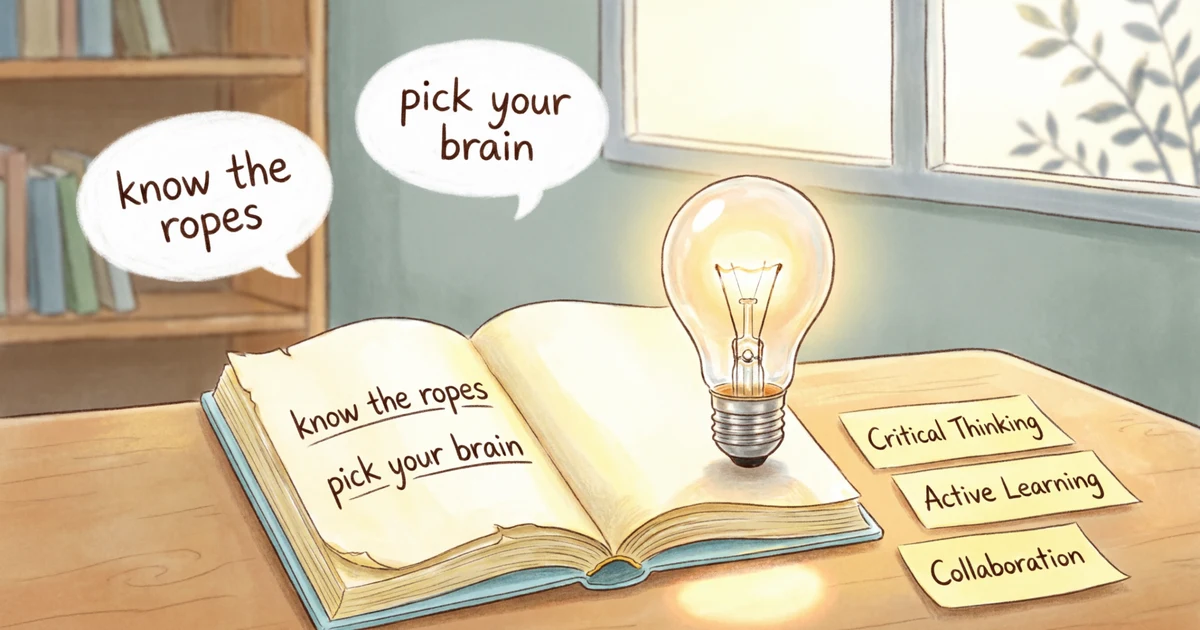
An idiom for knowledge is a fixed expression with a commonly understood meaning, such as know the ropes or pick someone’s brain. A knowledge metaphor compares knowledge to something else, such as knowledge is a light or education opens doors.
The core difference is simple: an idiom is usually a fixed phrase, while a metaphor is a comparison that creates an image or idea. Some idioms also contain metaphors, which is why learners often confuse them.
This guide explains both terms clearly, shows how they work, and gives practical examples for students, writers, and ESL learners.
What Idioms for Knowledge Mean
An idiom for knowledge is a common expression related to learning, understanding, intelligence, experience, or information. Its meaning usually does not come from the literal meaning of each word.
For example, know the ropes does not mean someone knows actual ropes. It means the person understands how a job, system, or situation works.
Simple definition:
An idiom for knowledge is a fixed expression that describes knowing, learning, understanding, or being experienced.
Purpose:
Idioms make language sound natural, conversational, and expressive.
How it works:
The phrase has a special meaning that English speakers understand through common use.
Short example:
“She knows the ropes after working here for five years.”
Why it gets confused with metaphors:
Many idioms use image-based language, so they can feel metaphorical even when people use them as fixed expressions.
What Knowledge Metaphors Mean
A knowledge metaphor describes knowledge by comparing it to something else. Writers often use metaphors to make abstract ideas easier to picture.
For example, knowledge is power compares knowledge to power because knowledge can give people control, confidence, and better choices.
Simple definition:
A knowledge metaphor compares knowledge, learning, or understanding to another idea or object.
Purpose:
Metaphors help readers see knowledge in a more vivid, meaningful, or emotional way.
How it works:
A metaphor transfers meaning from one thing to another. It does not always use “like” or “as.”
Short example:
“Education is the key that opens the door to opportunity.”
Why it gets confused with idioms:
Some knowledge idioms began as metaphors, and many still create a clear mental picture.
Idioms for Knowledge vs Knowledge Metaphors: The Core Difference
The main difference is that idioms are fixed expressions, while metaphors are comparisons.
An idiom usually has a meaning that people learn as a whole phrase. For example, pick someone’s brain means to ask someone for ideas or advice. You cannot understand the phrase fully by studying each word separately.
A metaphor works by comparison. For example, knowledge is a lamp in the dark compares knowledge to light because both help people see clearly.
So, when you use an idiom, you usually choose a phrase people already know. When you use a metaphor, you may create a fresh comparison or use a familiar one.
Quick Comparison Table
| Point | Idioms for Knowledge | Knowledge Metaphors |
|---|---|---|
| Definition | Fixed expressions about knowing, learning, or understanding | Comparisons that describe knowledge through another idea |
| Scope | Usually narrower because the phrase has a set meaning | Broader because writers can create many comparisons |
| Purpose | To sound natural, fluent, and conversational | To make an abstract idea vivid, symbolic, or emotional |
| Length | Usually short phrases | Can be short, extended, or developed across a paragraph |
| Structure | Often fixed wording | More flexible wording |
| Meaning | Often figurative and culturally learned | Based on comparison or symbolic meaning |
| Use in writing | Useful in dialogue, essays, explanations, and informal writing | Useful in literature, speeches, essays, and creative writing |
| Example | “She knows the ropes.” | “Knowledge is a bridge to a better future.” |
How Idioms for Knowledge Work
Idioms work because speakers share an understood meaning. Once a phrase becomes common, people do not need to analyze every word.
Take the idiom in the know. Literally, it sounds incomplete. In real use, it means someone has special or inside information.
Example:
“People in the know expected the policy to change.”
Idioms often depend on context. Wise up means to become aware of the truth, especially after being mistaken or naïve.
Example:
“He finally wised up and stopped trusting every rumor online.”
For ESL learners, the safest way to learn idioms is through full sentences. A phrase alone may confuse you, but a sentence shows tone, grammar, and meaning.
How Knowledge Metaphors Work
Knowledge metaphors work by turning an abstract idea into something concrete. You cannot touch “knowledge,” but you can imagine light, keys, maps, doors, seeds, tools, and treasure.
For example:
“Knowledge is a map.”
This metaphor suggests that knowledge helps people find direction. It does not mean knowledge is literally a paper map. The comparison helps readers understand the value of knowledge quickly.
Writers can also extend a metaphor:
“Knowledge is a map. Without it, even a short journey can feel confusing. With it, a difficult path becomes easier to follow.”
This extended metaphor develops the same comparison over several sentences.
Key Differences in Simple Language
Idioms and metaphors both use figurative language, but they work differently.
An idiom usually belongs to everyday language. People use it because it already has a known meaning.
A metaphor belongs strongly to comparison and imagery. Writers use it to create meaning, mood, or emphasis.
An idiom is often harder for ESL learners because the meaning can feel unpredictable. A metaphor may be easier to guess if the comparison is clear.
For example:
Idiom: “She has a good head on her shoulders.”
Meaning: She is sensible and intelligent.
Metaphor: “Her mind is a library of experience.”
Meaning: She has a lot of stored knowledge and wisdom.
The idiom sounds natural in conversation. The metaphor sounds more descriptive and literary.
Can Idioms for Knowledge and Knowledge Metaphors Overlap?
Yes, they can overlap.
Many idioms are metaphorical because they use images or comparisons. For example, a fountain of knowledge describes a person who knows a lot and can share information freely. It works as both an idiomatic expression and a metaphor because it compares knowledge to flowing water.
Another example is open someone’s eyes. It means to help someone understand something clearly. It also uses a metaphor of seeing as understanding.
The overlap happens because English often treats knowledge as light, vision, food, tools, or movement. That does not make every metaphor an idiom, though. An idiom must be a recognized expression, while a metaphor can be original.
Examples of Idioms for Knowledge
Here are common idioms for knowledge with simple meanings and examples.
1. Know the ropes
Meaning: To understand how something works.
Example:
“Ask Maria for help. She knows the ropes.”
2. Pick someone’s brain
Meaning: To ask someone for ideas, advice, or information.
Example:
“I want to pick your brain about my research topic.”
3. In the know
Meaning: Having special or inside information.
Example:
“People in the know say the company will announce changes soon.”
4. Learn the hard way
Meaning: To learn through mistakes or difficult experience.
Example:
“He learned the hard way that saving files is important.”
5. Wise up
Meaning: To become aware, sensible, or less easily fooled.
Example:
“She wised up after reading the contract carefully.”
6. Get the hang of it
Meaning: To begin to understand how to do something.
Example:
“After a few lessons, I got the hang of the software.”
7. A walking encyclopedia
Meaning: A person who knows a lot about many things.
Example:
“My grandfather is a walking encyclopedia of local history.”
8. Know something inside out
Meaning: To know something completely.
Example:
“She knows the grammar rules inside out.”
9. Have a good head on your shoulders
Meaning: To be sensible, intelligent, and practical.
Example:
“He is young, but he has a good head on his shoulders.”
10. Brush up on something
Meaning: To review or improve knowledge you already have.
Example:
“I need to brush up on my English before the test.”
Examples of Knowledge Metaphors
Knowledge metaphors often sound more poetic, symbolic, or thoughtful than idioms.
1. Knowledge is power
Meaning: Knowledge gives people control, confidence, and better choices.
Example:
“Knowledge is power when people use it to protect their rights.”
2. Knowledge is a light
Meaning: Knowledge helps people see clearly and understand truth.
Example:
“Knowledge is a light that guides us through confusion.”
3. Education is a key
Meaning: Education helps people access opportunities.
Example:
“Education is the key to a more independent life.”
4. The mind is a garden
Meaning: The mind grows when people feed it with learning and care.
Example:
“The mind is a garden, and books are the seeds.”
5. Knowledge is a bridge
Meaning: Knowledge connects people to new places, ideas, or futures.
Example:
“Knowledge is a bridge between fear and confidence.”
6. Wisdom is a compass
Meaning: Wisdom helps people choose the right direction.
Example:
“Wisdom is a compass when life becomes uncertain.”
7. Books are windows
Meaning: Books help people see other worlds, lives, and ideas.
Example:
“Books are windows into cultures we may never visit.”
Idioms for Knowledge vs Knowledge Metaphors in Literature and Writing
In literature, writers use both idioms and metaphors, but they create different effects.
Idioms can make characters sound natural. If a character says, “I had to learn the hard way,” the line feels conversational and realistic. Idioms often reveal voice, background, personality, or tone.
Metaphors create imagery and deeper meaning. If a writer says, “Her mind was a locked room,” the reader starts thinking about secrecy, memory, or emotional distance. The metaphor does more than explain knowledge; it builds mood.
In essays, idioms can make writing friendly, but too many idioms may sound informal. Metaphors can make an essay stronger when they clarify an idea instead of decorating it.
A student might write:
“Students often learn the hard way that memorizing facts is not enough.”
That idiom works well in a practical essay.
A more literary version might say:
“Knowledge is not a pile of facts; it is a map that helps students find meaning.”
That metaphor gives the idea more depth.
Idioms for Knowledge vs Knowledge Metaphors for Students and ESL Learners
Students and ESL learners should learn idioms carefully because idioms often do not translate word for word. For example, pick someone’s brain may sound strange or even funny if translated literally. In English, it simply means to ask someone for advice or ideas.
Metaphors also need care, but they often make sense through logic. If someone says knowledge is light, you can guess that knowledge helps people see or understand.
Use idioms when you want to sound fluent and natural. Use metaphors when you want to explain an idea in a vivid or creative way.
For school writing, idioms work best in examples, introductions, informal essays, and dialogue. Metaphors work well in creative writing, speeches, reflective essays, and literary analysis.
Common Mistakes and Confusion
One common mistake is treating every figurative phrase as an idiom. A phrase can be figurative without being an idiom. For example, “knowledge is a river” is a metaphor, but it is not a common idiom.
Another mistake is using idioms in very formal writing without checking tone. Phrases like pick someone’s brain sound natural in conversation, but they may feel too casual in academic writing.
ESL learners also sometimes change idioms too much. Idioms often need fixed wording. You can say know the ropes, but “understand the ropes” sounds less natural.
Writers may also overuse familiar metaphors. Knowledge is power works in many contexts, but it can sound predictable if you do not add a fresh idea or specific example.
When to Use Idioms and When to Use Knowledge Metaphors
Use idioms for knowledge when you want natural, everyday English.
Good situations for idioms include:
| Situation | Good idiom |
|---|---|
| Talking about experience | “know the ropes” |
| Asking for advice | “pick your brain” |
| Reviewing old knowledge | “brush up on” |
| Learning by mistake | “learn the hard way” |
| Understanding a skill | “get the hang of it” |
Use knowledge metaphors when you want to explain, inspire, persuade, or create imagery.
Good situations for metaphors include:
| Situation | Good metaphor |
|---|---|
| Speech or presentation | “Knowledge is power.” |
| Creative writing | “Her mind was a library of forgotten stories.” |
| Essay introduction | “Education is a bridge to opportunity.” |
| Reflective writing | “Wisdom is a compass.” |
| Literary analysis | “Light often represents knowledge and truth.” |
The best choice depends on tone. Idioms sound more conversational. Metaphors sound more descriptive, symbolic, or thoughtful.
Related Terms People Often Confuse With Them
Simile
A simile compares two things using “like” or “as.”
Example:
“His mind is like a sponge.”
This means he absorbs knowledge quickly.
Proverb
A proverb is a short traditional saying that gives advice or wisdom.
Example:
“A little knowledge is a dangerous thing.”
This warns that limited knowledge can lead to overconfidence.
Cliché
A cliché is an overused phrase or idea.
Example:
“Knowledge is power” can become a cliché if a writer uses it without fresh context.
Figurative language
Figurative language is the broad category. Idioms, metaphors, similes, and personification all belong to it.
Symbolism
Symbolism uses objects, colors, or images to represent deeper meanings.
Example:
Light often symbolizes knowledge, truth, or understanding.
Conclusion
Idioms for knowledge and knowledge metaphors both help people talk about learning, wisdom, and understanding in richer ways. The difference lies in how they work.
An idiom is a fixed expression with a commonly understood meaning, such as know the ropes, pick someone’s brain, or get the hang of it. A metaphor compares knowledge to something else, such as light, a key, a bridge, or a compass.
Use idioms when you want fluent, natural English. Use metaphors when you want stronger imagery, deeper meaning, or a more creative style. Once you understand the difference, you can choose each one with more confidence in essays, stories, speeches, and everyday conversation.
FAQs
What are idioms for knowledge?
Idioms for knowledge are common expressions about learning, understanding, intelligence, or experience. Examples include know the ropes, in the know, brush up on, and learn the hard way.
What is the difference between an idiom and a metaphor?
An idiom is a fixed phrase with a special meaning. A metaphor is a comparison between two things. Some idioms use metaphorical language, but not every metaphor is an idiom.
Is “knowledge is power” an idiom or a metaphor?
“Knowledge is power” works mainly as a metaphor because it compares knowledge to power. Many people also treat it like a common saying because it is widely known.
Is “know the ropes” a metaphor?
“Know the ropes” is an idiom. It may have a metaphorical background, but modern English speakers use it as a fixed phrase meaning “to understand how something works.”
Can I use idioms for knowledge in essays?
Yes, but choose them carefully. Idioms can make writing sound natural, but very casual idioms may not suit formal academic essays. For formal writing, use clear explanation first.
Why are knowledge idioms hard for ESL learners?
They are hard because their meanings often cannot be guessed from the individual words. Learners should study idioms in full sentences instead of memorizing word-by-word translations.
What is a good idiom for someone who knows a lot?
Good options include a walking encyclopedia, a fountain of knowledge, and know something inside out. The best choice depends on tone and context.