Introduction
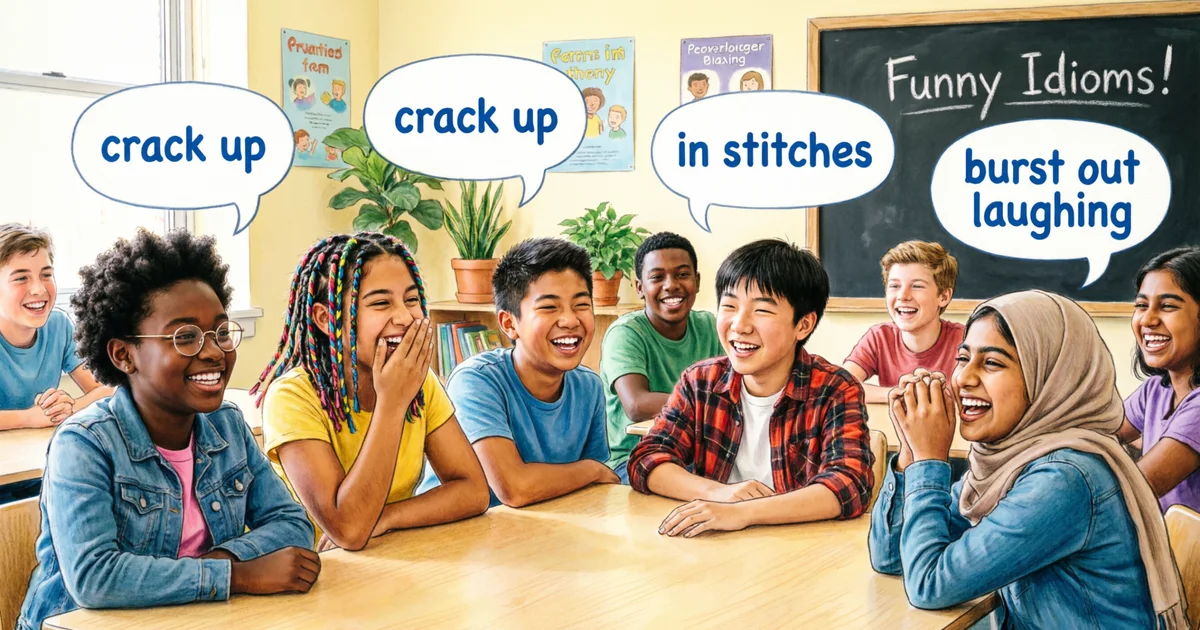
Laughter is easy to understand in real life, but English has many colorful ways to talk about it. People do not always say, “She laughed a lot.” They might say, “She burst out laughing,” “He cracked up,” or “They were in stitches.” These expressions make writing and speech sound more natural, vivid, and emotionally clear.
The phrase idioms for laughing usually refers to fixed English expressions that describe laughter in a lively way. Some of these expressions sound strange if you read them word by word. For example, “in stitches” does not literally mean someone has sewing stitches. It means someone laughed very hard.
Many students and ESL learners also confuse idioms with metaphors because both can use figurative language. The difference is simple: an idiom has a fixed meaning that people already recognize, while a metaphor compares one thing to another to create a fresh image or deeper meaning.
This article explains idioms and metaphors through the topic of laughing, shows how they overlap, and helps you choose the right expression in writing, conversation, and schoolwork.
What Idioms Mean
An idiom is a common expression whose meaning is different from the literal meaning of its individual words.
For example:
She was in stitches after hearing the joke.
This does not mean she had real stitches. It means she laughed very hard.
Simple definition
An idiom is a fixed phrase with a special meaning that native speakers understand as a whole.
Purpose
Idioms make language sound natural, expressive, and conversational. They help speakers describe feelings, actions, and situations in a short, memorable way.
How idioms work
Idioms work because people in a language community already know what they mean. You usually cannot change the words too much, because the expression may stop sounding natural.
For example, English speakers say:
He cracked up.
They do not usually say:
He broke up into laughter pieces.
Short natural example
The movie was so funny that we cracked up.
Why idioms get confused with metaphors
Idioms often use figurative language, just like metaphors. “In stitches” creates an image, but its meaning has become fixed through common use. That fixed meaning makes it an idiom.
What Metaphors Mean
A metaphor describes one thing as if it were another thing. It creates a comparison without using “like” or “as.”
For example:
Her laughter was music in the room.
Her laughter is not literally music. The sentence compares laughter to music to suggest that it sounded pleasant, joyful, or beautiful.
Simple definition
A metaphor is a figure of speech that says one thing is another thing to create meaning or imagery.
Purpose
Metaphors help writers create strong pictures, emotions, and ideas. They can make ordinary descriptions feel more creative, poetic, or meaningful.
How metaphors work
A metaphor connects two different things. The reader understands the comparison and feels the effect.
For example:
His laugh was thunder.
This metaphor suggests that his laugh was loud, powerful, and impossible to ignore.
Short natural example
Her giggle was a bright bell in the quiet room.
Why metaphors get confused with idioms
Some idioms began as metaphors. Over time, people used them so often that they became fixed expressions. That is why idioms and metaphors can feel similar, even though they work differently.
Idioms vs Metaphors: The Core Difference
The core difference is that idioms are fixed expressions with accepted meanings, while metaphors are comparisons that create images or ideas.
An idiom usually belongs to everyday language. A metaphor often belongs to descriptive, creative, or literary writing, although people also use metaphors in speech.
Compare these examples:
Idiom:
I nearly died laughing.
Meaning: I laughed very hard.
Metaphor:
His laughter was a wave that filled the room.
Meaning: His laughter spread strongly through the space.
The idiom gives a known meaning quickly. The metaphor creates a fresh image.
Quick Comparison Table
| Point | Idioms for Laughing | Metaphors for Laughing |
|---|---|---|
| Definition | Fixed expressions with non-literal meanings | Comparisons that describe laughter as something else |
| Scope | Narrower because the phrase has a known meaning | Broader because writers can create many new comparisons |
| Purpose | To sound natural, casual, or expressive | To create imagery, emotion, or deeper meaning |
| Length | Usually short phrases | Can be short or extended |
| Structure | Often fixed and hard to change | Flexible and creative |
| Meaning | Learned as a whole phrase | Understood through comparison |
| Use in writing | Good for dialogue, informal writing, and natural expression | Good for stories, poems, essays, and vivid description |
| Example | “She burst out laughing.” | “Her laughter was sunlight after rain.” |
How Idioms Work
Idioms work as ready-made expressions. You learn them as complete phrases, not as separate word meanings.
For example, the idiom “burst out laughing” means someone suddenly started laughing. The word “burst” suggests something quick and sudden, but the whole phrase has a recognized meaning.
Here are some common idioms for laughing:
Burst out laughing
To suddenly start laughing.
Example:
Everyone burst out laughing when the chair made a strange noise.
Crack up
To laugh a lot, often suddenly.
Example:
That silly video made me crack up.
Be in stitches
To laugh very hard.
Example:
We were in stitches during his speech.
Laugh your head off
To laugh loudly or uncontrollably.
Example:
She laughed her head off at the cartoon.
Have a good laugh
To enjoy laughing about something.
Example:
We had a good laugh about our old school photos.
Idioms often sound casual, so they work well in conversation, dialogue, personal stories, and friendly writing.
How Metaphors Work
Metaphors work by creating a comparison. Instead of using a fixed phrase, a writer builds an image.
For example:
His laughter was thunder.
This does not simply mean he laughed a lot. It suggests that his laugh was loud, deep, and powerful.
Here are some metaphors for laughing:
Her laughter was music.
This suggests her laughter sounded pleasant.
His laugh was a storm rolling through the room.
This suggests his laugh was loud and overwhelming.
Their laughter was sunshine after a long day.
This suggests their laughter brought comfort or happiness.
A small laugh escaped from her like a spark.
This suggests the laugh was quick, bright, and hard to hide.
Metaphors give writers more freedom than idioms. You can create your own metaphor as long as the comparison makes sense.
Key Differences in Simple Language
Idioms and metaphors both move beyond literal meaning, but they do not do the same job.
An idiom is something people already say.
A metaphor is something a speaker or writer creates to compare ideas.
An idiom is usually fixed. You should learn it as one expression.
A metaphor is flexible. You can shape it to match your tone, scene, or emotion.
An idiom often helps you sound fluent.
A metaphor often helps you sound vivid, poetic, or imaginative.
For ESL learners, idioms can be harder because their meanings are not always clear from the words. For writers, metaphors can be harder because weak or confusing comparisons can make a sentence feel awkward.
Can Idioms and Metaphors Overlap?
Yes, idioms and metaphors can overlap.
Some idioms are metaphorical because they create an image. For example:
I nearly died laughing.
Nobody literally died. The phrase exaggerates the intensity of laughter. It works like a metaphor or hyperbole, but because people commonly use it as a fixed expression, it counts as an idiom.
Another example:
She was in stitches.
This phrase creates an image of someone laughing so hard that they almost fall apart. Today, English speakers understand it as a fixed idiom.
So the overlap looks like this:
Some idioms use metaphorical images, but not every metaphor is an idiom. A metaphor can be new and original, while an idiom usually already exists in the language.
Examples of Idioms for Laughing
Here are useful idioms for laughing with meanings and examples.
1. Burst out laughing
Meaning: To suddenly start laughing.
Example:
The whole class burst out laughing when the teacher made a joke.
2. Crack up
Meaning: To laugh a lot.
Example:
I cracked up when I saw his dance moves.
3. Be in stitches
Meaning: To laugh very hard.
Example:
Her funny story had us in stitches.
4. Laugh your head off
Meaning: To laugh loudly or for a long time.
Example:
The kids laughed their heads off at the puppet show.
5. Have a good laugh
Meaning: To enjoy laughing about something.
Example:
We had a good laugh about the mistake later.
6. Laugh out loud
Meaning: To laugh audibly, not just smile.
Example:
That line made me laugh out loud.
7. Fall about laughing
Meaning: To laugh uncontrollably. This sounds more common in British English.
Example:
They fell about laughing when the dog stole the sandwich.
8. Split your sides laughing
Meaning: To laugh extremely hard.
Example:
The comedian made the audience split their sides laughing.
9. Giggle fit
Meaning: A period when someone cannot stop giggling.
Example:
The girls had a giggle fit during the sleepover.
10. Laugh all the way to the bank
Meaning: To profit from something, especially when others doubted you.
Example:
Critics mocked his idea, but now he is laughing all the way to the bank.
This idiom includes laughing, but it does not mainly describe humor. It describes success and profit.
Examples of Metaphors for Laughing
Metaphors for laughing often appear in stories, poems, personal essays, and descriptive writing.
1. Her laughter was music
Meaning: Her laughter sounded beautiful or pleasant.
Example:
After weeks of silence, her laughter was music to everyone in the house.
2. His laugh was thunder
Meaning: His laugh was loud and powerful.
Example:
His laugh was thunder, shaking the quiet café.
3. Their laughter was sunlight
Meaning: Their laughter created warmth or happiness.
Example:
Their laughter was sunlight in the middle of a hard day.
4. Her giggle was a silver bell
Meaning: Her giggle sounded light, clear, and sweet.
Example:
Her giggle was a silver bell at the back of the classroom.
5. The room filled with waves of laughter
Meaning: Laughter spread through the room.
Example:
When the story reached its funniest part, waves of laughter filled the room.
6. His laugh was a firework
Meaning: His laugh was sudden, bright, and energetic.
Example:
His laugh was a firework, bursting through the serious meeting.
7. Laughter bubbled inside her
Meaning: She felt laughter rising and could barely hold it in.
Example:
Laughter bubbled inside her as she tried to stay serious.
Some of these examples also use personification or imagery, but their main purpose is metaphorical comparison.
Idioms vs Metaphors in Literature and Writing
In literature, idioms and metaphors create different effects.
Idioms can make characters sound natural. If a character says, “I nearly died laughing,” the line feels conversational. It tells readers that the character speaks in a casual, familiar way.
Metaphors can make a scene more memorable. If a writer says, “Her laughter was sunlight breaking through the room,” the sentence does more than report laughter. It shows mood, relief, and emotional warmth.
Use idioms when you want:
clear everyday expression
natural dialogue
a casual tone
quick emotional meaning
realistic speech
Use metaphors when you want:
strong imagery
creative description
emotional depth
a poetic tone
a fresh way to describe laughter
A strong writer can use both. For example:
Everyone cracked up, and her laughter became sunlight in the gray room.
The idiom “cracked up” sounds natural. The metaphor “laughter became sunlight” adds emotional color.
Idioms vs Metaphors for Students and ESL Learners
Students and ESL learners often struggle with idioms because the literal meaning does not help much. If you translate “in stitches” word for word, the phrase may sound confusing. The best method is to learn idioms in full sentences.
For example, do not only memorize:
in stitches
Memorize:
The joke had everyone in stitches.
This helps you understand grammar, tone, and context.
Metaphors require a different skill. You do not memorize every metaphor. Instead, you learn how comparison works.
For example:
His laugh was thunder.
Ask yourself:
What does thunder suggest?
It suggests loudness, power, and sudden sound.
That helps you understand the metaphor.
For school writing, idioms can make examples sound natural, but too many idioms can make writing feel informal. Metaphors can improve creative writing, but unclear metaphors can confuse readers.
Common Mistakes and Confusion
Mistake 1: Taking idioms literally
A learner may read “She laughed her head off” and imagine something impossible. The real meaning is simple: she laughed a lot.
Mistake 2: Changing idioms too much
Idioms usually need their common wording. For example, say:
He burst out laughing.
Do not say:
He exploded out laughing.
That may sound unnatural unless you intentionally want a creative effect.
Mistake 3: Using casual idioms in formal writing
Some idioms sound too informal for academic essays. For example, “cracked up” works well in conversation, but “laughed loudly” may work better in a formal essay.
Mistake 4: Creating unclear metaphors
A metaphor should help the reader understand the feeling. If the comparison feels random, the sentence becomes confusing.
Weak metaphor:
His laughter was a pencil.
This comparison does not give a clear idea unless the context explains it.
Stronger metaphor:
His laughter was thunder.
This gives a clear sound and feeling.
Mistake 5: Thinking every figurative phrase is a metaphor
Many figurative phrases exist in English. Idioms, metaphors, similes, hyperbole, and personification can all describe laughter. They overlap sometimes, but they are not identical.
When to Use Idioms and When to Use Metaphors
Use idioms for laughing when you want your English to sound natural, fluent, and conversational.
Good situations for idioms:
friendly conversations
dialogue in stories
personal writing
informal emails or messages
ESL speaking practice
Example:
We cracked up when he told us what happened.
Use metaphors for laughing when you want to create a vivid image or emotional effect.
Good situations for metaphors:
creative writing
poetry
descriptive essays
literary analysis
storytelling
Example:
Her laughter was a warm light in the silent house.
In simple terms, use idioms when you want natural expression. Use metaphors when you want creative description.
Related Terms People Often Confuse with Idioms and Metaphors
Simile
A simile compares two things using “like” or “as.”
Example:
Her laugh was like music.
This is similar to a metaphor, but it uses “like.”
Hyperbole
Hyperbole means exaggeration for effect.
Example:
I laughed so hard I almost died.
This is not literal. It exaggerates the strength of laughter.
Figurative language
Figurative language is the broad category. It includes idioms, metaphors, similes, hyperbole, personification, and more.
Slang
Slang is informal language used by specific groups or in casual speech.
Example:
That meme had me rolling.
This can function like an idiom, but it also sounds slangy and informal.
Cliché
A cliché is an expression that people have used so often that it may feel unoriginal.
Some idioms can become clichés if writers overuse them.
Personification
Personification gives human qualities to non-human things.
Example:
Laughter danced through the room.
Laughter cannot literally dance, but the sentence gives it human-like action.
Conclusion
Idioms for laughing help English speakers describe humor, joy, and amusement in natural ways. Phrases like “crack up,” “burst out laughing,” “be in stitches,” and “laugh your head off” make speech lively and fluent.
Metaphors for laughing work differently. They compare laughter to something else, such as music, thunder, sunlight, or waves. Metaphors give writing more imagery and emotional depth.
The easiest way to remember the difference is this: an idiom is a fixed expression people already use, while a metaphor is a comparison that creates an image. Some idioms can feel metaphorical, but they become idioms when English speakers recognize them as set phrases.
For students and ESL learners, idioms improve natural expression. For writers, metaphors create stronger descriptions. Learn both, and your English will sound clearer, richer, and more expressive.
FAQs
What are common idioms for laughing?
Common idioms for laughing include burst out laughing, crack up, be in stitches, laugh your head off, have a good laugh, laugh out loud, and split your sides laughing. Each one describes laughter with a different level of intensity or tone.
What does “in stitches” mean?
In stitches means laughing very hard. For example, “The comedian had the audience in stitches” means the audience found the comedian extremely funny.
Is “laughing my head off” an idiom?
Yes. Laughing my head off is an idiom. It does not mean your head literally comes off. It means you are laughing a lot.
Are idioms and metaphors the same?
No. Idioms are fixed expressions with known meanings. Metaphors compare one thing to another to create imagery. Some idioms use metaphorical ideas, but not every metaphor is an idiom.
Can I use idioms for laughing in formal writing?
You can use them in some essays, but many laughing idioms sound informal. In formal writing, choose simpler wording such as “laughed loudly,” “found it amusing,” or “reacted with laughter.”
What is a metaphor for laughter?
A metaphor for laughter describes laughter as something else. For example, “Her laughter was music” compares laughter to music and suggests that it sounded pleasant.
What is the best idiom for laughing very hard?
Good idioms for laughing very hard include “be in stitches,” “laugh your head off,” “split your sides laughing,” and “crack up.” The best choice depends on your tone and context.