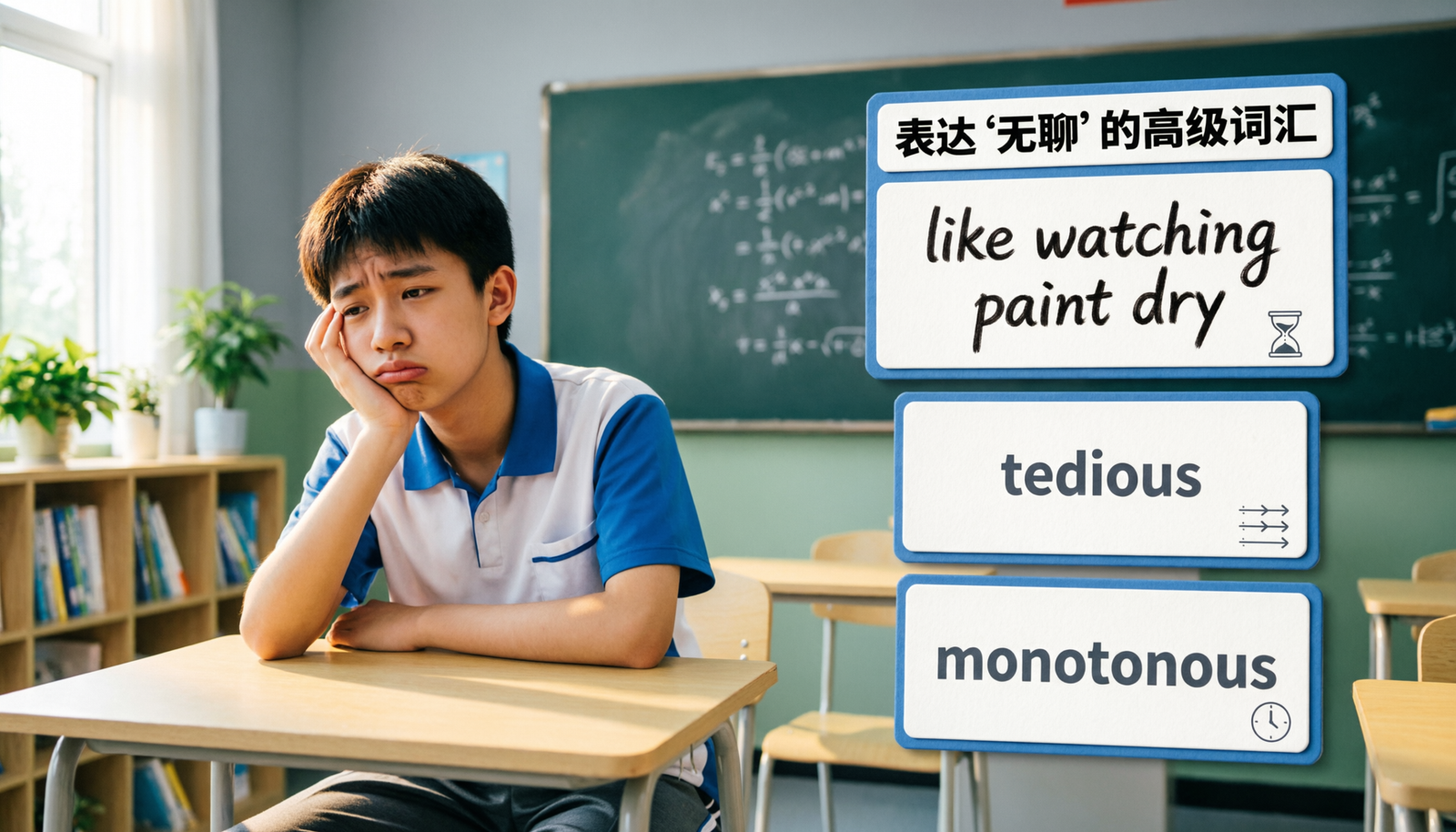
The word boring works well in everyday English, but using it repeatedly can make your own speech or writing sound dull. That is why students, writers, and ESL learners often search for idioms for boring, descriptive phrases, and alternative words that express the same general idea.
However, an idiom for boring and a synonym for boring do not work in exactly the same way.
A synonym replaces the word boring with another word that has a similar meaning, such as dull, tedious, or monotonous. An idiom expresses boredom or dullness through a figurative phrase, such as as dull as dishwater or like watching paint dry.
The core difference is simple:
Synonyms describe boredom directly, while idioms usually describe it figuratively and more expressively.
Both can help you avoid repetition, but the right choice depends on your audience, tone, and purpose.
What Idioms for Boring Mean
An idiom for boring is a fixed or commonly recognized expression that describes something as uninteresting, repetitive, lifeless, or difficult to enjoy.
The meaning of an idiom may not come directly from the individual words. Instead, the complete phrase carries a figurative meaning.
For example:
The lecture was like watching paint dry.
Nobody was literally watching paint. The phrase means the lecture felt extremely slow and uninteresting.
Simple definition
An idiom for boring is a figurative expression used to show that something lacks interest, excitement, or variety.
Purpose
Writers and speakers use these idioms to:
- make descriptions more vivid
- add humor or personality
- emphasize extreme boredom
- avoid repeating the word boring
- create an emotional reaction
How it works
The expression compares a dull experience with another activity or situation commonly associated with slowness, repetition, or lack of excitement.
Short example
The meeting was as dull as dishwater.
Why idioms get confused with synonyms
Idioms and synonyms can communicate similar ideas. However, an idiom normally contains several words and uses figurative meaning, while a synonym usually replaces boring directly with one word.
What Synonyms for Boring Mean
A synonym for boring is a word with the same or a closely related meaning as boring.
Common examples include:
- dull
- tedious
- monotonous
- tiresome
- uninteresting
- repetitive
- dreary
- lifeless
These words are not always completely interchangeable. Each one highlights a different type or cause of boredom.
For example, monotonous suggests repetition, while tedious suggests that something feels too long or requires tiresome effort.
Simple definition
A synonym for boring is a word that directly describes something as lacking interest, variety, energy, or enjoyment.
Purpose
Synonyms help speakers and writers:
- choose a more precise meaning
- avoid repetition
- match formal or informal situations
- describe the cause of boredom
- improve vocabulary
How it works
A synonym usually fits into the same grammatical position as the word boring.
Compare:
It was a boring lesson.
It was a tedious lesson.
The sentence structure stays almost the same, but the second sentence suggests that the lesson felt tiring or unnecessarily long.
Short example
The documentary became monotonous after the first hour.
Why synonyms get confused with idioms
Both offer alternative ways to express boredom. The difference is that synonyms communicate the meaning directly, while idioms usually use imagery, comparison, or figurative language.
Idioms for Boring vs Synonyms for Boring: The Core Difference
The main difference lies in how the meaning gets expressed.
A synonym names the quality directly:
The speech was tedious.
An idiom presents the same general idea through an image or comparison:
The speech was like watching grass grow.
The synonym is concise and precise. The idiom is more colorful and emotional.
This distinction also affects tone. Synonyms often work well in academic, professional, and formal writing. Idioms usually sound more natural in conversation, storytelling, reviews, personal essays, and informal writing.
Neither type is automatically better. The strongest choice depends on the sentence and the effect you want to create.
Quick Comparison Table
| Point | Idioms for Boring | Synonyms for Boring |
|---|---|---|
| Definition | Figurative phrases describing dullness or boredom | Words with meanings similar to boring |
| Scope | Expressive and often situation-based | Broad, direct, and vocabulary-based |
| Purpose | To add imagery, emphasis, humor, or personality | To describe something precisely and avoid repetition |
| Length | Usually several words | Usually one word |
| Structure | Often a fixed phrase, comparison, or expression | Usually an adjective or descriptive word |
| Meaning | Frequently figurative | Usually direct |
| Tone | Common in speech, fiction, reviews, and informal writing | Suitable for both formal and informal contexts |
| Use in writing | Adds voice and creates a vivid impression | Improves accuracy and word choice |
| Example | “It was like watching paint dry.” | “It was tedious.” |
| Best feature | Expressiveness | Precision |
How Idioms for Boring Work
Idioms for boring often work through exaggeration, comparison, or familiar cultural imagery.
Consider the expression:
It was like watching paint dry.
Watching paint dry involves little movement or change. The idiom transfers that sense of slowness to another experience, such as a lecture, game, movie, or meeting.
Several common patterns appear in boring idioms.
Comparison with a dull activity
Some idioms compare an experience with an activity that people generally consider unexciting.
Examples include:
- like watching paint dry
- like watching grass grow
- as exciting as waiting in line
- about as interesting as reading a phone book
These comparisons help the listener imagine the boredom.
Exaggeration
An idiom may deliberately overstate how dull something felt.
That presentation nearly bored me to death.
The speaker does not usually mean that death was a real possibility. The exaggeration emphasizes intense boredom.
Description of mental disengagement
Some expressions focus on the listener’s reaction rather than the dull object or event.
Examples include:
- my eyes glazed over
- I was bored out of my mind
- it put me to sleep
- my mind started to wander
These phrases show what boredom does to a person.
Humor and sarcasm
Idioms can also make criticism sound funny or sarcastic.
The movie was a real thrill a minute.
In the right context, this phrase may be sincere. With a sarcastic tone, however, it means the movie was not thrilling at all.
Because tone changes meaning, learners should pay attention to context.
How Synonyms for Boring Work
Synonyms for boring provide different shades of meaning. They allow writers to explain not only that something was boring but also why it felt boring.
Dull
Dull describes something that lacks interest, energy, brightness, or excitement.
The conversation became dull after a few minutes.
It is one of the closest and most flexible replacements for boring.
Tedious
Tedious describes something that feels too long, slow, detailed, or tiring.
Entering hundreds of names into the system was tedious.
Use it for tasks, explanations, processes, or experiences that require patience.
Monotonous
Monotonous describes something that repeats without enough change or variety.
The speaker’s monotonous voice made it hard to concentrate.
The word often applies to routines, sounds, jobs, speeches, and repeated actions.
Uninteresting
Uninteresting directly states that something does not attract attention or curiosity.
I found the second chapter uninteresting.
It sounds neutral and less emotional than many other alternatives.
Tiresome
Tiresome describes something that causes annoyance or mental fatigue, often because it continues for too long.
His tiresome complaints ruined the evening.
It can suggest irritation as well as boredom.
Dreary
Dreary describes something gloomy, depressing, or lacking energy.
They spent the afternoon in a dreary waiting room.
It combines dullness with sadness or bleakness.
Repetitive
Repetitive identifies repetition as the cause of boredom.
The exercises became repetitive after several lessons.
It is useful when the same action, idea, sound, or structure appears too often.
Lifeless
Lifeless describes writing, performances, places, or conversations that lack energy and personality.
The actor gave a lifeless performance.
It is especially useful in reviews and creative criticism.
Key Differences in Simple Language
Idioms and synonyms for boring differ in several important ways.
Direct versus figurative meaning
A synonym communicates the meaning directly:
The book was dull.
An idiom communicates it through an image:
Reading the book was like watching grass grow.
One word versus a complete phrase
Most synonyms contain one word, while idioms usually contain several words.
- Synonym: tedious
- Idiom: bored to tears
Precision versus personality
A synonym often gives a more exact description.
The work was repetitive.
This sentence explains the source of the boredom.
An idiom usually adds more personality.
The work was enough to put anyone to sleep.
Formal versus conversational use
Synonyms usually fit formal writing more easily.
The procedure was unnecessarily tedious.
Idioms often fit speech and informal writing better.
The procedure was like watching paint dry.
Flexible versus fixed structure
Writers can use synonyms in many grammatical structures. Idioms tend to follow a recognizable form and may sound unnatural when changed too much.
For example, English speakers commonly say bored to tears. Changing it to bored toward tears would be incorrect.
Can Idioms and Synonyms for Boring Overlap?
Idioms and synonyms can overlap in meaning because both describe a lack of interest or excitement.
For example:
The class was monotonous.
The class put me to sleep.
Both sentences suggest that the class was boring. However, they focus on different things.
The first sentence directly describes the class. The second describes the effect the class had on the speaker.
Writers may also use both forms in the same passage:
The training session was monotonous. After an hour of repeated slides, several employees looked as though they were watching paint dry.
Here, monotonous gives a precise description. The idiomatic comparison adds imagery and humor.
This combination can make writing more effective, provided the author does not overuse figurative expressions.
Examples of Idioms for Boring
1. Like watching paint dry
Meaning: Extremely slow and uninteresting.
The first half of the film was like watching paint dry.
This idiom works well for movies, sports, meetings, and other experiences with little action.
2. Like watching grass grow
Meaning: Painfully slow or uneventful.
Waiting for the results felt like watching grass grow.
It often describes a process that takes a long time without visible progress.
3. As dull as dishwater
Meaning: Extremely dull or uninteresting.
His speech was as dull as dishwater.
This expression is informal and more common in British English, although many English speakers understand it.
4. Bored to tears
Meaning: Extremely bored.
The children were bored to tears during the long ceremony.
The phrase exaggerates the emotional effect of boredom.
5. Bored out of my mind
Meaning: So bored that concentration becomes difficult.
I was bored out of my mind on the five-hour bus ride.
This expression sounds natural in casual conversation.
6. Bored stiff
Meaning: Completely or intensely bored.
We sat through the presentation bored stiff.
It creates the image of someone becoming rigid or unresponsive from boredom.
7. It put me to sleep
Meaning: It was so boring or calm that it made the person sleepy.
The lecturer’s flat voice nearly put me to sleep.
This may be literal or figurative, depending on the context.
8. My eyes glazed over
Meaning: I stopped paying attention because the subject became dull, confusing, or too detailed.
My eyes glazed over when he started explaining every minor regulation.
The expression describes a visible reaction to boredom or information overload.
9. My mind started to wander
Meaning: I lost concentration and began thinking about unrelated things.
My mind started to wander halfway through the lesson.
This phrase can describe boredom, tiredness, or distraction.
10. A cure for insomnia
Meaning: Something so boring that it could make a person fall asleep.
That slow documentary was a cure for insomnia.
This expression is usually humorous or sarcastic.
11. Nothing to write home about
Meaning: Ordinary, unimpressive, or not especially interesting.
The exhibition was nothing to write home about.
It does not always mean extremely boring. It often means that something was merely average.
12. Same old, same old
Meaning: The same familiar and unexciting routine.
How was work? Same old, same old.
People commonly use this phrase when nothing new or interesting has happened.
13. All talk and no action
Meaning: Full of discussion or promises but lacking real activity or results.
The event was all talk and no action.
The phrase does not mean boring in every context, but it can describe an experience that feels dull because nothing actually happens.
14. It dragged on forever
Meaning: It seemed to continue for an extremely long time.
The meeting dragged on forever.
The phrase emphasizes the speaker’s experience of time during a boring event.
15. Dry as dust
Meaning: Extremely dull, lifeless, or lacking imagination.
The textbook was informative but dry as dust.
This idiom often describes writing, lectures, explanations, and academic material.
Examples of Synonyms for Boring
1. Dull
The lecture was informative but dull.
Use dull as a general alternative when something lacks excitement or interest.
2. Tedious
Checking every reference manually became tedious.
Use tedious when an activity feels long, detailed, and tiring.
3. Monotonous
The machine produced a monotonous humming sound.
Use monotonous when repetition or lack of variation causes boredom.
4. Uninteresting
The opening scene was visually attractive but uninteresting.
Use uninteresting for a neutral, direct description.
5. Tiresome
Their argument became tiresome after several hours.
Use tiresome when something causes boredom and irritation.
6. Dreary
The office looked dreary under the weak lighting.
Use dreary when dullness also feels gloomy or depressing.
7. Repetitive
The game becomes repetitive once you learn the basic pattern.
Use repetitive when the same actions or ideas appear too often.
8. Lifeless
The dialogue felt unnatural and lifeless.
Use lifeless when something lacks energy, emotion, or personality.
9. Bland
The article offered accurate but bland advice.
Use bland for writing, food, designs, personalities, or experiences that lack distinctive qualities.
10. Stale
The comedian relied on stale jokes.
Use stale when something feels old, overused, or no longer fresh.
11. Uneventful
We had a quiet and uneventful journey.
Use uneventful when little or nothing significant happens. The word can sound neutral rather than negative.
12. Wearisome
The negotiations became wearisome.
Wearisome is a more formal word for something tiring and difficult to tolerate.
13. Mind-numbing
Copying the figures by hand was mind-numbing.
This strong informal adjective describes an activity so boring and repetitive that it seems to reduce mental alertness.
14. Humdrum
She wanted a break from her humdrum routine.
Humdrum describes ordinary, predictable, and unexciting activities.
15. Lackluster
The team delivered a lackluster performance.
Use lackluster when a performance, effort, or result lacks energy and enthusiasm.
Idioms vs Synonyms for Boring in Literature and Writing
Writers choose between idioms and synonyms according to voice, genre, character, and intended effect.
Idioms create a recognizable voice
Idioms can make dialogue sound natural and reveal a character’s personality.
“That party was about as exciting as watching paint dry,” Mia said.
The idiom suggests that Mia speaks informally and enjoys sarcasm.
A different character might say:
“The party was remarkably uneventful.”
This version sounds more formal and controlled.
Both sentences express disappointment, but they create different voices.
Synonyms improve descriptive precision
In narration, a precise synonym often communicates more information than the general word boring.
Compare:
He had a boring job.
He had a monotonous job.
The second sentence suggests that repetition makes the job boring.
Now compare:
He had a tedious job.
This version suggests that the work feels tiring, slow, or unnecessarily detailed.
Idioms strengthen imagery
An idiom can turn a plain judgment into a memorable image.
The courtroom explanation was boring.
The courtroom explanation was dry as dust.
The second version creates a stronger sensory impression.
Too many idioms can weaken writing
Figurative language works best when writers use it selectively. A paragraph filled with several familiar idioms may sound exaggerated or unoriginal.
For example:
The meeting was dull as dishwater, dragged on forever, bored us to tears, and nearly put us to sleep.
One expression would probably communicate the idea more effectively.
Formal writing usually favors direct language
Academic essays, reports, and professional documents often need accuracy more than humor.
Instead of writing:
The process was like watching paint dry.
A formal report might say:
Participants found the repetitive process difficult to remain engaged with.
The direct version better suits a professional setting.
Idioms vs Synonyms for Students and ESL Learners
Students and English learners benefit from understanding both categories, but they should learn them differently.
Learn synonyms by meaning groups
Do not memorize every synonym as an exact replacement for boring. Group the words by the type of boredom they describe.
General lack of interest:
- dull
- uninteresting
- bland
Repetition:
- monotonous
- repetitive
- humdrum
Length or effort:
- tedious
- tiresome
- wearisome
Lack of energy:
- lifeless
- lackluster
- flat
Gloomy dullness:
- dreary
- bleak
- depressing
This method makes word choice easier and more accurate.
Learn idioms as complete expressions
Idioms should usually be learned as fixed chunks rather than separate words.
Learn:
bored out of my mind
Do not try to construct a new version such as:
boring outside of my brain
The invented phrase may follow logical vocabulary patterns, but it is not a recognized English expression.
Study context and tone
Some idioms sound casual, humorous, or sarcastic. They may work naturally with friends but seem inappropriate in formal assignments.
For example:
The professor’s lecture was a cure for insomnia.
This may sound funny in a private conversation. It could sound disrespectful in academic feedback.
A more suitable version would be:
The lecture was difficult to follow because the delivery was monotonous.
Notice regional differences
Some expressions appear more frequently in certain English-speaking regions. As dull as dishwater, for instance, has strong associations with British English.
Learners do not need to avoid regional idioms, but they should understand how their audience may hear them.
Use simple language before advanced vocabulary
An uncommon synonym does not automatically improve a sentence. A clear word such as dull often works better than an advanced word used incorrectly.
Accuracy should come before complexity.
Common Mistakes and Confusion
Treating every related word as an exact synonym
Words such as tedious, monotonous, and dreary overlap with boring, but they do not mean exactly the same thing.
Incorrect or awkward:
The weather was tedious.
Weather can feel dreary, dull, or monotonous, but tedious usually describes an activity, process, explanation, or task that demands patience.
Better:
The endless rainy weather felt dreary.
Calling every descriptive phrase an idiom
Not every multiword description counts as an idiom.
extremely boring
This is a normal adjective phrase, not an idiom.
like watching paint dry
This is idiomatic because its meaning depends on a familiar figurative comparison.
Mixing idioms incorrectly
Learners sometimes combine two recognized expressions.
Incorrect:
I was bored out of tears.
Correct:
I was bored to tears.
Correct:
I was bored out of my mind.
Blending idioms may create a phrase that sounds unnatural.
Using informal idioms in formal writing
A university essay should not normally describe a historical text as a cure for insomnia unless the writer is intentionally using humor.
Better formal alternatives include:
- repetitive
- overly detailed
- unengaging
- monotonous
- lacking narrative variety
Overusing the strongest alternatives
Words such as mind-numbing and expressions such as bored to death communicate extreme boredom. They may sound excessive when describing a mildly disappointing experience.
For example:
The five-minute introduction was mind-numbing.
This might work as exaggeration, but slightly dull may express the situation more honestly.
Confusing boredom with difficulty
A subject can be difficult without being boring. It can also be boring without being difficult.
The article was confusing.
This means it was hard to understand.
The article was monotonous.
This means it lacked variety.
Writers should identify the real problem before choosing a word.
Describing people carelessly
Calling a person boring can sound harsh because it judges the person’s whole personality.
Instead of saying:
He is boring.
A more specific description may be fairer:
He talks about the same subject in every conversation.
Specific language usually communicates criticism more clearly and respectfully.
When to Use Idioms and When to Use Synonyms
Use an idiom when you want to:
- make your description vivid
- add humor or sarcasm
- create an informal tone
- show a character’s personality
- emphasize how strongly you felt
- make dialogue sound conversational
Example:
The awards ceremony dragged on forever.
Use a synonym when you want to:
- communicate the meaning directly
- explain the cause of boredom
- write formally or professionally
- remain concise
- choose a precise tone
- avoid exaggeration
Example:
The awards ceremony became repetitive and unnecessarily lengthy.
Use both when the direct word and the figurative phrase support each other without creating repetition.
The documentary became monotonous, and by the final section, watching it felt like watching paint dry.
Related Terms People Often Confuse With Them
Metaphor
A metaphor describes one thing as though it were another.
The lecture was a sleeping pill.
This metaphor suggests that the lecture caused sleepiness or boredom.
Some boring idioms contain metaphorical language, but not every metaphor is an idiom. A new metaphor can be invented, while an idiom normally has an established meaning within a language community.
Simile
A simile compares two things using like or as.
The presentation was like watching grass grow.
Many idioms for boring take the form of similes. However, an original simile is not automatically an idiom. It becomes idiomatic when people recognize and commonly use the expression.
Euphemism
A euphemism replaces a harsh expression with a softer one.
Instead of saying:
The book was boring.
Someone might say:
The book was not particularly engaging.
This is softer and more diplomatic, but it is not necessarily an idiom.
Hyperbole
Hyperbole uses deliberate exaggeration.
I nearly died of boredom.
The speaker does not mean the statement literally. Many idioms about boredom rely on hyperbole to intensify the message.
Cliché
A cliché is an expression used so frequently that it may feel predictable or unoriginal.
Like watching paint dry is both idiomatic and potentially clichéd. It remains understandable, but creative writers may prefer a fresher comparison.
Collocation
A collocation is a combination of words that commonly appear together.
Examples include:
- painfully boring
- incredibly dull
- highly repetitive
- mind-numbingly tedious
These are natural word combinations, but they are not necessarily idioms because their meanings remain fairly direct.
Slang
Slang consists of highly informal words and expressions associated with particular communities, age groups, or periods.
For example:
That movie was a snoozefest.
Snoozefest is an informal slang term for an extremely boring event. It works in casual conversation but rarely belongs in formal writing.
Conclusion
Idioms for boring and synonyms for boring express similar ideas, but they perform different jobs.
A synonym such as dull, tedious, or monotonous describes boredom directly. It usually offers greater precision and works in a wide range of formal and informal situations.
An idiom such as like watching paint dry, bored to tears, or dry as dust presents boredom through imagery, exaggeration, or comparison. It adds personality and emotional force, especially in conversation and creative writing.
Choose a synonym when clarity and accuracy matter most. Choose an idiom when you want a vivid, conversational, or humorous effect. Learning both will help you describe different kinds of boredom without making your own language repetitive.
FAQs
What is a good idiom for something extremely boring?
Like watching paint dry is one of the most widely recognized expressions for something extremely slow and boring.
The match was like watching paint dry.
What is another word for boring?
Common synonyms include dull, tedious, monotonous, uninteresting, repetitive, dreary, and lifeless. The best choice depends on why the subject feels boring.
Is “bored to tears” an idiom?
Yes. Bored to tears is an idiomatic and exaggerated way to say that someone felt extremely bored.
We were bored to tears during the delay.
Is “monotonous” the same as “boring”?
The words overlap, but monotonous has a narrower meaning. It describes something boring because it repeats with little change or variation.
Can I use boring idioms in academic writing?
You can use them when analyzing language, quoting someone, or creating a deliberate stylistic effect. For most formal academic writing, direct alternatives such as repetitive, unengaging, or tedious work better.
What is a polite way to say something was boring?
You can say it was not very engaging, somewhat repetitive, slow-paced, or less interesting than expected. These phrases communicate criticism without sounding unnecessarily harsh.
Is “like watching grass grow” a simile or an idiom?
It is both. Grammatically, it is a simile because it uses like to make a comparison. It also functions as an idiom because English speakers commonly recognize its figurative meaning.