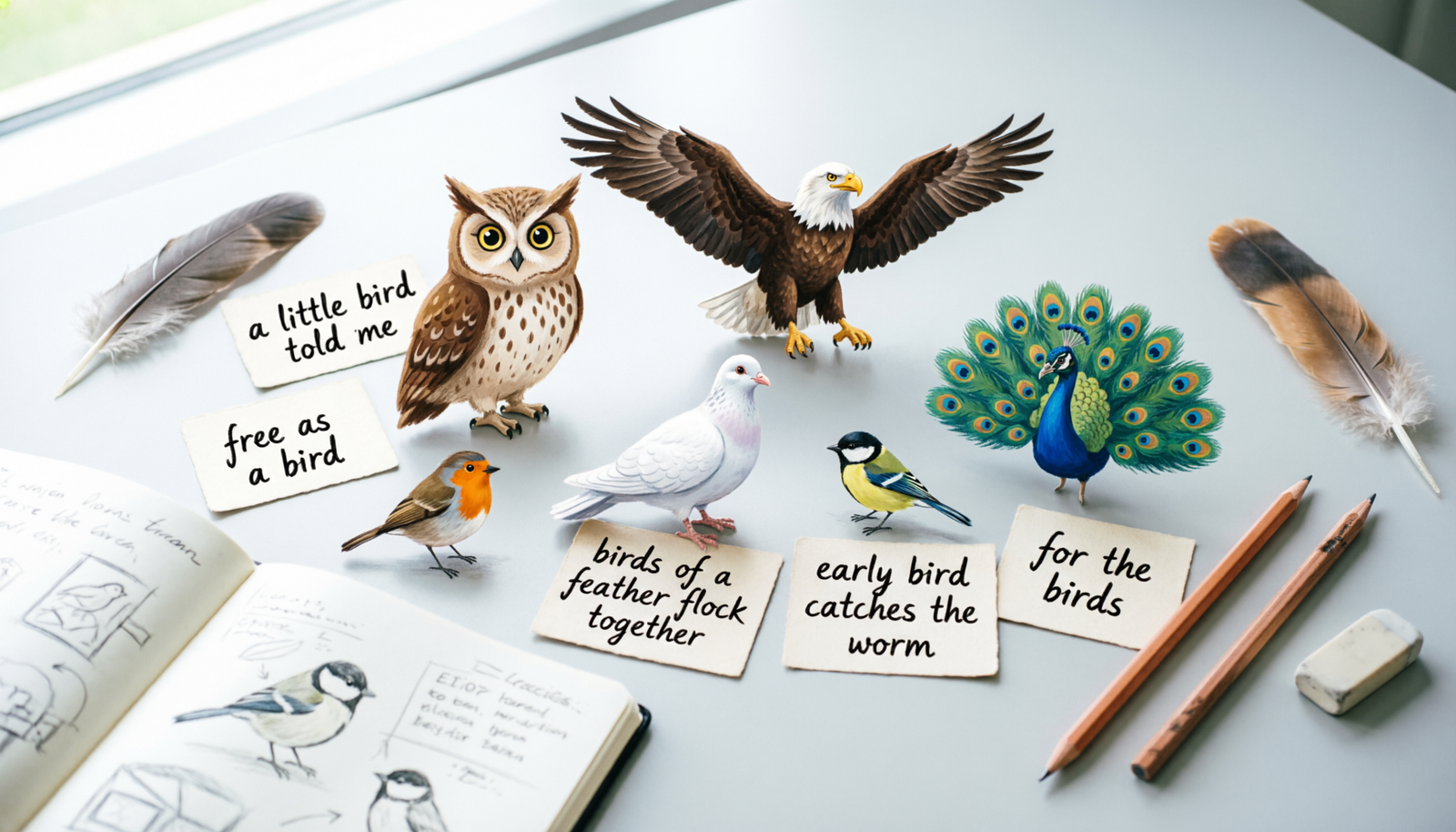
Birds appear everywhere in the English language. People talk about being as free as a bird, getting up with the early bird, or hearing important news straight from the horse’s mouth—although that last one has nothing to do with birds. These colorful expressions make English more vivid, but they can also confuse students and ESL learners.
When people search for idioms for birds, they usually want useful expressions such as “a little bird told me,” “kill two birds with one stone,” and “birds of a feather flock together.” However, not every familiar bird expression belongs to the same language category. Some are idioms, while others function more like proverbs.
The main difference is simple: a bird idiom is usually a fixed figurative expression used inside a sentence, while a bird proverb is a complete traditional saying that communicates advice, wisdom, or a general truth.
For example:
- A little bird told me is an idiom.
- The early bird catches the worm is a proverb.
Both use bird imagery, and both have meanings beyond the literal words. However, they differ in structure, purpose, and how people use them.
This guide explains bird idioms and bird proverbs clearly, compares them side by side, and provides practical examples for speaking, writing, schoolwork, and English revision.
What Bird Idioms Mean
A bird idiom is a fixed expression that uses a bird, bird behavior, or bird-related imagery to communicate a figurative meaning.
The speaker usually does not mean the words literally. For instance, when someone says, “A little bird told me you got the job,” no actual bird delivered the news. The phrase means that the speaker heard the information from an unnamed source.
Simple definition
A bird idiom is a familiar figurative phrase connected with birds that has a meaning different from the literal meaning of its individual words.
Purpose
Bird idioms help speakers and writers:
- express ideas creatively
- describe behavior or personality
- make conversations more natural
- communicate familiar ideas quickly
- add humor, emphasis, or imagery
How bird idioms work
An idiom works as part of a larger sentence. Its meaning comes from common usage rather than from the dictionary definitions of each word.
Consider this example:
Maya felt as free as a bird after finishing her final exam.
The phrase does not mean Maya became a bird. It means she felt completely free from pressure or responsibility.
Why bird idioms get confused with bird proverbs
Bird idioms and bird proverbs both use figurative language and familiar images. The confusion happens because some expressions, such as “birds of a feather flock together,” can behave like complete sayings while also appearing as idiomatic expressions in conversation.
What Bird Proverbs Mean
A bird proverb is a traditional saying that uses bird imagery to express advice, wisdom, a warning, or a general observation about life.
Unlike most idioms, a proverb usually forms a complete sentence and communicates a complete lesson.
Simple definition
A bird proverb is a short, traditional saying about birds that expresses a broader truth or piece of advice.
Purpose
Bird proverbs often:
- teach a lesson
- offer practical advice
- warn against a mistake
- describe common human behavior
- communicate shared cultural wisdom
How bird proverbs work
A proverb usually stands alone or appears as a complete comment on a situation.
For example:
You should apply for the scholarship today. The early bird catches the worm.
The proverb advises people to act early because those who act first often gain an advantage.
Why bird proverbs get confused with bird idioms
Like idioms, proverbs often have figurative meanings. They may also become fixed expressions that people repeat without changing the wording. However, a proverb normally communicates a full lesson, while an idiom usually contributes one idea inside a sentence.
Bird Idioms vs Bird Proverbs: The Core Difference
The clearest difference concerns function.
A bird idiom acts like a phrase within a sentence. It describes a feeling, action, person, or situation in a figurative way.
A bird proverb acts like a complete statement. It expresses advice, wisdom, or a general truth.
Compare these examples:
Daniel has always been an early bird.
Here, “an early bird” is an idiom describing someone who wakes up or arrives early.
The early bird catches the worm.
Here, the complete sentence is a proverb advising people to act before others.
The two expressions share similar bird imagery, but they perform different jobs.
Quick Comparison Table
| Point | Bird Idiom | Bird Proverb |
|---|---|---|
| Definition | A fixed figurative expression involving birds | A traditional saying involving birds |
| Scope | Usually describes one action, quality, or situation | Usually expresses a broader life lesson |
| Purpose | Adds imagery, personality, or emphasis | Offers advice, wisdom, or a warning |
| Length | Often a short phrase | Usually a complete sentence |
| Structure | Commonly used as part of another sentence | Can normally stand alone |
| Meaning | Figurative and context-dependent | Figurative, moral, or instructional |
| Use in writing | Dialogue, description, informal writing, creative work | Advice, reflection, arguments, speeches, and storytelling |
| Example | “He eats like a bird.” | “A bird in the hand is worth two in the bush.” |
How Bird Idioms Work
Bird idioms work through association. English speakers connect certain birds or bird behaviors with human qualities and experiences.
For example:
- Eagles suggest sharp vision, strength, or ambition.
- Owls suggest wisdom or late-night activity.
- Doves suggest peace or gentleness.
- Hawks suggest aggression or watchfulness.
- Chickens may suggest fear.
- Peacocks suggest pride or showiness.
These associations allow speakers to communicate complex ideas through short, recognizable images.
Consider the expression eagle-eyed:
The eagle-eyed editor noticed a missing comma.
An eagle can see small details from a great distance, so “eagle-eyed” describes a person who notices things carefully.
Some bird idioms use comparison:
She eats like a bird.
Others function as noun phrases:
Leo is a night owl.
Some operate as complete clauses:
A little bird told me.
Their grammatical structures vary, but their meanings remain figurative and conventional.
How Bird Proverbs Work
Bird proverbs turn observations about birds into lessons about human life.
For example, a person may have noticed that a bird already caught in the hand offers more certainty than two birds hidden in a bush. That image became the proverb:
A bird in the hand is worth two in the bush.
The proverb teaches that something certain and available may be more valuable than a larger but uncertain opportunity.
Bird proverbs often work through:
- comparison
- cause and effect
- contrast
- warning
- observation
- symbolic imagery
The listener must connect the bird image with a human situation.
For instance:
Don’t count your chickens before they hatch.
This proverb warns people not to assume success before the result becomes certain.
Key Differences in Simple Language
Bird idioms and bird proverbs share figurative language, but several differences help learners identify them.
An idiom is usually part of a sentence
Her children have finally flown the nest.
“Flown the nest” completes part of the sentence. It means the children have left home to live independently.
A proverb usually makes a complete point
Don’t put all your eggs in one basket.
This saying gives a complete warning about depending on only one plan, investment, or opportunity.
An idiom describes
Idioms often describe a person, feeling, action, or situation.
He was running around like a headless chicken.
The idiom describes confused and uncontrolled behavior.
A proverb advises or teaches
Proverbs often explain what someone should or should not do.
Don’t count your chickens before they hatch.
The proverb advises against assuming success too soon.
Idioms fit into many sentence patterns
A writer can change the surrounding sentence while keeping the idiom:
I heard it from a little bird.
A little bird told us about the surprise.
Proverbs usually keep a fixed sentence structure:
The early bird catches the worm.
Can Bird Idioms and Bird Proverbs Overlap?
Yes. The categories can overlap because language does not always fit into perfectly separate boxes.
Some complete sayings function as proverbs because they express general wisdom, but speakers may also use them idiomatically in everyday conversation.
Consider:
Birds of a feather flock together.
This saying suggests that people with similar personalities, interests, or values often spend time together. It can function as a proverb because it expresses a general observation about human behavior.
However, speakers may also use the shorter phrase birds of a feather as an idiom:
Sam and Daniel are birds of a feather.
Here, the expression describes two similar people and acts as part of a sentence.
Another example involves the early bird:
Nina is an early bird.
This is an idiom describing someone who wakes up, works, or arrives early.
The early bird catches the worm.
This is a proverb teaching that early action creates opportunities.
The best way to classify an expression is to examine how it functions in the sentence rather than relying only on its vocabulary.
Examples of Bird Idioms
1. A little bird told me
Meaning: I heard the information from a source I do not want to name.
Example: A little bird told me that you are planning a surprise party.
2. As free as a bird
Meaning: Completely free from restrictions or responsibilities.
Example: After submitting the project, I felt as free as a bird.
3. A bird’s-eye view
Meaning: A view from high above or a broad overview of a subject.
Example: The report gives readers a bird’s-eye view of the company’s finances.
4. An early bird
Meaning: A person who wakes up, arrives, or acts early.
Example: Marcus is an early bird who starts work before sunrise.
5. A night owl
Meaning: A person who prefers staying awake or working late at night.
Example: I am a night owl, so I do my best writing after midnight.
6. Eat like a bird
Meaning: Eat very little.
Example: Although Priya ordered a large meal, she ate like a bird.
This idiom can be misleading because many real birds eat large amounts relative to their body size.
7. Watch someone like a hawk
Meaning: Observe someone very closely.
Example: The lifeguard watched the children like a hawk.
8. Eagle-eyed
Meaning: Very observant and able to notice small details.
Example: Our eagle-eyed teacher spotted the spelling error immediately.
9. Chicken out
Meaning: Decide not to do something because of fear.
Example: I planned to ride the roller coaster, but I chickened out.
10. No spring chicken
Meaning: No longer young.
Example: My grandfather still hikes regularly, although he is no spring chicken.
11. Fly the nest
Meaning: Leave the family home and begin living independently.
Example: Their youngest daughter flew the nest after graduating from college.
12. Ruffle someone’s feathers
Meaning: Annoy, upset, or offend someone.
Example: His blunt criticism ruffled a few feathers during the meeting.
13. Take someone under your wing
Meaning: Protect, support, or guide someone.
Example: The senior designer took the new employee under her wing.
14. Run around like a headless chicken
Meaning: Act in a confused, panicked, or disorganized way.
Example: We ran around like headless chickens before the guests arrived.
15. Spread your wings
Meaning: Become more independent or try new experiences.
Example: Moving to another city gave Elena a chance to spread her wings.
16. In fine feather
Meaning: Healthy, cheerful, or in excellent condition.
Example: After a restful vacation, he returned in fine feather.
This expression sounds less common in everyday modern conversation but may still appear in literature and formal writing.
17. Pecking order
Meaning: A social ranking system in which some people have more power or status than others.
Example: New employees quickly learn the office pecking order.
18. Nest egg
Meaning: Money saved for the future.
Example: They built a healthy nest egg for retirement.
19. Feather your own nest
Meaning: Use a position or opportunity to gain money or advantages for yourself.
Example: The official was accused of using public funds to feather his own nest.
20. Swan song
Meaning: A final performance, achievement, or piece of work before retirement or departure.
Example: The album became the singer’s swan song.
21. Sing like a canary
Meaning: Reveal secret information, often to the authorities.
Example: The suspect began singing like a canary during the interview.
22. Proud as a peacock
Meaning: Extremely proud, sometimes in a showy way.
Example: He was as proud as a peacock after winning the competition.
23. Sick as a parrot
Meaning: Extremely disappointed.
Example: The fans were sick as parrots after their team lost in the final minute.
This idiom appears more often in British English than in American English.
24. For the birds
Meaning: Worthless, uninteresting, or not worth serious attention.
Example: That complicated reward program is for the birds.
This expression appears mainly in informal American English.
25. Go cold turkey
Meaning: Stop a habit suddenly and completely.
Example: She went cold turkey and stopped drinking soda overnight.
Examples of Bird Proverbs
1. The early bird catches the worm
Meaning: People who act early often gain an advantage.
Example: I submitted my application on the first day because the early bird catches the worm.
2. A bird in the hand is worth two in the bush
Meaning: A certain opportunity is often better than a more attractive but uncertain one.
Example: I accepted the confirmed job offer instead of waiting for another one. A bird in the hand is worth two in the bush.
3. Birds of a feather flock together
Meaning: People with similar interests or personalities often spend time together.
Example: Both students love robotics and coding. Birds of a feather flock together.
4. Don’t count your chickens before they hatch
Meaning: Do not assume something will succeed before it actually happens.
Example: You have not received the contract yet, so do not count your chickens before they hatch.
5. Don’t put all your eggs in one basket
Meaning: Do not risk everything on one plan or opportunity.
Example: Invest in several areas because you should not put all your eggs in one basket.
6. What is good for the goose is good for the gander
Meaning: People in similar situations should receive equal treatment.
Example: If employees must follow the rule, managers should follow it too. What is good for the goose is good for the gander.
7. One swallow does not make a summer
Meaning: One positive sign does not prove that a situation has completely improved.
Example: Sales increased this month, but one swallow does not make a summer.
8. Fine feathers make fine birds
Meaning: Attractive clothing can improve a person’s appearance or influence how others see them.
Example: Everyone noticed his elegant new suit. Fine feathers make fine birds.
The proverb may also carry a critical tone by suggesting that appearance can hide a person’s true character.
9. The chickens have come home to roost
Meaning: Past mistakes or harmful actions have finally produced negative consequences.
Example: The company ignored safety warnings for years, and now the chickens have come home to roost.
10. You cannot make an omelet without breaking eggs
Meaning: Progress sometimes requires sacrifice, difficulty, or disruption.
Example: The office renovation will cause inconvenience, but you cannot make an omelet without breaking eggs.
This saying uses eggs rather than birds directly, but it belongs naturally among common bird-related proverbs.
Bird Idioms vs Bird Proverbs in Literature and Writing
Writers use bird language because birds carry powerful symbolic associations. They can represent freedom, hope, danger, peace, migration, loneliness, ambition, or escape.
Bird idioms in writing
Idioms work well in:
- dialogue
- personal essays
- informal articles
- character descriptions
- humorous writing
- everyday storytelling
For example:
“A little bird told me you were leaving,” Clara said.
The idiom creates a natural conversational tone and adds a little mystery.
However, writers should avoid overusing idioms. Too many familiar expressions can make prose sound predictable or clichéd.
Bird proverbs in writing
Proverbs work well when a character offers advice, comments on a mistake, or summarizes a lesson.
For example:
His father warned him not to reject the guaranteed offer. “A bird in the hand is worth two in the bush,” he said.
The proverb reveals both the advice and the speaker’s traditional way of thinking.
Bird symbolism is broader than both
A bird image does not automatically become an idiom or proverb.
Consider:
The caged bird stared through the narrow bars.
In a literal scene, this sentence describes an actual bird. In a poem or novel, the caged bird might symbolize oppression or lost freedom. That symbolic image is not necessarily an idiom or proverb.
Writers should therefore distinguish among:
- literal bird references
- bird idioms
- bird proverbs
- bird metaphors
- bird symbols
Bird Idioms vs Bird Proverbs for Students and ESL Learners
Students often try to understand an unfamiliar idiom by translating every word literally. That strategy rarely works.
For example, the individual words in ruffle someone’s feathers may suggest touching a bird’s feathers. The actual expression means annoying or upsetting someone.
A better learning method involves four steps:
- Learn the complete expression.
- Learn its figurative meaning.
- Read it in a natural sentence.
- Practise using it in a realistic context.
For proverbs, learners should also identify the lesson.
Consider:
Don’t put all your eggs in one basket.
A learner should not stop at “eggs may break.” The broader lesson concerns risk. Depending on one option can leave a person with nothing if that option fails.
Students can ask two useful questions:
- Does the expression describe something inside a sentence?
- Does the expression communicate a complete lesson or truth?
The first usually points to an idiom. The second usually points to a proverb.
Common Mistakes and Confusion
Taking the expression literally
The sentence “He has flown the nest” normally refers to a young person leaving home, not to a man physically flying from a nest.
Always consider the context before choosing a literal interpretation.
Calling every bird expression an idiom
“The early bird catches the worm” contains figurative language, but it functions mainly as a proverb because it gives advice through a complete sentence.
Calling every complete sentence a proverb
“A little bird told me” can stand as a sentence, but it does not communicate general wisdom. It simply means that someone shared information. It functions as an idiom.
Mixing the wording
Fixed expressions normally follow established wording.
Correct:
Don’t count your chickens before they hatch.
Unnatural:
Don’t count the birds before the eggs open.
Changing important words may destroy the familiar meaning.
Using an idiom in the wrong tone
Some expressions sound informal or region-specific.
“Chicken out” suits conversation and casual writing, but it may sound unsuitable in a formal academic report.
“Sick as a parrot” may make sense to British readers but sound unfamiliar to many American readers.
Overusing bird expressions
One well-placed idiom can make writing lively. Several idioms in every paragraph may make the writing feel forced.
Confusing idioms with similes
“Proud as a peacock” is both a fixed expression and a simile because it compares someone with a peacock using “as.”
Not all bird idioms are similes:
She took the intern under her wing.
This idiom uses metaphorical imagery rather than a direct comparison with “like” or “as.”
When to Use Bird Idioms and When to Use Bird Proverbs
Use a bird idiom when you want to describe a person, action, feeling, or situation in a vivid and familiar way.
Examples:
I am a night owl.
She watched the children like a hawk.
Their son has finally flown the nest.
Bird idioms suit conversation, creative writing, informal articles, and personal communication.
Use a bird proverb when you want to provide advice, express a general truth, or comment on the result of someone’s behavior.
Examples:
The early bird catches the worm.
Don’t put all your eggs in one basket.
A bird in the hand is worth two in the bush.
Bird proverbs suit speeches, essays, stories, discussions, and situations where a speaker wants to summarize a lesson.
In formal writing, explain the idea directly unless the proverb adds genuine value. For example, an academic report may sound clearer with “diversification reduces financial risk” instead of “do not put all your eggs in one basket.”
Related Terms People Often Confuse With Them
Bird metaphors
A metaphor directly presents one thing as another.
She is a caged bird in that restrictive household.
The person is not literally a bird. The metaphor suggests confinement and lack of freedom.
A metaphor may be newly created, while an idiom usually has a fixed, widely recognized meaning.
Bird similes
A simile compares two things using words such as “like” or “as.”
He soared like an eagle after receiving the good news.
Some similes become familiar idioms, including “as free as a bird” and “proud as a peacock.”
Bird symbolism
Symbolism occurs when a bird represents a larger idea.
For example:
- a dove may represent peace
- an eagle may represent strength or freedom
- a raven may represent death or mystery
- a caged bird may represent oppression
- a phoenix may represent rebirth
Symbolism often develops across a poem, story, artwork, or cultural tradition.
Bird clichés
A cliché is an expression that people have used so often that it may feel unoriginal.
Many idioms can become clichés when writers use them without thought.
For example:
She was finally ready to spread her wings.
The expression remains understandable, but writers may prefer a more specific description in original creative work.
Bird sayings
“Bird saying” is a broad, informal label. It may include idioms, proverbs, quotations, similes, and traditional expressions.
Bird phrasal verbs
Some bird-related expressions resemble phrasal verbs.
He chickened out.
The children flew off in different directions.
“Chicken out” has an idiomatic meaning, while “flew off” may remain literal depending on the context.
Conclusion
Bird idioms and bird proverbs both use familiar bird imagery to communicate ideas beyond literal meaning, but they serve different purposes.
A bird idiom usually functions as part of a sentence and describes a person, action, feeling, or situation. Expressions such as “a night owl,” “under her wing,” and “ruffle a few feathers” make language more vivid and natural.
A bird proverb normally forms a complete statement and communicates advice, wisdom, or a general truth. Sayings such as “the early bird catches the worm” and “a bird in the hand is worth two in the bush” turn observations about birds into lessons about human life.
The easiest way to identify the difference is to examine the expression’s job. When it describes, it is likely an idiom. When it teaches or advises, it is likely a proverb. Some expressions overlap, but understanding their function, context, and intended meaning will help you use them accurately.
FAQs
What are some common idioms for birds?
Common bird idioms include “a little bird told me,” “as free as a bird,” “a night owl,” “watch like a hawk,” “fly the nest,” “ruffle someone’s feathers,” and “take someone under your wing.”
Is “birds of a feather flock together” an idiom or a proverb?
The complete saying is usually classified as a proverb because it expresses a general truth about similar people staying together. The shorter phrase “birds of a feather” can function as an idiom.
Is “the early bird catches the worm” an idiom?
People sometimes call it an idiom informally, but it is more accurately described as a proverb. It forms a complete sentence and teaches that acting early can provide an advantage.
What does “a little bird told me” mean?
It means that someone shared information with the speaker, but the speaker does not want to identify the source.
What is the difference between a bird idiom and a bird metaphor?
A bird idiom has a fixed meaning recognized by many speakers, such as “night owl.” A bird metaphor may be an original comparison created for a particular sentence, poem, or story.
Are bird idioms suitable for formal writing?
Some bird idioms can appear in formal writing, but writers should use them carefully. Direct language often works better in academic, legal, technical, or professional documents.
Why are birds common in English idioms?
Birds have noticeable behaviors and strong cultural associations. Flight suggests freedom, nests suggest home, hawks suggest sharp attention, and owls suggest wisdom or nighttime activity. These connections make birds useful sources of figurative language.