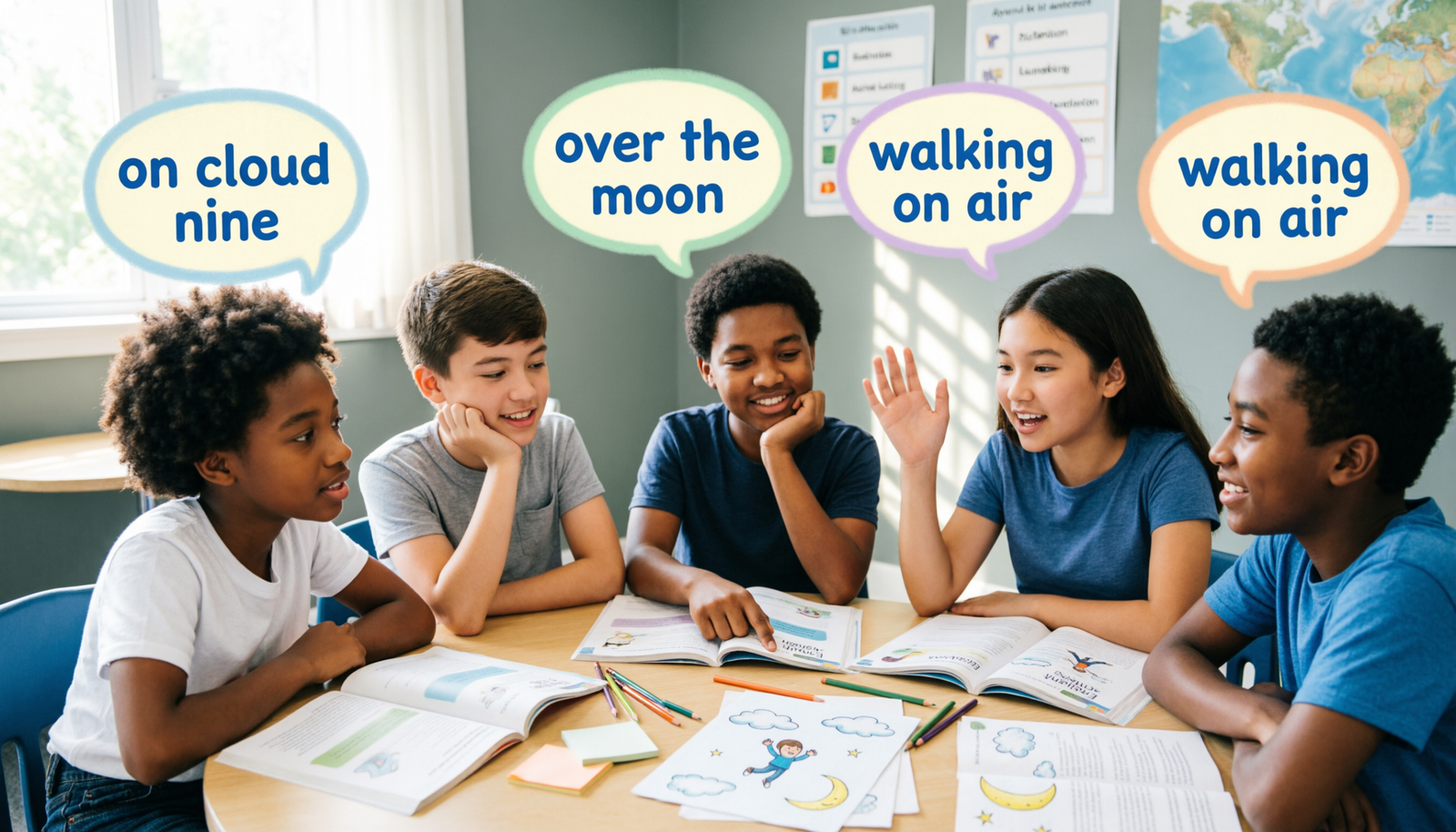
Happiness is easy to feel, but it is not always easy to describe. You can say, “I am happy,” and everyone will understand you. But English also gives you more colorful ways to express joy, excitement, relief, satisfaction, and delight. That is where idioms for happiness become useful.
An idiom is a phrase whose meaning is different from the literal meaning of its words. For example, when someone says they are on cloud nine, they do not mean they are standing on a real cloud. They mean they feel extremely happy.
Many students and ESL learners confuse idioms for happiness with simple happiness words such as happy, glad, pleased, or excited. The difference is simple: literal expressions say happiness directly, while idioms express happiness in a more imaginative or figurative way.
This article explains idioms for happiness, literal happiness expressions, their differences, their overlap, and how to use them naturally in writing and speech.
What Idioms for Happiness Mean
Idioms for happiness are fixed or common phrases that express joy, excitement, pleasure, or satisfaction in a figurative way.
Simple definition:
An idiom for happiness is a phrase that means someone feels happy, even though the words may not directly say “happy.”
Purpose:
Idioms make language more expressive, natural, and memorable. They help writers and speakers show emotion with color instead of using plain words every time.
How it works:
An idiom creates meaning through common usage, not through the literal meaning of each word.
Short example:
“She was over the moon when she got accepted into her dream university.”
Why it gets confused with literal happiness expressions:
Both describe happy feelings, but idioms do it indirectly. Learners may understand the emotion but miss the figurative meaning if they read the words literally.
What Literal Happiness Expressions Mean
Literal happiness expressions are direct words or phrases that clearly state a happy feeling.
Simple definition:
A literal happiness expression says exactly what the person feels, without using figurative or hidden meaning.
Purpose:
Literal expressions give clear, simple, and direct meaning. They work well when you want readers or listeners to understand the emotion quickly.
How it works:
The words mean exactly what they say.
Short example:
“She was very happy when she got accepted into her dream university.”
Why it gets confused with idioms for happiness:
Both sentences express joy, but the idiom sounds more colorful, while the literal expression sounds more direct.
Idioms for Happiness vs Literal Happiness Expressions: The Core Difference
The core difference is this:
Idioms for happiness express joy figuratively, while literal happiness expressions express joy directly.
If you say, “I am happy,” your meaning is clear and direct. If you say, “I am on cloud nine,” your meaning is still happiness, but you express it through an image. The idiom sounds more vivid and emotional.
Idioms are narrower because they belong to figurative language. Literal expressions are broader because they include simple words, phrases, and sentences that describe happiness plainly.
Quick Comparison Table
| Point | Idioms for Happiness | Literal Happiness Expressions |
|---|---|---|
| Definition | Figurative phrases that mean someone feels happy | Direct words or phrases that state happiness clearly |
| Scope | Narrower; a type of figurative language | Broader; includes simple emotional vocabulary |
| Purpose | To add color, personality, and natural expression | To communicate emotion clearly and directly |
| Length | Often short phrases | Can be one word, a phrase, or a full sentence |
| Structure | Usually fixed or commonly repeated | Flexible and easy to change |
| Meaning | Not always clear from the individual words | Clear from the actual words |
| Use in writing | Useful in dialogue, stories, essays, and creative writing | Useful in all kinds of writing and speech |
| Example | “He was walking on air.” | “He felt extremely happy.” |
How Idioms for Happiness Work
Idioms for happiness work by using images, exaggeration, or cultural associations to express emotion.
For example, walking on air suggests someone feels so light and joyful that they almost float. The person is not literally walking above the ground. The phrase shows a strong emotional state.
Many happiness idioms use ideas such as height, lightness, brightness, celebration, or physical excitement. These images match how happiness often feels in real life.
Common patterns include:
| Idiom Pattern | Example | Meaning |
|---|---|---|
| Height or rising | on cloud nine | extremely happy |
| Lightness | walking on air | joyful and excited |
| Celebration | jump for joy | show great happiness |
| Brightness | beaming with joy | visibly happy |
| Sweetness | pleased as punch | very pleased |
Idioms often sound more natural in informal speech, stories, and expressive writing. They help readers feel the emotion instead of only understanding it.
How Literal Happiness Expressions Work
Literal happiness expressions work by naming the emotion directly. They do not require the reader to understand a hidden meaning.
Examples include:
| Literal Expression | Meaning |
|---|---|
| happy | feeling pleasure or joy |
| glad | pleased or relieved |
| delighted | very pleased |
| joyful | full of happiness |
| excited | happy and energetic |
| satisfied | happy because something meets expectations |
| cheerful | noticeably happy and positive |
Literal expressions are useful because they are clear. In academic writing, business communication, beginner English, and formal situations, direct language often works better than idioms.
For example:
“She felt relieved and happy after passing the test.”
This sentence does not sound as colorful as “She was on cloud nine,” but it gives the meaning clearly.
Key Differences in Simple Language
Idioms for happiness are more colorful. Literal happiness expressions are more direct.
Idioms often create pictures in the reader’s mind. Literal expressions simply name the feeling.
Idioms can sound natural in conversation, creative writing, and storytelling. Literal expressions work almost everywhere.
Idioms may confuse beginners because the words do not always explain the meaning. Literal expressions help learners build clear vocabulary first.
A good rule is simple: use literal expressions when clarity matters most, and use idioms when you want stronger style or emotion.
Can Idioms for Happiness and Literal Expressions Overlap?
Yes, they can overlap because both describe the same emotional area: happiness.
For example:
“She was happy.”
“She was over the moon.”
Both sentences tell us that the person feels joy. The difference lies in style and structure. The first sentence says the feeling directly. The second sentence uses an idiom to make the feeling stronger and more expressive.
Writers often combine both:
“She was over the moon, happier than she had been in years.”
This sentence uses an idiom and a literal explanation together. That can help ESL learners and readers understand the emotion clearly while still enjoying the figurative language.
Examples of Idioms for Happiness
Here are common idioms for happiness with simple meanings and natural examples.
1. On cloud nine
Meaning: extremely happy
Example:
“After winning the scholarship, Maria was on cloud nine.”
Use it when someone feels great joy after good news or success.
2. Over the moon
Meaning: very happy and excited
Example:
“They were over the moon about their new home.”
This idiom works well in both American and British English.
3. Walking on air
Meaning: feeling light, joyful, and excited
Example:
“He was walking on air after his first book was published.”
This phrase often suggests happiness that lasts for a while.
4. In seventh heaven
Meaning: extremely happy
Example:
“She was in seventh heaven during her vacation in Italy.”
This idiom sounds slightly more literary or old-fashioned than “over the moon,” but people still understand it.
5. Jump for joy
Meaning: show great happiness
Example:
“The children jumped for joy when they saw the snow.”
This idiom can describe real physical action or strong emotional excitement.
6. Grin from ear to ear
Meaning: smile very widely because of happiness
Example:
“He was grinning from ear to ear after hearing the news.”
This phrase focuses on the visible sign of happiness.
7. Pleased as punch
Meaning: very pleased or satisfied
Example:
“Grandma was pleased as punch with the handmade card.”
This idiom has a warm, slightly informal tone.
8. Happy as a clam
Meaning: very happy and content
Example:
“She sat by the window with a book, happy as a clam.”
This idiom often suggests quiet satisfaction rather than loud excitement.
9. Like a kid in a candy store
Meaning: very excited and happy, especially because of many choices
Example:
“He was like a kid in a candy store at the music shop.”
This idiom works well when someone feels excited by abundance or possibility.
10. Beaming with joy
Meaning: looking very happy
Example:
“The bride was beaming with joy.”
This expression sits close to idiom and descriptive phrase. It uses imagery, but the meaning stays easy to understand.
Examples of Literal Happiness Expressions
Literal expressions describe happiness without figurative meaning.
1. Happy
Example:
“She felt happy after meeting her old friend.”
2. Glad
Example:
“I’m glad you came.”
3. Delighted
Example:
“We were delighted with the result.”
4. Joyful
Example:
“The room felt joyful and full of life.”
5. Cheerful
Example:
“He gave us a cheerful smile.”
6. Excited
Example:
“The students were excited about the trip.”
7. Content
Example:
“She felt content after a peaceful day at home.”
8. Satisfied
Example:
“He was satisfied with his progress.”
9. Thrilled
Example:
“They were thrilled to receive the invitation.”
10. Pleased
Example:
“The teacher was pleased with the class’s improvement.”
These words are easier for beginners because their meanings are direct. They also give writers more control over the exact type of happiness.
Idioms for Happiness vs Literal Expressions in Literature and Writing
In literature, idioms can make characters sound natural and emotionally alive. A character who says, “I’m over the moon,” sounds more expressive than one who only says, “I’m happy.”
Idioms also help writers show tone. For example:
“I was walking on air all the way home.”
This sentence suggests excitement, lightness, and emotional energy. It gives the reader a stronger image than a plain statement.
However, writers should not overuse idioms. Too many idioms can make writing sound crowded or unnatural. Strong writing often mixes direct emotion with figurative language.
Compare these two examples:
Plain version:
“She was very happy when her brother returned.”
More expressive version:
“When her brother returned, she grinned from ear to ear and ran to meet him.”
The second version works better because it shows happiness through action and expression. It uses idiom-like language without depending only on a fixed phrase.
Idioms for Happiness vs Literal Expressions for Students and ESL Learners
For students and ESL learners, the safest path is to learn literal expressions first, then add idioms.
Start with words like:
- happy
- glad
- pleased
- excited
- delighted
- cheerful
- content
- thrilled
After that, learn common idioms such as:
- on cloud nine
- over the moon
- walking on air
- jump for joy
- grin from ear to ear
Idioms can improve speaking and writing, but learners should understand three things.
First, idioms do not always translate word for word into another language.
Second, idioms often sound informal. They may not fit every essay, report, or professional message.
Third, idioms have fixed wording. For example, people say on cloud nine, not usually “on cloud eight” or “on a happy cloud.”
A useful ESL practice method is to learn idioms in full sentences instead of memorizing them alone.
Example:
“I was over the moon when I passed the exam.”
That full sentence teaches meaning, grammar, and context together.
Common Mistakes and Confusion
Mistake 1: Reading idioms literally
A learner may think “on cloud nine” refers to the weather or the sky. It does not. It means extremely happy.
Mistake 2: Using idioms in very formal writing
In a formal academic essay, “The researcher was over the moon about the result” may sound too casual. “The researcher was pleased with the result” sounds more suitable.
Mistake 3: Mixing idiom wording incorrectly
Incorrect:
“She was on the cloud nine.”
Correct:
“She was on cloud nine.”
Many idioms have fixed grammar, so small changes can make them sound unnatural.
Mistake 4: Using too many idioms together
Too much:
“He was on cloud nine, over the moon, walking on air, and happy as a clam.”
Better:
“He was on cloud nine after hearing the news.”
One strong idiom usually works better than four.
Mistake 5: Choosing the wrong level of happiness
“Content” means calm satisfaction. “Over the moon” means strong excitement. They both connect to happiness, but they do not express the same intensity.
When to Use Idioms for Happiness and When to Use Literal Expressions
Use idioms for happiness when you want writing or speech to sound more vivid, personal, or conversational.
Good places to use idioms:
- dialogue
- stories
- personal essays
- casual messages
- speeches
- creative writing
- blog posts
- informal emails
Example:
“I was over the moon when I got the job.”
Use literal happiness expressions when you need clarity, formality, or precision.
Good places to use literal expressions:
- school essays
- reports
- professional emails
- academic writing
- beginner English
- instructions
- formal explanations
Example:
“I was very pleased to receive the job offer.”
Both versions work. The better choice depends on audience, tone, and purpose.
Related Terms People Often Confuse with Them
Idiom
An idiom is a phrase with a meaning that cannot always be understood from the individual words.
Example:
“On cloud nine” means extremely happy.
Metaphor
A metaphor compares one thing to another without using “like” or “as.”
Example:
“Her smile was sunshine.”
This is not a common fixed idiom. It is a creative comparison.
Simile
A simile compares two things using “like” or “as.”
Example:
“She was as happy as a child on Christmas morning.”
Some similes become common enough to feel idiomatic.
Expression
An expression is a broad term for a phrase people commonly use.
Example:
“I’m glad to hear that.”
All idioms are expressions, but not all expressions are idioms.
Figurative Language
Figurative language uses words in a non-literal way to create meaning, imagery, or emotion.
Idioms, metaphors, similes, and personification all belong to figurative language.
Cliché
A cliché is an overused phrase that may feel tired or unoriginal.
Some happiness idioms can become clichés if writers use them too often. For example, “happy as a clam” may feel charming in casual speech but predictable in serious writing.
Conclusion
Idioms for happiness and literal happiness expressions both describe joy, but they do it in different ways. Idioms use figurative language, images, and common phrases to make happiness sound more colorful. Literal expressions state the feeling directly and clearly.
For students and ESL learners, the key difference is easy to remember: literal expressions say happiness plainly, while idioms show happiness through figurative language.
Use idioms when you want energy, personality, or natural conversation. Use literal expressions when you want clarity, precision, or a more formal tone. Strong writers know both and choose the one that best fits the sentence.
FAQs
What are idioms for happiness?
Idioms for happiness are figurative phrases that express joy, excitement, or pleasure. Examples include “on cloud nine,” “over the moon,” and “walking on air.”
What is the difference between idioms for happiness and literal happiness expressions?
Idioms express happiness indirectly through figurative language. Literal expressions use direct words such as “happy,” “glad,” “pleased,” or “delighted.”
Is “over the moon” an idiom for happiness?
Yes. “Over the moon” means extremely happy or excited. For example, “She was over the moon when she got the news.”
Are idioms for happiness formal or informal?
Most happiness idioms sound informal or conversational. Some can work in creative writing, but direct words often fit formal writing better.
Can ESL learners use happiness idioms in speaking?
Yes, ESL learners can use common idioms in speaking. They should learn the meaning, exact wording, and situation before using them.
What is a simple idiom for being very happy?
“On cloud nine” is a simple and common idiom for being very happy.
Should I use idioms in essays?
You can use idioms in personal or creative essays, but avoid too many in formal academic writing. Clear literal language often sounds more professional.