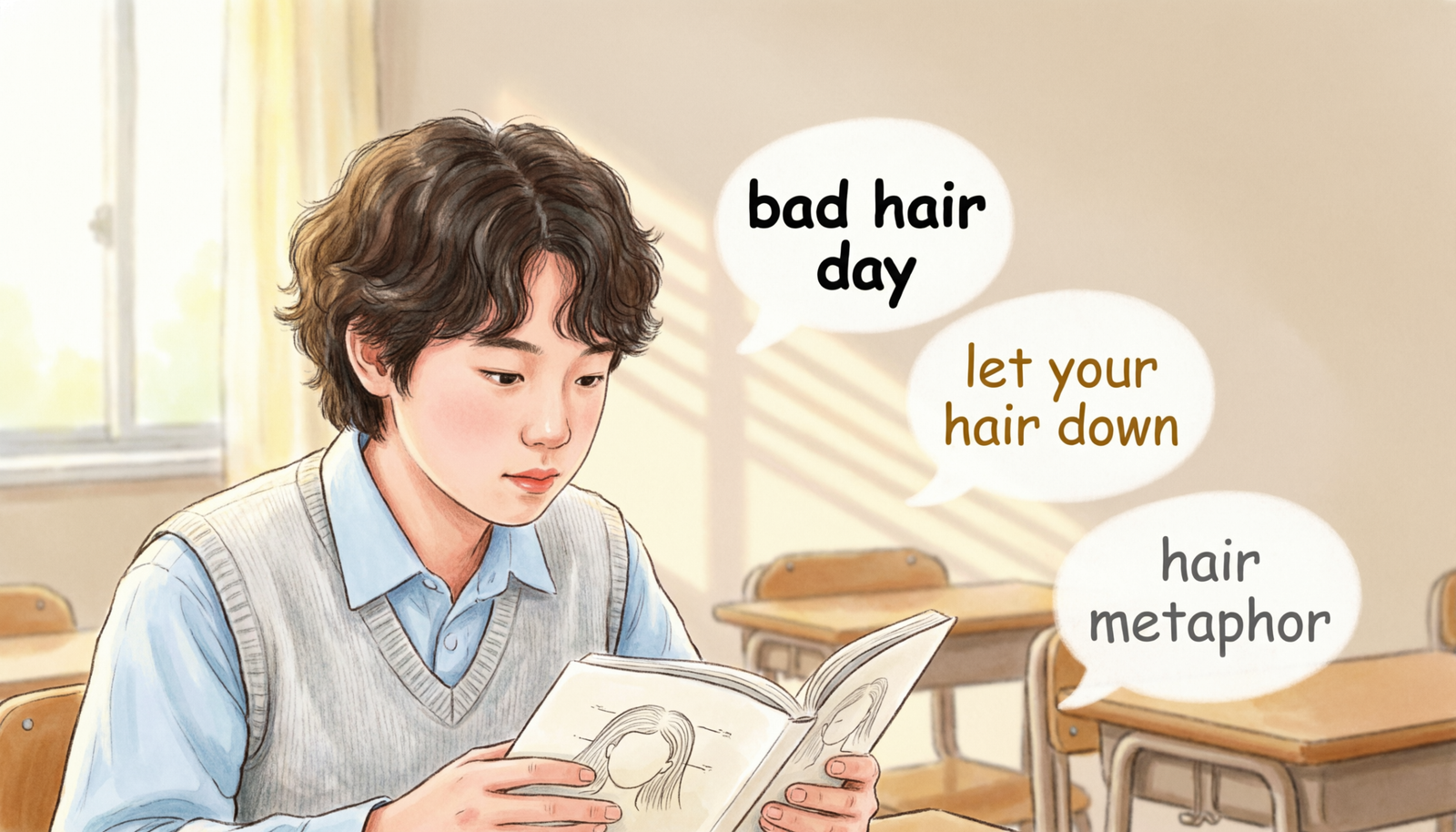
Hair appears in everyday English more often than many learners expect. People say they had a bad hair day, someone let their hair down, or a scary moment made their hair stand on end. These expressions do not always talk about actual hair. Many of them describe feelings, stress, freedom, fear, beauty, age, or personality.
That is why students, writers, and ESL learners often search for idioms for hair and then meet a bigger question: are these expressions idioms, metaphors, or both?
Here is the simple answer early: a hair idiom is a fixed expression with a commonly understood meaning, while a hair metaphor uses hair as a symbol or comparison to describe something more creatively. Idioms usually belong to everyday speech. Metaphors often give writing more imagery, emotion, or depth.
For example, “let your hair down” is a hair idiom. It means to relax and behave freely. “Her silver hair was a crown of wisdom” is a hair metaphor. It compares hair to a crown to suggest dignity, age, or experience.
Both use figurative language, but they work in different ways.
What Hair Idioms Mean
A hair idiom is a fixed phrase that includes the word hair and has a meaning that is not always clear from the individual words.
For example, “bad hair day” does not only mean your hair looks messy. People often use it to mean a day when everything feels wrong or annoying.
Simple definition
A hair idiom is a common expression with the word hair whose meaning usually goes beyond literal hair.
Purpose
Hair idioms help speakers express emotions, situations, and attitudes in a natural and familiar way.
How it works
An idiom works because many people in a language community already understand its meaning. You usually cannot change the words too much without making it sound strange.
Short natural example
“I’m having a bad hair day, and my meeting starts in ten minutes.”
Why hair idioms get confused with metaphors
Hair idioms often create a picture in the mind, so they can feel metaphorical. However, an idiom is usually a fixed phrase, while a metaphor can be more flexible and original.
What Hair Metaphors Mean
A hair metaphor uses hair to describe something else through comparison, without using like or as. It may compare hair to silk, fire, snow, a crown, a curtain, or a storm.
For example, “Her hair was a river of gold” does not mean her hair was literally a river. It means her hair looked long, flowing, and golden.
Simple definition
A hair metaphor is a figurative comparison that describes hair as something else to create a vivid image or deeper meaning.
Purpose
Hair metaphors help writers make descriptions more visual, emotional, symbolic, or poetic.
How it works
A metaphor connects two different things directly. It says one thing is another thing to highlight a shared quality.
Short natural example
“His hair was a dark cloud above his tired face.”
Why hair metaphors get confused with idioms
Some idioms started as metaphors, and many idioms still feel image-based. The difference is that metaphors can be newly created, while idioms usually have accepted meanings.
Hair Idioms vs Hair Metaphors: The Core Difference
The core difference is simple: hair idioms are fixed expressions people already use, while hair metaphors are creative comparisons that describe hair or use hair symbolically.
A hair idiom depends on shared meaning. If someone says, “I was tearing my hair out,” English speakers understand that the person felt very stressed or frustrated. They do not imagine the person literally pulling out hair in most situations.
A hair metaphor depends on comparison. If a writer says, “Her hair was midnight,” the reader understands that the hair looked very dark, rich, or mysterious.
So, idioms are more about common usage. Metaphors are more about creative description.
Quick Comparison Table
| Point | Hair Idioms | Hair Metaphors |
|---|---|---|
| Definition | Fixed expressions using “hair” with a known figurative meaning | Creative comparisons that describe hair as something else |
| Scope | Narrower because the phrase already exists in common use | Broader because writers can create new metaphors |
| Purpose | To express ideas naturally and conversationally | To create imagery, emotion, symbolism, or style |
| Length | Usually short phrases | Can be short or extended across a sentence or paragraph |
| Structure | Often fixed or semi-fixed | Flexible and original |
| Meaning | Usually learned as a whole phrase | Usually understood through comparison |
| Use in writing | Good for dialogue, informal writing, essays, and explanations | Good for poetry, fiction, descriptive writing, and speeches |
| Example | “She let her hair down after exams.” | “Her hair was a curtain of black silk.” |
How Hair Idioms Work
Hair idioms work by giving a familiar phrase a meaning that people recognize. They often come from physical experiences, appearance, emotion, or body language.
For example, when people feel fear, they may describe their hair as standing up. This physical idea became the idiom “make your hair stand on end.” It means something is extremely frightening or shocking.
Many hair idioms also connect to social behavior. “Let your hair down” suggests relaxing after behaving formally or carefully. The image comes from loosening hair, but the meaning focuses on freedom and comfort.
Hair idioms work best when you want natural English, not heavy literary description.
Examples:
- “The horror movie made my hair stand on end.”
- “After a stressful week, we finally let our hair down.”
- “I was tearing my hair out trying to fix the error.”
- “He won the race by a hair.”
- “She didn’t turn a hair when she heard the news.”
Notice how these phrases do not only describe hair. They describe fear, relaxation, stress, closeness, and calmness.
How Hair Metaphors Work
Hair metaphors work through direct comparison. A writer chooses an image that matches the hair’s color, texture, movement, shape, or symbolic meaning.
For example:
- “Her hair was silk.”
- “His white hair was winter on his head.”
- “Her curls were tiny springs.”
- “His hair was a crown of fire.”
- “Her braid was a rope of sunlight.”
These examples help readers see the hair more clearly. They also create mood. “A crown of fire” sounds bold and powerful. “Winter on his head” suggests age, coldness, or quiet dignity.
Hair metaphors can describe actual hair, but they can also suggest character. A person’s hair may symbolize youth, rebellion, beauty, wisdom, wildness, control, or identity.
Key Differences in Simple Language
Hair idioms and hair metaphors both use figurative language, but they do not serve the same purpose.
A hair idiom usually has a meaning you learn as a complete phrase. You cannot always guess it from the words. For example, “split hairs” means to argue about tiny details, not to cut or divide actual hair.
A hair metaphor creates a direct comparison. You can often understand it by thinking about the shared qualities. If someone writes, “Her hair was a waterfall,” you imagine hair that is long, flowing, and smooth.
Another key difference is flexibility. Idioms do not allow much change. “Let your hair down” sounds natural, but “lower your hair freely” does not carry the same idiomatic meaning. Metaphors allow more creativity. A writer can say hair is a river, curtain, flame, cloud, crown, or shadow.
In simple terms:
Use hair idioms when you want natural everyday expression. Use hair metaphors when you want vivid description.
Can Hair Idioms and Hair Metaphors Overlap?
Yes, hair idioms and hair metaphors can overlap.
Many idioms began as visual comparisons. “By a hair” suggests an extremely small distance, using a single hair as the image of something tiny. That image works metaphorically, but the phrase has also become a fixed idiom.
The same idea appears in “make your hair stand on end.” The phrase describes fear through a physical image. People now use it as an idiom, but it still carries a metaphorical feeling.
The overlap happens because both idioms and metaphors belong to figurative language. They both move beyond literal meaning. The difference lies in how people use them.
An expression counts more as an idiom when it has a stable, commonly accepted meaning. It counts more as a metaphor when the writer creates or uses a direct comparison for effect.
Examples of Hair Idioms
Here are common idioms for hair with simple meanings and natural examples.
1. Bad hair day
Meaning: A day when things go wrong or you feel unattractive, stressed, or unlucky.
Example:
“I missed the bus, spilled coffee, and forgot my notes. What a bad hair day.”
2. Let your hair down
Meaning: To relax and enjoy yourself, especially after being serious or formal.
Example:
“After the final exam, the students went out to let their hair down.”
3. Make your hair stand on end
Meaning: To make you feel very scared or shocked.
Example:
“The strange sound in the empty house made my hair stand on end.”
4. Tear your hair out
Meaning: To feel extremely frustrated or worried.
Example:
“I was tearing my hair out over the missing assignment file.”
5. Split hairs
Meaning: To argue about very small or unimportant differences.
Example:
“We agree on the main point, so let’s not split hairs.”
6. Not turn a hair
Meaning: To stay calm and show no emotion.
Example:
“She didn’t turn a hair when the judge announced the result.”
7. By a hair
Meaning: By a very small amount.
Example:
“He missed the first prize by a hair.”
8. Get in someone’s hair
Meaning: To annoy or bother someone.
Example:
“The children were getting in her hair while she tried to work.”
9. Keep your hair on
Meaning: Calm down; do not get angry.
Example:
“Keep your hair on. I’m only five minutes late.”
10. Hair-raising
Meaning: Very frightening or exciting.
Example:
“The mountain road was a hair-raising drive.”
Examples of Hair Metaphors
Hair metaphors help writers create strong visual images. Here are examples with simple explanations.
1. Her hair was a river of gold
Meaning: Her hair was long, flowing, and golden.
Why it works: A river suggests movement and smooth flow.
2. His hair was winter
Meaning: His hair was white or gray.
Why it works: Winter suggests whiteness, age, quietness, or cold beauty.
3. Her curls were dark springs
Meaning: Her curls were tight, lively, and bouncy.
Why it works: Springs suggest shape and movement.
4. His hair was a crown of fire
Meaning: His hair was bright red, bold, or striking.
Why it works: A crown suggests power, while fire suggests color and energy.
5. Her hair was a black curtain
Meaning: Her hair was dark, thick, and hanging around her face.
Why it works: A curtain suggests coverage, privacy, or softness.
6. His hair was a storm
Meaning: His hair looked messy, wild, or full of movement.
Why it works: A storm suggests disorder and energy.
7. Her braid was a rope of sunlight
Meaning: Her braid was golden, thick, and bright.
Why it works: Rope suggests shape, while sunlight suggests color and warmth.
8. His silver hair was a crown of years
Meaning: His gray hair showed age, wisdom, or dignity.
Why it works: The metaphor connects hair with time and respect.
Hair Idioms vs Hair Metaphors in Literature and Writing
In literature, hair can carry strong meaning. Writers often use hair to show identity, beauty, aging, freedom, social pressure, grief, rebellion, or transformation.
Hair idioms work well in dialogue because they sound natural. A character might say, “I’m tearing my hair out,” and the reader quickly understands frustration. This type of idiom makes speech sound realistic.
Hair metaphors work well in description. A novelist might write, “Her hair was a storm around her face,” to show wildness, movement, or emotional intensity. A poet might write, “His white hair was winter,” to suggest age or loneliness.
Idioms usually support tone and voice. Metaphors usually support imagery and symbolism.
For students, this distinction matters in essays. If you analyze a phrase like “let your hair down,” call it an idiom. If you analyze a sentence like “Her hair was a river of gold,” call it a metaphor.
Hair Idioms vs Hair Metaphors for Students and ESL Learners
ESL learners often struggle with hair idioms because the literal words can mislead them. For example, “split hairs” sounds like it might describe grooming, but it actually means focusing on tiny differences.
The best way to learn hair idioms is to study them as whole expressions. Do not translate each word directly. Learn the phrase, meaning, and situation together.
Hair metaphors require a different skill. To understand a metaphor, ask: What two things are being compared? What quality do they share? If hair becomes a river, the shared qualities may include length, movement, and smoothness.
For students, the easiest test is this:
- If the phrase appears commonly in dictionaries or daily speech, it is probably an idiom.
- If the sentence creates a fresh image by saying hair is something else, it is probably a metaphor.
Common Mistakes and Confusion
Many learners confuse hair idioms and hair metaphors because both move beyond literal meaning. The confusion makes sense, but the difference becomes clearer with practice.
Mistake 1: Taking idioms literally
A sentence like “I’m tearing my hair out” usually means someone feels frustrated. It does not always mean the person is physically pulling out hair.
Mistake 2: Calling every figurative phrase a metaphor
Not every figurative expression is a metaphor. “Let your hair down” is better called an idiom because people use it as a fixed expression.
Mistake 3: Changing idiom wording too much
Idioms often lose meaning when you rewrite them. “Let your hair down” works. “Put your hair downward” does not.
Mistake 4: Using idioms in very formal writing without care
Idioms can sound conversational. They may work in essays, stories, and speeches, but they do not always fit academic or technical writing.
Mistake 5: Making metaphors too confusing
A metaphor should help the reader see or feel something. If the comparison feels random, it weakens the writing.
When to Use Hair Idioms and When to Use Hair Metaphors
Use hair idioms when you want your English to sound natural, conversational, and familiar. They work well in dialogue, casual writing, blog posts, personal essays, and everyday speech.
Example:
“I was tearing my hair out trying to understand the instructions.”
Use hair metaphors when you want to describe hair in a vivid, creative, or emotional way. They work well in poetry, stories, character descriptions, and descriptive essays.
Example:
“Her hair was a dark river flowing over her shoulders.”
Use idioms for meaning. Use metaphors for imagery.
A writer can use both in the same piece, but not always in the same sentence. Too many idioms can make writing sound casual or crowded. Too many metaphors can make writing feel heavy or unclear. Strong writing chooses the right figurative tool for the moment.
Related Terms People Often Confuse with Hair Idioms and Hair Metaphors
Simile
A simile compares two things using like or as.
Example:
“Her hair was like silk.”
This is not a metaphor because it uses like. It is also not an idiom because it is not a fixed expression.
Symbolism
Symbolism happens when something represents a deeper idea.
Example:
“His gray hair symbolized wisdom and experience.”
Hair often symbolizes age, beauty, freedom, identity, or social status.
Figurative language
Figurative language is the broad category. Idioms, metaphors, similes, personification, and symbolism all belong under it.
Cliché
A cliché is an overused expression.
Example:
“Her hair was as black as night.”
This can still work in simple writing, but it may feel predictable if used too often.
Hyperbole
Hyperbole means exaggeration.
Example:
“I nearly pulled all my hair out waiting for the results.”
The sentence exaggerates frustration for effect.
Personification
Personification gives human qualities to non-human things.
Example:
“Her hair danced in the wind.”
Hair cannot literally dance, but the phrase gives it human-like movement.
Conclusion
Hair idioms and hair metaphors both make English more expressive, but they do different jobs.
A hair idiom is a fixed expression with a commonly understood meaning, such as “bad hair day,” “let your hair down,” or “split hairs.” Idioms help speakers sound natural and fluent.
A hair metaphor is a creative comparison, such as “her hair was a river of gold” or “his hair was winter.” Metaphors help writers create images, mood, and deeper meaning.
The easiest way to remember the difference is this: idioms are learned expressions, while metaphors are direct comparisons. Hair idioms belong mostly to everyday communication. Hair metaphors belong strongly to description, literature, and creative writing.
Both can improve your English when you use them carefully. Learn idioms as complete phrases. Build metaphors by choosing clear, meaningful comparisons. That way, your writing sounds natural, vivid, and easy to understand.
FAQs
1. What are idioms for hair?
Idioms for hair are common expressions that use the word hair but usually mean something beyond actual hair. Examples include “bad hair day,” “let your hair down,” “split hairs,” and “make your hair stand on end.”
2. Is “bad hair day” an idiom?
Yes. “Bad hair day” is an idiom. It can mean your hair looks bad, but people also use it to describe a difficult, unlucky, or frustrating day.
3. Is “her hair was silk” a metaphor?
Yes. “Her hair was silk” is a metaphor because it directly compares hair to silk. It suggests softness, smoothness, and shine.
4. What is the difference between a hair idiom and a hair metaphor?
A hair idiom is a fixed expression with a known meaning. A hair metaphor is a creative comparison that describes hair as something else. “Let your hair down” is an idiom. “Her hair was a golden river” is a metaphor.
5. Can a hair idiom also be metaphorical?
Yes. Some hair idioms use metaphorical images. “By a hair” suggests a very small difference by using the image of a tiny hair. Still, because people use it as a fixed phrase, it counts as an idiom.
6. Which hair idioms are useful for ESL learners?
Useful hair idioms include “bad hair day,” “let your hair down,” “split hairs,” “tear your hair out,” “by a hair,” and “make your hair stand on end.” These appear often in everyday English.
7. Should I use hair idioms in formal writing?
Use them carefully. Hair idioms can make writing sound natural, but some may feel too casual for formal academic writing. Hair metaphors usually fit better in creative writing, literary analysis, and descriptive essays.