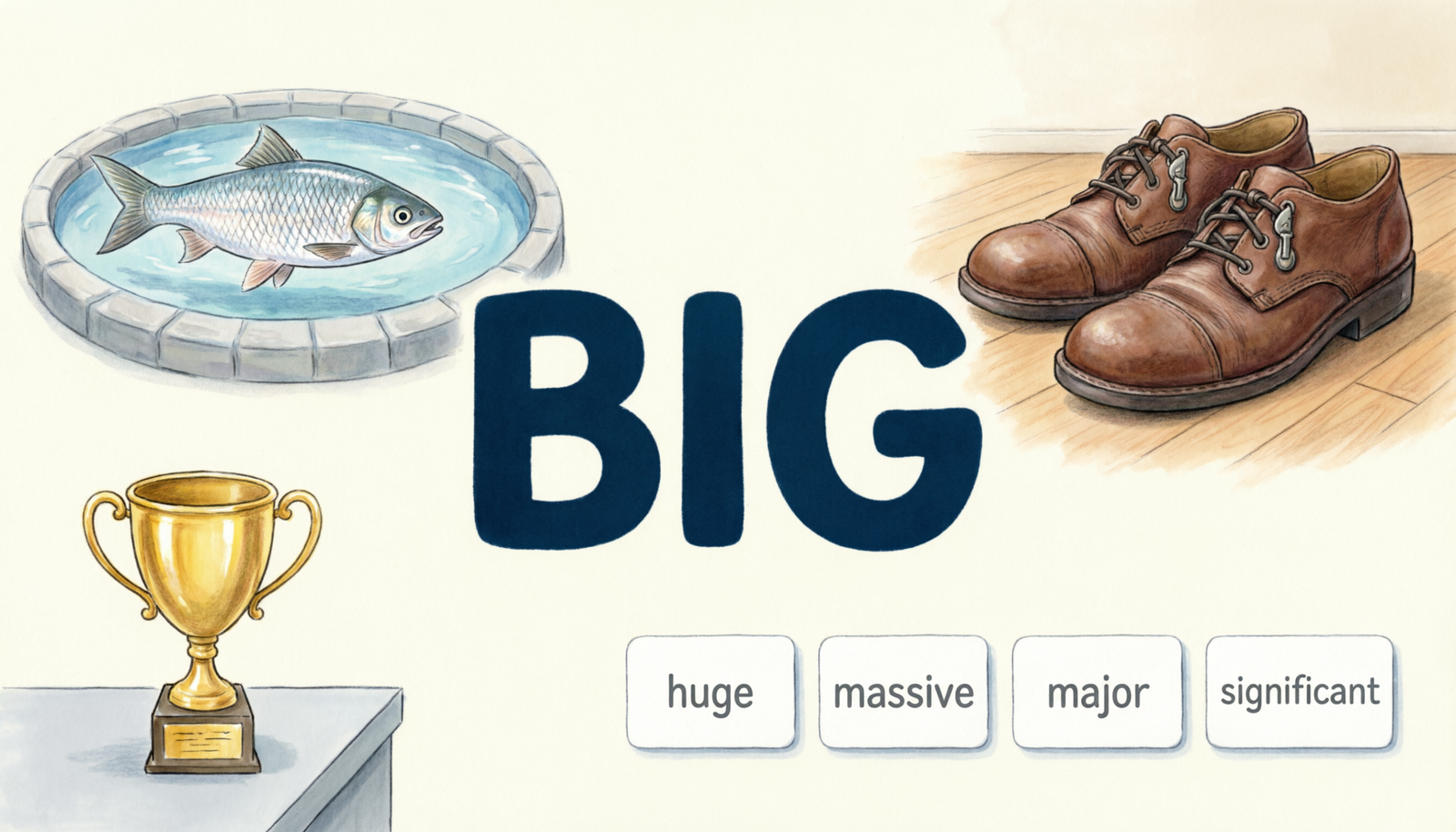
The word big appears everywhere in English. We use it to describe large objects, important events, serious problems, successful people, and powerful emotions. However, repeating big can make writing sound plain or imprecise.
Writers and learners often search for idioms for big because they want more expressive ways to communicate size, importance, success, or intensity. During that search, they may also find synonyms such as large, huge, major, and enormous. This creates a common question: Are idioms for big simply colorful synonyms, or do they work differently?
The difference is straightforward:
A synonym for big is a word or direct phrase with a similar meaning. An idiom is a fixed expression whose intended meaning may differ from the literal meaning of its individual words.
For example:
- Huge is a synonym for big.
- Larger than life is an idiom that can describe someone unusually impressive, exciting, or influential.
Both can communicate some form of greatness, but they do not perform the same job. Synonyms usually provide precision, while idioms add imagery, personality, or cultural meaning.
This guide explains how idioms and synonyms for big differ, where they overlap, and how students, writers, and ESL learners can choose the right expression.
What Idioms for Big Mean
An idiom for big is a recognized expression that communicates an idea related to great size, importance, success, influence, ambition, or intensity.
Idioms do not always refer to physical size. Many describe something figuratively.
Consider the expression:
Winning the contract was a big deal for the company.
Here, big deal does not mean that the deal has large physical dimensions. It means that the event is highly important.
Simple definition
An idiom for big is a fixed expression that indirectly suggests something large, important, impressive, serious, or successful.
Purpose
Idioms make language more vivid, natural, memorable, and expressive.
How idioms for big work
They use familiar wording, imagery, exaggeration, or cultural associations to communicate a figurative meaning.
Short example
Her grandfather was a larger-than-life character.
The expression means that he had an unusually strong, impressive, or memorable personality.
Why idioms get confused with synonyms
Both idioms and synonyms can replace the basic idea expressed by big. However, an idiom usually adds an extra emotional or figurative meaning rather than offering a direct one-word replacement.
What Synonyms for Big Mean
A synonym for big is a word with the same or a closely related meaning as big. Common examples include large, huge, enormous, major, important, and substantial.
The best synonym depends on what big means in a particular sentence.
For example:
- a large building
- a major decision
- an important meeting
- an enormous amount
- a serious problem
- a powerful influence
These words relate to big, but they are not interchangeable in every context.
Simple definition
A synonym for big is a word that directly expresses a similar idea, such as large size, great importance, or strong intensity.
Purpose
Synonyms help speakers and writers choose more accurate, varied, and context-appropriate language.
How synonyms for big work
They replace big with a word that matches the specific meaning of the sentence.
Short example
They made a major investment in renewable energy.
Here, major means important or substantial.
Why synonyms get confused with idioms
Both give learners alternatives to the word big. The difference is that synonyms usually communicate meaning directly, while idioms often communicate it figuratively.
Idioms for Big vs Synonyms for Big: The Core Difference
The main difference lies in directness and structure.
A synonym for big usually consists of one word and gives a direct meaning:
The company made a large profit.
An idiom generally consists of several words and may add a figurative or culturally recognized meaning:
The company hit the big time.
The first sentence tells us that the profit was large. The second suggests that the company became highly successful or famous.
A synonym normally replaces big grammatically. An idiom may require the writer to change the entire sentence.
Compare:
She received a big opportunity.
She received a major opportunity.
She finally got her big break.
Major directly replaces big. The idiom big break adds the idea of an opportunity that may lead to success.
Quick Comparison Table
| Point | Idioms for Big | Synonyms for Big |
|---|---|---|
| Definition | Fixed expressions connected with size, importance, success, or intensity | Words with meanings similar to big |
| Scope | Often figurative and context-dependent | Usually direct and specific |
| Purpose | Add imagery, emotion, emphasis, or personality | Improve accuracy, variety, and clarity |
| Length | Usually two or more words | Usually one word |
| Structure | Fixed or semi-fixed expression | Individual vocabulary item |
| Meaning | May differ from the literal meanings of the words | Usually understood through the word’s standard definition |
| Use in writing | Best for informal, conversational, narrative, or creative writing | Suitable for formal, academic, professional, and everyday writing |
| Example | The project became a big deal. | The project became important. |
| Direct replacement | Often requires restructuring the sentence | Often replaces big directly |
| Cultural knowledge | May require familiarity with natural English usage | Usually easier to understand through a dictionary |
How Idioms for Big Work
Idioms work through shared figurative meaning. Native and experienced speakers recognize the complete expression and understand that its meaning goes beyond the individual words.
For instance:
He is a big fish in a small pond.
Taken literally, the sentence seems to describe a fish. Figuratively, it describes an important or influential person within a small group, organization, or community.
Idioms for big may express several related ideas.
Physical or exaggerated size
Some expressions create a picture of something extremely large:
The shopping center is as big as a house.
This comparison exaggerates size to create emphasis.
Importance
Many idioms use big to communicate significance:
Getting accepted into medical school was a big deal.
Success
Some idioms describe career progress, fame, or achievement:
The actor finally hit the big time.
Influence
Other expressions describe status or power:
She became a big name in digital publishing.
Confidence or boasting
Certain idioms use size figuratively to describe behavior:
He was talking big, but he had no real plan.
Because idioms carry extra associations, writers should consider tone and context before using them.
How Synonyms for Big Work
Synonyms work by narrowing the intended meaning of big. The word big has many senses, so a good synonym depends on what the writer actually wants to describe.
Physical size
Use words such as:
- large
- huge
- enormous
- gigantic
- massive
- immense
- colossal
Example:
They live in a massive stone house.
Importance
Use words such as:
- major
- important
- significant
- consequential
- meaningful
- prominent
Example:
The court issued a significant ruling.
Amount
Use words such as:
- considerable
- substantial
- extensive
- enormous
- sizable
Example:
The repairs required a substantial investment.
Seriousness
Use words such as:
- serious
- severe
- critical
- considerable
Example:
Delayed payments created a serious problem.
Success or influence
Use words such as:
- successful
- influential
- powerful
- prominent
- leading
Example:
She became an influential figure in the industry.
Choosing a precise synonym helps readers understand exactly what kind of “bigness” the writer means.
Key Differences in Simple Language
Idioms and synonyms for big differ in several practical ways.
Synonyms are more direct
The synonym enormous immediately communicates very large size.
An enormous tree stood beside the house.
An idiom may communicate a broader idea:
The announcement was a big deal.
The expression refers to importance, not physical size.
Idioms contain multiple words
Most synonyms appear as single vocabulary items, such as large or major. Idioms usually contain several words, such as big fish in a small pond.
Idioms often add emotion or imagery
Compare:
She became successful.
She hit the big time.
The second sentence sounds more energetic and expressive.
Synonyms offer greater precision
Words such as major, massive, significant, and serious express different meanings. A precise synonym can make formal writing clearer.
Idioms depend more heavily on context
The expression too big for his boots has nothing to do with shoe size. It describes someone who acts more important or confident than their position justifies.
An ESL learner who translates the expression literally may misunderstand it.
Can Idioms and Synonyms for Big Overlap?
Yes. Idioms and synonyms overlap because both can communicate ideas associated with size, importance, intensity, power, or success.
For example:
The conference was a major event.
The conference was a big deal.
Both sentences show that the conference was important. However, the tone changes.
Major event sounds direct and suitable for professional or formal writing. Big deal sounds more conversational and may carry stronger personal emphasis.
They can also appear together:
Landing such a major role was her big break.
In this sentence, major is a synonym related to importance, while big break is an idiom meaning an opportunity that can lead to success.
The two forms complement each other, but they remain grammatically and stylistically different.
Examples of Idioms for Big
1. A big deal
Meaning: Something important, impressive, or serious.
Graduating from university is a big deal for many families.
The expression may also describe an influential person:
He thinks he is a big deal in the local business community.
2. Hit the big time
Meaning: To become highly successful, wealthy, or famous.
The band hit the big time after its third album went viral.
3. A big break
Meaning: An important opportunity that leads to progress or success.
Her first television role gave her the big break she needed.
4. Larger than life
Meaning: More impressive, exciting, confident, or memorable than an ordinary person.
The coach had a larger-than-life personality.
5. A big fish in a small pond
Meaning: An important person within a small or limited group.
He enjoyed being a big fish in a small pond at the regional office.
6. Too big for your boots
Meaning: Too confident, proud, or self-important.
After one successful project, he became too big for his boots.
In American English, people may say too big for your britches.
7. Think big
Meaning: To develop ambitious plans or goals.
Entrepreneurs often need to think big while starting small.
8. Talk big
Meaning: To make confident claims or boast about what you will do.
Anyone can talk big, but results require hard work.
9. The next big thing
Meaning: A person, product, idea, or trend expected to become highly successful or popular.
Investors believed the technology would become the next big thing.
10. Make it big
Meaning: To become successful, famous, or wealthy.
She moved to New York hoping to make it big as a designer.
11. Go big or go home
Meaning: Make a strong, ambitious effort rather than taking a cautious approach.
The team decided to go big or go home with its final campaign.
This idiom works best in informal or motivational contexts.
12. Big shoes to fill
Meaning: A difficult responsibility caused by replacing a highly respected or successful person.
The new principal has big shoes to fill after her predecessor’s long career.
13. Big picture
Meaning: The overall situation rather than minor details.
Do not let one small setback distract you from the big picture.
14. Big-headed
Meaning: Overly proud or convinced of one’s importance.
Winning the award made him a little big-headed.
15. Big-hearted
Meaning: Generous, caring, and kind.
She is a big-hearted person who always helps new students.
Examples of Synonyms for Big
Large
Meaning: Greater than average in physical size, number, or amount.
A large crowd gathered outside the stadium.
Huge
Meaning: Extremely large.
The campaign attracted a huge audience.
Enormous
Meaning: Very great in size, amount, or degree.
The bridge required an enormous amount of steel.
Massive
Meaning: Very large, heavy, extensive, or serious.
The storm caused massive damage along the coast.
Immense
Meaning: Extremely large or great, often in a way that inspires respect or amazement.
She felt immense relief after receiving the results.
Gigantic
Meaning: Extremely large in physical size.
A gigantic sculpture stood at the entrance.
Colossal
Meaning: Exceptionally large in size, scale, or effect.
Ignoring the warning turned out to be a colossal mistake.
Major
Meaning: Important, serious, or influential.
Cost remains a major concern for small businesses.
Significant
Meaning: Important enough to deserve attention.
The research revealed a significant improvement.
Substantial
Meaning: Large in amount, value, or importance.
The organization received a substantial donation.
Considerable
Meaning: Large enough to be noticeable or important.
The journey requires considerable preparation.
Important
Meaning: Having great value, influence, or effect.
Clear communication plays an important role in teamwork.
Serious
Meaning: Important, severe, or deserving careful attention.
Water shortages pose a serious risk to the region.
Prominent
Meaning: Important, well known, or easily noticed.
She is a prominent voice in environmental law.
Powerful
Meaning: Having great strength, influence, or effect.
The documentary delivered a powerful message.
Idioms for Big vs Synonyms for Big in Literature and Writing
Writers use synonyms and idioms for different stylistic purposes.
Synonyms create precision
In descriptive writing, a carefully chosen synonym helps readers imagine exact scale.
Compare:
A big wall surrounded the city.
A massive wall surrounded the city.
A towering wall surrounded the city.
An immense wall surrounded the city.
Each replacement creates a slightly different picture. Massive suggests weight and strength. Towering emphasizes height. Immense emphasizes extraordinary scale.
Idioms develop voice
Idioms can make dialogue or narration sound natural and culturally familiar.
“Do not get too big for your boots,” her brother warned.
This sentence reveals attitude and personality in a way that a direct description may not.
Compare:
Her brother warned her not to become arrogant.
The direct version is clear. The idiomatic version sounds more conversational and expressive.
Idioms can support characterization
A character who says go big or go home may sound bold and competitive. A character who focuses on the big picture may appear strategic or thoughtful.
Formal writing usually favors precise synonyms
Academic essays, reports, and professional documents generally benefit from direct vocabulary.
Instead of:
Climate change is a really big problem.
Write:
Climate change is a serious global problem.
Instead of:
The policy had a big effect.
Write:
The policy had a significant effect.
Idioms can still appear in opinion writing, speeches, journalism, fiction, and personal essays, but writers should match them to the expected tone.
Idioms for Big vs Synonyms for Big for Students and ESL Learners
Students and ESL learners should first understand the basic meaning of big, then learn its alternatives by category.
Do not memorize every synonym as though it means exactly the same thing. Instead, connect each word to a common use.
- Large for physical size, quantity, or groups
- Huge for strong informal emphasis
- Major for importance
- Serious for problems and risks
- Significant for effects, differences, or developments
- Substantial for amounts, evidence, or investment
- Prominent for important people or visible features
Idioms require a different learning method. Learn each idiom as a complete expression rather than translating every word separately.
For example, do not interpret big shoes to fill literally. Remember the complete meaning:
Replacing someone highly respected creates difficult expectations.
Learners should also study one natural sentence with each idiom. Context makes figurative meaning easier to remember.
Common Mistakes and Confusion
Treating every synonym as interchangeable
A big house can become a large house or a huge house. However, a big decision does not normally become a huge decision in every formal context. Major decision often sounds more natural.
Choose according to meaning, not only dictionary similarity.
Translating idioms literally
The idiom big fish in a small pond describes social importance within a limited environment. It does not describe an animal.
Literal translation often removes the intended meaning.
Using idioms in highly formal writing
Expressions such as hit the big time and go big or go home may sound unsuitable in academic research or formal business documentation.
A formal alternative usually communicates the point more clearly:
- achieved considerable success
- adopted an ambitious strategy
- became highly influential
Confusing “big words” with words that mean big
The expression big words often refers to long, difficult, or impressive vocabulary. It does not necessarily mean words that are synonyms for big.
For example, photosynthesis is a long technical word, but it does not mean big.
Assuming every phrase containing “big” is an idiom
A phrase becomes idiomatic when its established meaning goes beyond its literal wording.
a big box
This is an ordinary adjective-and-noun combination.
a big break
This can function as an idiom when it means a career-changing opportunity.
Overusing exaggerated synonyms
Words such as gigantic, colossal, and enormous create strong emphasis. Using them repeatedly can make writing sound dramatic or unreliable.
Reserve them for situations that genuinely justify their strength.
Using “big” when a more exact word exists
The medicine made a big difference.
This sentence is natural in conversation.
In a report, a more precise version may work better:
The medicine produced a significant improvement.
When to Use Idioms and When to Use Synonyms
Use an idiom for big when you want to:
- make dialogue sound natural
- create a memorable image
- express success, ambition, pride, or importance
- add personality to informal writing
- communicate a familiar cultural idea
- make a speech or story more engaging
Example:
The young designer hopes to make it big in the fashion industry.
Use a synonym for big when you want to:
- describe size accurately
- clarify the type of importance involved
- avoid unnecessary repetition
- maintain a formal or professional tone
- explain an idea to international readers
- make academic writing more precise
Example:
The discovery represents a significant development in cancer research.
In many cases, the simplest choice remains the best one. The word big is natural and useful. Replace it only when another word or expression communicates the intended meaning more accurately or effectively.
Related Terms People Often Confuse with Them
Metaphor
A metaphor describes one thing as another to create a comparison.
The city is a sleeping giant.
The sentence is metaphorical because the city is not literally a giant.
An idiom may have metaphorical roots, but an idiom is a recognized expression with an established meaning. A writer can create a new metaphor, while idioms usually come from shared language.
Simile
A simile compares things using words such as like or as.
The warehouse was as big as a football field.
This is a simile, not necessarily an idiom, because it makes a direct comparison.
Hyperbole
Hyperbole uses deliberate exaggeration.
The suitcase weighed a ton.
The suitcase did not literally weigh a ton. The exaggeration emphasizes its heaviness.
Expressions about extreme size may combine idiomatic language with hyperbole.
Collocation
A collocation is a group of words that commonly appear together.
Examples include:
- big decision
- big mistake
- big difference
- big opportunity
These combinations sound natural, but they are not always idioms because their meanings remain mostly literal.
Figurative language
Figurative language is the broad category that includes idioms, metaphors, similes, personification, and hyperbole. Idioms are therefore one type of figurative expression.
Antonyms
Antonyms express opposite meanings. Common antonyms for big include:
- small
- little
- tiny
- minor
- insignificant
- limited
The correct antonym depends on context. The opposite of a big house may be a small house, while the opposite of a major issue may be a minor issue.
Choosing the Right Alternative to Big
Before replacing big, ask what the word means in the sentence.
Does it describe physical size?
Choose large, huge, massive, immense, or gigantic.
They built a massive warehouse.
Does it describe importance?
Choose major, important, significant, or consequential.
The election produced a significant political change.
Does it describe an amount?
Choose substantial, considerable, sizable, or enormous.
The company accumulated substantial debt.
Does it describe a serious issue?
Choose serious, severe, critical, or major.
The hospital faces a serious staffing shortage.
Does it describe success?
Choose a direct word such as successful or an idiom such as make it big.
The company became highly successful.
The company finally made it big.
Does it describe influence?
Choose powerful, leading, prominent, or influential.
She became a prominent figure in modern architecture.
This approach produces clearer writing than replacing big with the strongest word available.
Conclusion
Idioms for big and synonyms for big can express related ideas, but they work differently.
A synonym provides a direct alternative. Words such as large, major, massive, significant, and substantial help writers communicate size, importance, amount, or seriousness precisely.
An idiom uses a recognized expression to communicate meaning more figuratively. Phrases such as hit the big time, a big fish in a small pond, big shoes to fill, and the next big thing add imagery, cultural meaning, emotion, or personality.
Use synonyms when clarity and precision matter most. Use idioms when the context allows a more conversational, vivid, or expressive tone. Most importantly, choose an expression according to the exact meaning of the sentence rather than treating every alternative as interchangeable.
FAQs
What is an idiom for something very important?
A big deal is a common idiom for something important or significant.
Passing the final examination was a big deal for him.
What are the best synonyms for big?
Common synonyms include large, huge, enormous, massive, major, significant, substantial, and important. The best choice depends on whether big refers to size, amount, importance, influence, or seriousness.
Is “larger than life” an idiom?
Yes. Larger than life describes a person or character who seems unusually impressive, exciting, confident, or memorable. It does not usually refer to literal physical size.
Is “huge” an idiom or a synonym?
Huge is a synonym for big. It is a single word with a direct meaning, not a fixed figurative expression.
Can an idiom replace the word “big” directly?
Not always. A synonym often replaces big without changing the sentence structure, but an idiom may require a complete rewrite.
It was a big opportunity.
It was a major opportunity.
It was the big break she had been waiting for.
Are idioms suitable for academic writing?
Most informal idioms should appear sparingly in academic writing. Precise synonyms such as significant, substantial, and major usually suit formal explanations better.
What does “think big” mean?
Think big means to develop ambitious ideas, plans, or goals instead of limiting yourself to small possibilities.
The mentor encouraged the students to think big.