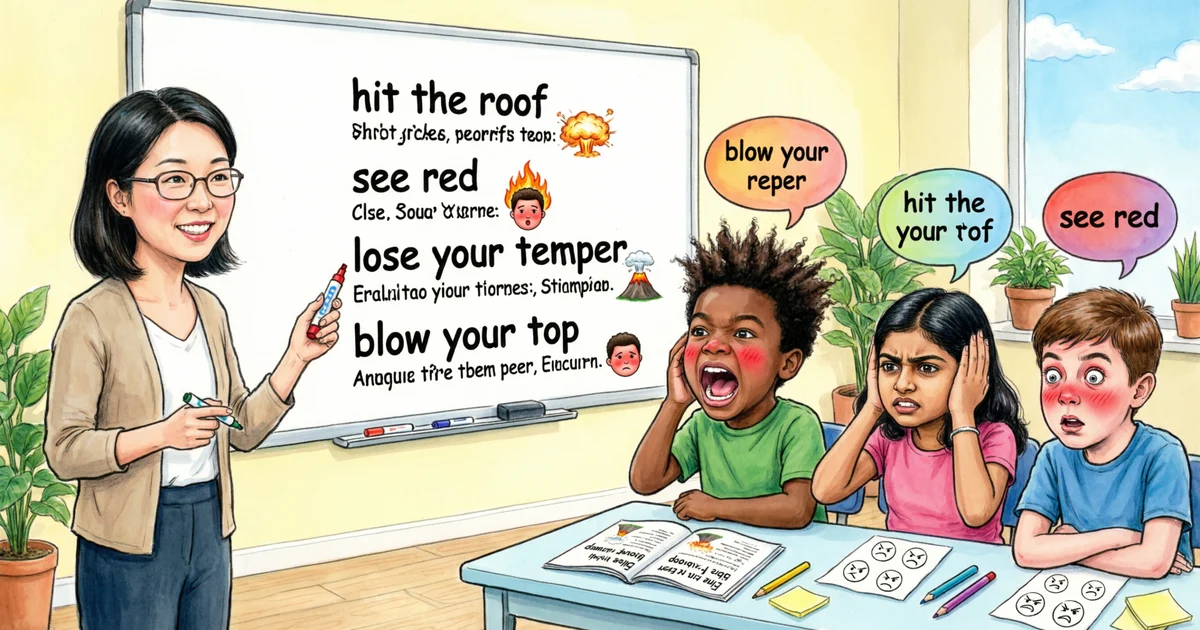
Idioms for anger help you describe anger in a more vivid, natural, and expressive way than plain words like “angry” or “mad.” Instead of saying someone is very angry, you can say they “hit the roof,” “lost their temper,” or “saw red.” These phrases make writing and speaking more colorful, especially for students, writers, and ESL learners.
The main difference is simple: anger words describe the emotion directly, while idioms for anger describe it figuratively. Both can show the same feeling, but idioms often add image, tone, personality, or drama.
For example:
Direct anger word:
He was angry.
Anger idiom:
He blew his top.
Both sentences show anger, but the idiom sounds more visual and emotional.
What Idioms for Anger Mean
Idioms for anger are fixed expressions that describe anger without always using the word “anger.” Their meanings usually cannot be understood by looking at each word alone.
For example, “hit the roof” does not mean someone actually touched a roof. It means the person became extremely angry.
Simple definition:
Idioms for anger are figurative phrases that express irritation, frustration, rage, or loss of emotional control.
Purpose:
They help speakers and writers describe anger in a lively and natural way.
How they work:
They use images, actions, or exaggeration to show how anger feels or looks.
Short example:
My dad hit the roof when he saw the broken window.
Why they get confused with direct anger words:
Both express the same emotion, but idioms do it indirectly and figuratively.
What Direct Anger Words Mean
Direct anger words are plain words that name the emotion clearly. These include words such as angry, mad, annoyed, furious, irritated, enraged, and upset.
Simple definition:
Direct anger words describe the feeling of anger in a clear and literal way.
Purpose:
They help readers understand the emotion quickly and directly.
How they work:
They name the emotion instead of creating a picture or figurative image.
Short example:
She was furious after hearing the rude comment.
Why they get confused with idioms for anger:
Both can describe the same emotional state, but direct words are literal while idioms are figurative.
Idioms for Anger vs Direct Anger Words: The Core Difference
The core difference is that idioms for anger are figurative expressions, while direct anger words are literal descriptions.
If you say, “He was furious,” you directly name the emotion.
If you say, “He flew off the handle,” you show the emotion through an idiom.
Writers often use idioms when they want the sentence to feel more natural, expressive, conversational, or dramatic. Students and ESL learners should learn both because direct words help with clarity, while idioms help with fluency and natural English.
Quick Comparison Table
| Point | Idioms for Anger | Direct Anger Words |
|---|---|---|
| Definition | Figurative phrases that express anger | Literal words that name anger |
| Scope | Broader and more expressive | Clearer and more direct |
| Purpose | To add color, emotion, or natural tone | To state the feeling clearly |
| Length | Often several words | Usually one word |
| Structure | Fixed phrase or expression | Single adjective, noun, or verb |
| Meaning | Often symbolic or indirect | Direct and easy to understand |
| Use in writing | Good for dialogue, stories, essays, and informal writing | Good for clear explanation and formal writing |
| Example | He blew his top. | He was angry. |
How Idioms for Anger Work
Idioms for anger work by turning emotion into a picture. English often connects anger with heat, pressure, explosions, fire, or sudden movement.
That is why many anger idioms sound intense:
- blow your top
- hit the roof
- see red
- fly off the handle
- be up in arms
These expressions do not describe anger in a literal way. Instead, they show how anger feels. A person who “blows their top” seems like a boiling pot or exploding container. A person who “sees red” seems so angry that emotion changes the way they see the situation.
This makes idioms useful in writing because they show mood and personality quickly.
Example:
When the manager blamed her for the mistake, she saw red.
This sentence suggests sudden, strong anger.
How Direct Anger Words Work
Direct anger words work by naming the emotion clearly. They do not require the reader to understand a hidden meaning.
Examples include:
- angry
- mad
- annoyed
- irritated
- furious
- enraged
- resentful
- frustrated
- upset
These words are useful when clarity matters more than style. In school essays, reports, explanations, and formal writing, direct words often work better than strong idioms.
Example:
The customer became frustrated after waiting for two hours.
This sentence is clear and professional. It does not sound dramatic or informal.
Key Differences in Simple Language
Idioms for anger are more colorful. Direct anger words are more exact.
An idiom can make a sentence sound natural and expressive, but it may confuse readers who do not know the phrase. A direct word is easier to understand, but it may sound plain if repeated too often.
Compare these two sentences:
Plain:
He was very angry when his phone broke.
More expressive:
He lost his temper when his phone broke.
The second sentence gives more movement and emotion. It sounds closer to real speech.
Can Idioms for Anger and Direct Anger Words Overlap?
Yes, they can overlap because both describe anger. The difference lies in style, not the basic emotion.
For example:
She was furious.
She blew her top.
Both sentences show strong anger. The first uses a direct anger word. The second uses an idiom.
Writers often combine both for stronger effect:
He was furious and finally blew his top.
This sentence names the emotion first, then shows the reaction.
Examples of Idioms for Anger
Here are common idioms for anger with simple meanings and natural sentences.
1. Blow your top
Meaning: To become extremely angry.
Example:
My teacher blew her top when half the class forgot the homework.
Use it when:
Someone suddenly reacts with strong anger.
2. Hit the roof
Meaning: To become very angry.
Example:
His parents hit the roof when they saw the repair bill.
Use it when:
The anger feels sudden, loud, or extreme.
3. Lose your temper
Meaning: To stop controlling your anger.
Example:
I tried to stay calm, but I lost my temper during the argument.
Use it when:
Someone becomes angry after trying to hold back.
4. See red
Meaning: To become very angry very quickly.
Example:
She saw red when someone insulted her brother.
Use it when:
The anger is intense and immediate.
5. Fly off the handle
Meaning: To suddenly become angry over something.
Example:
He flies off the handle whenever people question his work.
Use it when:
Someone reacts too quickly or too strongly.
6. Be up in arms
Meaning: To be very angry or strongly opposed to something.
Example:
Parents were up in arms about the school’s new rule.
Use it when:
A group of people feels angry or upset about an issue.
7. Get bent out of shape
Meaning: To become upset or angry, often over something small.
Example:
Don’t get bent out of shape over one small mistake.
Use it when:
The anger seems unnecessary or exaggerated.
8. Have a short fuse
Meaning: To become angry very easily.
Example:
Be careful what you say around him. He has a short fuse.
Use it when:
Someone has a quick temper.
9. Foam at the mouth
Meaning: To be extremely angry.
Example:
The coach was practically foaming at the mouth after the bad call.
Use it when:
You want to show extreme anger, often in a dramatic way.
10. Be hot under the collar
Meaning: To feel angry, embarrassed, or annoyed.
Example:
He got hot under the collar when his mistake was mentioned.
Use it when:
The anger is mixed with embarrassment or irritation.
Examples of Direct Anger Words
Direct anger words help you show different levels of anger.
1. Annoyed
Meaning: Slightly angry or bothered.
Example:
She was annoyed by the loud music.
2. Irritated
Meaning: Angry because something keeps bothering you.
Example:
He felt irritated after hearing the same question again.
3. Upset
Meaning: Unhappy, worried, or angry.
Example:
I was upset when my friend canceled our plan.
4. Mad
Meaning: Angry. This word sounds more casual in American English.
Example:
She got mad when he ignored her message.
5. Angry
Meaning: Feeling strong displeasure.
Example:
He was angry about the unfair decision.
6. Furious
Meaning: Very angry.
Example:
The customer was furious about the delay.
7. Enraged
Meaning: Extremely angry.
Example:
The unfair accusation enraged him.
8. Resentful
Meaning: Angry because something feels unfair.
Example:
She felt resentful after doing all the work alone.
Idioms for Anger in Literature and Writing
Writers use idioms for anger to make characters sound real and emotionally alive. In dialogue, idioms can reveal personality, culture, mood, and intensity.
For example:
Plain sentence:
Mark was angry at his brother.
More natural dialogue:
“I nearly blew my top when he lied to me,” Mark said.
The second version sounds more personal. It shows how Mark speaks, not just what he feels.
Idioms also help writers avoid repeating the word “angry.” Instead of using angry, furious, or mad in every sentence, a writer can vary the language.
Examples:
- She clenched her fists.
- He lost his temper.
- Her blood boiled.
- They were up in arms.
- He was hot under the collar.
However, writers should avoid overusing idioms. Too many idioms can make writing sound crowded or unnatural. One strong idiom often works better than three weak ones.
Idioms for Anger for Students and ESL Learners
Students and ESL learners should learn idioms for anger because they appear often in conversations, stories, movies, articles, and everyday English.
The best way to learn them is to connect each idiom with a situation.
Use “lose your temper” when someone stops controlling anger.
Use “see red” when anger is sudden and intense.
Or, Use “have a short fuse” when someone gets angry easily.
Use “up in arms” when a group strongly complains.
Use “hot under the collar” when someone feels annoyed or embarrassed.
ESL learners should also remember that idioms do not always translate word for word into another language. The meaning matters more than the literal words.
For example, “hit the roof” does not involve a real roof. It means someone became very angry.
Common Mistakes and Confusion
Mistake 1: Taking idioms literally
Incorrect understanding:
He hit the roof = He physically touched the roof.
Correct meaning:
He became very angry.
Mistake 2: Using strong idioms for small anger
Awkward:
I saw red when my pencil fell.
Better:
I felt annoyed when my pencil fell.
Use strong idioms for strong emotions.
Mistake 3: Using idioms in very formal writing
Too informal:
The citizens blew their top about the policy.
More formal:
The citizens strongly opposed the policy.
Idioms work well in stories, conversations, blog writing, and informal essays. Formal writing often needs direct language.
Mistake 4: Mixing idioms incorrectly
Incorrect:
He flew off the roof.
Correct:
He flew off the handle.
He hit the roof.
Idioms usually have fixed wording. Changing the words can make them sound strange.
Mistake 5: Using too many idioms together
Overloaded:
He saw red, blew his top, hit the roof, and flew off the handle.
Better:
He blew his top.
One clear idiom is usually enough.
When to Use Idioms for Anger and When to Use Direct Anger Words
Use idioms for anger when you want your writing or speech to sound expressive, natural, or conversational.
Good situations for anger idioms:
- dialogue
- stories
- personal writing
- informal essays
- blog posts
- creative writing
- speaking practice
Example:
My brother blew his top when he found out I used his laptop.
Use direct anger words when you need clarity, precision, or a formal tone.
Good situations for direct anger words:
- school explanations
- reports
- formal essays
- summaries
- definitions
- professional writing
Example:
The employee felt frustrated because the instructions were unclear.
A simple rule helps:
Use direct words when you want to explain anger. Use idioms when you want to show anger with more color.
Related Terms People Often Confuse With Idioms for Anger
Anger phrases
Anger phrases include both idioms and direct expressions. “I am angry” is a phrase, but it is not an idiom. “I blew my top” is both a phrase and an idiom.
Slang for anger
Slang is informal language used in casual speech. Words like “pissed,” “ticked off,” and “mad as hell” are informal. Some anger idioms can sound casual, but not all idioms are slang.
Metaphors for anger
A metaphor says one thing is another thing. For example, “His anger was a volcano” is a metaphor. Idioms can contain metaphorical ideas, but idioms are fixed expressions used by many speakers.
Similes for anger
A simile compares two things using “like” or “as.” For example, “as angry as a hornet” is a simile. It is different from an idiom like “hit the roof.”
Emotional vocabulary
Emotional vocabulary includes all words used to describe feelings. Idioms for anger are only one part of that larger group.
More Natural Sentences Using Idioms for Anger
Here are practical examples that show how anger idioms fit into real sentences.
- My mom hit the roof when she saw the messy kitchen.
- He lost his temper after waiting in line for an hour.
- The fans were up in arms after the referee’s decision.
- She saw red when her work was copied.
- Don’t fly off the handle before you hear the full story.
- He has a short fuse, so speak calmly.
- I got hot under the collar during the interview.
- The boss blew his top when the report was late.
- People got bent out of shape over a small change.
- The rude comment made her blood boil.
Choosing the Right Idiom for the Level of Anger
Not all anger idioms have the same strength. Some show mild irritation, while others show extreme anger.
Mild anger:
- hot under the collar
- bent out of shape
- annoyed by something
Medium anger:
- lose your temper
- get mad
- be up in arms
Strong anger:
- blow your top
- hit the roof
- see red
- foam at the mouth
This matters because using a very strong idiom for a small problem can sound unnatural.
For example:
Too strong:
He foamed at the mouth because his tea was cold.
Better:
He got a little annoyed because his tea was cold.
Idioms for Anger in American English
Many idioms for anger are common in American English. Students writing for a USA audience can safely use expressions like:
- lose your temper
- hit the roof
- blow your top
- see red
- fly off the handle
- have a short fuse
- hot under the collar
These idioms sound natural in everyday American speech, especially in stories, conversations, and casual writing.
However, tone matters. In a professional email, “I am frustrated about the delay” sounds better than “I blew my top about the delay.”
Practice: Replace Direct Anger Words With Idioms
Try replacing the direct anger word with a suitable idiom.
- She was very angry when she saw the damage.
Better: She hit the roof when she saw the damage. - He became angry during the meeting.
Better: He lost his temper during the meeting. - The crowd was angry about the decision.
Better: The crowd was up in arms about the decision. - My brother gets angry very easily.
Better: My brother has a short fuse. - She became extremely angry after the insult.
Better: She saw red after the insult.
Conclusion
Idioms for anger make English more expressive, natural, and memorable. They help writers and speakers show anger through images, actions, and familiar phrases instead of using only direct words like angry, mad, or furious.
The key difference is simple: direct anger words name the emotion, while idioms for anger show the emotion figuratively. Use direct words when you need clarity. Use idioms when you want style, personality, and stronger emotional impact.
For students and ESL learners, the best approach is to learn the meaning, tone, and situation for each idiom. Once you understand how each expression works, you can describe anger with more confidence and variety.
FAQs
What are idioms for anger?
Idioms for anger are figurative expressions that describe anger without always using the word “anger.” Examples include “hit the roof,” “blow your top,” “see red,” and “lose your temper.”
What is the most common idiom for anger?
“Lose your temper” is one of the most common idioms for anger. It means someone stops controlling their anger and reacts emotionally.
Is “very angry” an idiom?
No. “Very angry” is a direct phrase, not an idiom. It says the meaning literally. An idiom would be something like “hit the roof” or “see red.”
What does “see red” mean?
“See red” means to become extremely angry very quickly. For example, “She saw red when someone insulted her family.”
Are idioms for anger formal or informal?
Most idioms for anger sound conversational or informal. They work well in stories, dialogue, blog posts, and everyday speech. In formal writing, direct words like “angry,” “frustrated,” or “strongly opposed” may work better.
Can ESL learners use anger idioms in speaking?
Yes. ESL learners can use anger idioms in speaking, but they should learn the meaning and tone first. Some idioms are strong, so they should match the situation.
What is the difference between anger idioms and anger metaphors?
Anger idioms are fixed expressions used by many speakers, such as “blow your top.” Anger metaphors describe anger through comparison, such as “His anger was a volcano.” Some idioms contain metaphorical ideas, but not every metaphor is an idiom.