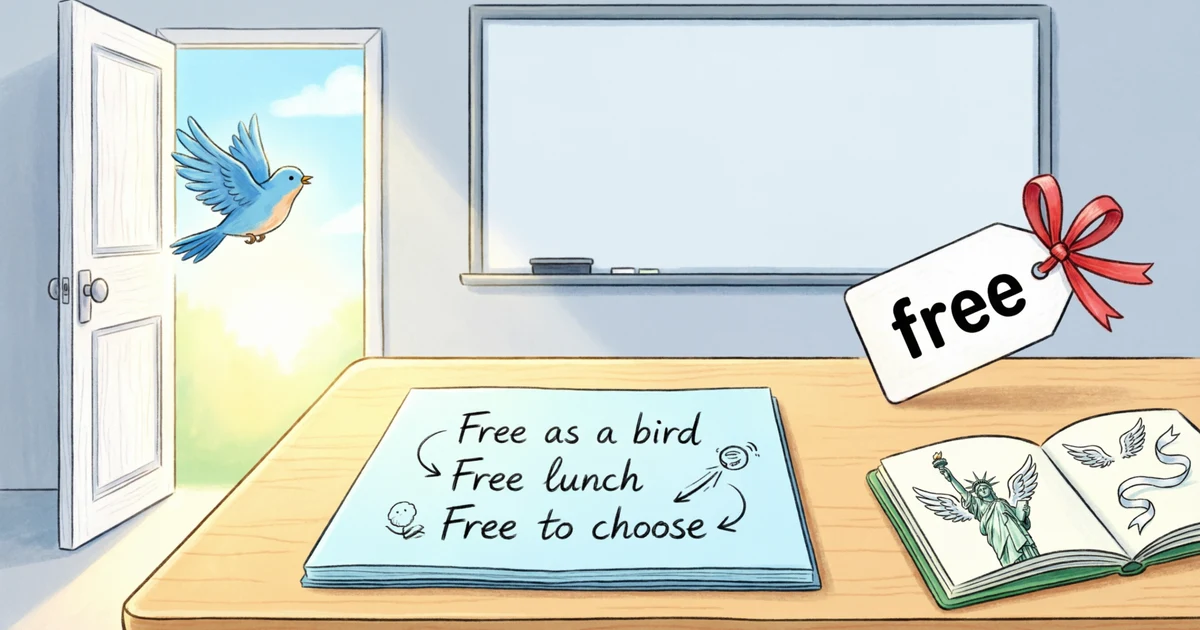
English has many colorful ways to talk about something being free. People say things like “on the house,” “free as a bird,” “at no cost,” or “there’s no such thing as a free lunch.” Some of these expressions are idioms, while others work more like metaphors.
This is where many students, writers, and ESL learners get confused. Both idioms and metaphors can sound figurative. Both can go beyond literal meaning, Both can make writing more expressive. But they do not work in the same way.
The core difference is simple: an idiom is a fixed expression with a meaning that people already know, while a metaphor describes one thing as another to create a comparison.
So, when you search for idioms for free, you usually want expressions that mean “without payment,” “without limits,” “released,” “independent,” or “easy to access.” This article explains idioms and metaphors clearly, shows how they differ, and gives practical examples related to the idea of being free.
What Idioms Mean
An idiom is a phrase whose meaning does not come directly from the individual words. Native speakers understand the phrase because people use it as a set expression.
For example, “on the house” means something costs nothing, especially in a restaurant or business setting.
You cannot understand this idiom by looking only at the words “on” and “house.” The meaning comes from common usage.
Simple definition:
An idiom is a common expression with a special meaning that differs from its literal words.
Purpose:
Idioms help speakers sound natural, fluent, and expressive.
How it works:
An idiom works as a fixed phrase. You usually should not change its wording too much.
Short example:
“The waiter gave us dessert on the house.”
Why it gets confused with metaphor:
Idioms often sound figurative, so learners may think every idiom is a metaphor. Some idioms include metaphorical ideas, but many idioms simply work as fixed expressions.
What Metaphors Mean
A metaphor describes one thing as if it were another thing. It creates a direct comparison without using “like” or “as.”
For example, “Freedom is an open sky” compares freedom to a wide, open sky. The sentence does not mean freedom is literally the sky. It suggests space, possibility, and no limits.
Simple definition:
A metaphor is a figure of speech that says one thing is another to show a deeper similarity.
Purpose:
Metaphors help writers create strong images, emotions, and meanings.
How it works:
A metaphor transfers meaning from one idea to another. It makes the reader connect two things mentally.
Short example:
“After graduation, the world was an open road.”
Why it gets confused with idiom:
Some idioms come from metaphorical images, such as “free as a bird.” But a metaphor can be original and creative, while an idiom usually belongs to common everyday language.
Idioms vs Metaphors: The Core Difference
Idioms and metaphors both use language in a non-literal way, but they serve different purposes.
An idiom is usually a familiar phrase with an accepted meaning. People use it because the expression already exists in the language.
A metaphor creates a comparison. Writers use it to help readers see one idea through another idea.
For example:
- Idiom: “The drinks were on the house.”
- Metaphor: “Freedom was a key in his hand.”
The idiom means the drinks cost nothing. The metaphor suggests that freedom gave someone control, access, or a new beginning.
In simple terms, idioms depend on shared usage, while metaphors depend on comparison.
Quick Comparison Table
| Point | Idiom | Metaphor |
|---|---|---|
| Definition | A fixed expression with a special meaning | A comparison that describes one thing as another |
| Scope | Usually common and familiar | Can be common, creative, short, or extended |
| Purpose | Makes speech natural and expressive | Creates imagery, emotion, and deeper meaning |
| Length | Often a short phrase | Can be a phrase, sentence, paragraph, or whole text |
| Structure | Usually fixed wording | Flexible and creative |
| Meaning | Learned through usage | Understood through comparison |
| Use in writing | Good for natural dialogue, informal writing, and clear expression | Good for poetry, stories, essays, speeches, and descriptive writing |
| Example | “Lunch was on the house.” | “Freedom was a door swinging open.” |
How Idioms Work
Idioms work because a language community agrees on their meaning over time. When someone says “free of charge,” the meaning is direct and clear. When someone says “on the house,” the meaning is idiomatic because the words do not explain the full idea by themselves.
Many idioms about free things connect to money, independence, permission, or release.
Examples include:
- On the house means paid for by the business.
- Free rein means freedom to act or decide.
- No strings attached means without hidden conditions.
- For free means without payment.
- At no cost means without financial charge.
Idioms can make writing sound natural, but writers need to choose them carefully. Some idioms fit casual speech, while others fit business or academic writing better.
For example, “at no cost” sounds more formal than “for free.”
“On the house” fits restaurants, stores, and services.
“No strings attached” fits offers, agreements, and relationships.
How Metaphors Work
Metaphors work by creating a mental connection between two things. They do not simply name an idea. They shape how readers feel about that idea.
When a writer says, “Freedom is a wide-open road,” the road suggests movement, choice, travel, and possibility. The metaphor makes freedom feel active and visual.
Metaphors about being free often use images such as birds, open doors, unlocked chains, open skies, fresh air, wide roads, and blank pages.
Examples include:
- Freedom is an open door.
- Her new life was a blank page.
- The truth unlocked his chains.
- He was a bird released into the sky.
- Opportunity was a road with no end.
These examples do more than say “free.” They show what freedom feels like.
Key Differences in Simple Language
The easiest way to separate idioms from metaphors is to ask one question:
Does the phrase already have a common fixed meaning, or does it create a comparison?
If the phrase already exists as a common expression, it is probably an idiom.
Example:
“On the house” is an idiom because people already understand it as “free.”
If the phrase compares freedom to another image, it is probably a metaphor.
Example:
“Freedom was a sunrise after a long night” is a metaphor because it compares freedom to sunrise.
Idioms often help with fluency. Metaphors often help with imagery.
Idioms sound conversational. Metaphors sound descriptive, poetic, or symbolic.
Idioms usually have set wording. Metaphors allow more creative freedom.
Can Idioms and Metaphors Overlap?
Yes, idioms and metaphors can overlap.
Some idioms began as metaphors. Over time, people repeated those phrases so often that they became fixed expressions.
For example, “free as a bird” compares a free person to a bird. That comparison makes it metaphorical. But people also use the phrase as a familiar expression, so it works like an idiom too.
Another example is “spread your wings.” It means to become more independent or try new things. The image comes from a bird using its wings, so it has metaphorical meaning. Since people use it as a common phrase, it also has idiomatic force.
This overlap explains why learners often confuse the two terms. The key is not to panic over labels. Instead, focus on how the phrase works in context.
If the expression feels fixed and commonly used, call it an idiom.
If the expression creates a comparison, call it a metaphor.
Or, If it does both, you can explain both features.
Examples of Idioms for Free
Here are useful idioms and expressions related to being free, having freedom, or getting something without payment.
1. On the house
Meaning: Free because the business pays for it.
Example: “The manager gave us coffee on the house.”
Use it when: You talk about restaurants, cafés, hotels, or customer service.
2. Free of charge
Meaning: Without payment.
Example: “The museum offers guided tours free of charge.”
Use it when: You want a clear and slightly formal expression.
3. For free
Meaning: Without paying money.
Example: “You can download the worksheet for free.”
Use it when: You want a simple everyday phrase.
4. At no cost
Meaning: Without any financial cost.
Example: “Students can access the course at no cost.”
Use it when: You write in a formal, professional, or educational context.
5. No strings attached
Meaning: Free from hidden conditions or obligations.
Example: “They offered a free trial with no strings attached.”
Use it when: You want to show that an offer has no secret requirements.
6. Free rein
Meaning: Freedom to make decisions or act as you choose.
Example: “The designer had free rein over the project.”
Use it when: You talk about creative control, leadership, or decision-making.
7. Off the hook
Meaning: Free from blame, duty, or punishment.
Example: “The teacher let him off the hook this time.”
Use it when: Someone escapes responsibility or trouble.
8. In the clear
Meaning: Free from danger, suspicion, or trouble.
Example: “After the audit, the company was in the clear.”
Use it when: A person or group no longer faces risk or blame.
9. Footloose and fancy-free
Meaning: Free from responsibilities, commitments, or worries.
Example: “After college, she felt footloose and fancy-free.”
Use it when: You want a light, old-fashioned, playful tone.
10. There’s no such thing as a free lunch
Meaning: Nothing is truly free; someone pays or expects something.
Example: “The app is free, but it collects your data. There’s no such thing as a free lunch.”
Use it when: You want to warn someone about hidden costs.
Examples of Metaphors for Free
Metaphors for freedom often create images of space, movement, release, or new beginnings.
1. Freedom is an open road
This metaphor suggests choice, movement, and possibility.
Example: “After she quit the job she hated, freedom was an open road.”
2. Freedom is a key
This metaphor suggests access, control, and escape.
Example: “Education became the key that unlocked his future.”
3. Freedom is fresh air
This metaphor suggests relief after pressure or restriction.
Example: “Leaving the toxic workplace felt like fresh air.”
4. Freedom is an open sky
This metaphor suggests limitlessness and peace.
Example: “For the first time in years, her life felt like an open sky.”
5. Freedom is a blank page
This metaphor suggests a new start and the power to write your own story.
Example: “Moving to a new city gave him a blank page.”
6. Freedom is a broken chain
This metaphor suggests escape from control, fear, or oppression.
Example: “Speaking the truth became the broken chain he had waited for.”
7. Freedom is a bird in flight
This metaphor suggests movement, independence, and natural freedom.
Example: “Her confidence rose like a bird in flight.”
Idioms vs Metaphors in Literature and Writing
Writers use idioms and metaphors for different effects.
Idioms can make dialogue sound realistic. A character who says “It’s on the house” sounds natural in a restaurant scene. A narrator who says someone got “off the hook” creates a casual tone.
Metaphors help writers build imagery and theme. A poet may describe freedom as “a door opening inside the chest.” A novelist may use a recurring image of birds, windows, or roads to show a character’s search for independence.
In literature, metaphors often carry more symbolic weight than idioms. They can support a theme across a poem, story, or essay. Idioms usually work at the sentence level, while metaphors can shape the mood of an entire passage.
That does not make one better than the other. A strong writer knows when to use each one.
Use idioms when you want natural speech.
Use metaphors when you want vivid meaning.
Idioms vs Metaphors for Students and ESL Learners
Students and ESL learners often struggle with idioms because the literal words can mislead them. For example, “on the house” does not mean something sits on top of a house. It means the business gives it for free.
Metaphors create a different challenge. Learners may understand the words but miss the comparison. For example, “Freedom is an open road” does not talk about a real road. It talks about choice and possibility.
Here is a simple learning method:
- For idioms, learn the whole phrase and its meaning.
- For metaphors, ask what two things the writer compares.
- For both, check the context before deciding the meaning.
ESL learners should also notice register. Some expressions sound casual, such as “for free.” Others sound more formal, such as “at no cost” or “free of charge.”
In academic writing, avoid slangy idioms unless they fit the topic. In creative writing, metaphors often give stronger results.
Common Mistakes and Confusion
Mistake 1: Thinking every figurative phrase is a metaphor
Not every non-literal phrase is a metaphor. “On the house” is an idiom because it has a fixed meaning. It does not mainly work by comparing two things.
Mistake 2: Changing idioms too much
Idioms usually have fixed wording. Saying “on the building” instead of “on the house” will confuse readers.
Mistake 3: Using idioms in the wrong context
“On the house” works well for food, drinks, or services from a business. It does not fit every situation involving something free.
Weak: “The government gave scholarships on the house.”
Better: “The government offered scholarships at no cost.”
Mistake 4: Making metaphors too unclear
A metaphor should help the reader understand the idea more deeply. If the comparison feels random, it weakens the writing.
Unclear: “Freedom was a spoon in the thunder.”
Clearer: “Freedom was a door he could finally open.”
Mistake 5: Confusing free as “no cost” with free as “independent”
The word free has more than one meaning. It can mean without payment, without control, available, released, or unrestricted.
Example:
“Free coffee” means no payment.
“A free person” means independent.
“A free seat” means available.
Choose the expression that matches the exact meaning.
When to Use Idioms and When to Use Metaphors
Use idioms when you want your English to sound natural, conversational, or familiar.
Good situations for idioms:
- Dialogue
- Blog writing
- Everyday conversation
- Informal essays
- Social media captions
- Simple explanations
Example:
“The samples are free of charge.”
Use metaphors when you want to create emotion, imagery, or symbolic meaning.
Good situations for metaphors:
- Poetry
- Stories
- Speeches
- Personal essays
- Descriptive writing
- Literary analysis
Example:
“Freedom was a window thrown open after years in a dark room.”
For clear informational writing, idioms often work better. For creative writing, metaphors usually give you more power.
Related Terms People Often Confuse with Idioms and Metaphors
Simile
A simile compares two things using “like” or “as.”
Example:
“She felt as free as a bird.”
This example uses “as,” so it works as a simile. The phrase “free as a bird” can also function as an idiomatic expression because people use it commonly.
Expression
An expression is a broad term for a phrase people commonly use. Idioms are one type of expression.
Example:
“For free” is a common expression.
Proverb
A proverb is a short saying that teaches a general truth or lesson.
Example:
“There’s no such thing as a free lunch.”
This saying teaches that free things often have hidden costs.
Cliché
A cliché is an expression people have used so often that it may feel weak or unoriginal.
Example:
“Free as a bird” can sound cliché if a writer uses it without a fresh context.
Symbol
A symbol is an object, image, or action that represents a larger idea.
Example:
A broken chain can symbolize freedom.
Symbols often appear in literature, art, and film.
Conclusion
Idioms and metaphors both make language more expressive, but they work in different ways. An idiom is a common fixed phrase with a special meaning. A metaphor creates a direct comparison between two things.
For the idea of free, idioms such as “on the house,” “free of charge,” “no strings attached,” and “free rein” help you speak naturally and clearly. Metaphors such as “freedom is an open road” or “freedom is a broken chain” help you create deeper imagery and emotion.
The simplest rule is this: use idioms for familiar meaning, and use metaphors for creative comparison. Once you understand that difference, you can choose stronger expressions in essays, stories, conversations, and everyday English.
FAQs
1. What are idioms for free?
Idioms for free include expressions such as “on the house,” “free of charge,” “for free,” “at no cost,” “no strings attached,” and “free rein.” Some mean without payment, while others mean without limits, control, or hidden conditions.
2. Is “on the house” an idiom?
Yes. “On the house” is an idiom. It means a business gives something to a customer for free. People often use it in restaurants, cafés, bars, and hotels.
3. Is “free as a bird” an idiom or a metaphor?
“Free as a bird” can work as both an idiomatic expression and a figurative comparison. It compares a person’s freedom to a bird’s freedom, so it has metaphorical meaning. Because people use it as a familiar phrase, it also feels idiomatic.
4. What is the difference between an idiom and a metaphor?
An idiom is a fixed expression with a meaning people learn through usage. A metaphor compares one thing to another to create imagery or deeper meaning. Idioms depend on common usage. Metaphors depend on comparison.
5. Can I use idioms in formal writing?
You can use some idioms in formal writing, but choose carefully. Expressions like “at no cost” and “free of charge” fit formal writing better than casual phrases like “for free” or playful idioms like “footloose and fancy-free.”
6. What is a good metaphor for freedom?
A good metaphor for freedom creates a clear image. Examples include “freedom is an open road,” “freedom is a key,” “freedom is fresh air,” and “freedom is a broken chain.”
7. Why do ESL learners confuse idioms and metaphors?
ESL learners confuse them because both can use non-literal language. Idioms have fixed meanings that may not match the words, while metaphors create comparisons. Context helps learners understand which one they are seeing.