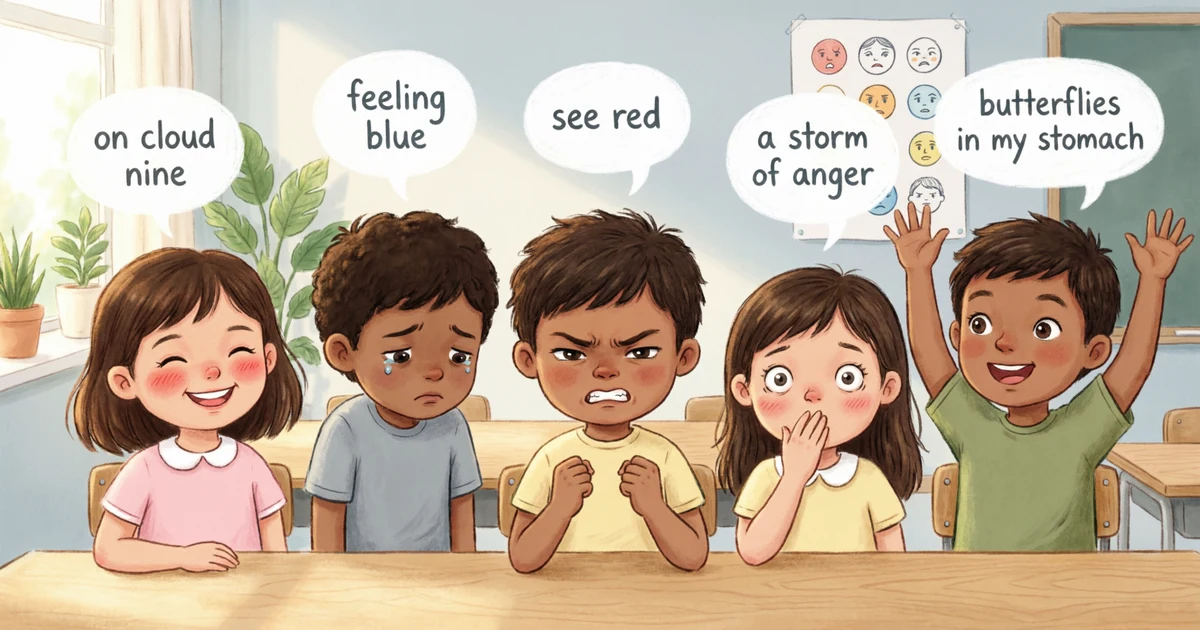
Emotions can be hard to describe with plain words. Saying “I am sad,” “I am angry,” or “I am nervous” works, but it can sound flat. That is why English speakers often use idioms for emotions and metaphors for emotions.
For example, someone might say they are on cloud nine when they feel extremely happy. Another person might say anger burned inside him to describe intense anger. Both expressions make feelings more vivid, but they do not work in exactly the same way.
The simple difference is this: an idiom is a fixed expression with a meaning you cannot always guess from the individual words, while a metaphor describes one thing as another to create a comparison. Idioms are often common phrases people already know. Metaphors are more flexible and creative.
This guide explains idioms and metaphors for emotions in simple language, with clear examples for students, writers, and ESL learners.
What Idioms Mean
An idiom is a common phrase whose meaning is different from the literal meaning of its words.
If someone says, “She was on cloud nine,” they do not mean she was standing on an actual cloud. They mean she felt extremely happy.
Simple definition
An idiom is a fixed expression with a special meaning.
Purpose
Idioms help speakers express ideas in a natural, familiar, and often colorful way.
How idioms work
Idioms work because a language community understands the phrase as a whole. You usually cannot change the words much without making the idiom sound wrong.
Short natural example
He was down in the dumps after failing the test.
This means he felt very sad or disappointed.
Why idioms get confused with metaphors
Many idioms began as figurative comparisons, so they can feel metaphorical. However, idioms usually have fixed wording and a recognized meaning.
What Metaphors Mean
A metaphor is a figure of speech that describes one thing as another thing. It does not use “like” or “as.”
For example, “Her heart was a locked room” compares her emotional state to a locked room. It suggests she was closed off, private, or unwilling to share her feelings.
Simple definition
A metaphor describes something by saying it is something else.
Purpose
Metaphors help writers and speakers explain feelings, ideas, and experiences in a deeper or more imaginative way.
How metaphors work
A metaphor creates meaning through comparison. It connects two unlike things so the reader can understand one through the other.
Short natural example
Grief was a heavy coat he could not take off.
This means his sadness felt constant, heavy, and hard to escape.
Why metaphors get confused with idioms
Some metaphors become so common that people start using them like idioms. For example, “a broken heart” is metaphorical, but it is also a familiar expression.
Idioms vs Metaphors: The Core Difference
The core difference between idioms and metaphors is fixed meaning vs creative comparison.
An idiom usually has a meaning that English speakers already recognize. A metaphor creates a comparison that may be familiar or original.
For example:
Idiom:
She was on cloud nine.
Meaning: She was very happy.
Metaphor:
Happiness bloomed inside her.
Meaning: Her happiness grew like a flower.
The idiom uses a known phrase. The metaphor creates an image.
Quick Comparison Table
| Point | Idiom | Metaphor |
|---|---|---|
| Definition | A fixed phrase with a non-literal meaning | A comparison that says one thing is another |
| Scope | Narrower and phrase-based | Broader and more creative |
| Purpose | To express meaning naturally and commonly | To create imagery, depth, or emotional impact |
| Length | Usually short | Can be short, extended, or part of a whole passage |
| Structure | Often fixed wording | Flexible wording |
| Meaning | Often learned as a complete expression | Understood through comparison |
| Use in writing | Good for natural dialogue and familiar tone | Good for description, poetry, fiction, and analysis |
| Example | “He lost his temper.” | “His anger was a storm.” |
How Idioms Work
Idioms work as ready-made expressions. Native speakers use them naturally in conversation, fiction, essays, and informal writing.
Many idioms for emotions describe feelings through the body, movement, weather, color, or physical pressure. For example:
- butterflies in your stomach means nervousness
- see red means sudden anger
- feel blue means sadness
- over the moon means extreme happiness
- at the end of your rope means emotional exhaustion
These phrases do not need long explanation when used with the right audience. Their meanings come from common usage.
For ESL learners, the challenge is that idioms often cannot be translated word for word. A phrase may sound strange literally but feel completely natural in English.
How Metaphors Work
Metaphors work by creating a direct comparison. They help readers feel an emotion rather than simply name it.
A writer can say:
She was sad.
That sentence is clear, but plain. A metaphor can make it stronger:
Sadness settled over her like winter.
This sentence creates a colder, heavier emotional image. Strictly speaking, it includes “like,” so it is a simile. Without “like,” it becomes a metaphor:
Sadness was winter inside her.
Metaphors for emotions often use ideas such as fire, weight, storms, darkness, light, walls, wounds, or oceans.
Examples:
- Anger was a fire in his chest.
- Her fear was a locked door.
- Joy spilled into the room.
- Grief swallowed the house.
- Hope was a small candle in the dark.
Metaphors give writers more freedom than idioms because they can create new images.
Key Differences in Simple Language
Idioms are usually common expressions. Metaphors are comparisons.
Idioms often need to be memorized. Metaphors need to be interpreted.
Idioms sound natural in everyday speech. Metaphors often sound more descriptive, literary, or imaginative.
Idioms usually have fixed wording. Metaphors can change depending on the writer’s style.
Idioms can be casual. Metaphors can be casual too, but they often carry more emotional or symbolic weight.
For example, “I’m feeling blue” is an idiom. “Sadness painted the room blue” is a metaphor.
Both express sadness, but the idiom gives a familiar phrase while the metaphor creates a fresh image.
Can Idioms and Metaphors Overlap?
Yes, idioms and metaphors can overlap.
Some idioms are metaphorical because they use comparison or imagery. For example, “carry the weight of the world on your shoulders” is an idiom, but it also works metaphorically. The person is not literally carrying the world. The phrase compares emotional pressure to physical weight.
Another example is “a broken heart.” This expression describes emotional pain through the image of physical damage. It is metaphorical, but it is also so common that many people treat it like an idiom.
The overlap happens because language changes. A fresh metaphor can become popular. Over time, people repeat it so often that it becomes a common expression.
So, the best way to tell them apart is to ask:
Is this a fixed phrase people commonly use?
It is probably an idiom.
Is this mainly a comparison that creates an image?
It is probably a metaphor.
Examples of Idioms for Emotions
Here are common idioms for emotions with simple meanings and examples.
1. On cloud nine
Meaning: extremely happy
Example:
She was on cloud nine after receiving the scholarship.
2. Down in the dumps
Meaning: sad or discouraged
Example:
He felt down in the dumps after his team lost the final.
3. See red
Meaning: become very angry
Example:
She saw red when she heard the unfair comment.
4. Butterflies in your stomach
Meaning: nervous excitement or anxiety
Example:
I had butterflies in my stomach before the speech.
5. Over the moon
Meaning: very happy or delighted
Example:
They were over the moon about their new home.
6. At the end of your rope
Meaning: emotionally exhausted or unable to cope
Example:
After weeks of stress, he was at the end of his rope.
7. Lose your temper
Meaning: become angry suddenly
Example:
Try not to lose your temper during the meeting.
8. Wear your heart on your sleeve
Meaning: show your emotions openly
Example:
She wears her heart on her sleeve, so everyone knows how she feels.
9. Have a heavy heart
Meaning: feel sadness or sorrow
Example:
He left the city with a heavy heart.
10. In high spirits
Meaning: cheerful and energetic
Example:
The students were in high spirits after the exam ended.
Examples of Metaphors for Emotions
Here are examples of metaphors that describe emotions with stronger imagery.
1. Anger was a storm in his chest.
Meaning: He felt intense anger.
2. Her joy was sunlight after a long winter.
Meaning: Her happiness felt warm, bright, and relieving.
3. Fear built a wall around him.
Meaning: Fear made him emotionally closed or cautious.
4. Grief was an ocean, and she was drowning in it.
Meaning: Her sadness felt overwhelming.
5. Hope was a candle in the dark.
Meaning: Hope felt small but important during a difficult time.
6. Shame burned across his face.
Meaning: He felt embarrassed or humiliated.
7. Loneliness was an empty room.
Meaning: Loneliness felt silent, bare, and isolating.
8. Excitement raced through her veins.
Meaning: She felt strong excitement in her whole body.
9. His guilt was a shadow that followed him.
Meaning: His guilt stayed with him wherever he went.
10. Love was a safe harbor.
Meaning: Love gave comfort, safety, and peace.
Idioms vs Metaphors in Literature and Writing
Writers use idioms and metaphors for different effects.
Idioms can make dialogue sound natural. If a character says, “I’m at the end of my rope,” the line sounds conversational and emotionally clear. Idioms can also reveal personality, culture, age, and tone.
Metaphors often create stronger imagery. A writer might say, “Her sadness filled the room like smoke.” This gives the reader a mood, not just a meaning.
In literature, metaphors usually carry more symbolic power. They can connect a character’s emotion to a larger theme. For example, a storm may represent anger, fear, conflict, or emotional chaos.
Idioms work best when the writer wants clarity and natural expression. Metaphors work best when the writer wants depth, originality, or emotional atmosphere.
Still, writers should use both carefully. Too many idioms can make writing sound cliché. Too many metaphors can make writing feel heavy or confusing.
Idioms vs Metaphors for Students and ESL Learners
Students and ESL learners often confuse idioms and metaphors because both use non-literal language.
The easiest way to understand the difference is this:
Idioms are learned phrases. Metaphors are created comparisons.
If you are learning English, study idioms as complete expressions. Do not try to understand every word literally. For example, “feel blue” means sad, not physically blue.
For metaphors, look for the comparison. Ask what two things connect. In “anger was a volcano,” the writer compares anger to a volcano. This suggests pressure, heat, danger, and eruption.
For school assignments, you can explain it this way:
An idiom has a meaning people already know. A metaphor helps readers understand one thing by comparing it to another.
That sentence works well because it shows both the practical and literary difference.
Common Mistakes and Confusion
Mistake 1: Thinking every idiom is a metaphor
Many idioms are figurative, but not every idiom works as a clear metaphor. Some idioms have meanings that come from history, culture, or repeated use.
Mistake 2: Taking idioms literally
If someone says, “I have butterflies in my stomach,” they do not mean real butterflies. They mean nervousness.
Mistake 3: Calling every emotional phrase an idiom
A phrase like “sadness was a dark cloud” is not automatically an idiom. It is a metaphor because it creates a comparison.
Mistake 4: Overusing idioms in formal writing
Idioms can sound too casual in academic essays. Use them carefully unless the assignment allows a conversational tone.
Mistake 5: Creating strange idioms by changing fixed wording
Idioms often have set forms. For example, English speakers say “over the moon,” not usually “above the moon” when they mean very happy.
Mistake 6: Making metaphors too complicated
A metaphor should help the reader understand the emotion. If the image feels confusing, choose a clearer comparison.
When to Use Idioms and When to Use Metaphors
Use idioms when you want your English to sound natural, familiar, and conversational.
Good uses for idioms:
- dialogue
- informal essays
- personal writing
- ESL speaking practice
- everyday conversation
- simple emotional expression
Example:
I was over the moon when I got the news.
Use metaphors when you want to create a strong image or emotional effect.
Good uses for metaphors:
- poetry
- fiction
- descriptive writing
- speeches
- literary analysis
- emotional scenes
- creative essays
Example:
The news opened a window of light inside her.
In simple terms, use idioms for natural expression and metaphors for creative description.
Related Terms People Often Confuse With Idioms and Metaphors
Simile
A simile compares two things using like or as.
Example:
Her smile was like sunshine.
A metaphor would say:
Her smile was sunshine.
Hyperbole
Hyperbole uses exaggeration for effect.
Example:
I cried a river.
This does not mean someone literally cried enough tears to make a river.
Personification
Personification gives human actions or qualities to non-human things.
Example:
Fear whispered in his ear.
Fear cannot literally whisper, but the sentence makes the emotion feel alive.
Symbolism
Symbolism uses an object, color, place, or action to represent a deeper meaning.
Example:
A dark room may symbolize sadness, loneliness, or fear.
Cliché
A cliché is an overused expression.
Example:
Time heals all wounds.
Some idioms and metaphors can become clichés if writers use them too often.
Figurative language
Figurative language is the broad category. Idioms, metaphors, similes, hyperbole, and personification all belong to figurative language.
Conclusion
Idioms and metaphors both help people describe emotions in a more vivid way, but they are not the same.
An idiom is a common fixed expression with a meaning people understand as a whole. Examples include on cloud nine, down in the dumps, and butterflies in your stomach.
A metaphor is a comparison that describes one thing as another. Examples include anger was a storm, grief was an ocean, and hope was a candle in the dark.
For students and ESL learners, the easiest rule is this: idioms are familiar phrases, while metaphors are meaningful comparisons. For writers, idioms can make language sound natural, while metaphors can make emotions feel deeper, fresher, and more powerful.
FAQs
What are idioms for emotions?
Idioms for emotions are common expressions that describe feelings in a non-literal way. Examples include on cloud nine for happiness, see red for anger, and down in the dumps for sadness.
What is the difference between an idiom and a metaphor?
An idiom is a fixed phrase with a special meaning. A metaphor is a comparison that says one thing is another. Idioms are usually learned as complete expressions, while metaphors are understood through comparison.
Is “butterflies in my stomach” an idiom or a metaphor?
Butterflies in my stomach is usually treated as an idiom. It means nervousness or nervous excitement. It also has metaphorical imagery because it compares nervous feelings to movement in the stomach.
Can an idiom also be a metaphor?
Yes. Some idioms are metaphorical. For example, carry the weight of the world on your shoulders is an idiom, but it also compares emotional stress to physical weight.
Are idioms good for formal writing?
Idioms can work in some essays, but many sound informal or conversational. In formal writing, use idioms carefully and choose clear language when accuracy matters most.
Are metaphors better than idioms in creative writing?
Metaphors often work better when you want original imagery or emotional depth. Idioms work better when you want natural speech or familiar expression. Strong writing can use both.
How can ESL learners remember emotional idioms?
Learn each idiom as a complete phrase with a short example sentence. Do not translate it word for word. Group idioms by emotion, such as happiness, sadness, anger, fear, and nervousness.