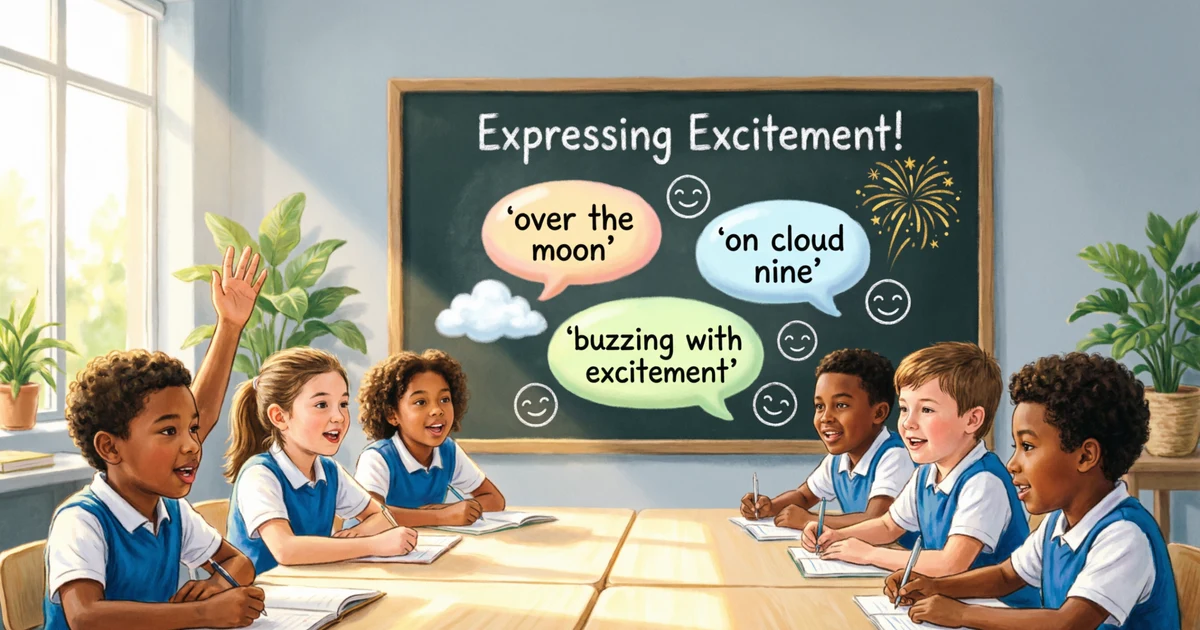
Writers and English learners often search for idioms for excitement because they want stronger ways to say someone feels happy, thrilled, nervous, eager, or full of energy. Phrases like “over the moon,” “on cloud nine,” and “buzzing with excitement” sound more vivid than simply saying “very excited.”
But many learners also confuse idioms with metaphors. That confusion makes sense. Both use figurative language. Both can make writing more colorful, Both can describe feelings in creative ways.
The main difference is simple: an idiom is a fixed phrase with a meaning that people already know, while a metaphor compares one thing to another to create meaning. Some idioms include metaphors, but not every metaphor counts as an idiom.
For example, “I’m over the moon” works as an idiom for excitement because English speakers understand it as “I’m extremely happy or thrilled.” But “excitement was fireworks in her chest” works as a metaphor because it creates a fresh image rather than using a common fixed phrase.
This guide explains idioms and metaphors clearly, shows how they overlap, and gives practical examples for students, writers, and ESL learners.
What Idioms Mean
An idiom is a common expression whose meaning differs from the literal meaning of its words. You usually understand an idiom as a whole phrase, not word by word.
For example, when someone says, “I’m on cloud nine,” they do not mean they are standing on a real cloud. They mean they feel extremely happy or excited.
Simple definition
An idiom is a fixed expression with a commonly understood figurative meaning.
Purpose
Idioms help speakers sound natural, expressive, and fluent. They can show emotion quickly because many people already know what the phrase means.
How idioms work
Idioms work through shared meaning. A group of words becomes familiar over time, and people learn the phrase as one unit.
Short natural example
She was over the moon when she got the scholarship.
This means she felt extremely happy and excited.
Why idioms get confused with metaphors
Many idioms use imaginative language. “Over the moon” creates a visual image, so it feels metaphorical. However, it still counts as an idiom because people use it as a fixed expression with an established meaning.
What Metaphors Mean
A metaphor describes one thing as another thing to show a similarity. It does not use “like” or “as.” Instead of saying one thing resembles another, it presents the comparison directly.
For excitement, a metaphor might describe the feeling as fire, electricity, fireworks, music, or a storm.
For example, “Excitement lit a fire in his chest” compares excitement to fire. The sentence does not use a common fixed idiom. It creates an image to help readers feel the emotion.
Simple definition
A metaphor is a direct comparison that describes one thing as something else.
Purpose
Metaphors make writing more vivid, emotional, and imaginative. They help readers picture or feel an idea more strongly.
How metaphors work
Metaphors connect two different things. The writer chooses a familiar image, such as fire or lightning, to explain an abstract feeling, such as excitement.
Short natural example
Her excitement was a spark racing through the room.
This metaphor compares excitement to a spark to show energy and movement.
Why metaphors get confused with idioms
Some metaphors become so common that they turn into idioms. For example, “on cloud nine” once sounded like a creative image, but now people use it as a familiar idiomatic phrase.
Idioms vs Metaphors: The Core Difference
The core difference comes down to fixed meaning versus creative comparison.
An idiom has a meaning that speakers already recognize. You usually cannot change its words much without making it sound strange. For example, “over the moon” works, but “above the planet” does not carry the same idiomatic meaning.
A metaphor gives the writer more freedom. You can create a new comparison as long as it makes sense. For example, you can write, “Excitement was a drumbeat under his ribs,” and readers can understand the feeling through the image.
So, for the keyword idioms for excitement, phrases like “over the moon,” “on cloud nine,” and “like a kid in a candy store” work best as idioms. Metaphors such as “excitement exploded like fireworks inside her” belong more to creative writing, though they can express the same emotion.
Quick Comparison Table
| Point | Idiom | Metaphor |
|---|---|---|
| Definition | A common fixed phrase with a figurative meaning | A direct comparison between two different things |
| Scope | Narrower because it depends on known expressions | Broader because writers can create new comparisons |
| Purpose | Helps speech and writing sound natural, fluent, and expressive | Helps writing feel vivid, emotional, and imaginative |
| Length | Usually a short phrase | Can be a phrase, sentence, or extended idea |
| Structure | Often fixed or semi-fixed | Flexible and creative |
| Meaning | Usually learned as a complete phrase | Built through comparison and context |
| Use in writing | Good for dialogue, informal writing, explanations, and natural expression | Good for stories, poems, descriptions, speeches, and essays |
| Example | “He was on cloud nine.” | “Excitement was lightning in his veins.” |
How Idioms Work
Idioms work because language communities agree on meaning over time. The words may not make literal sense, but the phrase has a familiar figurative meaning.
Take the idiom “bursting with excitement.” A person does not literally burst. The phrase means someone feels so excited that the feeling seems too strong to hold inside.
Idioms often work well in everyday English because they sound conversational. They help students and ESL learners move beyond basic words like “happy,” “excited,” and “glad.”
Common idioms for excitement include:
| Idiom | Meaning | Example |
|---|---|---|
| Over the moon | Extremely happy or excited | She was over the moon about the offer. |
| On cloud nine | Very happy and thrilled | He has been on cloud nine since the match. |
| Buzzing with excitement | Full of excited energy | The children were buzzing with excitement before the trip. |
| Like a kid in a candy store | Very excited by many enjoyable options | I felt like a kid in a candy store at the book fair. |
| Can’t wait | Very eager for something | I can’t wait for the concert. |
| Jumping for joy | Showing great happiness | They were jumping for joy after the win. |
| Thrilled to bits | Extremely pleased and excited | She was thrilled to bits with the result. |
These idioms help writers show excitement in a natural way, especially in casual writing, dialogue, emails, captions, and personal stories.
How Metaphors Work
Metaphors work by giving an abstract idea a concrete image. Excitement can feel hard to explain directly, so writers compare it to something readers can imagine.
For example:
Excitement crackled in the air.
This metaphor compares excitement to electricity or sparks. It suggests energy, tension, and movement.
Metaphors can sound fresh because the writer controls the image. Instead of using a familiar idiom, the writer creates a new way to describe the feeling.
Common metaphor ideas for excitement include:
| Metaphor | Meaning |
|---|---|
| Excitement was a fire in his chest. | He felt intense energy and emotion. |
| Her joy exploded like fireworks. | Her excitement felt bright, sudden, and powerful. |
| The room buzzed with energy. | Everyone felt excited and lively. |
| Hope sparked inside him. | He began to feel excited and positive. |
| Anticipation rolled through the crowd. | The crowd felt eager and excited. |
Metaphors work especially well in stories, poems, speeches, descriptive essays, and creative nonfiction.
Key Differences in Simple Language
Idioms and metaphors both make language more expressive, but they do different jobs.
An idiom gives you a ready-made expression. You use it because people already understand it.
A metaphor gives you a creative comparison. You use it because you want readers to see or feel something in a new way.
An idiom is usually narrower because it depends on a known phrase. A metaphor is broader because writers can create endless comparisons.
An idiom often sounds natural and conversational. A metaphor often sounds descriptive or literary, depending on how you write it.
For ESL learners, idioms require memorization and context. For writers, metaphors require imagination and control.
Can Idioms and Metaphors Overlap?
Yes, idioms and metaphors can overlap.
Many idioms started as metaphors. Over time, people repeated them so often that they became fixed expressions.
For example, “on cloud nine” creates a metaphorical image of someone floating high above normal life. But English speakers now treat it as an idiom because it has a familiar meaning: very happy or excited.
The same thing happens with “bursting with excitement.” It uses a metaphor of pressure building inside a person, but it also works like an idiom because many speakers use the phrase naturally.
So, the overlap looks like this:
| Phrase | Idiom, metaphor, or both? | Why |
|---|---|---|
| Over the moon | Mostly idiom | It has a fixed, familiar meaning. |
| On cloud nine | Idiom with metaphorical imagery | It uses an image, but people know the phrase as an idiom. |
| Excitement was a wildfire in her chest | Metaphor | It creates a direct comparison. |
| Buzzing with excitement | Idiom-like metaphor | It uses a common image of energy and vibration. |
The safest way to understand the difference is this: if people use the phrase as a fixed expression, call it an idiom. If the writer creates a direct comparison, call it a metaphor.
Examples of Idioms for Excitement
Here are practical idioms for excitement with meanings and natural examples.
1. Over the Moon
Meaning: Extremely happy or excited.
Example:
She was over the moon when she heard the good news.
This idiom works well when someone feels joyful after success, a surprise, or a special announcement.
2. On Cloud Nine
Meaning: Very happy, delighted, or thrilled.
Example:
He was on cloud nine after winning the competition.
This phrase often describes a happy feeling that lasts for a while.
3. Buzzing with Excitement
Meaning: Full of energy and eager emotion.
Example:
The classroom was buzzing with excitement before the science fair.
This idiom works well for groups, events, children, crowds, and lively places.
4. Jumping for Joy
Meaning: Showing great happiness or excitement.
Example:
The fans were jumping for joy after the final goal.
This phrase suggests visible excitement, not quiet happiness.
5. Like a Kid in a Candy Store
Meaning: Very excited because many enjoyable choices appear at once.
Example:
At the art supply shop, Maya felt like a kid in a candy store.
This idiom works well when someone feels excited by options, treats, tools, books, games, or opportunities.
6. Can’t Wait
Meaning: Very eager for something to happen.
Example:
I can’t wait to see the new movie.
This phrase sounds simple, natural, and common in everyday English.
7. Thrilled to Bits
Meaning: Extremely pleased or excited.
Example:
They were thrilled to bits with their new house.
This idiom sounds friendly and warm, especially in British English.
8. Fired Up
Meaning: Excited, motivated, and ready to act.
Example:
The coach’s speech got the team fired up.
This phrase works well for sports, goals, speeches, competitions, and challenges.
9. Pumped Up
Meaning: Very excited and energetic.
Example:
We were pumped up before the concert started.
This idiom sounds informal and common in casual speech.
10. Walking on Air
Meaning: Feeling extremely happy or excited.
Example:
After the proposal, she felt like she was walking on air.
This phrase often suggests lightness, joy, and emotional happiness.
Examples of Metaphors for Excitement
Metaphors for excitement can sound more creative than idioms. Use them when you want to create a strong image instead of using a familiar phrase.
1. Excitement Was Fire in His Chest
Example:
Excitement was fire in his chest as he stepped onto the stage.
This metaphor shows intensity, heat, and strong emotion.
2. Her Joy Exploded Like Fireworks
Example:
Her joy exploded like fireworks when she saw her name on the list.
This example uses a simile because it includes “like,” but writers often use fireworks imagery metaphorically for sudden excitement.
A pure metaphor would be:
Her joy was fireworks across the room.
3. The News Sent Electricity Through the Crowd
Example:
The news sent electricity through the crowd.
This metaphor suggests shared energy, surprise, and excitement.
4. Anticipation Drummed Under His Skin
Example:
Anticipation drummed under his skin before the race began.
This metaphor connects excitement with rhythm and physical tension.
5. The Room Became a Spark
Example:
When the band walked in, the room became a spark.
This metaphor suggests sudden energy and life.
6. Excitement Bloomed Inside Her
Example:
Excitement bloomed inside her as the plane took off.
This metaphor feels softer and more hopeful than fire or lightning.
7. His Heart Was a Starting Gun
Example:
His heart was a starting gun, ready to launch him forward.
This metaphor works well for nervous excitement before action.
Idioms vs Metaphors in Literature and Writing
In literature, idioms and metaphors serve different purposes.
Idioms can make dialogue sound realistic. If a character says, “I’m over the moon,” the line sounds natural and easy to understand. Idioms help characters sound like real people because real people use familiar expressions in speech.
Metaphors give writers more artistic control. A novelist might write, “Excitement crawled up her spine like a match catching flame.” That sentence creates a more specific mood than a common idiom.
Good writers choose based on effect.
Use idioms when you want:
- natural speech
- quick meaning
- friendly tone
- everyday expression
- familiar emotional language
Use metaphors when you want:
- vivid description
- fresh imagery
- emotional depth
- a literary style
- a unique voice
A student essay can use both, but it should use them carefully. Too many idioms may sound casual. Too many metaphors may sound dramatic or unclear. Strong writing balances clarity with expression.
Idioms vs Metaphors for Students and ESL Learners
Students and ESL learners often struggle with idioms because literal translation does not work. If someone says “I’m over the moon,” the words alone do not explain the meaning. You need to learn the phrase as a complete expression.
Metaphors can feel easier in one way because the writer creates a comparison. But they can also feel harder because the meaning depends on context.
For example:
The room buzzed with excitement.
A learner may understand this because “buzzed” suggests sound, energy, and movement. But another metaphor, such as “hope was a match in his ribs,” may need more interpretation.
Here is a simple learning tip:
Use idioms when you want to sound more natural in English conversation. Use metaphors when you want to make writing more vivid and original.
For classroom work, students should label a phrase as an idiom if it appears in common speech and has a fixed meaning. They should label it as a metaphor if it creates a direct comparison.
Common Mistakes and Confusion
Mistake 1: Taking idioms literally
Some learners read “on cloud nine” and try to understand it word by word. That creates confusion. Idioms usually need phrase-level meaning.
Better approach: Learn the whole expression and its common use.
Mistake 2: Calling every figurative phrase a metaphor
Not every figurative phrase counts as a metaphor. Idioms, similes, hyperbole, personification, and symbols also use non-literal meaning.
For example, “I can’t wait” expresses excitement, but it does not work as a metaphor. It works as a common expression of eagerness.
Mistake 3: Changing idioms too much
Idioms often lose meaning when you rewrite them freely.
Correct: She was over the moon.
Awkward: She was above the moon.
Metaphors allow more flexibility, but idioms depend on familiar wording.
Mistake 4: Using too many idioms in formal writing
Idioms can make writing sound casual. In academic essays, use them only when they fit the tone.
Instead of writing, “The scientist was over the moon,” you might write, “The scientist felt deeply encouraged by the result.”
Mistake 5: Creating unclear metaphors
A metaphor should help the reader, not confuse them.
Clear: Excitement sparked in her eyes.
Confusing: Excitement was a blue ladder under the window.
Creative language still needs logic.
When to Use Idioms and When to Use Metaphors
Use idioms for excitement when you want quick, natural, familiar expression.
Good situations for idioms include:
- everyday conversation
- dialogue
- personal stories
- informal essays
- blog writing
- social captions
- ESL speaking practice
Example:
I’m so excited for the trip. I can’t wait!
Use metaphors for excitement when you want richer imagery or a stronger emotional effect.
Good situations for metaphors include:
- stories
- poems
- speeches
- descriptive writing
- literary analysis
- creative essays
- emotional scenes
Example:
Excitement flickered inside her like the first light before sunrise.
In simple terms, idioms help you sound fluent. Metaphors help you sound imaginative.
Related Terms People Often Confuse with Idioms and Metaphors
Simile
A simile compares two things using “like” or “as.”
Example:
He was as excited as a child on Christmas morning.
This differs from a metaphor because it makes the comparison openly with “as.”
Hyperbole
Hyperbole uses exaggeration for effect.
Example:
I’m so excited I could explode.
The speaker does not mean this literally. The sentence exaggerates the feeling.
Figurative Language
Figurative language is the broad category. Idioms, metaphors, similes, personification, and hyperbole all belong to it.
Example:
The crowd roared with excitement.
This phrase uses figurative language because the crowd does not roar exactly like an animal.
Personification
Personification gives human actions or qualities to non-human things.
Example:
Excitement danced through the room.
Excitement cannot literally dance, but the sentence gives it human-like action.
Symbolism
Symbolism uses an object, image, or action to represent a deeper idea.
Example:
A rising sun may symbolize hope, fresh energy, or a new beginning.
Symbolism often works across a whole story or poem, while an idiom usually works as a single expression.
Conclusion
Idioms and metaphors both help writers and learners express excitement in stronger, more interesting ways. The difference matters because they work differently.
An idiom is a familiar fixed phrase with a known meaning, such as “over the moon” or “on cloud nine.” A metaphor is a direct comparison that creates an image, such as “excitement was lightning in his veins.”
Some idioms contain metaphorical imagery, so overlap can happen. Still, the easiest rule works well: use idioms when you want natural, ready-made expression, and use metaphors when you want creative, vivid description.
For students and ESL learners, idioms build fluency. For writers, metaphors build style. When you understand both, you can describe excitement with more precision, personality, and confidence.
FAQs
1. What are some common idioms for excitement?
Common idioms for excitement include over the moon, on cloud nine, buzzing with excitement, jumping for joy, can’t wait, fired up, pumped up, and like a kid in a candy store. Each phrase describes happiness, eagerness, or high energy in a natural way.
2. What is the difference between an idiom and a metaphor?
An idiom is a fixed expression with a commonly understood meaning. A metaphor directly compares one thing to another. For example, “on cloud nine” is an idiom, while “excitement was lightning in his veins” is a metaphor.
3. Can an idiom also be a metaphor?
Yes, some idioms use metaphorical images. “Over the moon” creates an image of being high above the earth, but people use it as a fixed idiom for extreme happiness or excitement.
4. Which is better for ESL learners, idioms or metaphors?
ESL learners should study both, but idioms help more with everyday fluency. Idioms appear often in conversation, TV, books, and casual writing. Metaphors help learners understand creative writing and express ideas with more imagination.
5. Is “bursting with excitement” an idiom or a metaphor?
“Bursting with excitement” works as both an idiom-like expression and a metaphor. It does not mean someone literally bursts. It compares strong excitement to pressure building inside the body.
6. Should I use idioms for excitement in formal writing?
Use idioms carefully in formal writing. Some idioms sound casual. In academic or professional writing, a direct phrase like “highly enthusiastic” or “deeply encouraged” may fit better than “over the moon.”
7. How can I tell if a phrase is an idiom or a metaphor?
Ask this simple question: Do English speakers commonly use the phrase with a fixed meaning? If yes, it is probably an idiom. Does the phrase create a direct comparison in a new or creative way? If yes, it is probably a metaphor.