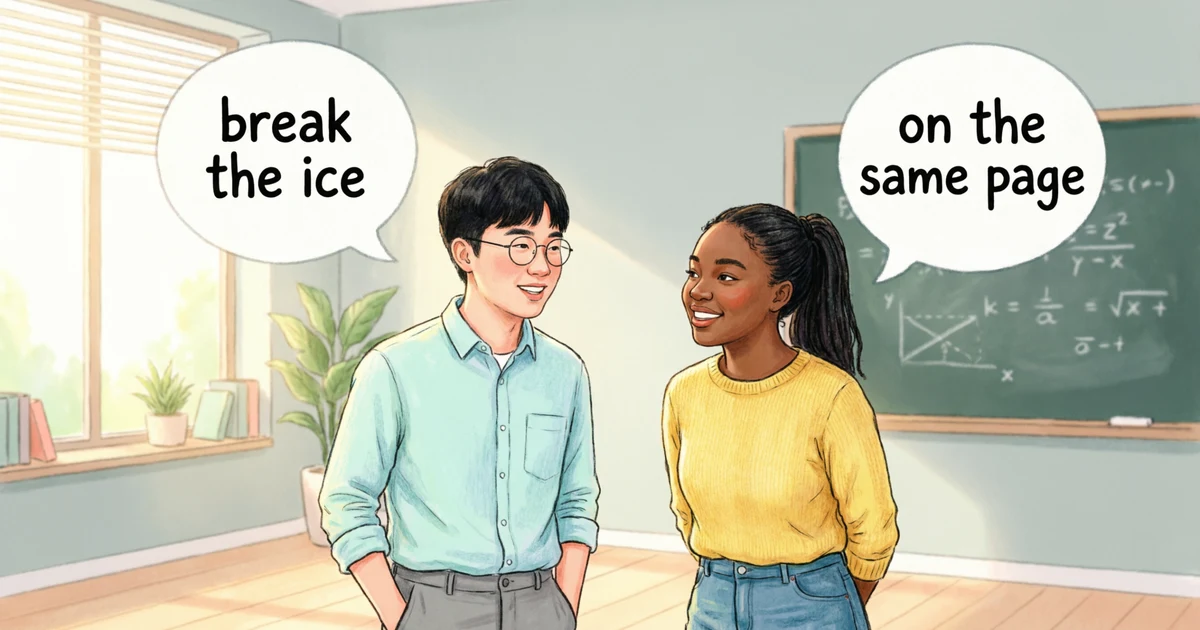
“Idioms for conversation” is a common search because many students, writers, and ESL learners want to sound more natural when they speak or write dialogue. The phrase can feel confusing because it mixes two ideas: idioms and conversation.
The simple difference is this: an idiom is a fixed expression with a special meaning, while a conversation is an exchange of spoken or written ideas between people. Idioms can appear inside conversations, but they are not the same thing.
For example, when someone says, “Let’s break the ice,” they do not mean they want to break real ice. They mean they want to make people feel more comfortable. That idiom can help start a conversation, but the whole conversation includes much more than one phrase.
This article explains idioms and conversation clearly, shows how they overlap, and gives practical examples you can use in speaking, writing, and ESL learning.
What Idioms Mean
An idiom is a phrase whose meaning is different from the literal meaning of its words.
If someone says, “spill the beans,” they usually mean “reveal a secret,” not drop actual beans on the floor.
Simple definition
An idiom is a common expression that has a meaning people understand as a whole phrase.
Purpose
Idioms help speakers sound natural, colorful, casual, emotional, or culturally fluent.
How it works
An idiom works because people in a language community already know its special meaning. You usually cannot understand it by translating each word separately.
Short natural example
“Can you give me a hand with this?”
This means, “Can you help me?”
Why idioms get confused with conversation
Idioms often appear in everyday conversation, so learners may think “idioms” and “conversation phrases” mean the same thing. They overlap, but idioms are only one type of expression used in conversation.
What Conversation Means
A conversation is communication between two or more people. It can happen face-to-face, on the phone, through text messages, in emails, or in written dialogue.
Conversation includes questions, answers, opinions, reactions, stories, pauses, tone, and expressions. Idioms may appear in it, but conversation itself is much broader.
Simple definition
A conversation is an exchange of ideas, feelings, or information between people.
Purpose
Conversation helps people connect, ask questions, share thoughts, solve problems, and build relationships.
How it works
Conversation works through turns. One person speaks or writes, another person responds, and the exchange continues.
Short natural example
A: “How was your meeting?”
B: “It went well. We finally got on the same page.”
Here, the conversation includes both the question and answer. “Got on the same page” is the idiom.
Why conversation gets confused with idioms
Many English learners study idioms to improve conversation skills. Because of that, they may use “conversation idioms” to mean useful idioms for speaking naturally.
Idioms vs Conversation: The Core Difference
The core difference is simple:
An idiom is a type of expression. A conversation is the larger communication situation where expressions are used.
Think of conversation as the full meal and idioms as one flavorful ingredient. A conversation can include idioms, slang, questions, jokes, polite phrases, stories, and simple direct language. An idiom is only one part of that larger language system.
For example:
“Let’s talk this through” is a normal conversational phrase.
“Let’s clear the air” is an idiom often used in conversation.
Both can appear in real speech, but only the second has a figurative meaning.
Quick Comparison Table
| Point | Idioms | Conversation |
|---|---|---|
| Definition | Fixed expressions with figurative or special meanings | An exchange of ideas between people |
| Scope | Narrower | Broader |
| Purpose | Adds naturalness, color, emotion, or cultural meaning | Helps people communicate, respond, and connect |
| Length | Usually short phrases | Can be short or long |
| Structure | Often fixed wording | Flexible and open-ended |
| Meaning | Often not literal | Can be literal, figurative, formal, casual, or emotional |
| Use in writing | Common in dialogue, essays, stories, and informal writing | Used in dialogue, interviews, scripts, chats, and real speech |
| Example | “Break the ice” | “Hi, how are you? Let’s talk about the project.” |
How Idioms Work
Idioms work through shared meaning. The words may look simple, but the phrase carries a meaning that goes beyond the words.
For example, “cut to the chase” means “get to the main point.” If you read it literally, it sounds like someone is cutting something or chasing someone. In real conversation, it means the speaker wants to avoid unnecessary details.
Idioms often come from culture, history, everyday life, work, sports, food, or old stories. Over time, people repeat them so often that they become familiar expressions.
In conversation, idioms can do several things:
They can soften a message: “Let’s clear the air” sounds gentler than “We need to discuss our problem.”
They can make speech shorter: “I’m all ears” quickly means “I’m listening carefully.”
Or, They can add personality: “That idea came out of the blue” sounds more natural than “That idea was unexpected.”
The main rule is this: use idioms when your reader or listener can understand them. Too many idioms can make writing confusing, especially for beginners.
How Conversation Works
Conversation works through interaction. It usually has a flow: opening, response, development, and closing.
A simple conversation might start with a greeting:
“Hi, how are you?”
Then someone responds:
“I’m good, thanks. How about you?”
From there, the conversation can move into a topic, such as school, work, weather, plans, feelings, or news.
Conversation uses many types of language. It can include:
Simple statements: “I finished the assignment.”
Questions: “What do you think?”
Polite phrases: “Could you explain that again?”
Idioms: “We need to get the ball rolling.”
Reactions: “That makes sense.”
Clarifying phrases: “Do you mean the first option or the second one?”
In writing, conversation often appears as dialogue. Good dialogue sounds natural, but it still needs purpose. Writers use conversation to reveal character, create tension, explain information, or move a story forward.
Key Differences in Simple Language
Idioms are expressions. Conversation is communication.
Idioms are usually short. Conversation can be short or long.
Idioms often have figurative meaning. Conversation can use both literal and figurative meaning.
Idioms are more fixed. Conversation is more flexible.
Idioms help language sound natural and expressive. Conversation helps people exchange ideas.
An idiom can be part of a conversation, but a conversation does not have to include idioms.
Can Idioms and Conversation Overlap?
Yes, idioms and conversation often overlap.
Many idioms are common in everyday conversation because they help people express ideas quickly. Native speakers use idioms in casual speech, workplace discussions, friendly chats, storytelling, and even arguments.
For example:
“Let’s get the ball rolling” means “Let’s start.”
“Can we touch base later?” means “Can we talk again later?”
“I’m on the fence” means “I haven’t decided yet.”
These idioms work well in conversation because they express common ideas in a natural way.
However, not every conversational phrase is an idiom. “How are you?” is conversational, but it is not an idiom. “Could you repeat that?” is useful in conversation, but it is not idiomatic in the same figurative sense.
Examples of Idioms
Here are useful idioms for conversation, especially for students, writers, and ESL learners.
1. Break the ice
Meaning: To make people feel more comfortable at the start of a conversation.
Example:
“The teacher asked a funny question to break the ice.”
2. Get the ball rolling
Meaning: To start something.
Example:
“Let’s get the ball rolling with a quick introduction.”
3. Be on the same page
Meaning: To understand or agree about the same thing.
Example:
“Before we continue, let’s make sure we’re on the same page.”
4. Speak your mind
Meaning: To say what you really think.
Example:
“You can speak your mind here. I won’t judge you.”
5. Clear the air
Meaning: To talk honestly about a problem and reduce tension.
Example:
“We need to clear the air after yesterday’s argument.”
6. Talk in circles
Meaning: To repeat ideas without reaching a clear point.
Example:
“We’ve been talking in circles for an hour.”
7. Get straight to the point
Meaning: To say the main idea directly.
Example:
“I don’t have much time, so please get straight to the point.”
8. Put in a good word
Meaning: To say something positive about someone.
Example:
“My teacher put in a good word for me.”
9. Hear someone out
Meaning: To listen to someone before judging or replying.
Example:
“I know you disagree, but please hear me out.”
10. Talk something over
Meaning: To discuss something carefully before deciding.
Example:
“We should talk it over before we make a final choice.”
Examples of Conversation
Conversation examples show how people exchange ideas. Some include idioms, and some do not.
Example 1: Casual conversation
A: “How was your first day at work?”
B: “Pretty good. Everyone was friendly, but I felt nervous at first.”
A: “That’s normal. It takes time to settle in.”
This is conversation, but it does not rely on idioms.
Example 2: Conversation with an idiom
A: “Should we start the project today?”
B: “Yes, let’s get the ball rolling.”
A: “Great. I’ll prepare the first draft.”
Here, “get the ball rolling” is an idiom inside the conversation.
Example 3: Classroom conversation
A: “I don’t understand the difference between these two words.”
B: “Let’s look at examples first.”
A: “That helps. I learn better that way.”
This is useful conversational English for students.
Example 4: Conflict conversation
A: “I think we misunderstood each other yesterday.”
B: “You’re right. Maybe we should clear the air.”
A: “I agree. I didn’t mean to sound rude.”
The idiom “clear the air” helps make the conversation sound natural and calm.
Idioms vs Conversation in Literature and Writing
In literature and writing, idioms and conversation play different roles.
Writers use conversation as dialogue. Dialogue shows how characters speak, think, react, and relate to one another. A strong conversation in a story can reveal personality, conflict, humor, fear, love, or tension.
Writers use idioms inside dialogue to make characters sound more realistic. A character who says “I’m at the end of my rope” sounds frustrated in a natural way. A character who says “Let’s not beat around the bush” sounds direct and impatient.
However, writers must use idioms carefully. Too many idioms can make dialogue sound forced. The best idioms fit the character, setting, and tone.
For example:
Natural dialogue:
“Stop beating around the bush. What happened?”
Forced dialogue:
“Let us break the ice, get the ball rolling, and stay on the same page before we clear the air.”
The second sentence uses too many idioms at once. It sounds unnatural because real people rarely pack several idioms into one line.
In essays, idioms can work in informal or reflective writing, but formal academic writing often needs clearer, more direct language. For example, instead of writing “This issue opened a can of worms,” a student might write “This issue created several new problems.”
Idioms vs Conversation for Students and ESL Learners
For students and ESL learners, the difference matters because it affects how you study English.
If you want to improve conversation, focus on questions, responses, pronunciation, listening, turn-taking, polite phrases, and topic flow.
If you want to improve idioms, focus on common expressions, meanings, context, and natural usage.
Do not memorize idioms as single words. Learn them in short situations. This helps you understand when they sound natural.
For example:
Less useful:
“Break the ice means make comfortable.”
More useful:
“At the start of the meeting, the host told a joke to break the ice.”
ESL learners should also remember that idioms can be difficult because they often do not translate word for word. A phrase that sounds normal in English may sound strange in another language. That is why examples matter.
A good learning method is:
Learn the meaning.
Read the idiom in context.
Say your own sentence.
Use it in one real conversation or writing exercise.
Check whether it fits the tone.
Common Mistakes and Confusion
Mistake 1: Thinking every conversation phrase is an idiom
Not every useful phrase is an idiom. “Nice to meet you” is conversational, but it is not a figurative idiom.
Mistake 2: Translating idioms word for word
Idioms often lose meaning when translated directly. “Hit the nail on the head” means “say exactly the right thing,” not physically hit a nail.
Mistake 3: Using idioms in the wrong tone
Some idioms sound casual. They may not fit formal essays, business reports, or academic writing.
Casual:
“We need to get the ball rolling.”
Formal:
“We need to begin the process.”
Mistake 4: Overusing idioms
Idioms can make speech lively, but too many can make writing unclear. Use them like seasoning, not the whole meal.
Mistake 5: Choosing rare or old-fashioned idioms
Some idioms appear in textbooks but not much in modern speech. Students should focus on idioms people still use naturally.
Mistake 6: Forgetting context
The same idiom may sound friendly in one context and rude in another. “Get to the point” can sound direct or impatient, depending on tone.
When to Use Idioms and When to Use Conversation
Use idioms when you want to sound natural, expressive, and fluent. They work well in casual speech, dialogue, storytelling, personal essays, and friendly messages.
Use conversation skills when your goal is to communicate clearly with another person. Conversation skills matter in interviews, classrooms, meetings, social situations, customer service, and daily life.
Choose idioms when:
You know the meaning clearly.
The context is informal or semi-formal.
The listener or reader will understand the phrase.
The idiom adds value, emotion, or natural tone.
Choose simple conversation language when:
The topic is serious or formal.
The listener may not know the idiom.
Clarity matters more than style.
You are writing academic or professional content.
For example, in a friendly chat, you can say:
“Let’s talk it over.”
In a formal report, you might write:
“We should discuss the matter before making a decision.”
Both are correct. The better choice depends on audience, tone, and purpose.
Related Terms People Often Confuse With Idioms and Conversation
Phrases
A phrase is any group of words that works together. An idiom is a special type of phrase with a non-literal meaning.
Example:
“In the morning” is a phrase, but not an idiom.
Expressions
An expression is a common way of saying something. Idioms are expressions, but not all expressions are idioms.
Example:
“Good luck” is an expression, but it is not usually treated as an idiom.
Slang
Slang is very informal language used by certain groups or in casual settings. Some slang can be idiomatic, but slang and idioms are not the same.
Example:
“That’s fire” is slang meaning “That’s excellent.”
Proverbs
A proverb is a short traditional saying that gives advice or wisdom.
Example:
“Actions speak louder than words.”
Collocations
A collocation is a natural word combination.
Example:
“Make a decision” sounds natural. “Do a decision” does not.
Dialogue
Dialogue is written conversation in a story, script, or play. It may include idioms, but it is not the same thing as idioms.
Figurative language
Figurative language uses words in non-literal ways. Idioms are part of figurative language, along with metaphors, similes, personification, and hyperbole.
Conclusion
Idioms and conversation connect closely, but they do not mean the same thing. An idiom is a fixed expression with a special meaning. A conversation is a broader exchange of ideas between people.
Idioms can make conversation sound natural, expressive, and fluent. Conversation, however, includes much more than idioms. It includes questions, answers, tone, listening, responses, topic changes, and context.
For students, writers, and ESL learners, the best approach is simple: learn idioms in real conversational situations. Do not memorize long lists without context. Use idioms when they fit the tone, and choose simple language when clarity matters most.
When you understand both idioms and conversation, your English becomes more natural, flexible, and effective.
FAQs
1. What are idioms for conversation?
Idioms for conversation are common idiomatic expressions people use while speaking or writing dialogue. Examples include “break the ice,” “hear me out,” “talk it over,” and “get to the point.”
2. Are idioms and conversation the same thing?
No. An idiom is a special expression with a figurative meaning. A conversation is an exchange of ideas between people. Idioms can appear inside conversations.
3. Why are idioms important in conversation?
Idioms help speakers sound more natural and fluent. They can also express ideas quickly, add emotion, and make speech feel more relaxed or realistic.
4. Should ESL learners use idioms in daily conversation?
Yes, but they should start with common idioms and learn them in context. ESL learners should avoid rare idioms or using too many idioms at once.
5. Can idioms make writing better?
Idioms can improve informal writing, dialogue, stories, and personal essays. In formal writing, direct language often works better.
6. What is an example of an idiom used in conversation?
Example: “Let’s clear the air before we continue.” This means the speakers should discuss a problem honestly so they can move forward.
7. How can I learn idioms naturally?
Read and listen to real English conversations, note common idioms, study their meanings in context, and practice using them in short sentences.