Quick Answer
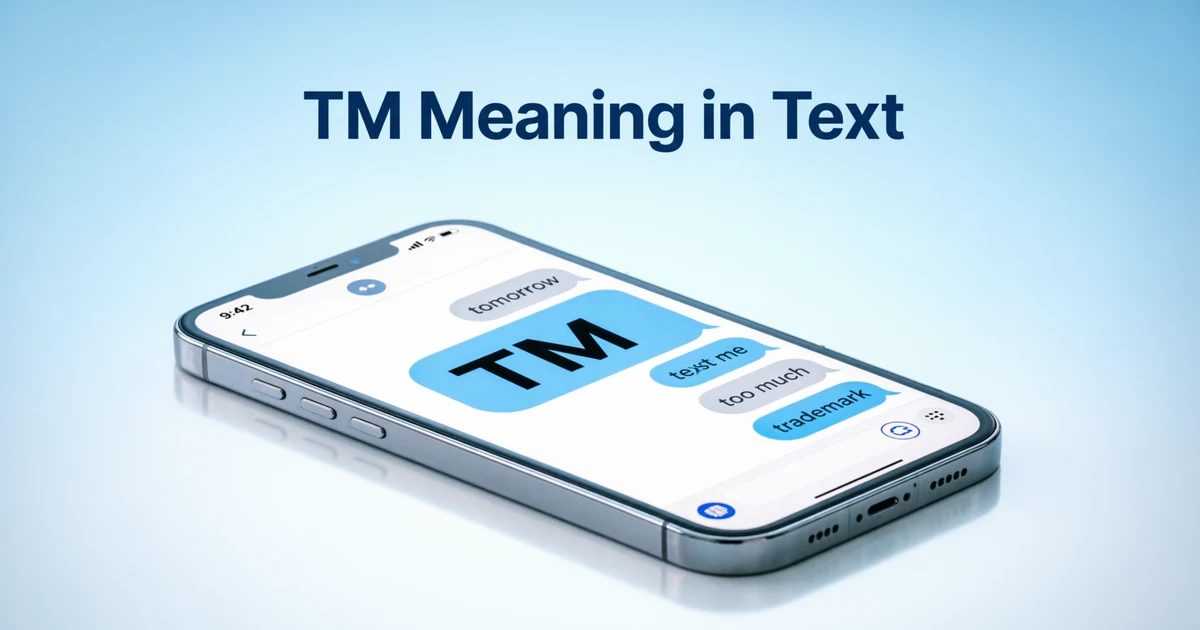
TM most commonly means tomorrow in a text message, especially when someone is discussing plans, schedules, school, work, or an upcoming activity.
However, TM can also mean:
- Text me
- Trust me
- Too much
- Trademark
The correct meaning depends on the sentence. For example, “See you tm” means “See you tomorrow,” while “TM when you get home” most likely means “Text me when you get home.” Look at the surrounding words and the topic of the conversation before replying.
People often type it in lowercase as tm, but capitalization usually does not change its meaning in casual messages.
Introduction
Seeing two unexplained letters in a message can make a simple conversation confusing. This is especially true with TM because it does not have only one accepted meaning. Someone may use it while making plans, asking for a message, emphasizing an opinion, or discussing a business name.
In most casual conversations, the TM meaning in text is tomorrow. A friend might write, “Are you free tm?” instead of typing the full word. It is quick, informal, and easy to understand when the conversation involves time or future plans.
Still, tomorrow is not the only possible interpretation. Depending on the sentence, TM may stand for text me, trust me, too much, or trademark. Some meanings are common in everyday chats, while others appear mainly in business, branding, or legal discussions.
This guide explains each meaning, shows realistic examples, and helps you use context to understand what the sender intended. You will also learn when TM sounds natural, when it may cause confusion, and which clearer alternatives you can use.
| Meaning | Where It Is Used | Simple Explanation | Example |
|---|---|---|---|
| Tomorrow | Plans and scheduling | The next day | See you tm |
| Text me | Personal conversations | Send me a message | TM when you arrive |
| Trust me | Advice or reassurance | Believe what I am saying | TM, this place is amazing |
| Too much | Reactions and comments | Excessive or overwhelming | That outfit is tm |
| Trademark | Business and branding | A claimed brand identifier | Add TM beside the logo |
What Does TM Mean in Text?
TM usually means tomorrow when it appears in a casual message about plans, appointments, deadlines, school, work, or events.
For example:
Are we still meeting tm?
Here, the sender is clearly asking whether the meeting is happening tomorrow.
People often shorten common words when texting quickly. Tomorrow may appear as tm, tmr, tmrw, or 2moro. Among these versions, tmr and tmrw are often easier to recognize, but tm is still used in short conversations.
TM can also mean text me, particularly when it appears at the beginning of an instruction.
For example:
TM after class.
This means the sender wants you to send them a text after class.
Another possible meaning is trust me. In this use, TM adds confidence or reassurance to a statement.
For example:
TM, you will love that movie.
The sender is saying, “Trust me, you will love that movie.”
Some people also use TM for too much, usually when reacting to something dramatic, excessive, funny, expensive, or emotionally overwhelming.
For example:
That final scene was tm.
This means the final scene felt like too much to process.
Because these meanings overlap, TM should not be interpreted alone. The words around it usually reveal the correct answer.
The Most Common Meaning of TM
In everyday texting, tomorrow is usually the most likely meaning of TM. This is especially true when the message includes a future action, meeting time, assignment, appointment, or plan.
Common examples include:
- Talk tm
- See you tm
- Are you working tm?
- I will finish it tm
- Let us decide tm
- The test is tm
In each example, replacing TM with tomorrow creates a complete and natural sentence.
A simple decoding method is to look for time related clues. Words such as see, meet, class, work, appointment, call, finish, due, and morning strongly suggest that TM means tomorrow.
The abbreviation is informal. It works well between friends, classmates, siblings, gaming partners, or close coworkers. In formal messages, writing tomorrow in full is usually clearer and more professional.
Other Common Meanings of TM
TM Meaning Text Me
TM can mean text me when someone asks you to contact them through a message.
Examples:
TM when the game ends.
TM once you are outside.
I am busy right now. TM later.
In these examples, replacing TM with text me makes sense. The abbreviation usually comes before a time, situation, or condition.
This meaning can sometimes be confused with tomorrow. For example, “TM later” could mean “text me later,” but “We can talk tm” probably means “We can talk tomorrow.” Sentence structure is the main clue.
TM Meaning Trust Me
TM may also mean trust me when someone is making a recommendation, giving advice, defending an opinion, or trying to reassure another person.
Examples:
TM, take the earlier flight.
You should order the pasta. TM.
TM, everything will work out.
The tone is usually confident and friendly. It can also sound playful when friends disagree about music, movies, food, sports, or relationships.
Because TM is not as widely recognized as common abbreviations such as TBH or IMO, writing trust me in full may be better when clarity matters.
TM Meaning Too Much
In reactions, TM can mean too much. It may describe something excessive, intense, expensive, embarrassing, dramatic, or emotionally overwhelming.
Examples:
That price is tm for me.
His reaction was tm.
This week has been tm.
The tone can be serious or humorous. Someone might use it to complain about stress, but they could also use it to react to a funny video or an exaggerated outfit.
In many conversations, people simply write too much instead of TM because the abbreviation can be misunderstood.
TM Meaning Trademark
TM also stands for trademark, particularly when it appears beside a business name, product name, slogan, design, or logo.
The trademark symbol is usually written as ™ rather than plain TM. It indicates that a person or organization is claiming a word, phrase, logo, or other identifier as a trademark. It does not automatically mean that the mark has been federally registered.
For example:
BrightPath™
In a conversation about a company logo, product label, website, or business registration, TM probably refers to trademark rather than texting slang.
Do not confuse ™ with the registered trademark symbol, ®. The registered symbol is generally associated with a formally registered mark, while TM may be used to claim trademark rights in an unregistered mark.
How to Tell What TM Means
The easiest way to understand TM is to replace it with each possible meaning and see which version creates a logical sentence.
| Situation | Likely Meaning | Context Clue | Simple Example |
|---|---|---|---|
| Discussing the next day | Tomorrow | A plan or scheduled activity | Call me tm |
| Requesting contact | Text me | Followed by when, later, or after | TM when you land |
| Giving reassurance | Trust me | Confident advice or a promise | TM, it gets better |
| Reacting to excess | Too much | A complaint or emotional reaction | That was tm |
| Discussing a brand | Trademark | A logo, company, slogan, or product | Put TM beside the name |
You can also ask three quick questions:
- Is the conversation about future plans?
- Is the sender asking me to contact them?
- Is the message about an opinion, reaction, or business name?
The answer usually becomes obvious once you identify the topic.
When the meaning remains unclear, ask the sender directly. A simple reply such as “Do you mean tomorrow?” prevents unnecessary confusion.
How TM Is Used in Everyday Conversations
TM appears most often in relaxed digital conversations. It may be used in regular text messages, direct messages, group chats, gaming chats, comments, and social media captions.
Making Plans
Friend: Want to get coffee tm?
You: Sure. What time?
TM means tomorrow because the conversation involves a future plan.
Discussing School
Student: Is the assignment due tm?
Classmate: Yes, before class.
The deadline makes tomorrow the obvious meaning.
Requesting an Update
Parent: TM when you arrive.
Teen: Okay, I will.
TM means text me because the sender wants an update.
Giving a Recommendation
Friend: Is that restaurant good?
You: Yes. TM, order the tacos.
TM means trust me because it introduces a confident recommendation.
Reacting to Something Dramatic
Friend: Did you see the final episode?
You: Yes, that ending was tm.
Here, TM most likely means too much.
Discussing a Logo
Designer: Should we place TM beside the new brand name?
Client: Yes, use the small symbol.
In this business context, TM means trademark.
Can You Use TM on Social Media?
TM may appear on platforms where users communicate through short posts, comments, captions, or direct messages. Its meaning still depends on context rather than the platform itself.
1-In a message about tomorrow’s plans, it probably means tomorrow:
Posting the photos tm.
2-In a call to continue the conversation privately, it may mean text me:
TM the details.
3-In a reaction, it may mean too much:
This video is tm.
4-Beside a company name or slogan, it means trademark:
FreshFocus™
Do not assume that TM has one special meaning on every social platform. Different users and communities may use the same abbreviation differently.
Is TM Formal or Informal?
TM is informal when it means tomorrow, text me, trust me, or too much. It is best suited to conversations with people who understand your texting style.
You may use it with:
- Friends
- Siblings
- Classmates
- Close coworkers
- Gaming friends
- Social media followers
Avoid using the abbreviation in formal emails, job applications, academic papers, customer messages, official notices, or important workplace communication. Writing the complete phrase reduces the risk of confusion.
For example, write:
I will send the completed report tomorrow.
Instead of:
I will send the completed report tm.
The trademark meaning is different. TM or ™ may appear in professional branding and business materials when used correctly.
TM Compared With Similar Texting Terms
Several abbreviations resemble TM or may appear in similar conversations.
| Term | Meaning | Tone | Example |
|---|---|---|---|
| TM | Tomorrow, text me, trust me, or too much | Informal | See you tm |
| TMR | Tomorrow | Informal | Let us talk tmr |
| TMRW | Tomorrow | Informal and clear | I will finish it tmrw |
| DM | Direct message | Informal | DM me the link |
| HMU | Hit me up | Casual | HMU when you are free |
| LMK | Let me know | Casual | LMK what you decide |
| TBH | To be honest | Casual | TBH, I did not like it |
| IMO | In my opinion | Casual | IMO, the first one is better |
TMR and TMRW are clearer alternatives when you mean tomorrow. DM me, message me, or text me are clearer when you are asking someone to contact you.
Common Mistakes When Using TM
Assuming It Always Means Tomorrow
Tomorrow is a common interpretation, but it is not correct in every sentence.
“TM when you get home” probably means text me, not tomorrow.
Confusing TM With the Trademark Symbol
Lowercase tm in a casual chat usually functions as texting shorthand. The symbol ™ beside a brand name refers to a trademark claim.
The topic and placement make the distinction clear.
Using TM in Formal Writing
Not every reader recognizes TM as tomorrow, text me, trust me, or too much. Avoid it when writing to a manager, teacher, customer, recruiter, or unfamiliar contact.
Writing an Ambiguous Message
A message such as “TM later” may confuse the reader. It could mean text me later, talk tomorrow, or something else.
Write the complete phrase when the context does not make your meaning obvious.
Assuming Capitalization Solves the Problem
TM, tm, and Tm may have the same meaning in casual messages. Capital letters do not guarantee that TM means trademark.
Look at the sentence rather than capitalization alone.
Better Alternatives to TM
TM saves a few characters, but clarity is often more valuable than speed.
Use these alternatives based on your intended meaning:
- Write tomorrow when discussing the next day.
- Write text me or message me when requesting contact.
- Write trust me when giving reassurance.
- Write too much when reacting to something excessive.
- Use the proper ™ symbol when discussing a trademark.
Clear language is especially useful in group chats because participants may have different ages, backgrounds, and texting habits.
Conclusion
The most common TM meaning in text is tomorrow, particularly in conversations about plans, deadlines, work, school, or upcoming events. However, it may also mean text me, trust me, too much, or trademark.
To find the correct meaning, read the full sentence and identify the topic. Future plans suggest tomorrow, a request for contact suggests text me, confident advice suggests trust me, and branding discussions suggest trademark. When the message remains unclear, asking the sender is better than guessing.
Frequently Asked Questions
What does TM mean in a text message?
TM most often means tomorrow in casual text messages. It can also mean text me, trust me, too much, or trademark, depending on the sentence.
Does TM mean tomorrow?
Yes. Tomorrow is one of the most common meanings of TM, especially in messages such as “See you tm” or “Are you free tm?”
Can TM mean text me?
Yes. In a message such as “TM when you arrive,” TM means text me. The sender is asking you to send an update.
Does TM mean trust me?
TM can mean trust me when it introduces confident advice, reassurance, or a recommendation. For example, “TM, this is the best option.”
What does TM mean on social media?
On social media, TM may mean tomorrow, text me, trust me, too much, or trademark. The platform does not determine the meaning. The surrounding message does.
Is TM the same as TMR?
TM and TMR can both mean tomorrow. TMR is usually easier to recognize because TM has several other possible meanings.
What is the difference between TM and ™?
TM in a casual text may be an abbreviation for tomorrow or another phrase. The ™ symbol placed beside a name, slogan, or logo indicates a trademark claim.
Should I reply when someone writes TM?
Your reply depends on the context. If they ask, “Are you free tm?” answer about tomorrow. If they say, “TM when you arrive,” send them a message after you arrive.