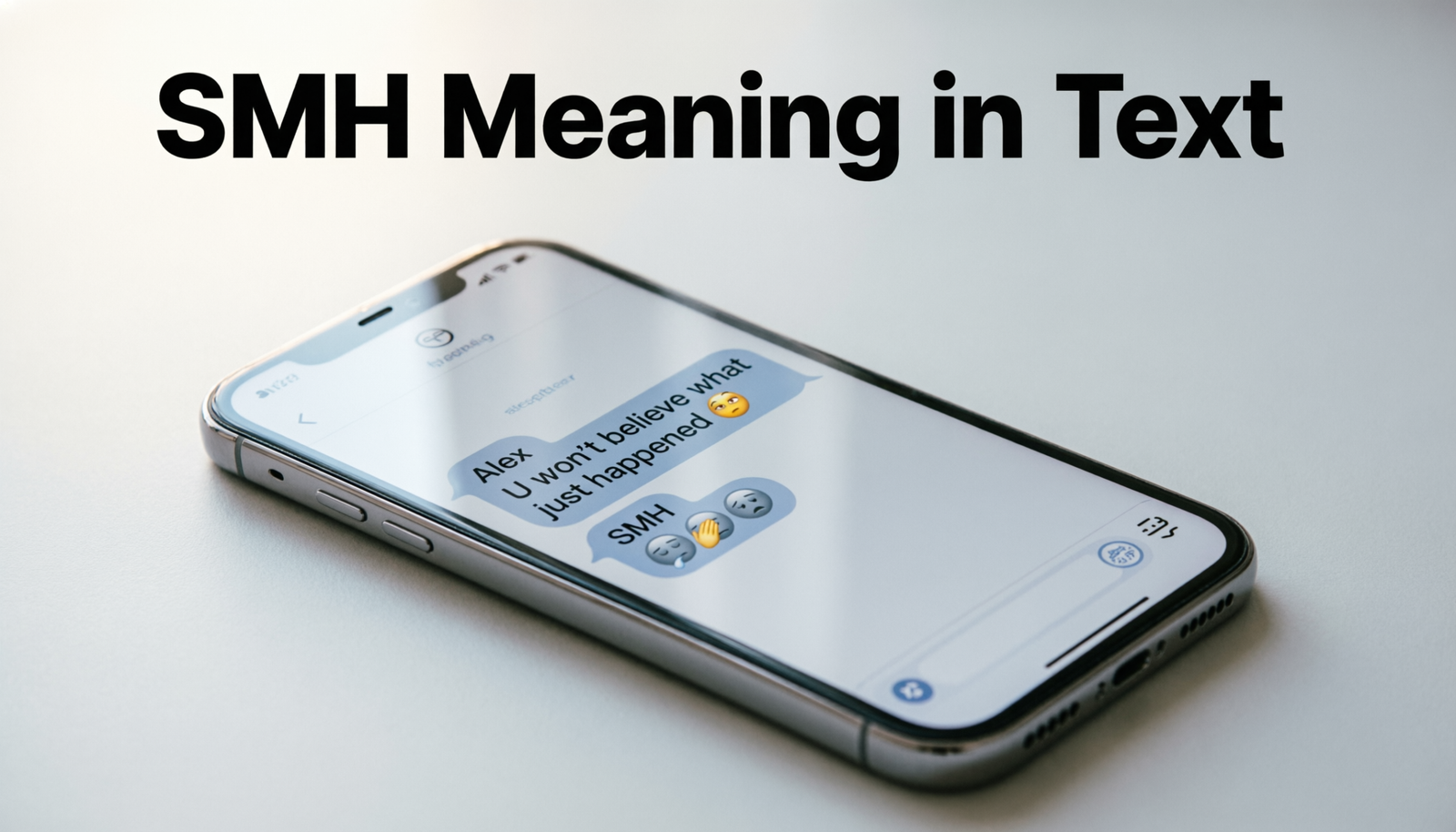
Quick Answer
SMH means shaking my head in text messages and online conversations. People use it to show disappointment, disbelief, frustration, embarrassment, or mild disapproval. It often reacts to something foolish, surprising, annoying, or difficult to understand.
For example, someone might text, “He forgot his keys again, smh.” In this sentence, SMH shows that the sender finds the situation frustrating or ridiculous. The exact tone depends on the conversation, so it may sound playful among friends or critical during a serious disagreement.
Introduction
Seeing SMH in a text can feel confusing when you do not regularly use internet slang. The letters do not form a complete word, and the sender may not explain whether they are joking, annoyed, disappointed, or simply reacting to something surprising. That is why many people search for the SMH meaning in text after receiving it in a message, comment, group chat, or social media reply.
SMH is one of the most recognizable reaction abbreviations used in casual digital communication. Instead of writing a full sentence such as “I cannot believe you did that,” a person can type SMH and communicate a similar reaction in just three letters. It is commonly used when someone hears about a poor decision, an obvious mistake, an awkward situation, or behavior they consider unreasonable.
This guide explains what SMH means, how its tone changes with context, and when it is appropriate to use. You will also find realistic texting examples, related slang terms, common misunderstandings, and simple ways to respond when someone sends SMH to you.
| Term | Meaning | Tone | Example |
|---|---|---|---|
| SMH | Shaking my head | Disappointed, surprised, or annoyed | You missed the bus again, smh |
| LOL | Laughing out loud | Amused or playful | That video was hilarious, lol |
| OMG | Oh my God | Shocked or excited | OMG, you got the job |
| SMDH | Shaking my darn head | Stronger frustration | They made the same mistake again, smdh |
| FR | For real | Agreement or disbelief | That test was difficult, fr |
What Does SMH Mean in Text?
SMH stands for shaking my head. It describes the physical reaction of moving your head from side to side when you feel disappointed, confused, embarrassed, frustrated, or unable to believe what happened.
In texting, the person usually is not literally shaking their head. The abbreviation represents the emotion connected with that gesture. It works like a brief reaction rather than a complete statement.
Consider this message:
“Jake stayed up all night and then complained that he was tired. SMH.”
The sender is expressing mild disbelief or criticism. They think Jake created his own problem and should have expected the result.
SMH can also express playful frustration:
“You ate the last slice of pizza without asking, smh.”
Among close friends, this may sound teasing rather than angry. However, the same abbreviation can feel judgmental in a serious conversation:
“You knew the deadline and still ignored it. SMH.”
Here, the sender sounds more disappointed and critical. The surrounding words, relationship, and topic determine whether SMH feels funny, sarcastic, annoyed, or harsh.
What Tone Does SMH Have?
SMH does not have one fixed emotional tone. It usually communicates a negative reaction, but the intensity can range from playful teasing to genuine disappointment.
Mild Disappointment
People often use SMH when someone makes a small or predictable mistake.
Example:
“You forgot your charger again, smh.”
The sender may be disappointed, but the issue is probably not serious.
Disbelief
SMH can show that a situation seems unreasonable or difficult to understand.
Example:
“They canceled the event after everyone had already arrived. SMH.”
The sender cannot believe the organizers handled the situation poorly.
Playful Teasing
Friends may use SMH jokingly when reacting to harmless behavior.
Example:
“You really put ketchup on that expensive steak, smh.”
The sender is probably teasing the other person rather than seriously criticizing them.
Frustration or Disapproval
In arguments or serious discussions, SMH may communicate clear judgment.
Example:
“You keep blaming everyone else instead of taking responsibility. SMH.”
This version can sound dismissive, especially if the receiver already feels defensive.
Secondhand Embarrassment
People also use SMH when another person does something awkward.
Example:
“He tried to impress everyone and forgot his own speech, smh.”
The sender feels embarrassed on the person’s behalf or thinks the situation was uncomfortable to watch.
How SMH Is Used in Text Messages
SMH can appear at the beginning, middle, or end of a message. Its position may slightly change the emphasis.
1-SMH at the Beginning
Placing SMH first makes the reaction immediate.
“SMH, I cannot believe they charged us twice.”
This structure emphasizes frustration before explaining the problem.
2-SMH at the End
This is one of the most common placements.
“She left her homework at home again, smh.”
The abbreviation works like a final reaction to the statement.
3-SMH Used Alone
Someone may reply with only “SMH” when the context already explains the situation.
Person 1: “I accidentally sent the message to the entire office.”
Person 2: “SMH.”
This reply may communicate disbelief, embarrassment, or mild criticism. Because it is so brief, it can sometimes feel colder than intended.
4-SMH With Other Slang
1-SMH may appear with terms such as LOL, FR, or OMG.
“SMH, lol, you always do this.”
This sounds more playful because LOL softens the criticism.
“SMH, fr, this needs to stop.”
This sounds more serious because FR emphasizes that the sender genuinely means it.
SMH Examples in Text Conversations
The easiest way to understand SMH is to see how people use it in everyday messages.
Between Friends
Friend 1: I stayed awake until 3 a.m. watching videos.
Friend 2: And now you are complaining about being tired, smh.
The second friend thinks the problem was avoidable.
In a Family Group Chat
Parent: Who left all the kitchen lights on?
Sibling: Probably Ryan again.
Parent: SMH, every single night.
Here, SMH expresses repeated frustration.
In a Social Media Comment
“They copied the entire idea and acted like it was original. SMH.”
The commenter disapproves of the behavior.
During a Playful Conversation
Person 1: I put pineapple on the pizza.
Person 2: SMH, we cannot be friends anymore.
This is probably teasing because the response exaggerates a harmless disagreement.
During a Serious Disagreement
Person 1: I did not think the rule applied to me.
Person 2: SMH. You were told twice.
In this context, SMH sounds more critical and dismissive.
Reacting to an Awkward Moment
“He waved back at someone who was waving at the person behind him, smh.”
The sender is reacting to an embarrassing but relatable situation.
Common Situations Where People Use SMH
People commonly use SMH when reacting to behavior or events that seem foolish, disappointing, avoidable, or surprising.
Typical situations include:
- Someone repeating the same mistake
- A friend making a poor decision
- A person forgetting something obvious
- A company providing bad customer service
- A sports team losing because of an avoidable error
- Someone sharing an unbelievable story
- A person behaving immaturely online
- An awkward or embarrassing social moment
- A plan failing because no one prepared properly
- Someone ignoring clear advice
SMH is most natural in informal communication. It appears frequently in texts, group chats, comments, direct messages, memes, gaming chats, and casual workplace messages.
Is SMH Rude?
SMH can sound rude, but it is not automatically offensive. Its impact depends on who sends it, what happened, and how serious the conversation is.
Between close friends, SMH often feels light and humorous. Friends understand each other’s personalities and may recognize that the sender is teasing.
In a disagreement, SMH can feel dismissive because it suggests that the other person’s behavior is foolish or not worth discussing. A one word reply such as “SMH” may appear more judgmental than a complete explanation.
For example:
“SMH, you never listen.”
This sounds accusatory.
“I was disappointed because we already discussed this.”
The second version communicates the concern more clearly and respectfully.
Avoid using SMH in sensitive conversations where the other person may feel hurt, ashamed, or misunderstood. A direct but calm sentence is usually better when discussing relationships, work problems, personal mistakes, or serious decisions.
How to Respond When Someone Texts SMH
Your response should match the situation and your relationship with the sender.
When They Are Joking
You can respond playfully:
- I know, I know
- Do not judge me
- It seemed like a good idea at the time
- You would have done the same thing
- Let me live
When You Made a Mistake
Acknowledge it without becoming defensive:
- You are right. That was my fault.
- I should have handled that better.
- I completely forgot.
- I will fix it.
- Fair enough. I deserved that reaction.
When You Do Not Understand Their Tone
Ask for clarification:
- Are you joking or actually upset?
- What did I do?
- Why SMH?
- Did I misunderstand something?
When the Message Feels Disrespectful
Respond calmly and directly:
- I understand that you disagree, but please explain what bothered you.
- I would rather discuss the issue than receive a dismissive response.
- Tell me what you think I should have done differently.
Do not assume every SMH message is hostile. Look at the previous messages, punctuation, topic, and your usual communication style with that person.
SMH Compared With Similar Texting Terms
Several abbreviations express reactions similar to SMH, but they are not interchangeable in every situation.
| Term | Meaning | Best Use | Example |
|---|---|---|---|
| SMH | Shaking my head | Disappointment or disbelief | You forgot again, smh |
| SMDH | Shaking my darn head | Stronger frustration | They ignored every warning, smdh |
| OMG | Oh my God | Surprise, shock, or excitement | OMG, that was close |
| WTF | What the heck | Strong confusion or anger | WTF just happened |
| FR | For real | Agreement or emphasis | That was unfair, fr |
| LOL | Laughing out loud | Humor or amusement | You actually said that, lol |
| Facepalm | Embarrassed disbelief | Obvious mistake or awkward moment | He replied to the wrong chat, facepalm |
SMH focuses mainly on disappointment, disbelief, or disapproval. LOL communicates amusement, while OMG communicates surprise. SMDH carries a stronger emotional reaction than SMH and may sound more aggressive.
Does SMH Have Other Meanings?
In most text messages and social media conversations, SMH means shaking my head. However, the same letters can represent other phrases in specialized contexts.
SMH may appear as initials for an organization, business, publication, school, hospital, or technical term. These meanings are usually clear because they appear in formal documents, professional discussions, news articles, medical records, or company names.
For example, a person discussing a hospital system may use SMH as an institutional abbreviation rather than internet slang. In a casual message such as “You missed the meeting again, smh,” it clearly means shaking my head.
Context provides the best clue. When SMH appears as a reaction to behavior or a story, it almost always carries the texting meaning.
Common Mistakes When Using SMH
Assuming It Always Means Anger
SMH may express anger, but it often shows mild disappointment, playful teasing, or disbelief. Do not treat every use as a serious confrontation.
Using It in Formal Writing
SMH is casual internet slang. Avoid it in academic assignments, reports, job applications, customer service emails, and formal workplace communication unless the environment is extremely relaxed.
Using It During Sensitive Conversations
A brief SMH response may make someone feel judged. Serious discussions usually require a clear explanation rather than a vague reaction.
Overusing It
Adding SMH to every complaint can make your messages sound constantly negative or critical. Use it when the reaction fits naturally.
Confusing SMH With SMDH
SMH means shaking my head. SMDH is a stronger variation that adds another word for emphasis. The second version usually communicates greater frustration.
Misreading Capitalization
SMH, smh, and Smh generally mean the same thing. Lowercase letters often feel more casual, while uppercase letters may appear stronger or more dramatic.
Conclusion
The SMH meaning in text is shaking my head. It communicates disappointment, disbelief, frustration, secondhand embarrassment, or playful disapproval. The exact tone depends on the conversation and the relationship between the people texting.
Before reacting negatively, read the surrounding message and consider whether the sender is teasing or genuinely upset. SMH works well in casual conversations, but a complete sentence is usually more respectful when the subject is serious.
Frequently Asked Questions
What does SMH mean from a girl?
SMH still means shaking my head, regardless of who sends it. She may be teasing, disappointed, annoyed, or reacting with disbelief. The surrounding conversation reveals the intended tone.
What does SMH mean from a guy?
It usually means shaking my head. He may think something was foolish, funny, frustrating, or surprising. Do not assume it signals anger without checking the context.
Is SMH a bad word?
No. SMH itself is not a bad word. It is a casual abbreviation, although it can sound rude or judgmental when used during an argument.
What does SMH mean on social media?
On social media, SMH means shaking my head. People use it in posts, comments, captions, and replies to react to disappointing, ridiculous, awkward, or unbelievable content.
Can SMH be used jokingly?
Yes. Friends often use SMH as playful teasing. Humor, emojis, laughter, and the surrounding message usually make the joking tone clear.
What is the difference between SMH and SMDH?
SMH means shaking my head. SMDH is a more intense version that communicates stronger disappointment or frustration. It may also sound more aggressive.
Should SMH be written in uppercase or lowercase?
Both SMH and smh are correct in casual messages. Uppercase may feel more forceful, while lowercase often looks relaxed and conversational.
What does it mean when someone replies only with SMH?
A standalone SMH usually expresses disbelief, disappointment, embarrassment, or disapproval. Since it provides little explanation, you may need to ask what the person means if the tone is unclear.