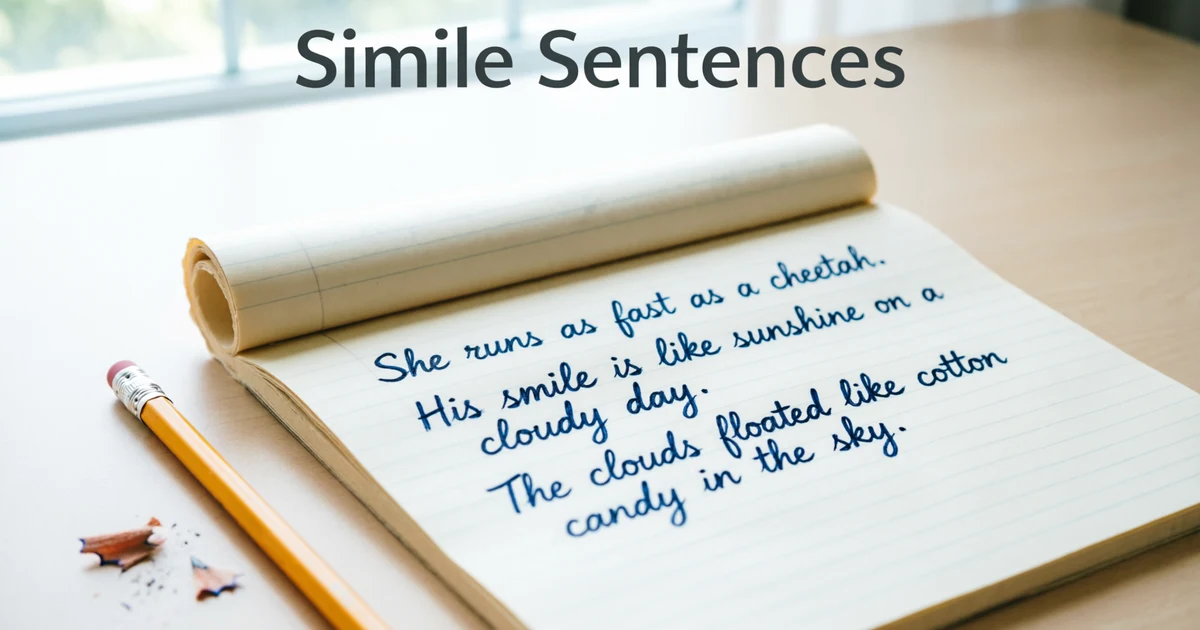
Simile sentences help writers explain ideas in a clear and colorful way. They compare one thing with another using words such as like or as. A good simile can make a sentence easier to understand, more vivid, and more memorable.
Students, teachers, writers, and English learners often use similes to describe people, feelings, places, actions, and objects. In this guide, you will learn what simile sentences mean, how they work, and how to write strong examples for school work, stories, poems, and daily conversation.
What Simile Sentences Mean in Simple Words
A simile sentence compares two different things to show a shared quality. Most similes use like or as to make the comparison clear.
For example:
Her smile was as bright as the sun.
This sentence compares her smile with the sun. The shared quality is brightness. The sentence does not mean her smile became the sun. It means her smile looked warm, bright, and pleasant.
A simile sentence usually has three parts:
- The thing you describe
- The thing you compare it with
- The quality they share
Examples:
- The baby slept like a peaceful kitten.
- His voice was as deep as the ocean.
- The classroom was as quiet as a library.
- She ran like the wind.
Simile sentences help readers create a picture in their mind. Instead of saying someone ran fast, you can say someone ran like the wind. That sentence gives more energy and movement.
How a Simile Works Inside a Sentence
A simile works by joining a real idea with a familiar image. The comparison helps the reader understand the meaning quickly.
Look at this sentence:
The boy was as brave as a lion.
The boy and the lion are different, but both show bravery. The sentence helps the reader understand the boy’s courage in a simple way.
A simile can describe:
- Appearance
- Speed
- Sound
- Emotion
- Strength
- Behavior
- Weather
- Movement
Examples:
- Her dress sparkled like stars in the night sky.
- The old chair creaked like a tired door.
- He stood as still as a statue.
- The soup tasted as spicy as fire.
- The news spread like wildfire.
Each example adds detail. The reader does not only receive information. The reader sees, hears, or feels the idea more clearly.
Easy Simile Sentences for Beginners
Beginners should start with simple comparisons. Choose common objects, animals, or natural things that people understand easily.
Here are easy simile sentences:
- The pillow is as soft as cotton.
- The water is as cold as ice.
- My brother eats like a hungry bear.
- Her hair shines like silk.
- The room was as dark as night.
- The test was as easy as pie.
- The child jumped like a frog.
- His hands were as rough as sandpaper.
- The car moved like a rocket.
- The stars looked like tiny diamonds.
These examples work well because they use familiar images. A beginner does not need complex ideas to write a good simile. Clear comparison matters more than fancy language.
A simple pattern can help:
Subject plus verb plus like or as plus comparison
Examples:
- The dog barked like a guard.
- The girl sang like a bird.
- His face turned as red as a tomato.
Common Simile Sentence Examples With Meanings
Many simile sentences appear often in English writing and speech. These examples help students and learners understand common comparisons.
- As busy as a bee
Meaning: Very busy
Sentence: My mother was as busy as a bee before the guests arrived. - As cold as ice
Meaning: Very cold
Sentence: His hands felt as cold as ice after he came inside. - As light as a feather
Meaning: Very light
Sentence: The scarf felt as light as a feather. - As strong as an ox
Meaning: Very strong
Sentence: The farmer was as strong as an ox. - As quiet as a mouse
Meaning: Very quiet
Sentence: The child stayed as quiet as a mouse during the lesson. - As fast as lightning
Meaning: Very fast
Sentence: The runner moved as fast as lightning. - Like a fish out of water
Meaning: Uncomfortable in a new place
Sentence: I felt like a fish out of water on my first day at school. - Like a dream
Meaning: Very smooth or beautiful
Sentence: The new car runs like a dream.
Common similes give writers ready examples, but strong writing often needs fresh comparisons too.
Short Simile Sentences for Quick Practice
Short simile sentences help learners practice without confusion. They also work well in captions, worksheets, and quick grammar exercises.
Examples:
- She sings like an angel.
- He swims like a fish.
- The bag is as heavy as a rock.
- The sky is as blue as glass.
- The baby laughed like bells.
- The road twisted like a snake.
- The candle glowed like a tiny sun.
- His eyes shone like stars.
- The cat moved like a shadow.
- The cake was as sweet as honey.
Short simile sentences still need clear meaning. A sentence like he runs like a chair does not work because a chair does not run. The comparison must make sense.
To practice, complete these patterns:
- The room was as quiet as ______.
- She danced like ______.
- His voice sounded like ______.
- The bag felt as heavy as ______.
- The rain fell like ______.
Good practice builds stronger sentence control.
Simile Sentences Using Like
Simile sentences with like compare actions, looks, sounds, and feelings. The word like often creates a natural and easy sentence.
Examples:
- The children laughed like little bells.
- The leaves danced like butterflies in the wind.
- He fought like a warrior.
- Her eyes sparkled like diamonds.
- The dog followed me like a loyal friend.
- The rain tapped on the roof like fingers on a table.
- The athlete jumped like a deer.
- The old man walked like a tired traveler.
- The river flowed like a silver ribbon.
- The candle flickered like a firefly.
Like works well when you describe action or appearance. It gives the sentence a smooth and natural sound.
A useful pattern:
Subject plus action verb plus like plus comparison
Examples:
- The bird flew like an arrow.
- The boy slept like a log.
- The clouds floated like cotton.
Simile Sentences Using As
Simile sentences with as usually describe qualities. Writers often use the pattern as plus adjective plus as.
Examples:
- The blanket was as warm as sunshine.
- Her answer was as clear as glass.
- His face became as pale as paper.
- The mountain stood as tall as a giant.
- The water was as smooth as silk.
- The night was as black as ink.
- The mango was as sweet as honey.
- The floor felt as cold as stone.
- The student was as sharp as a needle.
- The puppy was as playful as a child.
The word as helps you compare size, color, texture, taste, sound, or emotion.
A useful pattern:
Subject plus verb plus as plus adjective plus as plus comparison
Examples:
- The box was as light as air.
- The room was as clean as a new plate.
- Her voice was as soft as velvet.
Simile Sentences for Students
Students use simile sentences in essays, creative writing, poems, speeches, and grammar assignments. A good student simile should stay clear, correct, and easy to explain.
Examples for students:
- The library was as silent as a sleeping forest.
- My teacher explained the lesson like a guide on a journey.
- The exam felt as difficult as climbing a steep hill.
- The school bell rang like a warning signal.
- My notebook looked as neat as a printed page.
- The class worked like a team of builders.
- His idea spread like light across the room.
- The playground became as noisy as a market.
- My friend smiled like sunshine after the result.
- The science project grew like a tiny seed into a big plant.
Students should choose similes that match the topic. A serious essay needs a clear and sensible comparison. A story or poem can use more creative language.
Simile Sentence Examples for Kids
Kids understand similes best when the examples use animals, food, colors, toys, and nature. The comparison should feel fun and easy.
Examples for kids:
- The puppy is as cute as a teddy bear.
- My lunch box is as red as an apple.
- The rabbit jumps like a ball.
- The moon looks like a round cookie.
- My sister runs like a cheetah.
- The clouds look like soft pillows.
- The kitten sleeps like a baby.
- The candy is as sweet as sugar.
- The snow is as white as milk.
- The balloon floated like a bird.
Kids can also make their own similes with simple questions:
- What does it look like?
- What does it sound like?
- What does it feel like?
- What does it move like?
Example:
The frog jumped like a spring.
This sentence works because a frog and a spring both suggest bouncing movement.
Simile Sentences for Daily Conversation
People use simile sentences in daily speech to explain feelings and situations quickly. These similes make conversation more natural and expressive.
Examples:
- I slept like a baby last night.
- This room feels as hot as an oven.
- He eats like a king.
- She looked as happy as a child with a new toy.
- My phone battery drains like water from a leaking cup.
- The traffic moved like a snail.
- That joke hit me like a surprise.
- The coffee tasted as bitter as medicine.
- My schedule feels as packed as a suitcase.
- He talks like a news reporter.
Daily similes should sound natural. Avoid long or complicated comparisons in normal conversation. A short clear simile often works best.
Simile Sentences About People
Similes about people describe personality, looks, actions, and emotions. These sentences help readers understand a person quickly.
Examples:
- She is as kind as a caring nurse.
- He is as brave as a soldier.
- My grandfather speaks like a wise teacher.
- The baby smiled like a little angel.
- My cousin moves like a dancer.
- The coach shouted like a thunderstorm.
- Her face glowed like the morning sun.
- He stood as proud as a king.
- The child cried like a broken flute.
- My friend stayed as calm as a quiet lake.
When you write about people, keep the comparison respectful. Some similes can sound rude if they compare a person with something negative. Choose words that fit your purpose and tone.
Simile Sentences About Animals
Animals create strong simile sentences because readers know their common qualities. A lion suggests courage. A fox suggests cleverness. A turtle suggests slowness.
Examples:
- He ran like a cheetah.
- She was as graceful as a swan.
- The child climbed like a monkey.
- The old man moved as slowly as a turtle.
- My brother eats like a wolf.
- The guard watched like an eagle.
- The baby crawled like a little crab.
- The girl sang like a nightingale.
- The boxer fought like a tiger.
- The puppy followed me like a duckling.
Animal similes work best when the animal’s quality matches the sentence. Do not choose an animal only because it sounds interesting. Choose it because it helps the reader understand the idea.
Simile Sentences About Nature
Nature gives writers beautiful images for similes. You can compare ideas with the sun, moon, stars, flowers, rivers, storms, trees, and clouds.
Examples:
- Her smile shone like the sun.
- His anger grew like a storm.
- The river curled like a silver snake.
- The flowers opened like tiny cups.
- The stars glittered like diamonds.
- The wind whispered like a secret.
- The trees stood as tall as towers.
- The grass felt as soft as velvet.
- The morning sky looked as pink as a rose.
- The rain fell like beads from the sky.
Nature similes work well in descriptive writing. They help readers picture scenes with color, sound, and movement.
Simile Sentences About Feelings
Feelings can feel hard to explain. Similes make emotions easier to understand because they connect feelings with familiar images.
Examples:
- I felt as light as air after hearing the good news.
- Her sadness sat in her chest like a heavy stone.
- His fear spread like cold water through his body.
- My excitement bubbled like soda.
- She felt as lonely as a single star in a dark sky.
- His anger burned like fire.
- I felt as calm as a quiet lake.
- Her hope grew like a flower after rain.
- My worry followed me like a shadow.
- His joy burst like fireworks.
Emotional similes add depth to writing. They show feeling instead of only naming it. Instead of saying I was nervous, you can write My nerves shook like leaves in the wind.
Funny Simile Sentences That Sound Natural
Funny simile sentences make writing playful. They work well in light stories, jokes, speeches, and informal examples.
Examples:
- He danced like a chicken on roller skates.
- My hair looked like a bird built a nest in it.
- The baby ate like a tiny food machine.
- My cat stared at me like I owed her money.
- His room smelled like old socks in a gym bag.
- The dog ran in circles like a broken toy.
- My brother slept like a bear after a feast.
- The cake leaned like a tired tower.
- She laughed like a kettle ready to whistle.
- The alarm screamed like an angry bird.
Funny similes need surprise, but they still need logic. A silly comparison works when readers can understand the shared quality.
Creative Simile Sentences for Stories
Stories need similes that build mood, character, and setting. A creative simile can make a scene feel alive.
Examples:
- The city lights blinked like tired eyes in the rain.
- Her secret sat between them like a locked door.
- The old house groaned like it remembered every storm.
- His words fell like stones into silence.
- The moon hung over the field like a silver coin.
- The forest watched them like a crowd of silent giants.
- The train rushed past like a metal beast.
- Her hope flickered like a candle in the wind.
- The villain smiled like a knife under silk.
- The road stretched ahead like a question with no answer.
Story similes should match the scene. A scary scene needs darker comparisons. A joyful scene needs brighter ones. A soft scene needs gentle images.
Simile Sentences for Poems
Poems use similes to create rhythm, beauty, and meaning. A poetic simile can express an idea in a fresh way.
Examples:
- Your voice is like rain on thirsty ground.
- My heart is as restless as the sea.
- The moon floats like a pearl in the dark.
- Hope rises like dawn after a long night.
- Her laughter falls like music in the air.
- Time slips like sand through open fingers.
- The rose stands as red as a beating heart.
- Memories return like birds to an old tree.
- The night wraps around me like velvet.
- Love grows like a garden after spring rain.
Poetic similes do not need long explanations. They need strong images and clear feeling. The best poetic similes help readers feel the meaning, not just understand it.
How to Write Your Own Simile Sentence
You can write your own simile sentence by following a simple method.
Start with the thing you want to describe.
Example:
The boy ran fast.
Now choose a comparison that shows speed.
Possible comparisons:
- Wind
- Cheetah
- Rocket
- Arrow
Now write the simile:
The boy ran like a cheetah.
Here is another example:
Basic sentence:
The room was quiet.
Comparison:
A library
Simile sentence:
The room was as quiet as a library.
Steps to write a simile:
- Choose what you want to describe.
- Pick one clear quality.
- Find something familiar with the same quality.
- Use like or as.
- Read the sentence aloud.
More examples:
- The soup was hot.
The soup was as hot as fire. - The girl moved gracefully.
The girl moved like a swan. - The answer was clear.
The answer was as clear as glass.
A strong simile makes the idea clearer, not more confusing.
Difference Between Simple and Strong Simile Sentences
A simple simile gives a direct comparison. A strong simile adds freshness, detail, and purpose.
Simple simile:
He was as fast as a cheetah.
Strong simile:
He shot across the field like a cheetah chasing the wind.
Simple similes help beginners. Strong similes improve stories, essays, and poems.
Compare these examples:
Simple:
The room was as dark as night.
Strong:
The room was as dark as a cave with no torch.
Simple:
She cried like a baby.
Strong:
She cried like rain tapping on a lonely window.
Simple:
He was as brave as a lion.
Strong:
He stepped forward like a lion facing a storm.
Strong similes often use specific images. They avoid overused comparisons when the writing needs originality.
Common Mistakes When Writing Simile Sentences
Writers often make simile mistakes when they choose unclear or overused comparisons. A simile should help the reader, not confuse them.
Common mistakes include:
- Comparing two things with no shared quality
- Using too many similes in one paragraph
- Choosing a comparison that sounds forced
- Mixing similes with metaphors in a confusing way
- Using a cliché when a fresh image would work better
- Writing a simile that does not match the tone
Weak example:
The teacher was like a pencil.
This sentence feels unclear. What quality does the teacher share with a pencil?
Better example:
The teacher explained each step as clearly as a map.
Another weak example:
The room was like happiness.
This sounds vague.
Better example:
The room glowed like a warm sunrise.
A good simile needs a clear connection. Always ask: What quality do these two things share?
Conclusion
Simile sentences make writing clearer, brighter, and more expressive. They help readers understand ideas through comparison. A simple sentence can become more interesting when you compare it with something familiar.
Use like when you want to compare actions, sounds, or appearances. Use as when you want to describe a quality. Start with easy examples, then try stronger and more creative similes as your writing improves. The best simile sentence always matches the meaning, tone, and purpose of your writing.
FAQs
What is a simile sentence?
A simile sentence compares two different things using like or as. It shows a shared quality between them.
What is an example of a simile sentence?
An example is: Her smile was as bright as the sun. This compares her smile with the brightness of the sun.
How do you write a simile sentence?
Choose something to describe, pick a quality, find a familiar comparison, then use like or as in the sentence.
What are simile sentences using like?
Examples include: She sings like an angel and The car moved like a rocket.
What are simile sentences using as?
Examples include: The water was as cold as ice and The room was as quiet as a library.
Why do writers use simile sentences?
Writers use simile sentences to make ideas clearer, more vivid, and easier to imagine.
Are simile sentences good for students?
Yes, students can use simile sentences in essays, poems, stories, speeches, and grammar practice.
What makes a strong simile sentence?
A strong simile sentence uses a clear, fresh, and meaningful comparison that fits the idea.
Can a simile sentence describe feelings?
Yes, a simile can describe feelings. Example: His fear spread like cold water through his body.
What mistake should I avoid in simile sentences?
Avoid unclear comparisons. Make sure both things share a real quality that the reader can understand.