Quick Answer
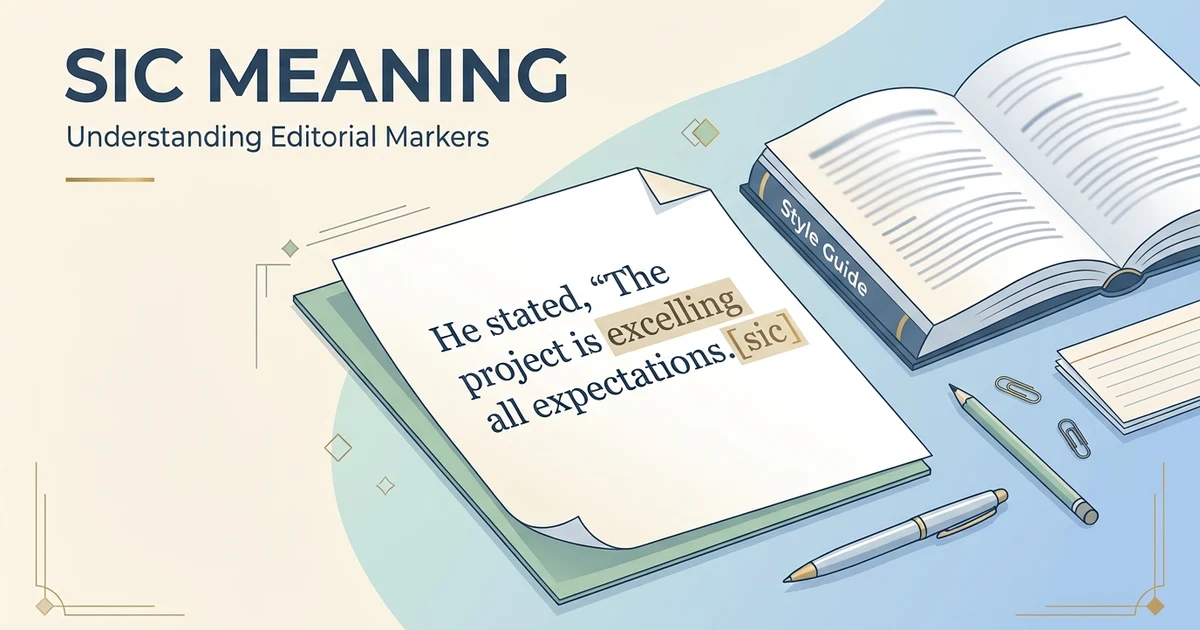
Sic is a Latin word that means thus or so. In modern English writing, people usually place [sic] after a word or phrase that looks incorrect, unusual, or misspelled in a quotation. It tells the reader that the wording appears exactly as it did in the original source and that the person quoting it did not make the mistake. You may see sic in articles, books, news reports, academic writing, legal documents, and other formal text.
Introduction
You may have noticed [sic] inside a quotation and wondered why the writer included those three letters. At first glance, it can look like a typo or an unexplained abbreviation. In fact, sic serves a specific purpose in written English.
Writers use [sic] when they reproduce someone else’s words exactly, even when the original contains a spelling mistake, grammatical error, unusual wording, or another apparent problem. The marker tells readers that the writer intentionally preserved the original wording.
For example, imagine someone originally wrote, “The store recieve your order.” If a writer quotes that sentence exactly, they might write, “The store recieve [sic] your order.” The [sic] tells readers that recieve appeared in the original text.
The term comes from Latin and roughly means “thus” or “so.” Today, English writers mainly use it as an editorial marker that protects the accuracy of a quotation and helps readers distinguish an original mistake from a mistake made by the person quoting it.
What Does Sic Mean?
Sic comes from Latin and means thus or so.
In English writing, [sic] usually means that the writer has reproduced the quoted wording exactly as it appeared in the original source.
It can draw attention to:
- A spelling mistake
- A grammatical error
- Unusual wording
- An unexpected fact or form of a word
- An unusual capitalization choice
- A wording choice that may look like a quotation error
For example:
The original note said, “Please send the documents tommorow [sic].”
The writer did not accidentally spell tomorrow incorrectly. The original source contained tommorow, and the writer preserved that spelling.
The marker therefore helps answer a reader’s possible question: “Did the person quoting this make that mistake?”
Why Do Writers Use [Sic]?
The main purpose of [sic] is to show that a quotation matches the original source.
When you quote someone, changing their words can change the meaning or make the quotation less accurate. Sometimes the original contains an obvious error, but correcting it would mean altering the source.
Using [sic] lets the writer keep the original wording while signaling that the unusual part came from the original.
For example:
The report stated that the company had “recieved [sic] several complaints.”
The writer preserves the original spelling but makes it clear that recieved did not come from the writer.
This practice can matter in journalism, academic research, legal writing, historical documents, and other situations where accurate quotations matter.
How Is Sic Used in a Sentence?
Writers usually place [sic] immediately after the unusual or incorrect part of a quotation.
For example:
The letter described the situation as “very serius [sic].”
Here, [sic] follows the unusual spelling.
If a quotation contains several issues, writers may use the marker after each relevant word when necessary. However, writers should avoid adding [sic] so often that the quotation becomes difficult to read.
The brackets help distinguish the editorial marker from the original words.
Sic Examples
Understanding a few examples can make the purpose much clearer.
Spelling Error
Original:
“The meeting will happen tomorow.”
Quoted:
The message said, “The meeting will happen tomorow [sic].”
The writer keeps the original spelling and uses [sic] to signal the error.
Grammar Error
Original:
“She don’t know the answer.”
Quoted:
The student wrote, “She don’t [sic] know the answer.”
The marker shows that the writer intentionally preserved the original grammar.
Unusual Wording
A quotation might contain wording that seems strange or unexpected.
The advertisement described the product as “the most better [sic] option.”
The [sic] tells the reader that the unusual phrase came from the original material.
Capitalization
Writers can also use [sic] when an unusual capitalization choice matters to the quotation.
The document referred to the department as “the Finance office [sic].”
Whether [sic] is necessary depends on why the writer is preserving the exact wording.
Sic vs Correction
A useful way to understand [sic] is to compare it with silently correcting a quotation.
Suppose an original source says:
“The adress is incorrect.”
A writer has two basic choices.
They can preserve the original wording:
“The adress [sic] is incorrect.”
Or, depending on the rules and purpose of the quotation, they may make a permitted editorial correction and clearly indicate that change using an appropriate editorial method.
The important point is that [sic] tells readers the quoted wording came from the original source.
Sic in Academic Writing
Academic writers may use [sic] when they need to quote a source accurately.
For example, a researcher might discover a spelling mistake in an old document. If the exact wording matters, the researcher may reproduce the mistake and add [sic].
This approach can help readers distinguish the original source from the researcher’s own writing.
However, academic style guides can differ in how they recommend handling errors in quotations. Writers should follow the style guide required for their project.
Sic in Journalism
Journalists may encounter [sic] when quoting statements, documents, social media posts, or historical material.
The marker can help prevent readers from assuming that the journalist introduced a spelling or grammatical error.
However, journalists do not need to use [sic] for every small imperfection. Editorial practices vary, and writers often consider whether the original wording matters enough to preserve exactly.
Sic in Legal Writing
Legal documents and quoted evidence can contain unusual language or mistakes from an original source. A writer may use [sic] to show that the wording comes directly from that source.
Because legal writing can have strict requirements, anyone preparing an official legal document should follow the applicable professional or court rules rather than relying on general usage advice.
Sic vs Etc. and Other Latin Terms
English uses several Latin expressions in formal writing.
| Term | Meaning | Common Use |
|---|---|---|
| Sic | Thus or so | Shows that quoted wording appears in the original |
| Etc. | And so on | Indicates additional items |
| E.g. | For example | Introduces an example |
| I.e. | That is | Clarifies or restates something |
These terms have different purposes. Sic specifically relates to wording that a writer reproduces from another source.
Does Sic Mean Something Different in Other Contexts?
Yes. The word sic can appear in other contexts, but the editorial use of [sic] is especially common in written English.
You may also encounter sic as part of Latin expressions or in contexts unrelated to quotation editing.
The surrounding words usually make the intended meaning clear.
For example, [sic] after a spelling mistake inside quotation marks strongly suggests the editorial meaning.
Common Mistakes When Using Sic
One common mistake involves using [sic] simply because the writer dislikes someone’s wording. The marker should not become a tool for mocking another person’s writing.
Another mistake involves placing [sic] far away from the word or phrase that needs clarification. Readers should be able to tell what the marker refers to.
Writers should also avoid using [sic] unnecessarily. If an error does not matter to the quotation and the applicable style allows a correction, another approach may work better.
Finally, do not assume that every unusual phrase contains an error. A writer may use a regional expression, informal wording, historical spelling, or specialized terminology intentionally.
Is Sic Rude?
[Sic] itself is neutral. It simply identifies wording that appears in the original source.
However, the way someone uses it can affect the tone. Repeatedly adding [sic] to another person’s writing can come across as mocking, especially when the writer highlights minor errors that do not matter.
Use the marker when it serves a clear purpose, such as preserving an important quotation accurately.
Does Sic Mean the Writer Made a Mistake?
No. When you see [sic] inside a quotation, it usually means the writer quoting the source did not make the unusual wording mistake.
Instead, the original source contained that wording.
For example:
The sign read, “No dogs alowed [sic].”
The [sic] tells you that alowed appeared in the original sign.
How to Read [Sic] in a Quotation
When you see [sic], read it as a small editorial note.
You can mentally understand the sentence like this:
The writer quoted the original exactly, including that unusual wording.
You do not normally need to pronounce [sic] when reading the sentence aloud. It functions mainly as a written signal for the reader.
Common Mistakes About Sic
Readers sometimes think [sic] means “this statement is false.” It does not.
It also does not mean that the quoted person has a particular opinion or that the writer agrees with the statement.
[Sic] focuses on the form of the quoted wording rather than its truth or meaning.
Another common misunderstanding involves confusing [sic] with an abbreviation such as “source.” It does not mean source. It comes from Latin and traditionally means “thus” or “so.”
Conclusion
The most common sic meaning in modern English writing comes from the Latin word meaning thus or so. Writers use [sic] inside quotations to show that unusual, incorrect, or unexpected wording appeared in the original source.
The marker helps protect the accuracy of a quotation. It tells readers that the person quoting the source did not accidentally introduce the spelling or grammar issue.
You may encounter [sic] in academic papers, journalism, legal documents, books, historical research, and other formal writing. When you see it, look at the word or phrase immediately before it. That is usually the part the writer intentionally preserved from the original source.
FAQs
What does sic mean?
Sic comes from Latin and means “thus” or “so.” In modern writing, [sic] usually shows that a quoted passage contains wording reproduced exactly from the original source.
What does [sic] mean in a quote?
[Sic] tells readers that the unusual or incorrect wording appeared in the original quotation. The person quoting the material did not introduce the error.
Why do writers use sic?
Writers use [sic] to preserve the exact wording of a source while making it clear that an apparent mistake came from the original material.
Is sic a Latin word?
Yes. Sic comes from Latin and traditionally means “thus” or “so.”
Is using [sic] rude?
The marker itself is neutral, but excessive or unnecessary use can make a quotation sound mocking. Writers should use it when it serves a clear purpose.
Does sic mean that a quote is false?
No. [Sic] says nothing about whether a statement is true or false. It only indicates that the quoted wording matches the original source.
Where does sic appear in a sentence?
Writers normally place [sic] immediately after the unusual word or phrase in a quotation.
Should I use [sic] for every spelling mistake?
Not necessarily. The need for [sic] depends on the purpose of the quotation and the applicable writing or style guidelines.