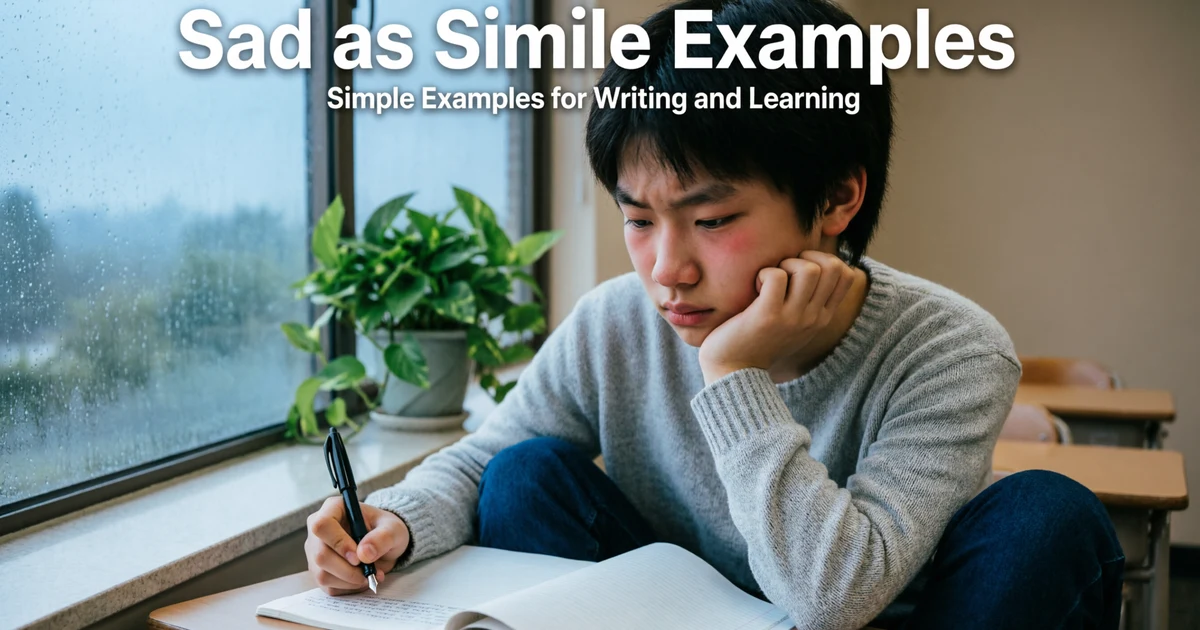
Sadness can feel heavy, quiet, deep, lonely, or even numb. A good simile helps readers feel that sadness instead of only reading the word sad. It turns a plain emotion into a clear picture.
In this article, you will learn what sad as simile means, how to write sad similes naturally, and how to use them in school writing, poems, stories, conversations, and creative descriptions. You will also find many simple examples with meanings so you can choose the right expression for the right feeling.
What Sad as Simile Means in Simple Words
A sad simile compares sadness to something else using words like as or like. It helps describe the feeling in a more vivid way.
For example:
As sad as a rainy morning
As sad as a lost child
Sad like a song with no ending
These similes do more than say someone feels sad. They show the mood, image, and depth of the feeling.
A sad simile can describe:
• A person
• A face
• A voice
• A memory
• A place
• A moment
• A mood in a story
Simple example:
She looked as sad as a flower left in the dark.
This tells us she looks weak, lonely, and without joy.
Best Sad Simile Examples for Everyday Writing
Everyday writing needs simple similes that readers understand quickly. These examples work well in school work, journal writing, messages, and short descriptions.
Examples:
1• As sad as a cloudy sky
Meaning: A soft and simple sadness
2• As sad as a forgotten toy
Meaning: A lonely and neglected feeling
3• As sad as a song played too slowly
Meaning: A quiet emotional sadness
4• As sad as rain on an empty street
Meaning: A lonely mood
5• Sad like a candle burning out
Meaning: A fading hope or energy
Sentence examples:
He felt as sad as a cloudy sky after hearing the news.
Her room looked sad like rain on an empty street.
His smile faded like a candle burning out.
These similes work because they use familiar images. Readers can picture them without confusion.
Sad as Simile Examples with Clear Meanings
A strong simile should not sound pretty only. It should also make sense. Each comparison should match the type of sadness you want to show.
Examples with meanings:
1• As sad as a bird with a broken wing
Meaning: Helpless sadness
2• As sad as a home without laughter
Meaning: Empty sadness
3• As sad as a letter never sent
Meaning: Regret and unspoken emotion
4• As sad as winter without sunlight
Meaning: Cold and lasting sadness
5• As sad as a bell that no one hears
Meaning: Loneliness and being ignored
Sentence examples:
He sat there as sad as a bird with a broken wing.
The old house felt as sad as a home without laughter.
Her apology stayed inside her, as sad as a letter never sent.
Clear meanings help students and writers choose the right simile instead of using random comparisons.
Simple Sad Similes for Students
Students often need easy similes for essays, stories, worksheets, and classroom writing. The best student examples stay clear and natural.
Simple examples:
• As sad as a rainy day
• As sad as a lost puppy
• As sad as an empty playground
• As sad as a wilted flower
• As sad as a broken toy
• As sad as a dark room
• As sad as a lonely bench
Sentence examples:
The boy was as sad as a lost puppy.
The garden looked as sad as a wilted flower.
After the game ended, the playground felt as sad as an empty playground.
Students should choose similes that match the sentence. A sad person may feel like a lost puppy, while a sad place may look like an empty playground.
Easy Sad Similes for ESL Learners
ESL learners need similes that use common words and simple images. A clear simile helps learners understand both emotion and comparison.
Easy examples:
• As sad as rain
• As sad as a gray sky
• As sad as a lonely child
• As sad as a quiet house
• As sad as a broken heart
• Sad like a cold night
• Sad like an empty chair
Sentence examples:
She felt as sad as rain.
His face looked as sad as a gray sky.
The house felt sad like an empty chair.
Useful pattern for ESL learners:
Subject plus verb plus as sad as plus image
Example:
He was as sad as a lonely child.
Another useful pattern:
Subject plus verb plus sad like plus image
Example:
Her voice sounded sad like a cold night.
These patterns help learners write correct and natural sentences.
Emotional Sad Similes for Creative Writing
Creative writing needs deeper similes that carry feeling, sound, and image. These similes can help readers connect with a character or scene.
Examples:
• Sad like moonlight on an empty road
• As sad as a song no one finishes
• Sad like a photograph fading in a drawer
• As sad as a heart waiting for a reply
• Sad like a room after someone leaves forever
Sentence examples:
She stood by the gate, sad like moonlight on an empty road.
His voice sounded as sad as a song no one finishes.
The memory stayed with him, sad like a photograph fading in a drawer.
Creative sad similes work best when they feel specific. Instead of writing he was very sad, show what kind of sadness he carries.
Sad Similes for Stories and Descriptive Paragraphs
Stories need similes that help readers imagine the scene. A sad simile can show a character’s feelings without long explanation.
Examples for stories:
• As sad as a child watching a train leave
• Sad like a house after the lights go out
• As sad as a tree losing its last leaf
• Sad like footsteps fading down a hallway
• As sad as a promise no one kept
Paragraph example:
Mina sat near the window and watched the rain slide down the glass. Her face looked as sad as a child watching a train leave. She did not cry, but her silence filled the room.
Another example:
The village felt sad like a house after the lights go out. No one spoke loudly. Even the wind seemed careful.
These similes help writers build mood, character, and setting at the same time.
Sad Similes for Poems and Personal Writing
Poems and personal writing often need gentle, emotional language. A sad simile can make a private feeling easier to express.
Examples:
• Sad like a tear hidden in a smile
• As sad as a rose losing its color
• Sad like a poem no one reads
• As sad as silence after goodbye
• Sad like rain tapping on a lonely roof
Poetry style examples:
My heart felt sad like rain tapping on a lonely roof.
Her smile looked as sad as a rose losing its color.
The goodbye stayed between us, as sad as silence after goodbye.
Personal writing should feel honest. Choose images that match your real emotion instead of choosing the most dramatic line.
Sad Similes for Describing a Lonely Person
Loneliness is one of the most common forms of sadness. These similes show isolation, silence, and emotional distance.
Examples:
• As sad as a lone star in a dark sky
• Sad like a chair at an empty table
• As sad as a voice with no answer
• Sad like a person waiting at a closed door
• As sad as a shadow with no body nearby
Sentence examples:
He looked as sad as a lone star in a dark sky.
She sat there sad like a chair at an empty table.
His call sounded as sad as a voice with no answer.
These similes work well when you want to show that someone feels unseen, forgotten, or emotionally alone.
Sad Similes for Describing Crying
Crying can show grief, fear, regret, pain, or relief. A good crying simile should match the emotion behind the tears.
Examples:
• She cried like rain falling from a heavy cloud
• He cried like a child who had lost his way
• Her tears fell like water from a cracked cup
• He wept as sadly as wind through an empty house
• She cried like the sky could not hold its rain
Sentence examples:
She cried like rain falling from a heavy cloud.
His tears fell like water from a cracked cup.
The old man wept as sadly as wind through an empty house.
Avoid using too many crying similes in one paragraph. One strong image often creates more emotion than several weak ones.
Sad Similes for Describing a Broken Heart
A broken heart needs similes that show pain, loss, and emotional damage. These examples work well for love writing, poems, and character descriptions.
Examples:
• As sad as a heart split by goodbye
• Sad like a song after love ends
• As sad as flowers left on a doorstep
• Sad like a ring no one wears anymore
• As sad as a love letter torn in half
Sentence examples:
She felt as sad as a heart split by goodbye.
His voice sounded sad like a song after love ends.
The memory felt as sad as a love letter torn in half.
Broken heart similes should not always sound dramatic. Sometimes quiet images feel more powerful.
Sad Similes for Describing Grief and Loss
Grief has a deeper weight than ordinary sadness. It often feels slow, heavy, and hard to explain. Use careful language when writing about loss.
Examples:
• As sad as an empty chair at dinner
• Sad like a room that still remembers someone
• As sad as flowers placed beside a photograph
• Sad like a voice missing from a song
• As sad as a door that will not open again
Sentence examples:
The table looked as sad as an empty chair at dinner.
Her room felt sad like it still remembered someone.
The family stood there as sad as flowers placed beside a photograph.
When you write about grief, keep the tone respectful. Simple similes often feel more honest than dramatic ones.
Sad Similes for Describing Quiet Pain
Not every sad person cries. Some people carry sadness quietly. These similes help describe hidden pain.
Examples:
• Sad like a stone at the bottom of a river
• As sad as a smile hiding tears
• Sad like music playing in another room
• As sad as a secret kept too long
• Sad like a lamp left on in an empty house
Sentence examples:
He looked calm, but he felt sad like a stone at the bottom of a river.
Her smile looked as sad as a smile hiding tears.
His silence felt as sad as a secret kept too long.
Quiet pain similes work well for characters who hide emotions or struggle silently.
Sad Similes for Describing a Sad Face
A sad face can show many emotions. It may look tired, hurt, disappointed, or lonely. Use a simile that matches the expression.
Examples:
• Her face looked as sad as a rainy window
• His face looked sad like a cloudy morning
• Her eyes looked as sad as a lost child
• His mouth drooped like a flower without water
• Her face seemed as sad as a sky before a storm
Sentence examples:
Her face looked as sad as a rainy window.
His eyes looked as sad as a lost child.
Her mouth drooped like a flower without water.
A sad face simile works best when it focuses on one detail, such as the eyes, mouth, or expression.
Sad Similes for Describing Mood and Atmosphere
Writers often use sad similes to describe the mood of a place. This helps readers feel the atmosphere before anything happens.
Examples:
• The room felt sad like a song with no music
• The street looked as sad as rain at dusk
• The house felt as sad as a memory no one wanted
• The evening settled like a blanket of sorrow
• The town felt sad like a photograph without color
Sentence examples:
The room felt sad like a song with no music.
The street looked as sad as rain at dusk.
The town felt sad like a photograph without color.
Mood similes help build the emotional background of a scene. They work especially well in stories, poems, and descriptive essays.
Powerful Sad Similes That Create Strong Emotion
Powerful similes create a strong image without sounding forced. They often connect sadness with loss, silence, darkness, or fading hope.
Examples:
• As sad as a dream dying before morning
• Sad like a prayer with no answer
• As sad as a child holding a broken gift
• Sad like the last light leaving the sky
• As sad as a heart learning to let go
Sentence examples:
He felt as sad as a dream dying before morning.
Her voice sounded sad like a prayer with no answer.
The moment felt as sad as the last light leaving the sky.
Use powerful similes in important moments. If every sentence sounds intense, the writing loses emotional strength.
Gentle Sad Similes for Sensitive Writing
Some topics need soft language. Gentle similes can express sadness without making the writing too heavy.
Examples:
• Sad like a soft rain
• As sad as a quiet goodbye
• Sad like a fading sunset
• As sad as a tired flower
• Sad like a whisper in an empty room
Sentence examples:
She felt sad like a soft rain.
Their goodbye was as sad as a quiet goodbye.
His eyes looked sad like a fading sunset.
Gentle similes work well for children’s writing, reflective essays, emotional messages, and sensitive topics.
How to Use Sad Similes Naturally in Sentences
A sad simile should fit the sentence smoothly. Do not add one only to make the writing sound fancy.
Useful sentence patterns:
• She looked as sad as a rainy sky.
• He felt sad like a lost child.
• The room seemed as sad as an empty home.
• Her voice sounded sad like music from far away.
• His heart felt as sad as a winter morning.
Tips for natural use:
• Match the simile with the emotion
• Keep the image clear
• Avoid confusing comparisons
• Use one strong simile at a time
• Choose simple words when the feeling already feels deep
Weak example:
He was sad as a blue loud mountain.
Better example:
He was as sad as a lonely mountain under gray clouds.
The better sentence gives a clearer picture.
Common Mistakes When Writing Sad Similes
Many writers make sad similes too dramatic, too confusing, or too common. A good simile should feel clear and meaningful.
Common mistakes:
• Using a comparison that does not match sadness
• Adding too many similes in one paragraph
• Choosing images that confuse readers
• Using clichés without adding fresh detail
• Making every sad moment sound extreme
Weak examples:
She was as sad as a chair.
He cried like a refrigerator.
The night was sad like a pencil.
These comparisons do not create clear emotion.
Better examples:
She was as sad as an empty chair at a family table.
He cried like rain after a long dry season.
The night felt sad like a room after goodbye.
Small details make a big difference.
Better Words to Use with Sad Similes
The word sad works well, but other words can show a more exact feeling. Strong writing often uses precise emotion words.
Better words for sad:
• Lonely
• Heartbroken
• Gloomy
• Miserable
• Sorrowful
• Grief stricken
• Downcast
• Melancholy
• Hurt
• Empty
• Hopeless
• Heavy hearted
Example sentences:
She looked lonely, like a lamp glowing in an empty room.
He felt heartbroken, like a song that ended too soon.
The sky looked gloomy, as if it carried every gray thought in the world.
Using better words helps readers understand the exact kind of sadness you mean.
Conclusion
Sad similes help writers turn emotion into a clear picture. Instead of only saying someone feels sad, you can show sadness through rain, silence, empty rooms, broken hearts, fading light, or lonely places.
The best sad simile matches the exact feeling. A lonely character may feel like an empty chair. A grieving family may seem like a room missing a voice. A heartbroken person may feel like a song after love ends. When your comparison feels honest and clear, your writing becomes stronger, deeper, and easier to understand.
FAQs
What is a sad simile?
A sad simile compares sadness to another image using words like as or like. Example: as sad as a rainy day.
What is an example of sad as a simile?
As sad as a lost puppy is a simple sad simile. It shows loneliness, hurt, and helplessness.
What is a good sad simile for students?
A good student friendly example is as sad as a wilted flower. It uses a simple image that most readers understand.
Can I use sad similes in essays?
Yes, you can use sad similes in essays when the topic allows descriptive or creative language. Keep the comparison clear and relevant.
What is a sad simile for crying?
She cried like rain falling from a heavy cloud is a strong simile for crying.
What is a sad simile for a lonely person?
As sad as a lone star in a dark sky works well for describing a lonely person.
What is a sad simile for heartbreak?
Sad like a love letter torn in half is a useful simile for heartbreak.
Are sad similes useful for ESL learners?
Yes, sad similes help ESL learners understand emotion, comparison, and descriptive sentence patterns.
How do I write my own sad simile?
Choose the type of sadness first. Then compare it to a clear image, such as rain, silence, an empty room, or a broken object.
What should I avoid when writing sad similes?
Avoid confusing images, overused phrases, and too many similes in one paragraph. Use one clear comparison that fits the emotion.