Quick Answer
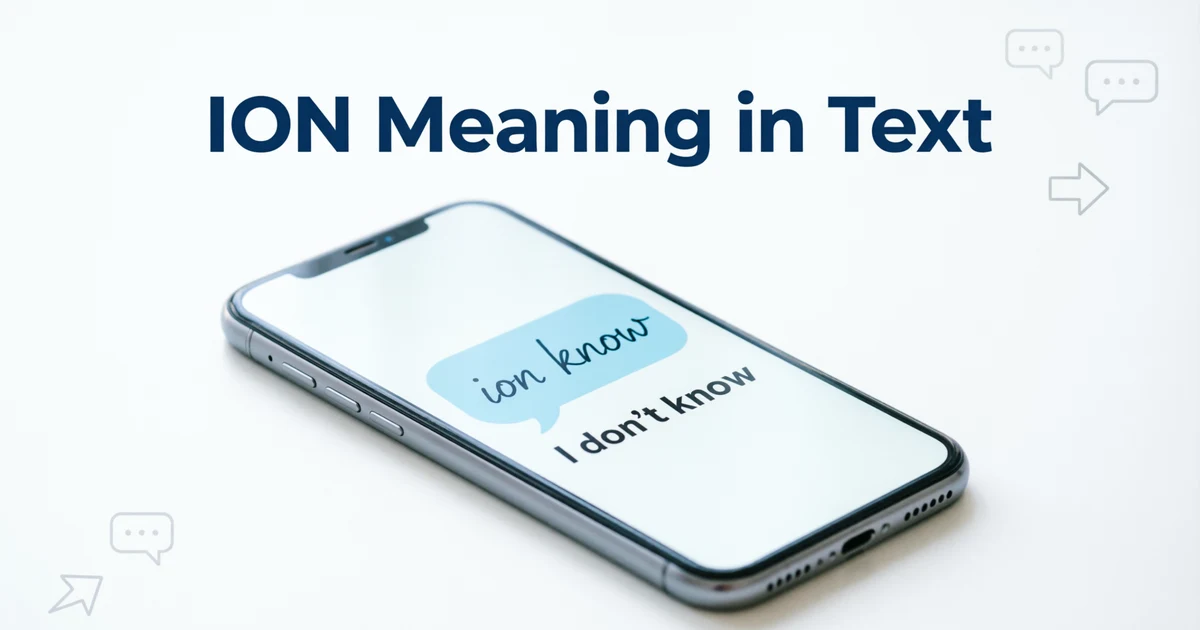
In texting and social media, ION usually means I don’t. It reflects the way the phrase sounds when spoken quickly in casual conversation. For example, ion know means I don’t know, while ion care means I don’t care. It is informal slang commonly seen in texts, captions, comments, memes, and direct messages. In other contexts, ion can also refer to a scientifically charged atom or molecule, so the surrounding sentence determines the intended meaning.
Introduction
Seeing ion in a text can be confusing because most people first recognize it as a science term. However, when someone writes ion know, ion care, or ion think so, they are usually not talking about chemistry. They are using a phonetic spelling of I don’t.
People often search for the ion meaning in text after encountering it on TikTok, Instagram, Snapchat, X, group chats, or private messages. The slang is especially common in relaxed online conversations where people write words the way they sound when spoken quickly.
This guide explains what ion means, how to understand it from context, and how people use it naturally. You will also see realistic examples, tone differences, related slang terms, and common mistakes. By the end, you should be able to recognize whether ion means I don’t, refers to a scientific ion, or has been used in another context.
| Term | Meaning | Tone | Example |
|---|---|---|---|
| ion | I don’t | Very casual | Ion know what happened |
| I don’t | Standard negative phrase | Neutral | I don’t know what happened |
| idk | I don’t know | Casual | Idk what happened |
| nah | No or not really | Casual | Nah, I’m staying home |
| ion even | I don’t even | Informal and expressive | Ion even know what to say |
What Does ION Mean in Text?
In most casual texts, ion means I don’t. It is based on pronunciation rather than traditional spelling. When I don’t is said quickly, especially in relaxed speech, it can sound similar to ion.
For example:
1-Ion know means I don’t know.
2-Ion want that means I don’t want that.
3-Ion think so means I don’t think so.
The term is not usually treated as an acronym. The letters do not normally stand for separate words. Instead, ion is a phonetic representation of how I don’t may sound in fast, informal speech.
People may write it in lowercase as ion, but uppercase ION can carry the same meaning when someone types in all caps for emphasis. Capitalization alone does not change the definition.
Because ion replaces I don’t rather than an entire sentence, you usually need to read the words that follow it. Those words reveal what the person is denying, rejecting, questioning, or expressing uncertainty about.
Why Does I Don’t Become ION?
Internet slang often reflects spoken language. People shorten words, remove sounds, and spell phrases according to how they sound in everyday conversation.
When I don’t is spoken quickly, the d and t sounds may become less noticeable. The phrase can then sound close to ion. Texting captures that relaxed pronunciation in written form.
This pattern appears in many other casual expressions. People may write tryna for trying to, finna for fixing to or about to, and lemme for let me. These spellings are usually used to create a conversational tone rather than follow formal grammar.
Ion also has roots in African American English and has spread widely through music, memes, online communities, and social media. People from many backgrounds now use it online, although its tone remains highly informal.
How ION Is Used in Text Messages
Ion usually appears before a verb or verb phrase. It works in the same position where someone would normally write I don’t.
To Show Uncertainty
People often use ion when they do not know an answer or are unsure about something.
Friend: Who invited everyone?
Reply: Ion know. I just got here.
The reply means the person does not know who sent the invitation.
To Express Disagreement
Ion can introduce a different opinion without directly saying no.
Person 1: That movie was amazing.
Person 2: Ion think it was that good.
The second person is saying, I don’t think it was that good.
To Reject Something
Someone may use ion to say they do not want, like, need, or support something.
Ion want to go out tonight.
This means the person does not want to go out.
To Show Indifference
Ion care is a common phrase that communicates a lack of concern or interest.
Ion care what they say.
Depending on context, this may sound confident, dismissive, annoyed, or rude.
To Express Confusion
Ion may appear when someone does not understand a situation.
Ion get why everyone is upset.
This means, I don’t understand why everyone is upset.
To Add Emphasis
Writers sometimes combine ion with even to show stronger disbelief, confusion, or frustration.
Ion even know where to start.
The sentence means the person feels so uncertain or overwhelmed that they do not know how to begin.
Common ION Examples and Their Meanings
| Text Example | Standard Meaning | Likely Tone |
|---|---|---|
| Ion know | I don’t know | Uncertain or casual |
| Ion care | I don’t care | Indifferent or dismissive |
| Ion think so | I don’t think so | Doubtful |
| Ion want it | I don’t want it | Rejecting |
| Ion like that | I don’t like that | Disapproving |
| Ion get it | I don’t understand it | Confused |
| Ion remember | I don’t remember | Uncertain |
| Ion trust him | I don’t trust him | Suspicious |
| Ion see the problem | I don’t see the problem | Disagreeing |
| Ion even know | I don’t even know | Confused or overwhelmed |
Examples of ION in Conversations
Understanding ion becomes easier when you see it in complete exchanges.
Example 1: Making Plans
Alex: Are you coming to the party?
Jordan: Ion know yet. I might have to work.
Here, ion know means I don’t know. Jordan has not made a decision.
Example 2: Sharing an Opinion
Taylor: Everyone says that restaurant is great.
Morgan: Ion think it’s worth the price.
Morgan does not believe the restaurant provides enough value for its cost.
Example 3: Showing Frustration
Chris: Why are they blaming you?
Sam: Ion even know. I wasn’t there.
Ion even know emphasizes Sam’s confusion and frustration.
Example 4: Rejecting an Idea
Jamie: You should text your ex.
Riley: Ion want that drama again.
Riley is saying that they do not want to experience more conflict.
Example 5: Expressing Confidence
Friend: People might judge your outfit.
Reply: Ion care. I like it.
In this context, ion care expresses confidence and independence.
What Does Ion Know Mean?
Ion know means I don’t know. It is one of the most common uses of ion in messages and social media posts.
Someone may use it when they lack information:
Ion know where she went.
They may also use it to express uncertainty:
Ion know if I should apply for that job.
Sometimes ion know is used as a reaction to something confusing or surprising:
Ion know what’s going on anymore.
The phrase can sound neutral, uncertain, frustrated, or humorous depending on the rest of the conversation.
What Does Ion Care Mean?
Ion care means I don’t care. It indicates that the person is not concerned about something or does not consider it important.
For example:
Ion care who wins.
This suggests the person has no strong preference.
However, tone matters. In a friendly discussion, ion care may simply communicate indifference. During an argument, the same phrase can sound cold or disrespectful.
Compare these examples:
Ion care where we eat. You choose.
This sounds flexible and relaxed.
Ion care about your excuses.
This sounds dismissive and confrontational.
Read the full sentence and conversation before deciding how the writer intended it.
What Does Ion Even Know Mean?
Ion even know means I don’t even know. People use it when they feel especially confused, surprised, frustrated, or speechless.
Examples include:
1-Ion even know how that happened.
2-Ion even know what to say right now.
3-Ion even know why I’m still awake.
Adding even makes the statement more expressive. It suggests that the person cannot provide a clear answer or explanation, sometimes because the situation feels overwhelming or ridiculous.
Is ION an Acronym?
Ion is generally not an acronym when it means I don’t. It does not usually represent one word for each letter.
It is better described as slang based on pronunciation. People write the phrase according to how it may sound in quick, casual speech.
However, uppercase ION may be used as an acronym in specialized organizations, businesses, technology, or academic settings. The exact meaning would depend on the subject being discussed.
In an ordinary message such as ion know or ion want to go, the slang meaning I don’t is almost certainly intended.
Other Meanings of Ion
Although I don’t is the main texting meaning, ion has other definitions. Context helps separate them.
| Meaning | Where It Is Used | Simple Explanation | Example |
|---|---|---|---|
| I don’t | Texting and social media | Informal negative phrase | Ion believe that |
| Charged particle | Chemistry and physics | An atom or molecule with an electrical charge | Sodium forms a positive ion |
| Name or title | Personal or creative contexts | Ion may appear as a name | Ion was listed as the author |
| Specialized acronym | Business or technology | Letters may represent an organization or system | The meaning depends on the industry |
Ion in Science
In chemistry and physics, an ion is an atom or molecule with a positive or negative electrical charge. It becomes charged after gaining or losing electrons.
For example, sodium can lose an electron and become a positively charged ion. Chlorine can gain an electron and become a negatively charged ion.
A message about atoms, batteries, electrolytes, chemistry class, or electrical charge is probably using the scientific definition.
Ion as a Name
Ion can also be a personal name in some cultures. When it appears with a capital I and refers to a person, it may not be slang.
For example:
Ion will attend the meeting tomorrow.
If Ion is someone’s name, the sentence means that person will attend.
ION as a Specialized Acronym
Some companies, projects, publications, technologies, and organizations use ION as an acronym or brand name. There is no single universal expansion that applies in every professional context.
Look for clues such as technical language, company references, product names, or capital letters. When the sentence does not make sense with I don’t, another meaning may be intended.
How to Tell What ION Means From Context
You can usually identify the meaning by replacing ion with I don’t.
Consider this sentence:
Ion believe that story.
Replace ion with I don’t:
I don’t believe that story.
The sentence makes sense, so the slang meaning is correct.
Now consider:
An ion can carry a positive charge.
Replacing ion with I don’t would produce a meaningless sentence. The scientific meaning is clearly intended.
Use these clues:
- Ion followed by know, care, think, want, like, get, believe, or remember usually means I don’t.
- Ion near words such as atom, molecule, electron, charge, sodium, or chemistry usually has the scientific meaning.
- Ion used as the subject of a sentence with a capital I may be a person’s name.
- ION beside a company, product, or technical term may be an acronym or brand name.
Is ION Formal or Informal?
Ion is highly informal. It works best in casual conversations with friends, social media comments, memes, captions, song discussions, and relaxed group chats.
It is generally not appropriate for:
- School assignments
- College essays
- Job applications
- Resumes
- Business emails
- Client communication
- Formal reports
- Professional presentations
In formal writing, use I don’t or another complete phrase.
Instead of writing:
Ion understand the updated policy.
Write:
I don’t understand the updated policy.
For an even more professional tone, you could write:
I would appreciate clarification about the updated policy.
Slang can help a message feel natural, but standard wording is safer when clarity and professionalism matter.
How to Respond When Someone Says ION
Your response should match both the sentence and its tone. Ion itself does not require a special reply.
If someone says:
Ion know what to do.
You might respond:
Want to talk through your options?
If someone says:
Ion care where we go.
You could reply:
Okay, I’ll choose the place.
If someone says:
Ion believe you.
You might say:
What part sounds unbelievable?
If the meaning is unclear, ask directly:
Do you mean you don’t know?
It is better to clarify than assume the wrong meaning, especially when the conversation is serious.
Similar Texting Terms and Phrases
Several slang terms may appear in conversations with ion, but they do not all mean the same thing.
| Term | Meaning | Best Use | Example |
|---|---|---|---|
| ion | I don’t | Casual negative statements | Ion want to argue |
| idk | I don’t know | Expressing uncertainty | Idk where he went |
| ik | I know | Confirming knowledge | Ik what you mean |
| imo | In my opinion | Sharing a viewpoint | Imo, the first one is better |
| nah | No or not really | Casual refusal | Nah, I’m good |
| ain’t | Am not, is not, are not, or have not | Informal negative statements | I ain’t going |
| fr | For real | Emphasis or agreement | That was strange fr |
| ngl | Not gonna lie | Introducing an honest opinion | Ngl, I liked it |
| finna | About to or planning to | Describing an upcoming action | I’m finna leave |
| tryna | Trying to | Describing effort or intention | I’m tryna finish this |
1-ION Versus IDK
Ion means I don’t and needs another word or phrase to complete its idea.
Ion remember his name.
Idk already means I don’t know and can stand alone.
Who called you?
Idk.
You could also write ion know, which communicates the same basic answer as idk.
ION Versus Ain’t
Ion specifically replaces I don’t. Ain’t can replace several negative phrases, including am not, is not, are not, has not, or have not.
Ion like it means I don’t like it.
I ain’t ready means I am not ready.
They are both informal, but they do different grammatical jobs.
ION Versus Nah
Nah is a casual form of no or not really. Ion introduces a negative statement.
Nah, I’m not going.
Ion want to go.
Both may reject an invitation, but their sentence structures differ.
Common Mistakes When Interpreting ION
Assuming It Always Refers to Chemistry
Many readers first associate ion with science. That meaning is correct in academic and technical contexts, but it is usually not intended in phrases such as ion know or ion care.
Check whether I don’t fits naturally in the sentence.
Treating It as a Universal Acronym
Some people assume ION must represent three separate words because it is written in capital letters. In everyday texting, it is usually phonetic slang rather than an acronym.
Capital letters may simply add emphasis.
Reading It as I On
Ion is not normally a shortened version of I on. A sentence such as ion my way may be a typo for I’m on my way, but that is different from the standard slang use.
The phrase ion my way is incomplete if ion means I don’t, so the writer may have made a typing error.
Using It in Professional Communication
Ion can look careless or unclear in a workplace email, academic assignment, or customer message. Use I don’t in situations where standard English is expected.
Ignoring the Tone
Phrases such as ion care can sound playful in one conversation and rude in another. Consider the relationship between the people, the topic, punctuation, and previous messages.
Confusing ION With ON
A missing space or autocorrect error may create ion where someone intended I on or I’m on. Read the complete sentence instead of relying on one word.
Should You Use ION in Your Own Messages?
You can use ion when communicating casually with people who understand the slang. It may help your message sound relaxed, expressive, or conversational.
Good situations include:
- Texting close friends
- Commenting on casual social posts
- Writing a humorous caption
- Participating in an informal group chat
- Matching the established tone of a conversation
Avoid it when the reader may not recognize the term or when your message needs to sound clear and professional.
Language also carries social and cultural context. Since ion developed from a particular speech pattern and became closely associated with African American English, use it naturally rather than forcing it into every message to imitate a voice or persona.
Conclusion
The most common ion meaning in text is I don’t. It appears in casual phrases such as ion know, ion care, ion think so, and ion want that. You can usually confirm the meaning by replacing ion with I don’t and checking whether the sentence still makes sense.
Remember that ion can also describe a charged particle in science, appear as a personal name, or function as a specialized acronym. Context is the key. Use the slang form in relaxed conversations, but choose standard wording in school, workplace, and other formal communication.
Frequently Asked Questions
What does ion mean in text messages?
Ion usually means I don’t in text messages. For example, ion know means I don’t know, and ion like it means I don’t like it.
What does ion mean on TikTok?
On TikTok, ion usually means I don’t. It appears in captions, comments, memes, and videos where users write phrases according to casual pronunciation.
What does ion mean on Snapchat?
On Snapchat, ion normally means I don’t. A message such as ion wanna go means I don’t want to go.
Does ion mean I don’t know?
Ion by itself means I don’t, not I don’t know. However, the common phrase ion know means I don’t know.
Is ion short for something?
In texting, ion is usually not an acronym. It is a phonetic spelling of I don’t based on how the phrase may sound when spoken quickly.
What does ion even mean in slang?
The phrase ion even is short for I don’t even. It usually appears before another verb, as in ion even remember or ion even care.
Is ion rude in a text?
Ion itself is not automatically rude. The full statement determines the tone. Ion know sounds casual, while ion care about your opinion may sound dismissive.
Can ion have a scientific meaning?
Yes. In science, an ion is an atom or molecule with an electrical charge. Texts about electrons, chemistry, atoms, or electrical charge are probably using this definition.