Quick Answer
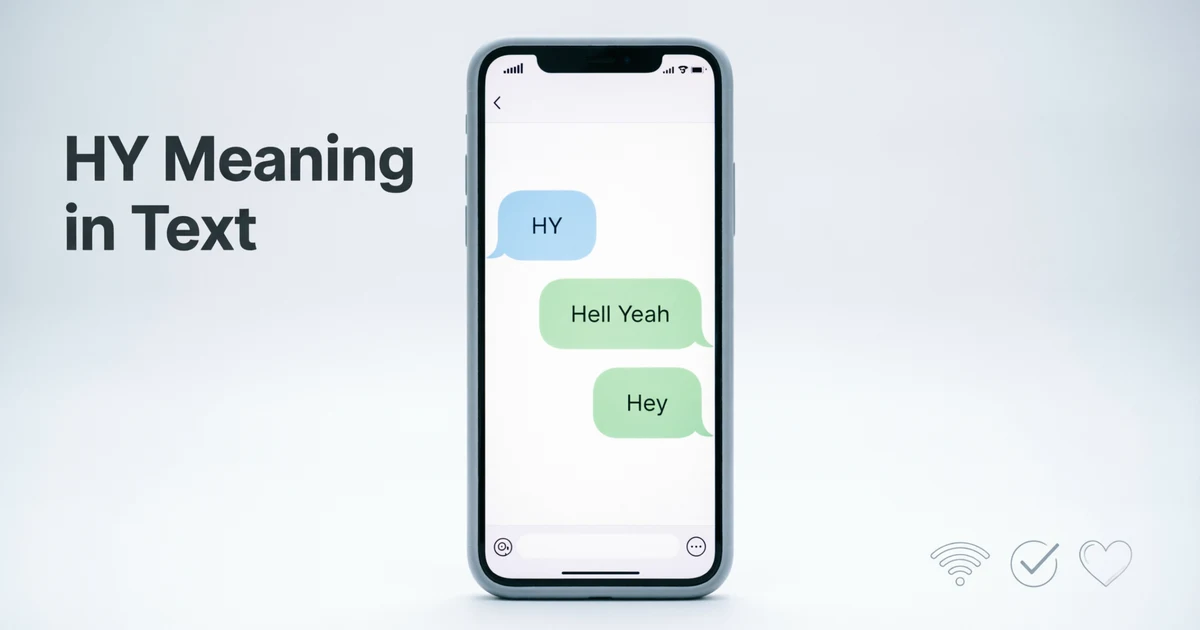
HY usually means hell yeah or hell yes in a text message. It expresses enthusiastic agreement, excitement, or strong approval. For example, if someone asks, Are you coming to the party tonight? replying HY means you are definitely interested.
However, HY can also be a casual spelling of hi, hey, or hello when it appears at the beginning of a conversation. Context, message placement, and the sender’s tone help you identify the intended meaning. Informal slang references commonly record both uses, though hell yeah is widely recognized as the primary texting abbreviation.
Introduction
Seeing only two letters in a message can leave you wondering whether the sender greeted you, agreed with you, or typed something by mistake. That is why people often search for the HY meaning in text after receiving it in a chat, direct message, comment, or social media reply.
In most casual conversations, HY expresses an excited yes. It carries more enthusiasm than a plain yes, yep, or okay. Someone might use it when accepting an invitation, reacting to good news, agreeing with an idea, or showing support. The abbreviation can also represent hi or hey, especially when it appears as the first message in a conversation.
The intended meaning depends heavily on context. A reply such as HY, I’m coming probably means hell yeah. A message that simply says HY, how are you? probably means hi or hey. This guide explains both meanings, shows realistic examples, compares HY with similar expressions, and helps you choose an appropriate response.
| Term | Meaning | Tone | Example |
|---|---|---|---|
| HY | Hell yeah or hell yes | Excited and strongly positive | HY, that sounds amazing |
| HY | Hi or hey | Casual and friendly | HY, what are you doing? |
| HY | Hate you | Playful or negative, but uncommon | HY right now, you ate my fries |
| Yes | Agreement | Neutral | Yes, I can come |
| YH | Yeah | Casual | YH, I saw it |
| HYY | Hey | Friendly or playful | HYY, how have you been? |
What Does HY Mean in Text?
The most common slang meaning of HY is hell yeah or hell yes. People use it to show strong agreement, excitement, approval, or willingness.
It is more energetic than simply saying yes. A plain yes communicates agreement, while HY suggests that the person is genuinely excited about the idea.
Consider this conversation:
Friend: Want to get pizza after class?
You: HY, I’m starving.
Here, HY means hell yeah. The reply clearly shows enthusiasm about getting pizza.
HY may also mean hi, hey, or hello. This meaning is more likely when the term starts a conversation rather than answers a question.
Person 1: HY, are you busy?
Person 2: Not really. What’s up?
In this example, HY works as a greeting. It is probably a shortened or stylized version of hey.
Some people may use HY to mean hate you, usually as a joke between close friends. This interpretation is much less common and should only be assumed when the surrounding conversation supports it.
How Context Changes the Meaning of HY
You do not need to memorize every possible interpretation. Look at where HY appears and what message came before it.
HY as an enthusiastic yes
HY probably means hell yeah when it responds to an invitation, suggestion, question, or exciting statement.
Example:
Are you ready for the concert?
HY, I’ve been waiting all week.
The sender is expressing strong excitement.
HY as a greeting
HY probably means hi or hey when it appears at the beginning of a new conversation.
Example:
HY, I wanted to ask you something.
Since there is no earlier question requiring a yes or no answer, the greeting meaning makes more sense.
HY as hate you
HY may mean hate you when the conversation includes teasing, annoyance, or playful frustration.
Example:
You finished the last cookie?
HY right now.
The sender may be joking, especially if the people involved are close friends. In a serious disagreement, however, it could sound genuinely negative.
How HY Is Used in Everyday Conversations
HY appears most often in informal communication between friends, classmates, siblings, couples, and social media users. It is suitable for relaxed conversations but rarely appropriate in formal writing.
Accepting an invitation
Message: Want to come over and watch the game?
Reply: HY, what time?
The reply shows enthusiastic interest.
Agreeing with an opinion
Message: That movie was much better than the first one.
Reply: HY, the ending was incredible.
Here, HY reinforces agreement.
Reacting to good news
Message: We got tickets for Saturday.
Reply: HY! I thought they were sold out.
The abbreviation communicates excitement.
Supporting a friend
Message: I finally submitted my application.
Reply: HY, I knew you could do it.
In this situation, HY works as encouragement and approval.
Starting a casual conversation
Message: HY, did you finish the assignment?
Here, HY most likely means hi or hey.
HY Meaning on Snapchat, Instagram, and TikTok
The meaning of HY generally stays the same across texting and social media platforms. It most often means hell yeah, hell yes, or occasionally hey.
On Snapchat, someone may reply HY to a story about a party, trip, outfit, concert, or upcoming event. The response shows excitement or approval.
On Instagram, HY might appear in a comment or direct message:
Post: New music dropping Friday.
Comment: HY, finally!
On TikTok, users may place HY in comments to strongly agree with an opinion, reaction, or trend.
The platform does not determine the meaning by itself. The surrounding words and the content being discussed provide the best clues.
Is HY Positive or Negative?
HY is usually positive. When it means hell yeah, it communicates enthusiasm, confidence, and approval.
However, its tone can change based on punctuation and context.
| Message | Likely Tone | Meaning |
|---|---|---|
| HY! | Very excited | Absolutely yes |
| HY 😂 | Playful agreement | Yes, definitely |
| HY, I’m down | Enthusiastic | I want to join |
| HY? | Confused or questioning | Hi? or what do you mean? |
| HY right now | Playfully annoyed | Hate you right now |
| HY, what’s up? | Friendly | Hi or hey |
Capital letters do not necessarily indicate anger. Texting abbreviations are often written in uppercase because they represent shortened phrases.
Natural Examples of HY in Text Messages
The following examples show how people might use HY in real conversations.
When HY means hell yeah
Example 1
Want to grab coffee before work?
HY, I need caffeine.
Example 2
Did you like the new episode?
HY, that twist was wild.
Example 3
Are we still going to the beach this weekend?
HY, the weather looks perfect.
Example 4
You think our team can win?
HY, they’ve been playing great.
Example 5
Should we order dessert too?
HY, get the chocolate cake.
When HY means hi or hey
Example 1
HY, how was your weekend?
Example 2
HY, can you send me the notes from class?
Example 3
HY, I haven’t heard from you in a while.
Example 4
HY, are you free later?
When HY may mean hate you
Example 1
You posted that embarrassing photo?
HY 😂
Example 2
You ate my leftovers again. HY right now.
Because hate you can sound harsh without context, it is safer to write the full phrase or include a playful emoji when joking.
How to Reply to HY
Your response should match the meaning and mood of the message.
When HY means hell yeah
Continue the conversation by confirming plans or sharing the sender’s excitement.
Possible responses include:
- Awesome, I’ll send you the details.
- Let’s do it.
- I knew you’d be interested.
- Perfect, I’ll see you there.
- Same, I’m so excited.
When HY means hi or hey
Reply with a friendly greeting.
Possible responses include:
- Hey, what’s up?
- Hi, how are you?
- Hey, good to hear from you.
- Hi, what are you doing?
- Hey, how can I help?
When the meaning is unclear
Ask naturally instead of guessing.
You could say:
- Do you mean hey?
- HY as in hell yeah?
- I’m not sure what you mean.
- Are you saying yes?
A simple clarification prevents an awkward misunderstanding.
HY Compared With Similar Texting Terms
Several abbreviations can look or sound similar to HY, but they do not always mean the same thing.
| Term | Meaning | Best Use | Example |
|---|---|---|---|
| HY | Hell yeah or hell yes | Strong agreement | HY, I’m coming |
| YH | Yeah | Casual agreement | YH, that works |
| HYY | Hey | Friendly greeting | HYY, what’s up? |
| Y | Why or yes | Very brief questions or answers | Y did you leave? |
| HBU | How about you? | Returning a question | I’m good, HBU? |
| HMU | Hit me up | Asking someone to contact you | HMU when you’re free |
| FR | For real | Strong agreement or disbelief | FR, that was crazy |
| IKR | I know, right? | Agreeing with someone | IKR, it was so good |
HY shows more excitement than YH or yes. It is closer to absolutely, definitely, or of course, but it sounds much more informal.
When Should You Use HY?
Use HY when you are communicating casually with someone who understands texting slang. It works well in friendly conversations, social media replies, group chats, and informal direct messages.
It may be appropriate when:
- Accepting a fun invitation
- Showing excitement about plans
- Strongly agreeing with a friend
- Reacting positively to an announcement
- Greeting someone casually
Avoid HY in professional emails, job applications, academic assignments, customer service messages, or formal workplace conversations. In those situations, use clear language such as yes, absolutely, I agree, or hello.
Even in casual conversations, consider whether the recipient uses abbreviations. Research on texting behavior suggests that excessive abbreviations may sometimes be perceived as lower effort or less sincere, particularly when a warmer or more thoughtful reply is expected.
Common Mistakes When Interpreting HY
Assuming it always means hi
HY can function as a greeting, but it frequently means hell yeah. Check whether it appears at the beginning of a conversation or after a question.
Confusing HY with YH
YH usually means yeah. HY often carries stronger enthusiasm and may stand for hell yeah.
Reading uppercase letters as anger
HY is commonly capitalized because it is an abbreviation. Capitalization alone does not make it aggressive.
Using it in formal communication
HY is informal slang. It can appear careless or unclear in a professional message.
Assuming hate you without context
Hate you is a possible but uncommon meaning. Do not interpret HY negatively unless the surrounding conversation clearly suggests annoyance or teasing.
Ignoring punctuation and emojis
An exclamation point often adds excitement. A laughing emoji may signal playful teasing. A question mark can show confusion. These details can completely change the tone.
Conclusion
The most common HY meaning in text is hell yeah or hell yes. It expresses enthusiastic agreement, excitement, or approval. HY can also mean hi or hey when it starts a conversation, while hate you is a less common interpretation used mainly in playful situations.
To understand the message correctly, look at what came before HY, where it appears in the conversation, and whether the sender included other words, punctuation, or emojis. Context usually makes the intended meaning easy to identify.
Frequently Asked Questions
What does HY mean in texting?
HY usually means hell yeah or hell yes. It is an enthusiastic way to say yes, definitely, or absolutely.
Can HY mean hi?
Yes. HY can be an informal spelling of hi or hey, especially when it appears at the beginning of a conversation.
What does HY mean from a girl?
Its meaning does not depend on the sender’s gender. It usually means hell yeah when answering a question or hey when starting a conversation.
What does HY mean from a guy?
It most likely means hell yeah, hell yes, hi, or hey. Look at the previous message to identify the intended meaning.
What does HY mean on Snapchat?
On Snapchat, HY usually means hell yeah or hell yes. It can express excitement about a snap, story, invitation, or plan. It may also mean hey in a new chat.
Is HY a flirty abbreviation?
HY is not automatically flirty. It may appear in a flirty conversation, but its basic meaning is enthusiastic agreement or a casual greeting.
Does HY mean hate you?
It can, but that meaning is uncommon. Close friends may use it jokingly after playful teasing. Context should clearly support this interpretation.
Is HY rude?
HY is not usually rude, but hell yeah contains mild profanity. Use heck yeah, absolutely, or definitely when you want a cleaner or more polite alternative.