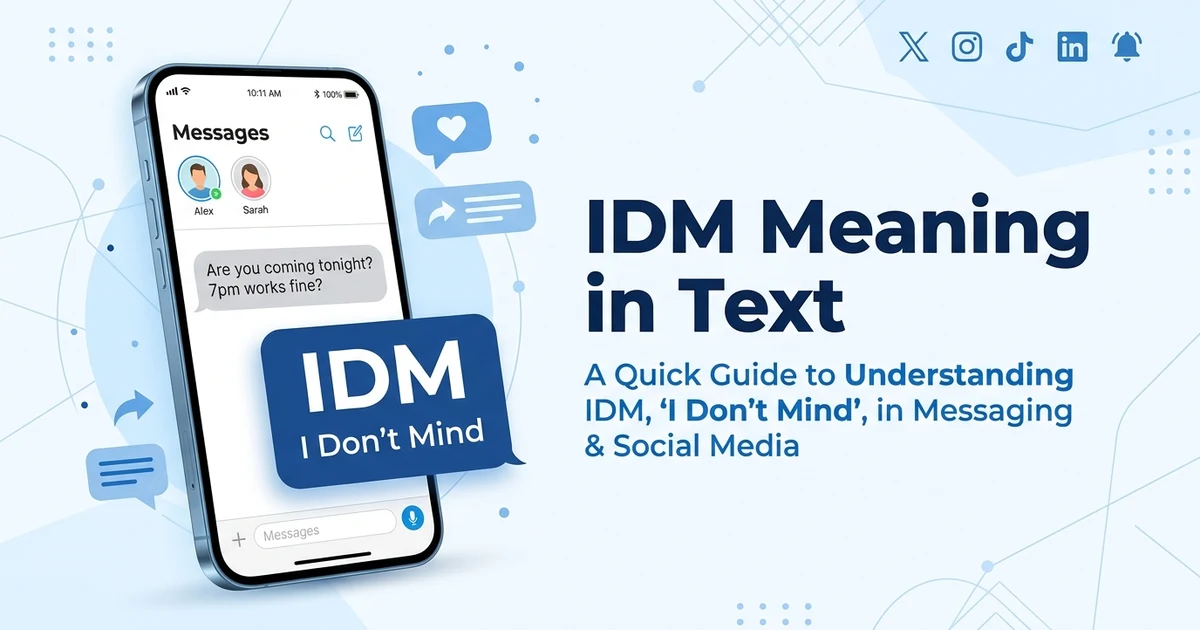
Knowing what IDM means in text is only part of the story. You also need to understand when it fits naturally into a conversation.
People usually use IDM in relaxed chats with friends, family members, classmates, coworkers they know well, and people they interact with on social media. It helps keep messages short while expressing uncertainty or flexibility.
For example, imagine two friends are trying to decide where to eat.
Friend 1: Want pizza tonight?
Friend 2: IDM. You can choose.
Here, IDM tells the other person that either option is fine.
You can also use it when someone asks for your opinion but you genuinely have no strong preference.
Examples include:
- Which movie should we watch?
IDM. Pick your favorite. - Should we meet at 5 or 6?
IDM. Both work for me. - Do you want coffee or tea?
IDM. I’ll drink either.
In each example, IDM politely shows flexibility without making the conversation longer.
However, avoid using IDM in professional emails, school assignments, business reports, or formal conversations. Writing the full phrase sounds much more professional in those situations.
Examples of IDM in Text Conversations
Seeing IDM used in context makes it much easier to understand.
Example 1
Alex: Do you want to sit inside or outside?
Taylor: IDM. It’s nice either way.
Meaning: Taylor has no preference.
Example 2
Mom: Pasta or tacos for dinner?
Child: IDM. Both sound good.
Meaning: Either meal is acceptable.
Example 3
Friend: Should we play basketball or soccer?
You: IDM. Whatever everyone wants.
Meaning: You are happy with either activity.
Example 4
Coworker: Should we schedule the meeting today or tomorrow?
You: I don’t mind. Tomorrow may work better for everyone.
Although the full phrase is used here instead of IDM, the meaning is exactly the same.
Example 5
Friend: Blue shirt or black shirt?
You: IDM. They both look great.
This shows that you do not have a strong opinion.
Common Situations Where People Use IDM
IDM appears in many everyday conversations, especially when someone wants to avoid making a decision.
Some common situations include:
- Choosing a restaurant.
- Deciding what movie to watch.
- Picking a meeting time.
- Selecting a game to play.
- Planning weekend activities.
- Choosing between two products.
- Deciding where to sit.
- Agreeing with a group decision.
Because it expresses flexibility, IDM helps conversations move forward without unnecessary debate.
Similar Texting Abbreviations
Many texting abbreviations express opinions or reactions. Some have meanings similar to IDM, while others serve completely different purposes.
| Term | Meaning | Best Use | Example |
|---|---|---|---|
| IDM | I Don’t Mind | Showing no preference | IDM, you choose. |
| IDC | I Don’t Care | Showing little interest or concern | IDC what movie we watch. |
| IMO | In My Opinion | Sharing a personal opinion | IMO, the first option is better. |
| IMHO | In My Humble Opinion | Giving an opinion politely | IMHO, this phone is worth buying. |
| TBH | To Be Honest | Being honest or direct | TBH, I liked the first one more. |
| NVM | Never Mind | Canceling a previous thought | NVM, I figured it out. |
Although IDM and IDC may seem similar, they create different impressions.
I don’t mind sounds polite and cooperative.
I don’t care can sometimes sound rude or uninterested depending on the conversation.
Because of this difference, many people prefer using IDM when they want to sound friendly.
Common Mistakes
People often misunderstand IDM because it has several meanings outside texting.
Here are the most common mistakes.
Confusing IDM with Internet Download Manager
Many people search for IDM expecting information about the popular download software. If you’re reading a text message, however, IDM almost always means I Don’t Mind, not the software.
Assuming It Means I Don’t Care
These phrases are similar but not identical.
- I don’t mind means either choice is fine.
- I don’t care can suggest that something is unimportant.
Using the wrong one may unintentionally sound dismissive.
Using IDM in Formal Writing
IDM works well in casual conversations but looks unprofessional in emails, reports, essays, or business communication.
Instead, write:
- I don’t mind.
- Either option works for me.
- I have no preference.
These full sentences are clearer and more appropriate in formal settings.
Conclusion
The most common IDM meaning in text is I Don’t Mind. It is a friendly texting abbreviation used to show that you have no preference between two or more choices. You will often see it in text messages, social media chats, online conversations, and group discussions.
Since IDM has other meanings in technology, business, and education, always consider the context before deciding what it means. In casual texting, though, I Don’t Mind is almost always the correct interpretation. Using it appropriately can make your conversations shorter, more natural, and more polite.
FAQs
What does IDM mean in text?
IDM most commonly means I Don’t Mind. It tells someone that you are happy with any option or decision.
Is IDM the same as IDC?
No. IDM means I Don’t Mind, while IDC means I Don’t Care. IDM sounds more polite and shows flexibility, whereas IDC can sound uninterested depending on the situation.
Can IDM have more than one meaning?
Yes. Besides I Don’t Mind, IDM can also refer to Internet Download Manager, Identity Management, Integrated Disease Management, and other terms. The correct meaning depends on the context.
Is IDM used on Snapchat and Instagram?
Yes. People commonly use IDM in chats on Snapchat, Instagram, WhatsApp, Messenger, Discord, and other messaging platforms to say they have no preference.
Should I use IDM in professional emails?
No. It is better to write I don’t mind or Either option works for me in professional communication because abbreviations may appear too casual.
Why do people use IDM instead of writing I don’t mind?
People use IDM because it saves time and makes texting faster. Like many internet abbreviations, it helps keep conversations short while still conveying the intended meaning.
Does IDM always mean I Don’t Mind?
No. While I Don’t Mind is the most common meaning in text messages, the abbreviation can represent different phrases in technology, healthcare, business, and education. Always read it within the context of the conversation.