Introduction
When people search for idioms for loud, they usually want better ways to describe noisy people, strong sounds, shouting, or attention-grabbing voices. They may also wonder whether expressions like “loud as thunder,” “make a racket,” or “raise the roof” are idioms, metaphors, similes, or just descriptive phrases.
This confusion makes sense. Idioms and metaphors both use figurative language. They help writers and speakers say something in a more colorful way than plain literal words. But they do not work in exactly the same way.
The core difference is simple: an idiom is a fixed expression whose meaning is not always clear from the individual words, while a metaphor compares one thing to another without using “like” or “as.”
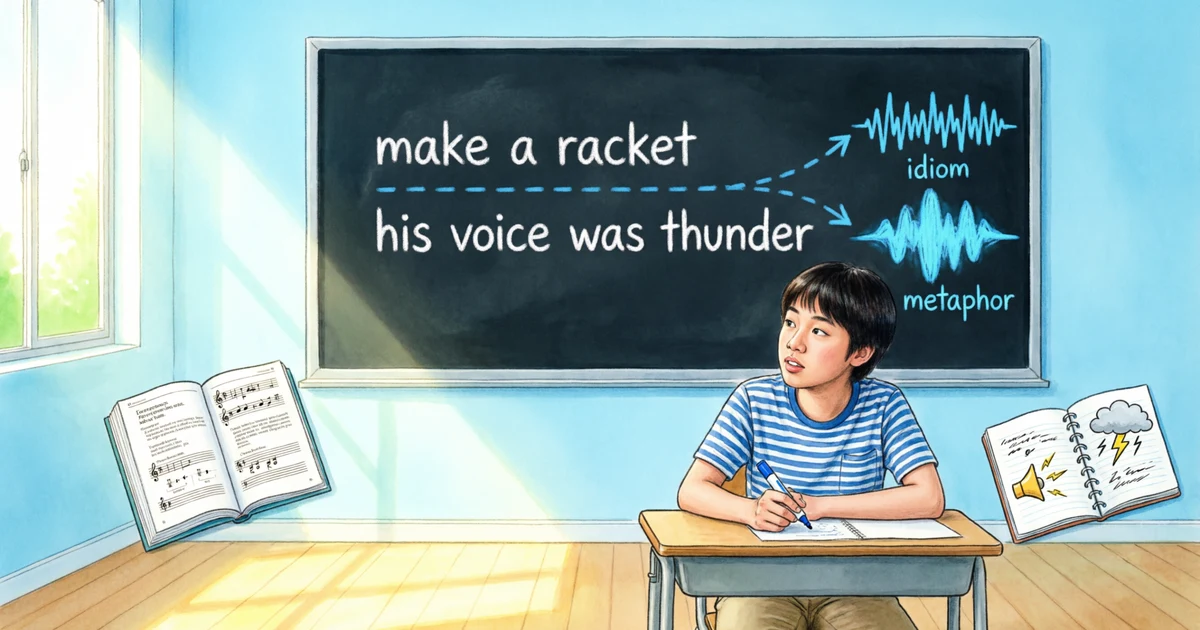
So, when you describe someone as “all bark and no bite,” you use an idiom. When you say “his voice was thunder,” you use a metaphor. Both can describe loudness, but they do it differently.
This guide explains idioms and metaphors in simple language, with examples focused on loud sounds, loud people, noisy places, and strong voices.
What Idioms Mean
An idiom is a common expression with a meaning that cannot always be understood by looking at each word separately. Native speakers often understand idioms because they have heard them many times.
For example, “make a racket” means to make a lot of noise. The word racket can mean noise, but the full phrase works as a common expression. It sounds natural in everyday English.
Purpose: Idioms make speech and writing sound more natural, expressive, and familiar.
How it works: An idiom usually has a fixed or semi-fixed wording. You cannot always change the words freely without making it sound strange.
Example:
The children were making a racket in the hallway.
Why it gets confused with metaphors: Many idioms use imagery. Since imagery often feels metaphorical, learners may think every idiom is a metaphor. Some idioms do contain metaphor, but not all of them work as direct metaphors.
What Metaphors Mean
A metaphor is a figure of speech that describes one thing as if it were another thing. It creates a comparison without using like or as.
For example, “Her voice was a siren” compares her voice to a siren. The sentence does not mean her voice literally became a siren. It means her voice was loud, sharp, and impossible to ignore.
Purpose: Metaphors help readers imagine an idea more clearly, emotionally, or creatively.
How it works: A metaphor connects two things that are different but share one important quality.
Example:
His laugh was thunder across the room.
Why it gets confused with idioms: Some metaphors become common expressions over time. When many people use the same metaphor in the same way, it may begin to feel idiomatic.
Idioms vs Metaphors: The Core Difference
The main difference is that idioms depend on accepted usage, while metaphors depend on comparison.
An idiom works because people in a language community already know what it means. A metaphor works because the reader can see the comparison.
For example:
“Raise the roof” is an idiom. It means to make a lot of noise, celebrate loudly, or cheer with energy.
“The crowd was a storm” is a metaphor. It compares the crowd to a storm to show noise, movement, and force.
Both can describe something loud, but they use different methods.
Quick Comparison Table
| Point | Idiom | Metaphor |
|---|---|---|
| Definition | A common expression with a meaning beyond the exact words | A comparison that says one thing is another thing |
| Scope | Usually fixed and familiar | Can be familiar or completely original |
| Purpose | Makes language sound natural, expressive, or conversational | Creates a strong image or deeper meaning |
| Length | Often short phrases | Can be a phrase, sentence, or extended image |
| Structure | Usually set wording | Flexible and creative |
| Meaning | Often learned as a whole expression | Understood through comparison |
| Use in writing | Common in dialogue, informal writing, essays, and explanations | Common in poetry, fiction, speeches, and descriptive writing |
| Example | The fans raised the roof. | The stadium was a volcano of sound. |
How Idioms Work
Idioms work because speakers agree on their meaning through repeated use. The words may not explain the full meaning by themselves.
Take the idiom “loud and clear.” It does not only mean something has high volume and clarity. It often means a message was fully understood.
Example:
I hear you loud and clear.
This sentence usually means “I understand you completely.” It may not refer to actual sound at all.
That is how idioms can surprise learners. A phrase may include a sound-related word like loud, but the real meaning may relate to understanding, confidence, complaint, or attention.
Common idioms related to loudness include:
Make a racket
Meaning: to make a lot of noise
Example: The neighbors made a racket all night.
Raise the roof
Meaning: to cheer, shout, or celebrate loudly
Example: The crowd raised the roof when the band came on stage.
Loud and clear
Meaning: very clearly understood
Example: Your message came through loud and clear.
At the top of your lungs
Meaning: as loudly as possible
Example: She screamed at the top of her lungs.
Make some noise
Meaning: cheer, clap, shout, or show excitement
Example: The host asked the audience to make some noise.
How Metaphors Work
Metaphors work by creating a direct comparison. They do not need fixed wording. A writer can invent a metaphor for a specific situation.
For loudness, metaphors often compare sounds to powerful things, such as:
- thunder
- storms
- explosions
- sirens
- drums
- waves
- engines
- bells
For example:
His voice was thunder.
This metaphor suggests that his voice was deep, loud, and powerful. It creates a stronger image than simply saying “His voice was loud.”
Another example:
The classroom became a beehive.
This does not only suggest noise. It may also suggest movement, busyness, and restless energy.
Metaphors give writers more freedom than idioms. You can create a new metaphor as long as the comparison makes sense.
Key Differences in Simple Language
An idiom is something people already say. A metaphor is something people may create to make a comparison.
An idiom often needs cultural or language knowledge. A metaphor often needs imagination.
An idiom may not make sense word by word. A metaphor usually makes sense when you understand the shared quality between the two things.
For example:
The kids were making a racket.
This is idiomatic and natural. It means the kids were noisy.
The kids were a thunderstorm in the living room.
This is metaphorical. It compares the kids’ noise and energy to a thunderstorm.
The idiom sounds more everyday. The metaphor sounds more creative and descriptive.
Can Idioms and Metaphors Overlap?
Yes, idioms and metaphors can overlap.
Some idioms are built from metaphorical ideas. For example, “raise the roof” does not mean people literally lift a roof. It creates the image of noise so loud that it could push the roof upward. That image is metaphorical, but the phrase also works as an idiom because it has a widely accepted meaning.
Another example is “all bark and no bite.” This idiom compares a person to a dog that makes noise but does not attack. It means someone sounds threatening but does not act. The expression is idiomatic, but it also contains metaphorical comparison.
So, the best way to think about it is this:
All idioms are fixed expressions, and some idioms use metaphor. But not every metaphor is an idiom.
Examples of Idioms for Loud
Here are useful idioms and idiomatic expressions related to loudness, noise, shouting, and strong sound.
Make a racket
Meaning: to make a lot of noise
Example: The workers made a racket while repairing the roof.
Best use: everyday speech and informal writing
Raise the roof
Meaning: to make a lot of noise through cheering, singing, or celebration
Example: The fans raised the roof after the final goal.
Best use: concerts, sports, parties, celebrations
At the top of your lungs
Meaning: as loudly as you can
Example: He called for help at the top of his lungs.
Best use: shouting, screaming, calling, singing
Loud and clear
Meaning: clearly heard or clearly understood
Example: I got your message loud and clear.
Best use: communication, instructions, warnings
Make some noise
Meaning: cheer, clap, shout, or show excitement
Example: The singer told the crowd to make some noise.
Best use: performances, public events, audience interaction
Blow your own trumpet
Meaning: to talk proudly and loudly about your own achievements
Example: He is always blowing his own trumpet at work.
Best use: personality description, criticism, informal speech
All bark and no bite
Meaning: someone sounds aggressive or threatening but does not actually do much
Example: Do not worry about his shouting. He is all bark and no bite.
Best use: describing loud but harmless people
Examples of Metaphors for Loud
These examples describe loud sounds through comparison.
His voice was thunder
Meaning: his voice sounded deep, powerful, and loud
Example: His voice was thunder in the quiet hall.
The room was a storm of noise
Meaning: the room was full of loud, chaotic sound
Example: By lunchtime, the cafeteria was a storm of noise.
Her scream was a siren
Meaning: her scream was sharp, loud, and alarming
Example: Her scream was a siren in the dark street.
The applause was a wave
Meaning: the applause grew, moved, or surrounded the space like a wave
Example: The applause was a wave rolling through the theater.
The drums were a heartbeat
Meaning: the drums were strong, regular, and powerful
Example: The drums were a heartbeat under the singer’s voice.
The city was an engine
Meaning: the city sounded busy, loud, and constant
Example: At dawn, the city was already an engine.
Idioms vs Metaphors in Literature and Writing
Writers use idioms and metaphors for different effects.
Idioms often make writing sound natural. They work well in dialogue because real people use idioms when they speak. A character who says “Stop making a racket” sounds casual and believable.
Metaphors often make writing more vivid. They help readers feel the sound instead of only knowing that it exists. A sentence like “The crowd was a volcano of sound” creates a stronger picture than “The crowd was very loud.”
In literature, metaphors usually carry more emotional or symbolic weight. A loud sound may represent fear, power, anger, celebration, chaos, or danger.
Compare these two sentences:
Idiom: The crowd raised the roof.
This sounds energetic and familiar.
Metaphor: The crowd became a living storm.
This sounds dramatic and visual.
Both describe loudness, but they create different tones.
Idioms vs Metaphors for Students and ESL Learners
Students and ESL learners often confuse idioms and metaphors because both move beyond literal meaning. The best way to separate them is to ask two questions.
First, ask: Is this a common expression that people usually say in this form?
If yes, it may be an idiom.
Second, ask: Does it directly compare one thing to another?
If yes, it may be a metaphor.
For example:
“Make a racket” is a common expression. It is an idiom.
“His voice was thunder” directly compares a voice to thunder. It is a metaphor.
ESL learners should also remember that idioms are harder to translate word for word. A phrase like “raise the roof” may sound strange in another language if translated literally. Metaphors can also be difficult, but they often become clearer when you identify the comparison.
Common Mistakes and Confusion
Mistake 1: Thinking every colorful phrase is an idiom
Not every creative phrase is an idiom. “The room exploded with noise” is figurative, but it may work more like a metaphor or hyperbole than a fixed idiom.
Mistake 2: Calling every comparison a metaphor
A comparison with like or as is usually a simile, not a metaphor.
Loud as thunder is a simile.
His voice was thunder is a metaphor.
Mistake 3: Taking idioms literally
If someone says “I hear you loud and clear,” they may not be talking about volume. They usually mean they understand the message.
Mistake 4: Using idioms in the wrong tone
Some idioms sound casual. For example, “make a racket” works well in conversation, but it may sound too informal in a serious academic essay.
Mistake 5: Overusing metaphors
One strong metaphor can improve writing. Too many metaphors can make a paragraph feel heavy or confusing.
When to Use Idioms and When to Use Metaphors
Use idioms when you want natural, familiar, everyday English.
Good situations for idioms:
- dialogue
- informal writing
- personal essays
- blog posts
- simple explanations
- conversational descriptions
Example:
The upstairs neighbors made a racket until midnight.
Use metaphors when you want stronger imagery, emotion, or literary effect.
Good situations for metaphors:
- stories
- poems
- speeches
- creative descriptions
- dramatic scenes
- reflective writing
Example:
The upstairs noise was a drumbeat against the ceiling.
For ESL learners, idioms help you sound more fluent. For writers, metaphors help you sound more vivid and original.
Related Terms People Often Confuse with Idioms and Metaphors
Simile
A simile compares two things using like or as.
Example: Her voice was as loud as thunder.
This is not a metaphor because it uses as.
Hyperbole
Hyperbole means exaggeration for effect.
Example: The music was loud enough to wake the whole city.
The sentence probably is not literally true. It exaggerates the loudness.
Figurative language
Figurative language is the broad category. Idioms, metaphors, similes, and hyperbole all fit inside it.
Personification
Personification gives human qualities to non-human things.
Example: The siren screamed through the night.
A siren does not literally scream like a person, but the word creates a human-like image.
Cliché
A cliché is an expression used so often that it feels unoriginal.
Some idioms can become clichés if writers rely on them too much.
Conclusion
Idioms and metaphors both help us describe loud sounds in more interesting ways, but they work differently.
An idiom is a common expression with a learned meaning, such as “make a racket” or “raise the roof.” A metaphor creates a direct comparison, such as “his voice was thunder” or “the room was a storm of noise.”
The easiest rule is this: idioms are fixed expressions, while metaphors are comparisons. Some idioms include metaphorical ideas, so they can overlap. Still, not every idiom is a metaphor, and not every metaphor is an idiom.
For students and ESL learners, idioms build fluency. For writers, metaphors build imagery. When you understand both, you can describe loudness with more accuracy, style, and confidence.
FAQs
What are some common idioms for loud?
Common idioms for loud include make a racket, raise the roof, at the top of your lungs, loud and clear, and make some noise. Each one describes noise, shouting, cheering, or clear communication in a natural way.
Is “loud as thunder” an idiom or a metaphor?
“Loud as thunder” is usually a simile because it uses as to make a comparison. A metaphor version would be “His voice was thunder.”
Is “raise the roof” an idiom?
Yes. “Raise the roof” is an idiom. It means to make a lot of noise, usually by cheering, singing, celebrating, or reacting with excitement.
What is a metaphor for a loud voice?
A good metaphor for a loud voice is “His voice was thunder.” It compares the voice to thunder to show power, volume, and force.
Can an idiom also be a metaphor?
Yes, some idioms contain metaphorical ideas. “All bark and no bite” is an idiom, but it also uses a comparison to describe someone who sounds threatening without taking action.
Which is better for writing, idioms or metaphors?
It depends on your purpose. Use idioms for natural, conversational writing. Use metaphors for vivid, creative, or emotional writing.
Why do ESL learners confuse idioms and metaphors?
ESL learners confuse them because both use non-literal meaning. Idioms usually need memorization, while metaphors need understanding of the comparison.