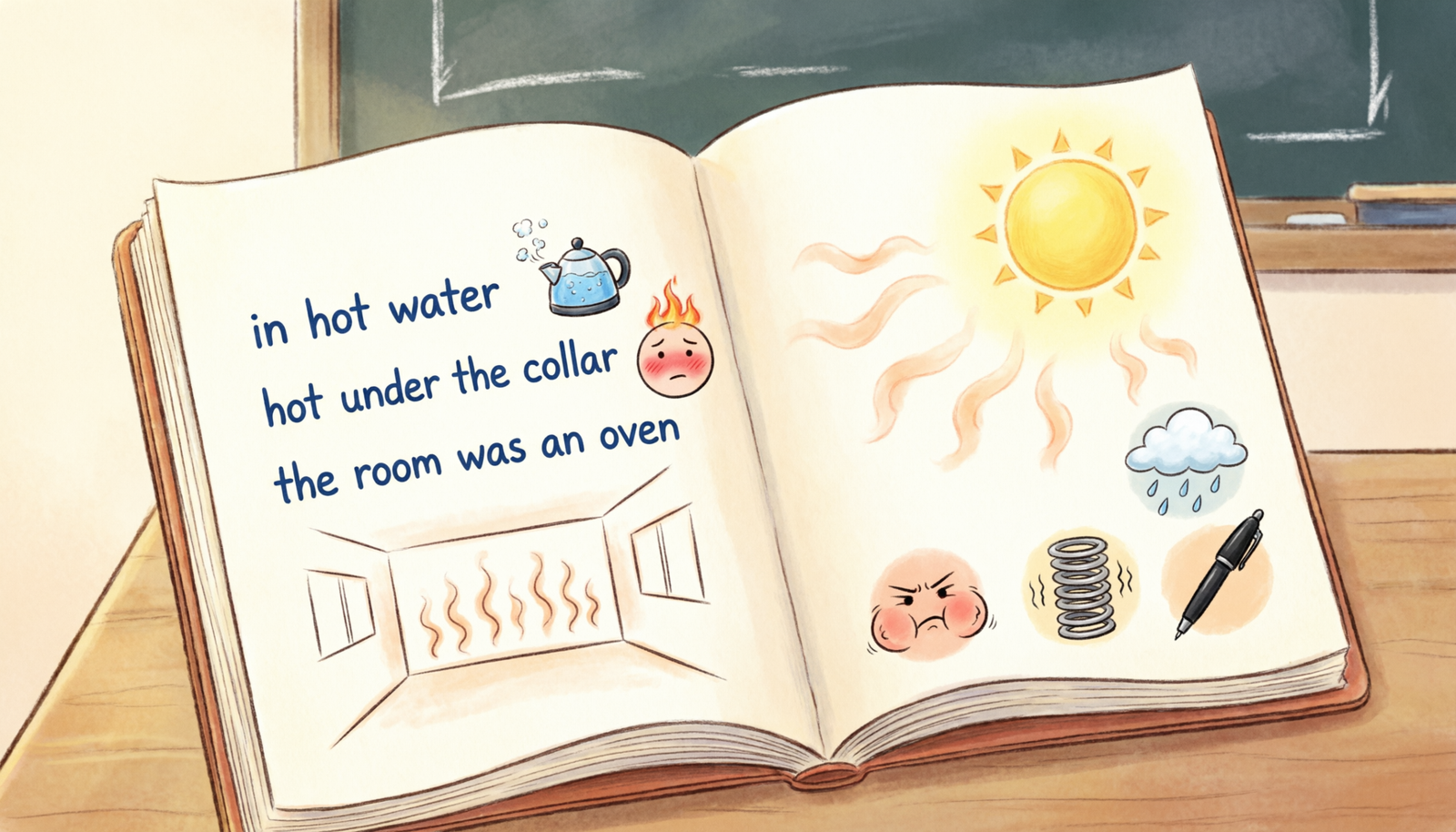
English has many colorful ways to describe heat. You can say a day is hot, but you can also say it is blazing hot, like an oven, a scorcher, or hot enough to fry an egg. These expressions help writers, students, and ESL learners describe temperature, weather, food, emotions, pressure, and even popularity in a more natural way.
The phrase idioms for hot usually refers to fixed expressions that use “hot” or describe heat in a figurative way. But learners often confuse idioms with related terms such as metaphors, similes, and slang expressions. The difference matters because each one works a little differently in writing and conversation.
The core difference is simple: an idiom has a meaning that may not be clear from the individual words, while a metaphor compares one thing to another directly to create a stronger image. Some hot expressions are idioms. Others are metaphors, similes, or simple descriptive phrases.
What Idioms for Hot Mean
Idioms for hot are fixed or common expressions that describe heat, warm weather, strong emotion, pressure, anger, trouble, or popularity in a figurative way.
An idiom does not always mean exactly what its words say. For example, “in hot water” does not mean someone is standing in warm water. It means the person is in trouble.
Simple definition:
An idiom for hot is a common expression related to heat that has a special meaning beyond the literal words.
Purpose:
Idioms make speech and writing more natural, expressive, and culturally familiar.
How it works:
An idiom uses a familiar phrase, but the full meaning comes from common usage, not from the literal meaning of each word.
Short natural example:
“She forgot the report, so now she’s in hot water with her manager.”
Why it gets confused with metaphors:
Many hot idioms create images in the reader’s mind, just like metaphors do. The difference is that idioms are usually fixed phrases, while metaphors can be original or flexible.
What “Hot Metaphors” Mean
Hot metaphors describe heat by saying one thing is another thing, usually to create a vivid image. A metaphor does not use “like” or “as.” It makes a direct comparison.
For example, “The room was an oven” does not mean the room was literally an oven. It means the room felt extremely hot.
Simple definition:
A hot metaphor is a direct comparison that describes heat by turning one thing into another image.
Purpose:
Metaphors help writers make heat feel more vivid, emotional, or dramatic.
How it works:
A metaphor connects heat to another object, place, or experience, such as fire, an oven, a furnace, or burning metal.
Short natural example:
“By noon, the city was a furnace.”
Why it gets confused with idioms:
Some metaphors become so common that people start using them like idioms. For example, “the room was an oven” feels familiar enough that many learners may call it an idiom, even though it works as a metaphor.
Idioms for Hot vs Hot Metaphors: The Core Difference
The main difference is that idioms are common fixed expressions with accepted meanings, while metaphors are comparisons that create imagery.
An idiom like “in hot water” means “in trouble.” You cannot understand it fully by looking only at the words. A metaphor like “the sidewalk was a frying pan” creates a mental picture of extreme heat. You can understand it through comparison.
So, if you want a phrase that native speakers already recognize, use a hot idiom. If you want strong description or creative writing, use a hot metaphor.
Quick Comparison Table
| Point | Idioms for Hot | Hot Metaphors |
|---|---|---|
| Definition | Common expressions related to heat with special meanings | Direct comparisons that describe heat through imagery |
| Scope | Often used in speech, casual writing, and everyday English | Often used in creative writing, description, poetry, and storytelling |
| Purpose | To express ideas naturally and idiomatically | To make heat feel vivid, emotional, or visual |
| Length | Usually short fixed phrases | Can be short or extended |
| Structure | Often fixed or semi-fixed | More flexible and creative |
| Meaning | May be figurative and not obvious from the words | Usually understood through comparison |
| Use in writing | Good for dialogue, essays, explanations, and informal tone | Good for descriptive, literary, and narrative writing |
| Example | “He’s in hot water.” | “The room was an oven.” |
How Idioms for Hot Work
Idioms for hot work by connecting the idea of heat with other meanings. Heat often suggests discomfort, pressure, danger, anger, speed, excitement, or popularity. English uses these ideas in many everyday expressions.
For example, “hot under the collar” means angry or irritated. The phrase connects anger with the physical feeling of becoming warm or flushed.
Another idiom, “hot off the press,” means very recent or just published. It comes from the idea of printed material being fresh from the printing press.
Here are some common meanings behind hot idioms:
| Heat Idea | Figurative Meaning | Example |
|---|---|---|
| Heat as trouble | Someone faces a problem | “He’s in hot water.” |
| Heat as anger | Someone feels irritated | “She got hot under the collar.” |
| Heat as freshness | Something is new or recent | “Here’s the news, hot off the press.” |
| Heat as popularity | Something is trendy or wanted | “That song is hot right now.” |
| Heat as pressure | Someone faces intense stress | “The team felt the heat before the final.” |
Idioms work best when the situation matches the accepted meaning. You should not change them too much because idioms often sound strange when rewritten.
For example, say:
“She is in hot water.”
Do not say:
“She is inside warm water with her boss.”
The second sentence changes the idiom and loses the meaning.
How Hot Metaphors Work
Hot metaphors work by turning heat into a strong image. Instead of saying “It was very hot,” a writer may say, “The afternoon was a furnace.” This makes the heat feel stronger and more physical.
Metaphors give writing energy because they help readers feel the experience, not just understand it.
Common images in hot metaphors include:
| Image | Meaning |
|---|---|
| Oven | A closed, extremely hot space |
| Furnace | Intense, burning heat |
| Fire | Heat, passion, anger, danger, or energy |
| Desert | Dry, harsh heat |
| Boiling pot | Pressure, anger, or rising tension |
| Burning sun | Strong sunlight and heat |
A hot metaphor can describe weather:
“The playground was a skillet under the afternoon sun.”
It can describe emotion:
“His anger was a fire spreading through the room.”
It can describe pressure:
“The final exam turned the classroom into a pressure cooker.”
Unlike idioms, metaphors allow more creativity. You can create your own, as long as the comparison makes sense.
Key Differences in Simple Language
Idioms for hot and hot metaphors both use heat, but they do not do the same job.
An idiom works like a ready-made phrase. Native speakers already know its meaning. For example, “in hot water” means “in trouble.”
A metaphor works like a picture. It helps the reader imagine heat or intensity. For example, “The kitchen was a volcano” shows extreme heat and energy.
Idioms focus more on accepted meaning. Metaphors focus more on imagery.
Idioms often appear in everyday conversation. Metaphors often appear in stories, poems, essays, speeches, and descriptive paragraphs.
Can Idioms for Hot and Hot Metaphors Overlap?
Yes, they can overlap.
Some expressions begin as metaphors but become common enough to feel idiomatic. For example, “feel the heat” can work as an idiom meaning “feel pressure or criticism.” It also creates a heat image, so it has a metaphorical quality.
Another example is “hot topic.” It does not mean the topic has a high temperature. It means people are actively discussing it, often with strong opinions. This expression works like an idiom because people use it in a fixed way.
Overlap happens because idioms, metaphors, and figurative language often share the same source images. Heat naturally connects with pressure, anger, danger, excitement, and energy, so many expressions use the same idea in different ways.
Examples of Idioms for Hot
Here are common idioms and expressions related to hot, with simple meanings and natural examples.
1. In hot water
Meaning: In trouble.
Example:
“He missed the deadline, so he’s in hot water with his teacher.”
2. Hot under the collar
Meaning: Angry, annoyed, or embarrassed.
Example:
“My dad got hot under the collar when he saw the broken window.”
3. Hot off the press
Meaning: Very new, fresh, or recently announced.
Example:
“The results are hot off the press.”
4. Feel the heat
Meaning: Feel pressure, criticism, or stress.
Example:
“The coach started to feel the heat after three losses.”
5. Take the heat
Meaning: Accept blame, pressure, or criticism.
Example:
“She took the heat for the team’s mistake.”
6. Hot topic
Meaning: A subject many people are discussing.
Example:
“Artificial intelligence is a hot topic in schools.”
7. Hot property
Meaning: Someone or something very popular or in demand.
Example:
“That young actor is hot property right now.”
8. Hot seat
Meaning: A difficult position where someone faces questions or pressure.
Example:
“The manager was in the hot seat during the meeting.”
9. Strike while the iron is hot
Meaning: Act at the right moment, while the chance is still good.
Example:
“The offer may not last, so strike while the iron is hot.”
10. Hot and bothered
Meaning: Upset, nervous, flustered, or physically uncomfortable.
Example:
“She got hot and bothered before her presentation.”
11. Too hot to handle
Meaning: Too difficult, dangerous, attractive, or controversial to deal with.
Example:
“The scandal became too hot to handle.”
12. A hot mess
Meaning: A person or situation that looks chaotic, confused, or poorly organized.
Example:
“My notes were a hot mess before I rewrote them.”
13. Hot on someone’s heels
Meaning: Very close behind someone.
Example:
“The second runner was hot on her heels.”
14. Hot stuff
Meaning: Someone or something impressive, exciting, attractive, or talented.
Example:
“He thinks he’s hot stuff after winning one match.”
15. Sell like hotcakes
Meaning: Sell very quickly.
Example:
“The new phone sold like hotcakes.”
Examples of Hot Metaphors
Hot metaphors describe heat or intensity through direct comparison. These examples work well in creative writing, descriptions, and essays.
1. The room was an oven.
Meaning: The room was extremely hot.
Example:
“After the air conditioner broke, the room was an oven.”
2. The city was a furnace.
Meaning: The city felt intensely hot.
Example:
“By afternoon, the city was a furnace of traffic and sunlight.”
3. The sun was a burning coin in the sky.
Meaning: The sun looked small, bright, and painfully hot.
Example:
“The sun was a burning coin in the sky above the empty road.”
4. The classroom became a pressure cooker.
Meaning: The classroom felt tense, stressful, or overheated.
Example:
“During the exam, the classroom became a pressure cooker.”
5. His anger was a wildfire.
Meaning: His anger spread quickly and strongly.
Example:
“His anger was a wildfire, burning through every calm word.”
6. The pavement was a griddle.
Meaning: The pavement was extremely hot.
Example:
“At noon, the pavement was a griddle under our shoes.”
7. Her cheeks were small flames.
Meaning: Her cheeks looked red from heat, embarrassment, or emotion.
Example:
“After the compliment, her cheeks were small flames.”
8. The kitchen was a volcano.
Meaning: The kitchen was full of heat, noise, and activity.
Example:
“Before dinner, the kitchen was a volcano of steam and shouting.”
9. The afternoon was a blanket of fire.
Meaning: The heat felt heavy and inescapable.
Example:
“The afternoon was a blanket of fire over the village.”
10. The debate was a boiling pot.
Meaning: The debate was intense and full of rising emotion.
Example:
“The debate was a boiling pot by the final question.”
Idioms for Hot vs Hot Metaphors in Literature and Writing
In literature, hot idioms and hot metaphors both add expression, but writers use them for different effects.
Idioms make characters sound natural. A character might say, “I’m in hot water now,” and the reader immediately understands the trouble. This works well in dialogue because real people often use idioms in speech.
Metaphors create stronger imagery. A narrator might write, “The desert was a furnace without walls.” This does more than tell the reader the desert was hot. It creates atmosphere, mood, and sensory detail.
In essays, idioms can make writing sound conversational, but too many idioms may weaken a formal tone. Metaphors can improve descriptive writing, but unclear metaphors may confuse readers.
For school writing, use idioms when you want natural expression. Use metaphors when you want vivid description or literary effect.
Idioms for Hot vs Hot Metaphors for Students and ESL Learners
Students and ESL learners often find hot idioms confusing because many of them do not describe real temperature.
For example, “hot topic” means an important or widely discussed subject. It does not mean the subject feels warm. “In hot water” means in trouble, not in a bathtub.
Hot metaphors can feel easier because they usually create a clear picture. If someone says, “The room was an oven,” most learners understand that the room was extremely hot.
Here is a simple learning rule:
Use idioms when the phrase has a known figurative meaning.
Use metaphors when the phrase compares heat to something else for description.
For ESL learners, the best approach is to learn idioms as whole phrases. Do not translate them word by word. For metaphors, focus on the image and ask, “What feeling or idea does this comparison create?”
Common Mistakes and Confusion
Mistake 1: Taking idioms literally
A learner may hear “He is in hot water” and think the person is actually in water. The real meaning is that he is in trouble.
Mistake 2: Calling every hot expression an idiom
Not every phrase about heat is an idiom. “The room was an oven” is a metaphor. “Hot weather” is literal. “As hot as fire” is a simile.
Mistake 3: Changing fixed idioms too much
Idioms usually have set wording. For example, “strike while the iron is hot” should not become “hit while the metal is warm.” That version sounds unnatural and loses the idiom.
Mistake 4: Using idioms in very formal writing
Idioms can sound casual. In academic writing, use them carefully. Instead of “The company was in hot water,” you might write, “The company faced serious criticism.”
Mistake 5: Mixing metaphor and idiom labels
Some expressions can fit more than one category. Do not worry too much about labels at first. Focus on meaning, usage, and context.
When to Use Idioms for Hot and When to Use Hot Metaphors
Use idioms for hot when you want natural English, especially in conversation, informal essays, blog writing, dialogue, and everyday examples.
Good situations for hot idioms include:
- talking about trouble: “in hot water”
- describing anger: “hot under the collar”
- discussing pressure: “feel the heat”
- describing popularity: “hot topic”
- talking about timing: “strike while the iron is hot”
Use hot metaphors when you want vivid description, mood, emotion, or sensory detail.
Good situations for hot metaphors include:
- describing weather in a story
- creating a strong image in poetry
- showing tension in a scene
- making an essay introduction more memorable
- describing anger, pressure, or excitement
For example:
Idiom:
“The mayor is in hot water after the announcement.”
Metaphor:
“The announcement lit a fire across the city.”
Both use heat, but the first gives a common meaning. The second creates a dramatic image.
Related Terms People Often Confuse With Them
Simile
A simile compares two things using like or as.
Example:
“The room was as hot as an oven.”
This is not a metaphor because it uses “as.” It is also not a strong idiom unless people use it as a common expression.
Literal description
A literal description means exactly what it says.
Example:
“The soup is hot.”
This sentence does not use an idiom or metaphor. It simply describes temperature.
Slang
Slang uses informal words or meanings. “Hot” can mean attractive, exciting, stolen, or popular, depending on context.
Example:
“That jacket is hot.”
This may mean the jacket looks stylish, not that it has a high temperature.
Hyperbole
Hyperbole means exaggeration for effect.
Example:
“It’s hot enough to melt my shoes.”
The speaker does not mean the shoes will really melt. The sentence exaggerates the heat.
Personification
Personification gives human actions or qualities to non-human things.
Example:
“The heat chased us indoors.”
Heat cannot literally chase people, but the sentence makes the heat feel active and powerful.
Symbolism
Symbolism uses something concrete to represent a deeper idea. Heat can symbolize passion, anger, danger, pressure, desire, or change.
Example:
“In the story, the summer heat represents rising tension in the family.”
Conclusion
Idioms for hot and hot metaphors both make English more expressive, but they work in different ways. Hot idioms are common expressions with accepted meanings, such as “in hot water,” “hot under the collar,” and “hot off the press.” They help learners sound more natural and fluent.
Hot metaphors create vivid images by comparing heat to something else, such as “The room was an oven” or “The city was a furnace.” They help writers describe weather, emotion, pressure, and atmosphere more powerfully.
For students and ESL learners, the easiest rule is this: learn idioms as fixed phrases, and use metaphors to create images. When you understand both, you can describe heat, anger, pressure, popularity, and intensity with more confidence and style.
FAQs
What are idioms for hot?
Idioms for hot are common expressions that use heat-related words in a figurative way. Examples include “in hot water,” “hot under the collar,” “hot off the press,” and “feel the heat.”
Is “in hot water” an idiom?
Yes. “In hot water” is an idiom that means someone is in trouble. It does not usually refer to real hot water.
Is “the room was an oven” an idiom or a metaphor?
“The room was an oven” is mainly a metaphor because it directly compares the room to an oven. It means the room felt extremely hot.
What is a simple idiom for very hot weather?
A common expression is “It’s a scorcher.” You can also say “It’s hot enough to fry an egg,” which uses exaggeration to describe extreme heat.
Can “hot” mean popular?
Yes. In informal English, “hot” can mean popular, trendy, exciting, or in demand. For example, “That song is hot right now” means the song is very popular.
What is the difference between a hot idiom and a hot simile?
A hot idiom has a special accepted meaning, such as “in hot water.” A hot simile compares heat using like or as, such as “as hot as fire.”
Should ESL learners memorize hot idioms?
Yes, but they should memorize them as complete phrases. Idioms often do not make sense word by word, so learning the full phrase with an example helps much more.