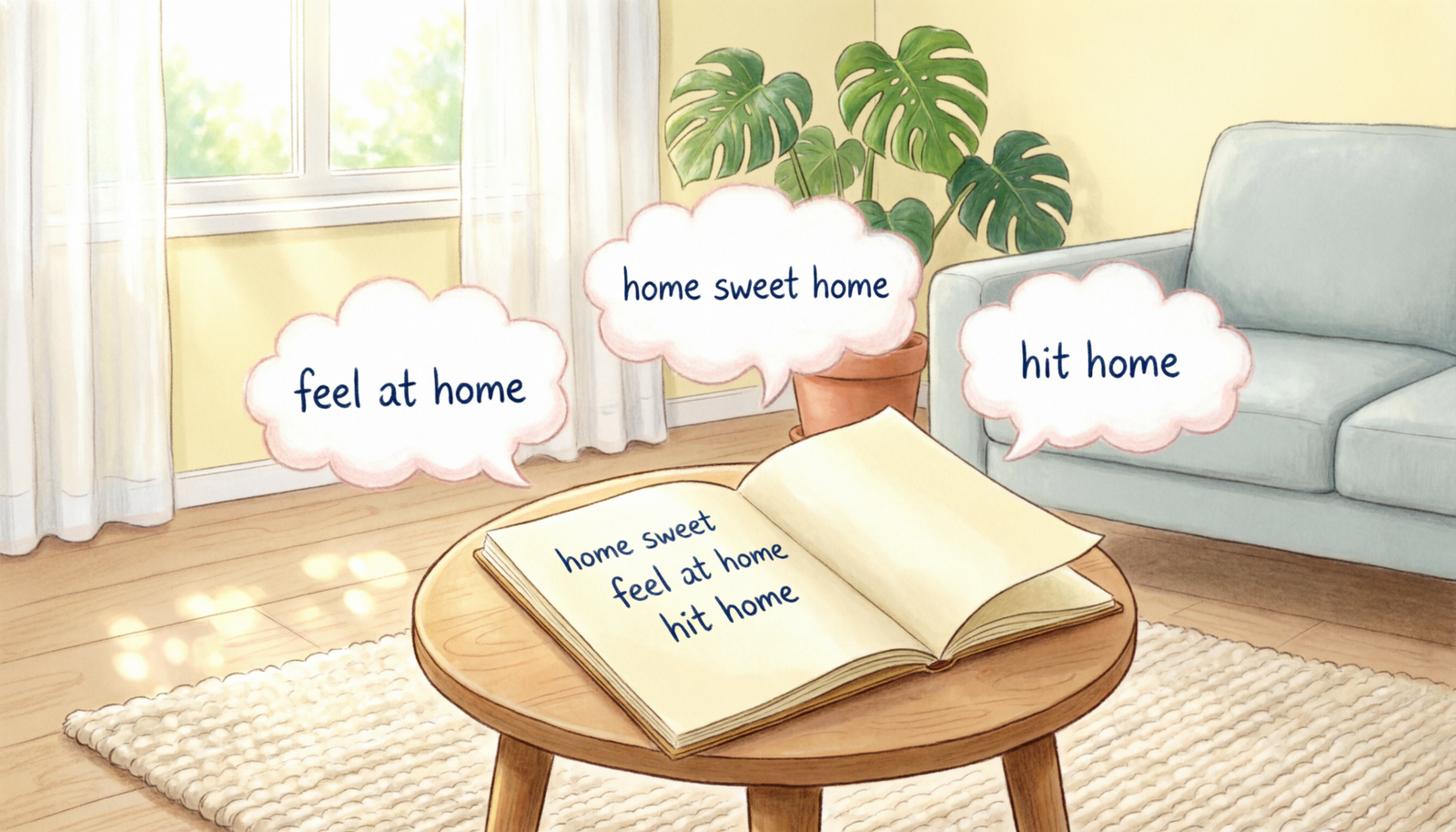
Home is one of the most common topics in English. People talk about home when they describe comfort, family, safety, belonging, privacy, memories, and even responsibility. Because home carries so much emotional meaning, English has many idioms for home.
Some expressions are true idioms, such as “home sweet home” or “make yourself at home.” Others are simple home-related phrases, such as “go home,” “stay at home,” or “a family home.” Students and ESL learners often confuse these because both use the word home, but they do not work in the same way.
The simple difference is this: an idiom has a meaning that is not always literal, while a home-related phrase usually means exactly what the words say. For example, “bring something home” can mean “help someone understand something clearly,” not physically carry something to a house. That makes it idiomatic.
This guide explains idioms and home-related phrases, shows how they overlap, and gives practical examples you can use in speaking, writing, and revision.
What Idioms Mean
An idiom is a fixed expression whose meaning is different from, or deeper than, the literal meaning of its words.
Simple definition
An idiom is a group of words with a special meaning that people understand as a whole.
Purpose
Idioms make language sound more natural, expressive, and memorable. They can show emotion, attitude, culture, humor, or experience in a short phrase.
How it works
An idiom works because people recognize the expression and understand its accepted meaning. You usually cannot translate it word for word or change its wording too much.
Short natural example
After three weeks of travel, I finally said, “Home sweet home.”
Here, “home sweet home” means the speaker feels happy, safe, and comfortable to be back home.
Why idioms get confused with home-related phrases
Idioms often include ordinary words like home, house, door, or roof, so learners may think every expression with those words is an idiom. That is not true. Some are literal phrases, while others carry figurative meaning.
What Home-Related Phrases Mean
A home-related phrase is any phrase that talks about home, houses, family life, or where someone lives. It may be literal or descriptive rather than idiomatic.
Simple definition
A home-related phrase is a normal expression about living spaces, family homes, or the act of going or being home.
Purpose
Home-related phrases help people talk clearly about location, family life, daily routines, property, comfort, or personal space.
How it works
Most home-related phrases mean exactly what the words say. For example, “stay at home” means remain at home. “move home” means change where you live.
Short natural example
I stayed at home because it was raining.
This sentence is literal. The speaker remained in their home.
Why home-related phrases get confused with idioms
Some home phrases sound emotional or familiar, so learners may assume they are idioms. But an expression only becomes an idiom when its full meaning goes beyond the literal meaning of the words.
Idioms vs Home-Related Phrases: The Core Difference
The core difference is literal meaning vs figurative or special meaning.
A home-related phrase often talks directly about a real place, such as a house, apartment, or family home. An idiom for home may use home as a symbol of comfort, belonging, understanding, or personal identity.
For example:
Literal phrase:
I went home after school.
This means the person physically went to their home.
Idiom:
The teacher’s example really brought the lesson home.
This does not mean the lesson went to a house. It means the example made the lesson clear and meaningful.
So, home-related phrases are broader, because they include any phrase about home. Idioms for home are narrower, because they must have a special or figurative meaning.
Quick Comparison Table
| Point | Idioms for Home | Home-Related Phrases |
|---|---|---|
| Definition | Fixed expressions with special or figurative meanings connected to home | Normal phrases that talk about home, houses, or living |
| Scope | Narrower | Broader |
| Purpose | To express comfort, belonging, understanding, privacy, or emotion in a vivid way | To describe location, daily life, family, or housing clearly |
| Length | Usually short fixed expressions | Can be short or long |
| Structure | Often fixed; changing words can sound unnatural | More flexible |
| Meaning | Often figurative or emotional | Usually literal and direct |
| Use in writing | Good for creative writing, dialogue, essays, and natural speech | Good for clear description and everyday communication |
| Example | Make yourself at home | Stay at home |
How Idioms for Home Work
Idioms for home often use home as more than a physical place. In English, home can suggest safety, comfort, belonging, family, identity, or a place where someone feels accepted.
For example, “feel at home” does not always mean you are inside your own house. You can feel at home in a classroom, a city, a workplace, or a group of people. The idiom means you feel comfortable and accepted there.
Example
She felt at home in the new school after only one week.
The sentence does not mean the school became her house. It means she felt relaxed and welcome.
Home idioms also help writers show emotion quickly. Instead of saying, “He felt safe, comfortable, and accepted,” a writer can say, “He finally felt at home.” That short idiom carries a warm emotional meaning.
How Home-Related Phrases Work
Home-related phrases usually describe real actions, places, or situations. They help readers understand where someone is, where someone lives, or what kind of home life someone has.
For example:
They bought their first home last year.
This sentence talks about a real home. It does not use figurative meaning. The phrase “first home” means the first property or place they bought to live in.
Home-related phrases can still feel emotional, but they do not always count as idioms. A sentence can be clear, warm, and meaningful without being idiomatic.
Example
My childhood home was near a small park.
This phrase gives literal information about a place from the speaker’s past.
Key Differences in Simple Language
The easiest way to separate the two is to ask one question:
Does the phrase mean exactly what the words say?
If yes, it is probably a normal home-related phrase.
If no, it may be an idiom.
Look at these examples:
“Go home” means physically go to your home. It is a phrase.
“Hit home” means affect someone deeply or make someone understand something clearly. It is an idiom.
“A home address” means the address of your home. It is a phrase.
“Bring it home” can mean finish strongly, succeed, or make a point clear. It is often idiomatic.
In short, home-related phrases are direct, while idioms for home are often symbolic, emotional, or figurative.
Can Idioms and Home-Related Phrases Overlap?
Yes, they can overlap.
Some expressions are about home and also have idiomatic meaning. These are home idioms.
For example:
Make yourself at home.
This phrase includes the word home, and it has an idiomatic meaning. It does not mean the guest should turn the place into their own house. It means the guest should relax and feel comfortable.
Another example:
Charity begins at home.
This idiom uses home to mean one’s family or close circle. It teaches that people should care for those near them before trying to help others far away.
The overlap happens when a phrase uses home-related words but carries a meaning beyond the literal idea of a house.
Examples of Idioms for Home
Here are useful idioms for home with meanings and natural examples.
1. Home sweet home
Meaning: A warm expression people use when they are happy to return home.
Example:
After a long flight, I opened the door and said, “Home sweet home.”
2. Make yourself at home
Meaning: Relax and feel comfortable, usually said to a guest.
Example:
Come in, take a seat, and make yourself at home.
3. Feel at home
Meaning: Feel comfortable, accepted, or relaxed in a place or situation.
Example:
The friendly staff made me feel at home right away.
4. Hit home
Meaning: Affect someone deeply or make someone realize the truth.
Example:
Her words hit home because I knew she was right.
5. Bring something home
Meaning: Make something clear, powerful, or easy to understand.
Example:
The final example brought the message home for the whole class.
6. Close to home
Meaning: Personally sensitive or emotionally connected to someone’s life.
Example:
The story felt close to home because my family had faced the same problem.
7. Nothing to write home about
Meaning: Not special, impressive, or exciting.
Example:
The food was fine, but it was nothing to write home about.
8. Home away from home
Meaning: A place where someone feels as comfortable as they do at home.
Example:
That small café became my home away from home during college.
9. Bring home the bacon
Meaning: Earn money to support yourself or your family.
Example:
She works hard every day to bring home the bacon.
10. The lights are on, but nobody’s home
Meaning: Someone seems confused, unaware, or not thinking clearly.
Example:
He stared at the question like the lights were on, but nobody was home.
Examples of Home-Related Phrases
These phrases use the idea of home, but most of them are literal rather than idiomatic.
1. Go home
Meaning: Travel or return to your home.
Example:
I usually go home at five.
2. Stay at home
Meaning: Remain in your home.
Example:
We decided to stay at home this weekend.
3. Work from home
Meaning: Do your job from your home instead of an office.
Example:
My brother works from home three days a week.
4. Family home
Meaning: A home where a family lives or lived.
Example:
They sold their family home after twenty years.
5. Childhood home
Meaning: The home where someone lived as a child.
Example:
I visited my childhood home last summer.
6. Dream home
Meaning: The ideal home someone wants to live in.
Example:
They finally built their dream home near the lake.
7. Home address
Meaning: The address where someone lives.
Example:
Please write your home address on the form.
8. Home life
Meaning: Someone’s life at home, especially with family.
Example:
Her home life was quiet and peaceful.
9. Home town
Meaning: The town where someone was born or grew up.
Example:
He returned to his home town after graduation.
10. Home cooking
Meaning: Food cooked at home, often simple and comforting.
Example:
I missed my mother’s home cooking while I was away.
Idioms vs Home-Related Phrases in Literature and Writing
In literature and creative writing, home often becomes a symbol. Writers use home to represent safety, memory, identity, family, loss, or belonging. This symbolic meaning makes home idioms especially useful.
For example:
The old library became a home away from home for Maya.
This sentence tells us more than where Maya spent time. It suggests comfort, attachment, and emotional safety.
A home-related phrase, however, gives clearer factual information:
Maya walked home after school.
This sentence moves the story forward. It tells us what Maya did, but it does not carry the same symbolic weight.
Writers often use both. Literal home phrases create setting and action. Home idioms add emotional depth.
A student writing a story might use a literal phrase first:
He returned to his childhood home.
Then the student might add an idiom:
But the place no longer felt like home.
Together, these lines show both physical return and emotional change.
Idioms vs Home-Related Phrases for Students and ESL Learners
Students and ESL learners should learn the difference because it affects comprehension, vocabulary, and writing style.
When you see the word home, do not automatically translate the whole phrase word by word. First, check whether the expression makes literal sense.
For example:
I brought my books home.
This is literal. The speaker carried books to their home.
The speaker brought the issue home to the audience.
This is idiomatic. The speaker made the issue clear or emotionally powerful.
In essays, idioms can make writing more natural, but students should use them carefully. Too many idioms can make formal writing sound casual. In everyday speech, stories, personal essays, and dialogue, home idioms often work very well.
For ESL learners, the best method is to learn idioms as complete expressions. Do not memorize only the word home. Learn the whole phrase, its meaning, and one example sentence.
Common Mistakes and Confusion
Mistake 1: Thinking every phrase with “home” is an idiom
Not every home expression is idiomatic. “Go home” and “home address” are usually literal phrases.
Mistake 2: Translating idioms word for word
Idioms often lose meaning when translated directly. “Hit home” does not mean someone hit a house. It means something affected someone deeply or made a point clear.
Mistake 3: Changing fixed idioms too much
Many idioms sound natural only in their usual form. For example, English speakers say “make yourself at home,” not usually “make yourself in home.”
Mistake 4: Using casual idioms in very formal writing
Some idioms, such as “bring home the bacon,” sound informal. They work better in conversation, blog writing, stories, and casual essays than in academic papers.
Mistake 5: Confusing “house” and “home”
A house is usually a building. A home is the place where someone lives or feels they belong. This difference matters because many idioms use home for emotional meaning.
When to Use Idioms and When to Use Home-Related Phrases
Use idioms for home when you want to sound natural, expressive, emotional, or conversational.
Good places to use them include:
Personal essays, stories, dialogue, speeches, blog posts, captions, and informal explanations.
Example:
After months in a busy city, the quiet village felt like a home away from home.
Use home-related phrases when you need clear, direct meaning.
Good places to use them include:
Instructions, forms, reports, simple descriptions, school writing, and factual communication.
Example:
Please include your home address and phone number.
In simple terms, choose an idiom when you want expression. Choose a normal phrase when you want direct information.
Related Terms People Often Confuse With Them
Phrase
A phrase is a small group of words that works together. It may be literal or idiomatic.
Example: at home
Expression
An expression is a common way of saying something. Idioms are one type of expression, but not all expressions are idioms.
Example: welcome home
Saying
A saying is a familiar sentence or phrase that often gives advice or wisdom.
Example: Charity begins at home.
Proverb
A proverb is a short traditional saying that teaches a lesson.
Example: East or west, home is best.
Metaphor
A metaphor compares one thing to another directly. Some home idioms can feel metaphorical because home often represents comfort or belonging.
Example: That classroom was my safe harbor.
Literal language
Literal language means exactly what the words say.
Example: I went home after dinner.
Figurative language
Figurative language uses words in a non-literal way to create meaning, emotion, or imagery.
Example: Her speech hit home.
Conclusion
Idioms for home help English speakers express comfort, belonging, emotion, understanding, and personal connection. They are different from normal home-related phrases because idioms often carry a special or figurative meaning.
The main difference is simple: home-related phrases usually mean exactly what they say, while home idioms often mean something deeper. A phrase like “stay at home” is literal. An idiom like “feel at home” can describe comfort in any place, not just someone’s house.
For students, writers, and ESL learners, the best approach is to learn each idiom as a complete expression. Study the meaning, notice the context, and use idioms when they make your writing or speaking clearer, warmer, or more natural.
FAQs
1. What are idioms for home?
Idioms for home are expressions that use the idea of home to express comfort, belonging, understanding, family, or personal feeling. Examples include “home sweet home,” “make yourself at home,” and “hit home.”
2. Is “home sweet home” an idiom?
Yes. “Home sweet home” is an idiom because it means more than the literal words. People use it to express happiness, comfort, or relief when they return home.
3. What is the difference between a home idiom and a home phrase?
A home idiom has a special or figurative meaning. A home phrase usually has a direct meaning. “Go home” is a phrase. “Hit home” is an idiom.
4. Can “home” be symbolic in writing?
Yes. In writing, home can symbolize safety, memory, identity, family, comfort, or belonging. Writers often use home idioms to add emotional meaning.
5. Are idioms for home useful for ESL learners?
Yes. Home idioms appear often in conversation, stories, movies, articles, and everyday English. ESL learners should learn them as full expressions instead of translating each word separately.
6. Is “work from home” an idiom?
No, “work from home” is usually a literal phrase. It means someone does their job from home instead of an office.
7. What does “hit home” mean?
“Hit home” means something affects someone deeply or makes them understand something clearly. For example, “The warning hit home” means the warning felt serious or personally meaningful.