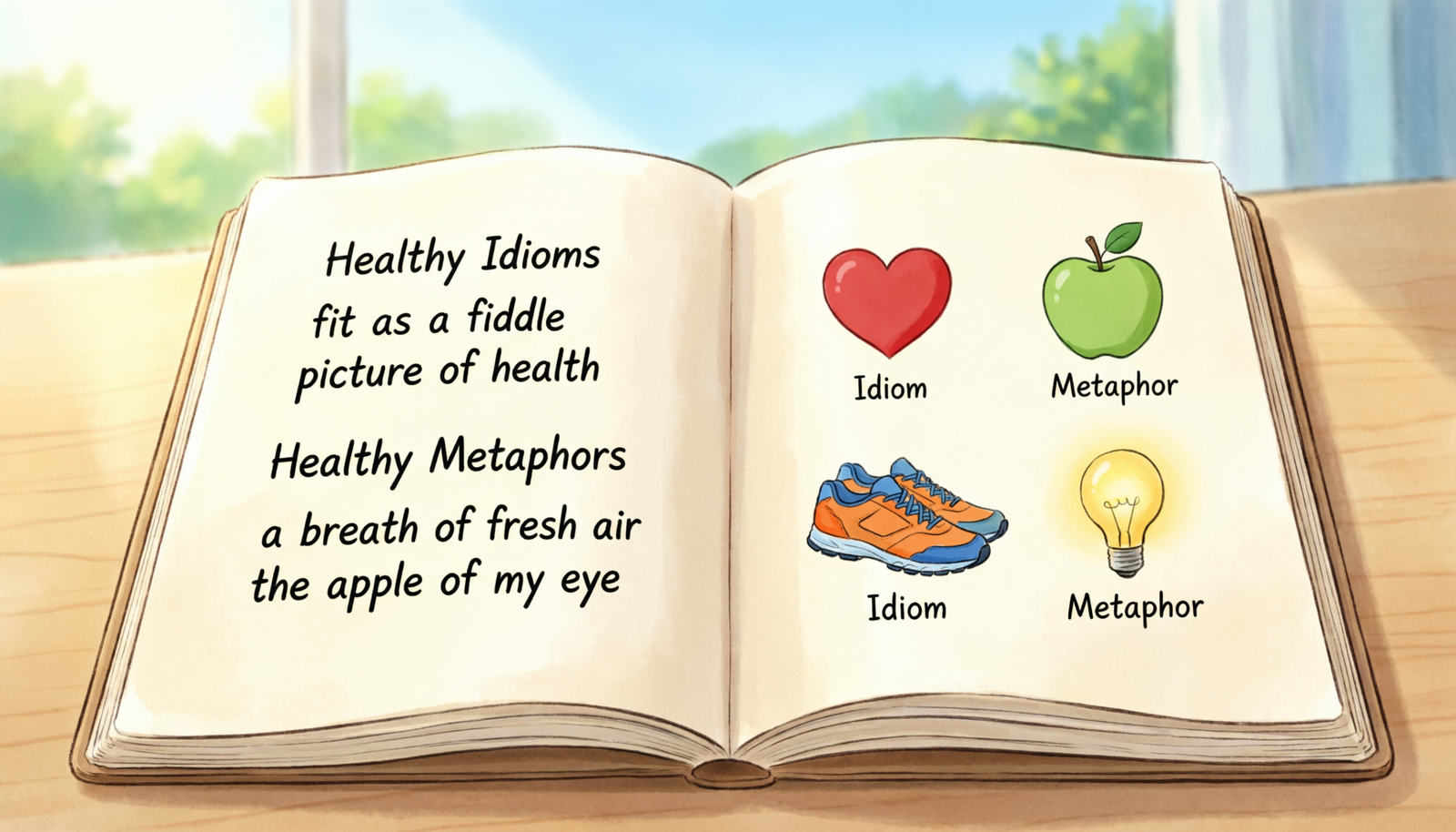
When people search for idioms for healthy, they often want more than a list of expressions. They want to know how to describe good health in natural, vivid English. They may also wonder whether phrases like fit as a fiddle, in good shape, or a picture of health are idioms, metaphors, or just common expressions.
The simple answer is this: an idiom is a fixed expression whose meaning is not always clear from the individual words, while a metaphor compares one thing to another to create a clear image or idea.
Some health expressions work as idioms. Others work more like metaphors. A few can overlap. This guide explains the difference in simple language, with examples for students, writers, and ESL learners.
What Idioms for Healthy Mean
An idiom for healthy is a fixed or common phrase used to describe someone who is well, strong, energetic, or physically fit.
Idioms often have meanings that go beyond the literal words. For example, fit as a fiddle does not mean a person looks like a musical instrument. It means the person is very healthy or in excellent physical condition.
Simple definition:
An idiom for healthy is a common expression that means someone is well, strong, fit, or full of energy.
Purpose:
Idioms make speech and writing sound natural, conversational, and expressive.
How it works:
An idiom works as a ready-made phrase. You usually use it in its normal form because changing the words can make it sound strange.
Short example:
After months of exercise, Maya felt fit as a fiddle.
Why it gets confused with metaphor:
Many idioms use imagery, so they can feel metaphorical. Still, idioms are usually fixed expressions that people already recognize.
What Metaphors for Healthy Mean
A metaphor for healthy describes health by comparing it to something else, often something strong, bright, fresh, or full of life.
For example, if someone says, His energy was a bright flame, they do not mean there is a real flame inside him. They mean his health or energy feels strong and alive.
Simple definition:
A metaphor for healthy compares health, strength, or vitality to another image or idea.
Purpose:
Metaphors help readers imagine health more vividly. Writers use them to create mood, emotion, and meaning.
How it works:
A metaphor says or suggests that one thing is another thing. It does not use “like” or “as” in a direct comparison.
Short example:
Her recovery was a fresh spring morning after a long winter.
Why it gets confused with idiom:
Some common metaphors become familiar expressions over time. When people use them often enough, they may start to feel like idioms.
Idioms for Healthy vs Metaphors for Healthy: The Core Difference
The core difference is simple:
Idioms for healthy are common fixed expressions. Metaphors for healthy are creative comparisons.
An idiom usually belongs to everyday language. You learn it as a phrase. A metaphor can be original and flexible. A writer can create a new metaphor to describe health, strength, recovery, or energy.
For example:
Idiom:
He is fit as a fiddle.
Metaphor:
His body was a well-tuned engine.
The idiom is a familiar phrase. The metaphor creates an image of the body working smoothly and powerfully.
Quick Comparison Table
| Point | Idioms for Healthy | Metaphors for Healthy |
|---|---|---|
| Definition | Fixed expressions that mean someone is healthy, fit, or well | Comparisons that describe health through another image or idea |
| Scope | Narrower because idioms are usually set phrases | Broader because metaphors can be common or original |
| Purpose | To sound natural, conversational, and expressive | To create imagery, mood, and deeper meaning |
| Length | Usually short phrases | Can be short, extended, or part of a larger description |
| Structure | Often fixed and hard to change | Flexible and creative |
| Meaning | Often figurative and learned as a whole phrase | Based on comparison between two ideas |
| Use in writing | Good for dialogue, informal writing, essays, and explanations | Good for stories, poems, speeches, and descriptive writing |
| Example | She is in the pink. | Her strength was a deep-rooted tree. |
How Idioms for Healthy Work
Idioms work because speakers share a common understanding of the phrase. The words may not explain the meaning directly, but the expression has a known meaning in the language.
Take this idiom:
In good shape
Literally, “shape” can mean form or outline. In health-related English, in good shape means physically fit, healthy, or well prepared.
Example:
He exercises every morning, so he is in good shape.
Some idioms for healthy sound very informal. Others sound slightly old-fashioned or literary. For example, hale and hearty means strong and healthy, but it sounds more traditional than healthy and fit.
Common idioms for healthy include:
| Idiom | Meaning | Example |
|---|---|---|
| Fit as a fiddle | Very healthy and physically fit | Grandpa is 80, but he is still fit as a fiddle. |
| In good shape | Fit, healthy, or physically prepared | She is in good shape after training all summer. |
| Alive and well | Still active, healthy, or successful | The old tradition is alive and well. |
| Hale and hearty | Strong and healthy, often used for older people | He looked hale and hearty after his holiday. |
| In the pink | In excellent health | After a week of rest, she was in the pink. |
| Full of beans | Energetic and lively | The children were full of beans after breakfast. |
| As right as rain | Feeling well again | I was sick yesterday, but now I feel as right as rain. |
Idioms help ESL learners sound more natural, but they also require care. Some idioms are informal, regional, or old-fashioned. Writers should match the idiom to the audience and tone.
How Metaphors for Healthy Work
Metaphors work through comparison. They describe health by connecting it to something readers already understand.
A writer might compare a healthy person to:
- a strong tree
- a bright flame
- a clean river
- a well-oiled machine
- spring after winter
- sunlight returning after a storm
For example:
Her body was a well-oiled machine after years of disciplined training.
This metaphor suggests strength, balance, and smooth function. It does more than say “she was healthy.” It gives the reader a picture.
Metaphors can describe physical health, emotional health, recovery, energy, or inner strength.
Examples:
| Metaphor | Meaning | Example |
|---|---|---|
| A well-oiled machine | A body or system that works smoothly | After training, his body was a well-oiled machine. |
| A bright flame | Strong energy or vitality | Her spirit was a bright flame after recovery. |
| A deep-rooted tree | Strength and stability | His health was a deep-rooted tree, steady and strong. |
| A fresh spring morning | Renewal and recovery | After treatment, each day felt like a fresh spring morning. |
| A clear river | Clean, balanced health | Her mind and body felt like a clear river. |
Metaphors work especially well in creative writing because they allow writers to show health instead of simply naming it.
Key Differences in Simple Language
Idioms and metaphors both use figurative language, but they do not work in the same way.
An idiom is something people already say. A metaphor is something a writer can create.
An idiom often has a fixed form. A metaphor has more room for originality.
An idiom can sound natural in conversation. A metaphor can sound poetic, dramatic, or descriptive.
For example:
Idiomatic:
She is in good shape.
Metaphorical:
Her strength was sunlight returning to a dark room.
The idiom gives a quick meaning. The metaphor creates an emotional image.
Can Idioms for Healthy and Metaphors for Healthy Overlap?
Yes, idioms and metaphors can overlap.
Some idioms began as metaphors. Over time, people repeated them so often that they became fixed expressions. Fit as a fiddle is a good example. It uses comparison, but people now treat it as an idiom because it has a familiar, fixed meaning.
Another example is a picture of health. This phrase compares a healthy person to a picture that perfectly represents health. It works metaphorically, but it also functions as a common expression.
So the overlap looks like this:
All idioms are not metaphors, but some idioms contain metaphorical imagery.
For learners, the safest way to separate them is to ask:
Is this a fixed phrase people commonly use?
Then it is probably an idiom.
Is this a comparison that creates an image?
Then it is probably a metaphor.
Can it do both?
Yes, especially when the phrase is familiar and image-based.
Examples of Idioms for Healthy
Here are practical idioms for healthy, with meanings and examples.
1. Fit as a fiddle
Meaning: Very healthy and physically fit.
Example:
After joining the hiking club, Daniel became fit as a fiddle.
This idiom sounds cheerful and conversational. It works well in everyday speech, but it may feel slightly informal in academic writing.
2. In good shape
Meaning: Healthy, fit, or physically ready.
Example:
The team is in good shape before the final match.
This phrase can describe people, bodies, plans, businesses, or objects. Context tells the reader whether it refers to health or condition.
3. In the pink
Meaning: In excellent health.
Example:
She looked tired last month, but now she is in the pink.
This idiom sounds more old-fashioned in some places, so use it carefully.
4. Hale and hearty
Meaning: Strong, healthy, and full of life.
Example:
At ninety, he remained hale and hearty.
This expression often describes older people who are still strong and healthy.
5. As right as rain
Meaning: Fully well again after feeling ill or tired.
Example:
Take a nap, and you will feel as right as rain.
This idiom works well in friendly conversation.
6. Full of beans
Meaning: Energetic, lively, and active.
Example:
The puppy was full of beans after breakfast.
This idiom describes energy more than medical health.
7. Alive and kicking
Meaning: Still active, lively, or doing well.
Example:
After a difficult year, the small business is still alive and kicking.
This idiom can describe people, traditions, projects, or organizations.
Examples of Metaphors for Healthy
Metaphors for healthy often appear in creative writing, speeches, wellness writing, and descriptive essays.
1. Her body was a well-oiled machine
Meaning: Her body worked smoothly, strongly, and efficiently.
Example:
After months of training, her body was a well-oiled machine.
This metaphor suggests discipline, movement, and physical control.
2. His strength was a deep-rooted tree
Meaning: His strength felt stable, natural, and lasting.
Example:
Even after illness, his strength was a deep-rooted tree.
This metaphor works well in literary or reflective writing.
3. Her energy was a bright flame
Meaning: She had strong, visible energy.
Example:
After recovery, her energy was a bright flame in every room she entered.
This metaphor suggests warmth, vitality, and presence.
4. Recovery was a spring morning
Meaning: Recovery felt fresh, hopeful, and new.
Example:
After the long treatment, recovery was a spring morning.
This metaphor connects health with renewal.
5. His lungs were open windows
Meaning: He breathed freely and easily.
Example:
After weeks of rest, his lungs felt like open windows.
This metaphor gives a strong sensory image.
6. Her health was a clear river
Meaning: Her health felt clean, balanced, and flowing.
Example:
With better sleep and food, her health became a clear river again.
This metaphor works best in poetic or reflective writing.
Idioms for Healthy vs Metaphors for Healthy in Literature and Writing
In literature, idioms and metaphors serve different purposes.
Writers use idioms to make characters sound natural. Idioms can reveal personality, region, age, and tone. A character who says, “I’m as right as rain now” sounds casual and friendly.
Writers use metaphors to build imagery and theme. A metaphor can connect health with nature, light, machines, seasons, or movement. It can also show emotional recovery, not just physical wellness.
Compare these two sentences:
Idiom:
After two days of rest, I felt as right as rain.
Metaphor:
After two days of rest, my body felt like a garden after rain.
The idiom sounds familiar and direct. The metaphor feels more descriptive and personal.
In essays, idioms can help when the tone allows natural expression. In poems, stories, and speeches, metaphors often add more depth.
Idioms for Healthy vs Metaphors for Healthy for Students and ESL Learners
Students and ESL learners often confuse idioms and metaphors because both are figurative. The difference becomes easier when you focus on form and use.
An idiom is usually something you memorize as a phrase. You should learn its exact meaning and normal context.
A metaphor is something you understand through comparison. You can study common metaphors, but you can also create your own.
For ESL learners, idioms can be tricky because the meaning may not come from the words alone. For example, in the pink does not clearly mean “healthy” unless someone teaches you the phrase.
Metaphors can also confuse learners, but they often make sense if the image is clear. Her energy was a bright flame suggests warmth, brightness, and life.
A simple learning rule:
Use idioms when you want natural everyday English.
Use metaphors when you want a strong image or creative description.
Common Mistakes and Confusion
Mistake 1: Treating every figurative phrase as an idiom
Not every figurative phrase is an idiom. A phrase can be metaphorical without being a fixed idiom.
Example:
His health was a mountain.
This is a metaphor, not a common idiom.
Mistake 2: Changing idioms too much
Idioms often sound strange when you change their words.
Natural:
She is fit as a fiddle.
Unnatural:
She is fit as a guitar.
A creative writer may change idioms on purpose, but learners should first use the standard form.
Mistake 3: Using old-fashioned idioms in modern casual writing
Some idioms still make sense but sound dated in many contexts.
For example, in the pink is correct, but in good shape sounds more common and modern.
Mistake 4: Using metaphors that do not match the meaning
A health metaphor should create the right image. If the image suggests weakness, danger, or sickness, it may confuse readers.
Weak metaphor:
His health was a broken ladder.
This suggests damage, not wellness.
Stronger metaphor:
His health was a strong bridge.
This suggests support and stability.
Mistake 5: Using idioms in very formal writing without checking tone
In academic or medical writing, clear direct language often works better than idioms.
Informal:
The patient felt as right as rain.
Formal:
The patient reported that she felt well.
When to Use Idioms for Healthy and When to Use Metaphors for Healthy
Use idioms for healthy when you want your language to sound natural, friendly, or conversational.
Good places to use health idioms:
- informal essays
- dialogue
- blog posts
- everyday conversation
- ESL speaking practice
- captions or light descriptions
Example:
After a week of sleep and good food, I felt as right as rain.
Use metaphors for healthy when you want to create a strong image, emotional tone, or literary effect.
Good places to use health metaphors:
- stories
- poems
- speeches
- personal essays
- descriptive writing
- reflective paragraphs
Example:
After months of recovery, her body became a house with every window open to the sun.
Use direct language when clarity matters most.
Better for medical or formal contexts:
He is healthy and physically active.
Better for creative writing:
His health was a steady flame.
Or, Better for casual speech:
He is in good shape.
Related Terms People Often Confuse With Them
Simile
A simile compares two things using like or as.
Example:
She felt as fresh as spring air.
Some idioms contain similes, such as fit as a fiddle and as right as rain.
Figurative language
Figurative language is the broad category. Idioms, metaphors, similes, personification, and symbolism all belong to it.
Expression
An expression is any common phrase. Some expressions are idioms, but not all expressions are idiomatic.
Cliché
A cliché is an overused phrase. Some idioms can feel cliché if writers use them too often.
Example:
Fit as a fiddle is useful, but it may sound predictable in serious creative writing.
Symbolism
Symbolism uses an object, color, image, or action to represent a larger idea.
Example:
Spring can symbolize recovery, renewal, and health.
Analogy
An analogy explains one idea by comparing it with another in more detail.
Example:
A healthy body is like a well-run city: every system has a role, and balance keeps everything working.
Conclusion
Idioms for healthy and metaphors for healthy both make language more expressive, but they do different jobs.
An idiom for healthy is a common fixed phrase, such as fit as a fiddle, in good shape, or as right as rain. It helps you sound natural and fluent.
A metaphor for healthy creates a comparison, such as her body was a well-oiled machine or his strength was a deep-rooted tree. It helps you create imagery, emotion, and depth.
For students and ESL learners, the easiest rule is this: learn idioms as fixed phrases, and use metaphors as creative comparisons. Some expressions overlap, but the difference becomes clear when you look at whether the phrase is commonly fixed or newly descriptive.
FAQs
1. What is an idiom for healthy?
An idiom for healthy is a common expression that means someone is well, fit, strong, or full of energy. Examples include fit as a fiddle, in good shape, and as right as rain.
2. Is “fit as a fiddle” an idiom or a metaphor?
Fit as a fiddle is usually treated as an idiom. It uses comparison, so it has a figurative quality, but people know it as a fixed expression meaning very healthy.
3. What is a metaphor for being healthy?
A metaphor for being healthy describes wellness through an image or comparison. For example, her body was a well-oiled machine means her body worked smoothly and strongly.
4. What is the difference between an idiom and a metaphor?
An idiom is a fixed phrase with a known meaning. A metaphor is a comparison that describes one thing as another. Idioms often sound conversational, while metaphors often sound more creative or literary.
5. Can an idiom also be a metaphor?
Yes, some idioms contain metaphorical imagery. For example, a picture of health works like a metaphor, but it also functions as a common expression.
6. Which is better for ESL learners: idioms or metaphors?
Both are useful. Idioms help ESL learners sound more natural in everyday English. Metaphors help learners understand creative writing and express ideas more vividly.
7. Should I use idioms for healthy in formal writing?
Use them carefully. In formal, academic, or medical writing, direct language often works better. Instead of saying someone is as right as rain, say the person is healthy, recovered, or physically well.