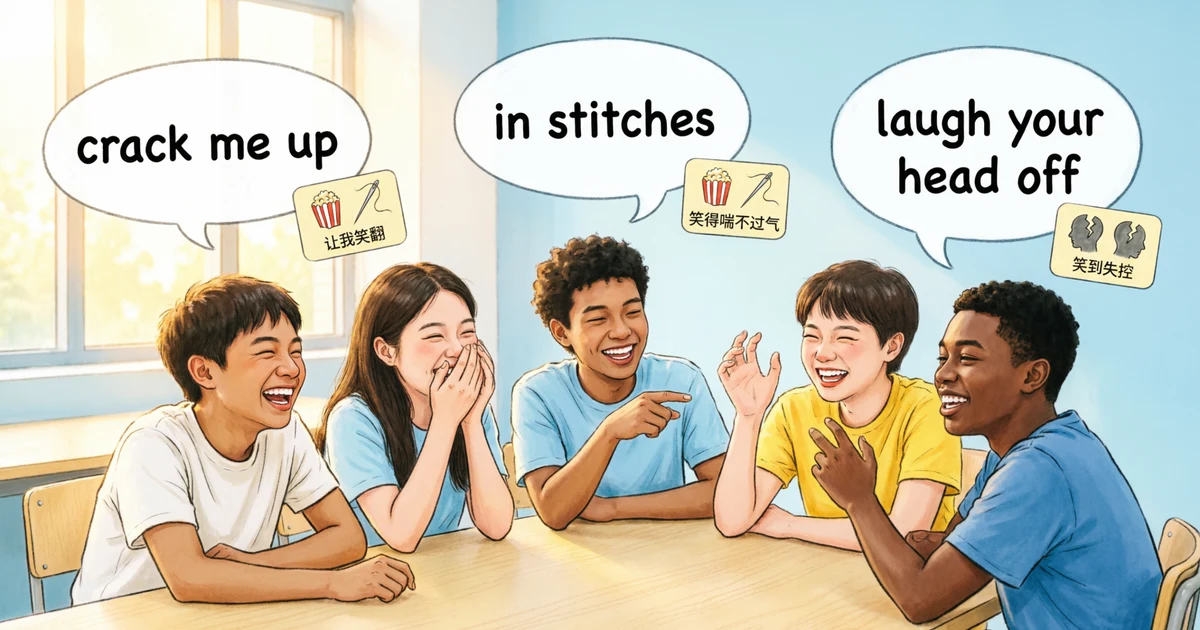
English has many creative ways to describe something funny. You can say a joke made you “laugh your head off,” a comedian “had everyone in stitches,” or a silly situation “cracked you up.” These phrases sound more colorful than simply saying, “It was funny.”
Most of these expressions are idioms. Some may also feel close to metaphors because they create mental pictures. That is where students, writers, and ESL learners often get confused.
The main difference is simple: an idiom is a fixed expression with a meaning people understand as a phrase, while a metaphor compares one thing to another to create meaning or imagery. An idiom may contain a metaphor, but not every metaphor is an idiom.
This guide explains idioms for funny, how they work, how metaphors differ from them, and how to use both naturally in writing and everyday English.
What Idioms Mean
An idiom is a common phrase whose meaning does not always come from the individual words. You usually need to learn the whole expression as one unit.
For example, “crack someone up” does not mean you physically break someone. It means you make someone laugh.
Simple definition:
An idiom is a fixed expression with a special meaning that native speakers recognize.
Purpose:
Idioms make speech and writing sound natural, lively, and familiar.
How it works:
An idiom works because people in a language community already know what the phrase means. The words may sound strange if you take them literally, but the phrase has a shared meaning.
Short natural example:
“His impression of the teacher cracked everyone up.”
Why idioms get confused with metaphors:
Many idioms create pictures in your mind. “Laugh your head off” sounds visual and exaggerated, so learners may think it works exactly like a metaphor. It can feel metaphorical, but people use it as a fixed idiom.
What Metaphors Mean
A metaphor says one thing is another thing to show a similarity. It does not usually use “like” or “as.” Writers use metaphors to create meaning, emotion, or imagery.
For example, if you say, “His humor is sunshine in a dull room,” you do not mean his humor is literally sunlight. You mean it makes the mood brighter.
Simple definition:
A metaphor describes one thing as another to show a deeper similarity.
Purpose:
Metaphors help writers explain ideas, emotions, and qualities in a vivid way.
How it works:
A metaphor transfers meaning from one thing to another. It helps readers understand an idea through comparison.
Short natural example:
“Her jokes were fireworks at the party.”
Why metaphors get confused with idioms:
Some idioms began as metaphors or still sound metaphorical. However, a metaphor can be original, while an idiom usually follows a set phrase people already know.
Idioms vs Metaphors: The Core Difference
The core difference is this: idioms depend on common usage, while metaphors depend on comparison.
An idiom has a fixed meaning because speakers use it that way. A metaphor creates meaning by connecting two ideas.
For example, “in stitches” is an idiom. If you say, “The movie had us in stitches,” you mean the movie made you laugh a lot. You do not need to explain the image because the expression already has a known meaning.
But “the comedian was a spark in a quiet room” is a metaphor. It compares the comedian to a spark to show energy and excitement. This phrase may not appear in a dictionary as a fixed expression, but readers can understand the comparison.
So, when you search for idioms for funny, you mostly want fixed expressions that mean something or someone is humorous. When you study metaphors for funny moments, you look for creative comparisons that describe humor in a fresh way.
Quick Comparison Table
| Point | Idioms for Funny | Metaphors for Funny |
|---|---|---|
| Definition | Fixed expressions that mean something is funny or makes people laugh | Comparisons that describe humor through another image or idea |
| Scope | Narrower because each idiom has a known phrase and meaning | Broader because writers can create new metaphors |
| Purpose | To sound natural, conversational, and expressive | To create vivid description, emotion, or imagery |
| Length | Usually short phrases | Can be short, extended, or thematic |
| Structure | Often fixed wording | Flexible and creative |
| Meaning | Often non-literal and learned as a whole phrase | Based on comparison |
| Use in writing | Good for dialogue, informal writing, examples, and natural tone | Good for creative writing, poetry, essays, and vivid description |
| Example | “That joke cracked me up.” | “His humor was a bright spark in the room.” |
How Idioms Work
Idioms work through shared meaning. Native speakers hear the phrase and understand the intended idea without analyzing every word.
Take the idiom “have someone in stitches.” A learner might picture thread, needles, or sewing. In real use, it means someone laughs very hard.
Idioms for funny often use exaggeration. They make laughter sound physical, dramatic, or hard to control. That is why English has expressions such as:
- “laugh your head off”
- “split your sides laughing”
- “roll on the floor laughing”
- “burst out laughing”
- “crack up”
These idioms do not describe literal actions in most situations. They describe the strength of laughter.
Writers use idioms when they want a sentence to sound natural and familiar. ESL learners should learn the whole phrase, not translate each word.
How Metaphors Work
Metaphors work through comparison. They help readers see one idea through another idea.
For humor, a metaphor might compare a funny person to light, music, medicine, a spark, or a burst of energy.
Examples:
- “His jokes were medicine after a hard day.”
- “Her laughter was music in the room.”
- “The comedian was a lightning bolt of energy.”
- “That silly story was a breath of fresh air.”
These examples do not work as fixed idioms in the same way “crack me up” does. They work because the comparison makes sense.
A metaphor can also stretch across a whole paragraph, scene, poem, or story. That makes it broader than an idiom.
Key Differences in Simple Language
Idioms and metaphors both use non-literal language, but they do different jobs.
An idiom gives you a ready-made phrase. You use it because people already know it.
A metaphor gives you a comparison. You use it because it helps readers imagine or feel something.
An idiom is often more practical in everyday speech. A metaphor often feels more creative in writing.
For example:
“His jokes cracked me up” sounds natural in conversation.
“His jokes were little fireworks in a quiet room” sounds more literary and descriptive.
Both can describe humor, but they create different effects.
Can Idioms and Metaphors Overlap?
Yes, idioms and metaphors can overlap.
Some idioms are metaphorical because they create an image. For example, “laugh your head off” uses exaggeration and body imagery. It does not mean your head actually comes off. It means you laugh very hard.
Still, the phrase works as an idiom because English speakers already recognize it as a set expression.
Here is the easiest way to tell them apart:
If the phrase has a common fixed meaning, treat it as an idiom.
If the phrase creates a comparison, especially a fresh or original one, treat it as a metaphor.
Or, If a fixed expression also creates a comparison, it can be both idiomatic and metaphorical.
Examples of Idioms for Funny
Here are useful idioms for describing funny people, jokes, stories, and situations.
1. Crack Someone Up
Meaning: To make someone laugh.
Example:
“That video cracked me up.”
Use it when:
Something makes people laugh quickly or strongly.
2. Have Someone in Stitches
Meaning: To make someone laugh a lot.
Example:
“Her story had the whole class in stitches.”
Use it when:
Someone or something causes loud, uncontrolled laughter.
3. Laugh Your Head Off
Meaning: To laugh very hard.
Example:
“I laughed my head off at that scene.”
Use it when:
You want to exaggerate how funny something was.
4. Split Your Sides Laughing
Meaning: To laugh extremely hard.
Example:
“We were splitting our sides laughing during the show.”
Use it when:
The humor feels intense and almost physical.
5. Burst Out Laughing
Meaning: To suddenly start laughing.
Example:
“He made one face, and I burst out laughing.”
Use it when:
Laughter happens suddenly.
6. A Barrel of Laughs
Meaning: A very funny person, event, or experience.
Example:
“That party was a barrel of laughs.”
Use it when:
You describe an enjoyable and funny experience.
7. A Laugh a Minute
Meaning: Very funny almost all the time.
Example:
“That sitcom is a laugh a minute.”
Use it when:
Something keeps making people laugh repeatedly.
8. A Riot
Meaning: Very funny or entertaining.
Example:
“Your uncle is a riot.”
Use it when:
A person or event feels lively and hilarious.
9. Funny as a Clown
Meaning: Very funny in a silly or playful way.
Example:
“He was funny as a clown at the family dinner.”
Use it when:
The humor feels goofy, light, or physical.
10. Rolling on the Floor Laughing
Meaning: Laughing extremely hard.
Example:
“That meme had me rolling on the floor laughing.”
Use it when:
You want a dramatic or informal expression for strong laughter.
Examples of Metaphors for Funny
Metaphors for funny moments often describe humor as light, medicine, energy, music, or surprise.
1. His Humor Was Sunshine
Meaning: His humor made people feel happier.
Example:
“After a long meeting, his humor was sunshine.”
Why it works:
Sunshine suggests warmth, brightness, and relief.
2. Her Jokes Were Fireworks
Meaning: Her jokes felt bright, exciting, and full of energy.
Example:
“Her jokes were fireworks at the dinner table.”
Why it works:
Fireworks suggest surprise, color, and excitement.
3. Laughter Was Medicine
Meaning: Laughter helped people feel better.
Example:
“After such a stressful week, laughter was medicine.”
Why it works:
Medicine suggests healing and comfort.
4. The Comedian Was a Spark
Meaning: The comedian brought energy to the room.
Example:
“The comedian was a spark in a quiet crowd.”
Why it works:
A spark suggests sudden energy or life.
5. His Wit Was a Sharp Knife
Meaning: His humor was clever, quick, and cutting.
Example:
“His wit was a sharp knife, but he never used it cruelly.”
Why it works:
A sharp knife suggests precision and intelligence.
6. Her Laugh Was Music
Meaning: Her laugh sounded pleasant and joyful.
Example:
“Her laugh was music after the awkward silence.”
Why it works:
Music suggests beauty, rhythm, and warmth.
7. The Joke Was a Tiny Explosion
Meaning: The joke created sudden laughter.
Example:
“The joke was a tiny explosion in the quiet classroom.”
Why it works:
An explosion suggests sudden force and surprise.
Idioms vs Metaphors in Literature and Writing
In literature, idioms and metaphors both add color, but writers use them for different effects.
Idioms help dialogue sound real. If a character says, “That cracked me up,” the line sounds natural and conversational. Idioms can also reveal personality, age, region, and tone.
Metaphors help writing feel more original. A writer might describe a comedian as “a match struck in a dark room.” That comparison gives the reader an image and mood. It does more than say the person was funny.
In stories, idioms work well when characters speak. Metaphors work well when the narrator wants to create imagery or emotional depth.
For example:
Idiom in dialogue:
“That joke had me in stitches.”
Metaphor in narration:
“His joke broke the tension like sunlight through a locked window.”
The idiom sounds casual. The metaphor feels more literary.
Idioms vs Metaphors for Students and ESL Learners
Students and ESL learners should learn idioms as complete phrases. Do not translate them word by word. A phrase like “crack me up” may sound strange at first, but it becomes easy once you connect it with the meaning “make me laugh.”
Metaphors need a different skill. You should look for the comparison. Ask yourself: What two things does the sentence connect? What quality do they share?
For idioms, ask:
“What does this whole phrase mean?”
For metaphors, ask:
“What comparison does this sentence create?”
Here is a simple example:
Idiom:
“The movie had us in stitches.”
Meaning: The movie made us laugh a lot.
Metaphor:
“The movie was a comedy rocket.”
Meaning: The movie felt fast, exciting, and full of humor.
Idioms help learners sound more fluent. Metaphors help learners write more creatively.
Common Mistakes and Confusion
Many learners make mistakes because idioms and metaphors both move away from literal meaning. Here are the most common problems.
1. Taking Idioms Literally
A learner may think “laugh your head off” describes a real action. It does not. It simply means to laugh very hard.
Better understanding:
“I laughed my head off” means “I laughed a lot.”
2. Changing Fixed Idiom Wording Too Much
Idioms often need exact or familiar wording. You can say “That cracked me up,” but “That broke me into laughter” sounds unnatural.
Better sentence:
“That joke cracked me up.”
3. Calling Every Figurative Phrase a Metaphor
Not every non-literal phrase works as a metaphor. Some phrases are idioms, some are hyperbole, and some are slang.
Example:
“LOL” is not a metaphor. It is an abbreviation.
“Crack up” is an idiom.
“Laughter was medicine” is a metaphor.
4. Overusing Idioms in Formal Writing
Idioms can make formal writing sound too casual. In an essay, you may prefer “The scene was humorous” instead of “The scene cracked me up.”
5. Creating Confusing Metaphors
A metaphor should make the idea clearer, not harder to understand.
Weak metaphor:
“His joke was a refrigerator of clouds.”
Clearer metaphor:
“His joke was a spark in a dull room.”
When to Use Idioms and When to Use Metaphors
Use idioms for funny when you want natural, everyday English. They work well in conversations, dialogue, casual essays, blog posts, reviews, captions, and friendly writing.
Examples:
- “That movie cracked me up.”
- “Your story had me in stitches.”
- “The show was a barrel of laughs.”
Use metaphors when you want creative description. They work well in stories, poems, personal essays, speeches, and expressive writing.
Examples:
- “Her humor was sunshine in a tense room.”
- “His joke was a spark that lit the whole table.”
- “Their laughter became music in the hallway.”
Choose idioms for fluency. Choose metaphors for imagery. Use both carefully when you want writing that sounds natural and vivid.
Related Terms People Often Confuse with Idioms and Metaphors
Idioms and metaphors belong to figurative language, but they are not the only related terms.
Simile
A simile compares two things using “like” or “as.”
Example:
“His joke landed like a firework.”
A simile differs from a metaphor because it uses a comparison word. A metaphor says one thing is another.
Hyperbole
Hyperbole means deliberate exaggeration.
Example:
“I laughed for a million years.”
Many funny idioms use hyperbole, such as “laugh your head off.”
Slang
Slang means informal language used by certain groups or in casual speech.
Example:
“That meme was hilarious, bro.”
Slang changes quickly. Idioms often last longer.
Cliché
A cliché is an overused phrase.
Example:
“Laughter is the best medicine.”
This phrase can work, but writers should use it carefully because readers have seen it many times.
Figurative Language
Figurative language is the broad category. Idioms, metaphors, similes, and hyperbole all fit inside it.
Conclusion
Idioms for funny help you describe laughter and humor in natural English. Phrases like “crack someone up,” “have someone in stitches,” and “laugh your head off” make your speech sound lively and fluent.
Metaphors work differently. They describe humor through comparison, such as “her jokes were fireworks” or “his humor was sunshine.” Metaphors give writing imagery and emotional depth.
The easiest difference is this: idioms are fixed expressions with known meanings, while metaphors create meaning through comparison. Some idioms may sound metaphorical, but they still work as idioms because speakers understand them as set phrases.
For students and ESL learners, idioms build fluency. For writers, metaphors build vivid style. When you understand both, you can describe funny moments with more confidence, variety, and precision.
FAQs
What are idioms for funny?
Idioms for funny are common expressions that describe humor, laughter, or amusing situations. Examples include “crack someone up,” “have someone in stitches,” “laugh your head off,” and “a barrel of laughs.”
Is “crack me up” an idiom or a metaphor?
“Crack me up” is mainly an idiom. It means “make me laugh.” The phrase does not mean someone physically cracks or breaks you. English speakers understand it as a fixed expression.
What is the difference between an idiom and a metaphor?
An idiom is a fixed phrase with a special meaning. A metaphor compares one thing to another to create meaning or imagery. Idioms depend on common usage, while metaphors depend on comparison.
Can an idiom also be a metaphor?
Yes, some idioms can sound metaphorical or may have started as metaphors. For example, “laugh your head off” creates an exaggerated image, but people use it as a fixed idiom meaning “laugh very hard.”
What is a good idiom for something very funny?
“Have someone in stitches” is a strong idiom for something very funny. You can say, “The comedian had the audience in stitches,” which means the comedian made everyone laugh a lot.
Are idioms good for formal writing?
Idioms can work in some essays or articles, but they often sound casual. For formal writing, use them carefully. Instead of “The scene cracked me up,” you could write, “The scene creates a humorous effect.”
How can ESL learners remember funny idioms?
ESL learners should learn idioms as full phrases with examples. Do not translate each word. Connect “crack someone up” with “make someone laugh,” and practice it in natural sentences.