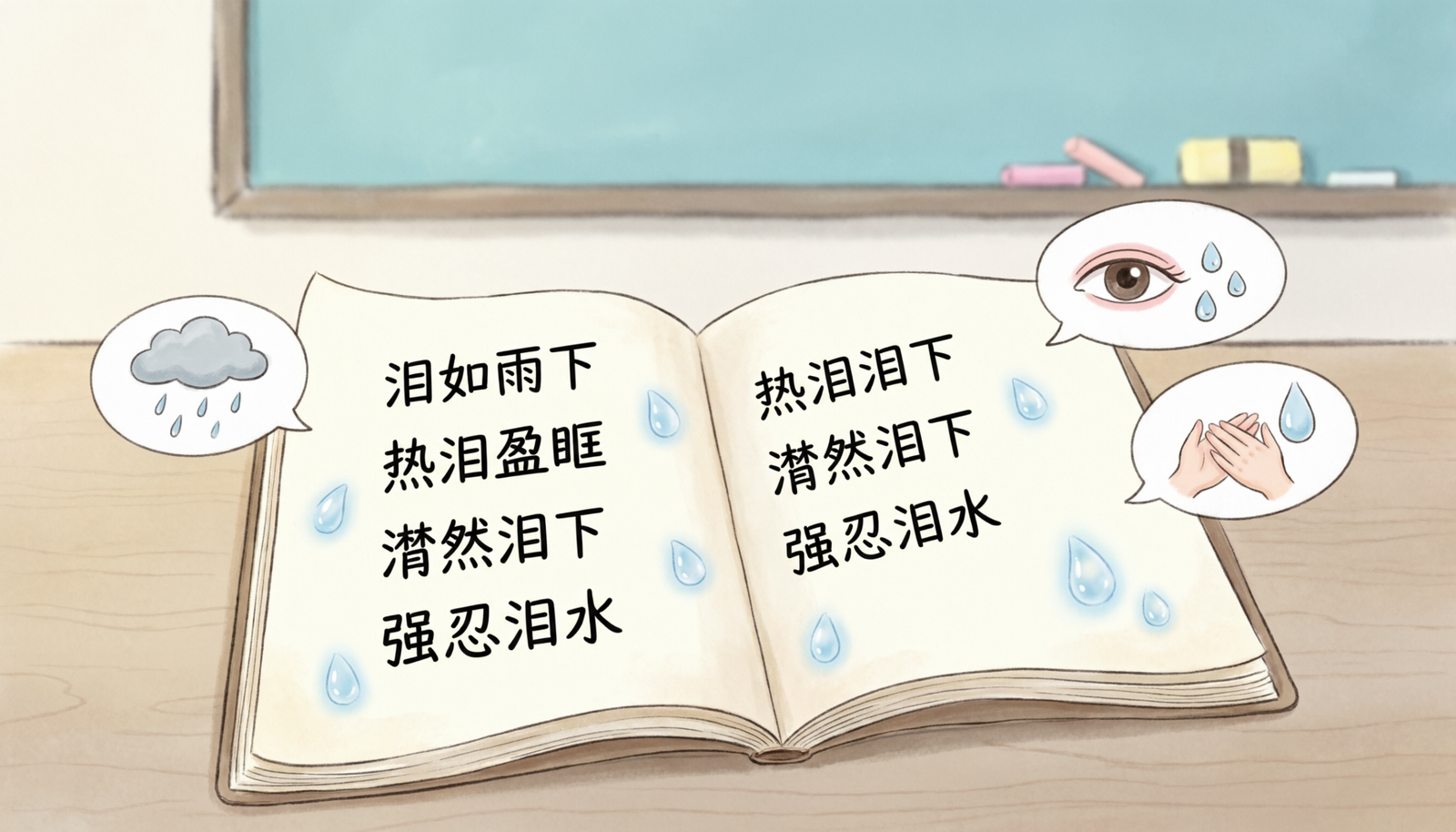
People often search for idioms for crying when they want a stronger, more natural way to describe sadness, grief, pain, or emotional release. Writers may want expressive phrases for a story. Students may need examples for homework. ESL learners may want to understand why phrases like “cry your eyes out” do not literally mean someone’s eyes fall out.
This topic also creates a common confusion: are phrases about crying idioms, metaphors, or both?
The simple answer is this: an idiom is a fixed expression whose meaning is not always literal, while a metaphor compares one thing to another to create a deeper image or meaning. Some idioms about crying feel metaphorical, but not every metaphor is an idiom.
For example, “cry your eyes out” is an idiom because English speakers use it as a familiar fixed phrase meaning “to cry a lot.” A sentence like “Her tears were a river of grief” is a metaphor because it compares tears to a river to show intensity.
Understanding the difference helps students, writers, and ESL learners use emotional language more clearly and confidently.
What Idioms Mean
An idiom is a common phrase whose meaning cannot always be understood by looking at each word separately. Idioms belong to everyday language. Native speakers often use them naturally in speech, stories, essays, and conversation.
The purpose of an idiom is to express an idea in a short, familiar, and often colorful way.
For example:
She cried her eyes out after hearing the news.
This does not literally mean her eyes came out. It means she cried very hard.
Idioms get confused with metaphors because many idioms use imaginative language. However, an idiom works mainly because people already know the phrase as a set expression.
What Metaphors Mean
A metaphor is a figure of speech that describes one thing as if it were something else. It does not use “like” or “as.” Instead, it creates a direct comparison to help readers feel or understand an idea more deeply.
The purpose of a metaphor is to create imagery, emotion, or symbolic meaning.
For example:
His tears were silent rain.
This sentence compares tears to rain. It suggests sadness, softness, and heaviness without saying everything directly.
Metaphors get confused with idioms because both can be non-literal. The difference is that metaphors are often created by the writer, while idioms usually already exist in the language.
Idioms vs Metaphors: The Core Difference
The core difference is simple:
An idiom is a known expression with a fixed meaning. A metaphor is a comparison that creates meaning through imagery.
An idiom often sounds natural in everyday speech because people have heard it before. A metaphor may sound more poetic, creative, or literary because it builds a fresh image.
Take these two examples:
Idiom:
She cried her eyes out.
Metaphor:
Her tears were a storm inside her.
The idiom uses a familiar phrase. The metaphor creates a new comparison between tears and a storm. Both describe strong emotion, but they work in different ways.
Quick Comparison Table
| Point | Idiom | Metaphor |
|---|---|---|
| Definition | A common expression with a meaning different from the literal words | A direct comparison between two unlike things |
| Scope | Narrower because it usually refers to fixed phrases | Broader because it can appear in poetry, stories, essays, and speech |
| Purpose | To express an idea naturally, quickly, or colorfully | To create imagery, emotion, or symbolic meaning |
| Length | Usually short and fixed | Can be short, long, simple, or extended |
| Structure | Often a set phrase people already know | Often created by the writer or speaker |
| Meaning | Usually learned as a whole phrase | Understood through comparison |
| Use in writing | Good for dialogue, casual tone, and relatable expression | Good for description, emotion, theme, and literary effect |
| Example | “She cried her eyes out.” | “Her tears were a river of sorrow.” |
How Idioms Work
Idioms work because a language community agrees on their meaning over time. The words may sound strange when taken literally, but the full phrase carries a familiar meaning.
For example, “burst into tears” means to suddenly start crying. The word “burst” suggests something happening quickly and forcefully. You do not need to imagine a literal explosion. The phrase has become a normal way to describe sudden crying.
Idioms for crying often show:
- how much someone cried
- how suddenly someone cried
- how deeply someone felt emotion
- whether the crying seemed dramatic, private, fake, or uncontrollable
A natural example:
When she saw the old photo, she burst into tears.
This idiom helps readers understand both the action and the sudden emotion behind it.
How Metaphors Work
Metaphors work by connecting one idea to another. They help readers feel an emotion instead of only understanding it logically.
When a writer says:
His grief was a heavy cloud.
The writer does not mean grief is literally a cloud. The comparison suggests darkness, weight, and sadness. The metaphor gives the feeling a shape.
Metaphors about crying often use images such as:
- rain
- rivers
- storms
- oceans
- floods
- broken glass
- heavy skies
- silent wells
A natural example:
Her tears became a river she could not stop.
This metaphor makes the crying feel powerful and continuous. It gives emotion a visual form.
Key Differences in Simple Language
Idioms and metaphors both use non-literal language, but they are not the same.
An idiom usually has a meaning that you must learn. For example, “cry over spilled milk” means to be upset about something that cannot be changed. The phrase does not mainly describe real crying. It teaches a common idea.
A metaphor asks you to understand a comparison. For example, “Her sadness was an ocean” compares sadness to an ocean to show depth and size.
Idioms are often more conversational. Metaphors are often more descriptive or literary.
Idioms are usually fixed. You normally say “cry your eyes out,” not “weep your eyes away.” Metaphors allow more freedom because writers can create new comparisons.
Can Idioms and Metaphors Overlap?
Yes, idioms and metaphors can overlap.
Some idioms began as metaphors. Over time, people repeated them so often that they became fixed expressions. For example, “floods of tears” uses a metaphorical image of water, but it can also feel idiomatic because many English speakers recognize the phrase.
Another example is “cry a river.” It exaggerates crying by comparing tears to a river. It works like a metaphor, but it is also a familiar idiomatic expression.
So, a phrase can be both idiomatic and metaphorical when it uses a familiar expression and creates an image at the same time.
The key question is this:
Is the phrase mainly a fixed expression people already know, or is it mainly a creative comparison?
If it is fixed and commonly used, call it an idiom. If it creates a direct image or comparison, call it a metaphor, If it does both, explain the overlap.
Examples of Idioms for Crying
Here are useful idioms for crying, with simple meanings and natural examples.
1. Cry your eyes out
Meaning: To cry a lot or very hard.
Example:
She cried her eyes out after her best friend moved away.
This idiom sounds emotional and intense. It works well in conversation, fiction, and personal writing.
2. Burst into tears
Meaning: To suddenly start crying.
Example:
The child burst into tears when he lost his toy.
This idiom focuses on the sudden start of crying.
3. Break down
Meaning: To lose emotional control and start crying or showing distress.
Example:
He tried to stay calm, but he broke down during the speech.
This idiom can describe crying, stress, grief, or emotional collapse.
4. Choke back tears
Meaning: To try not to cry.
Example:
She choked back tears as she said goodbye.
This phrase shows emotional control and hidden sadness.
5. Fight back tears
Meaning: To try hard to stop yourself from crying.
Example:
He fought back tears during the farewell ceremony.
This idiom is useful when someone feels emotional but wants to stay strong.
6. Be in tears
Meaning: To be crying.
Example:
By the end of the movie, half the audience was in tears.
This simple idiom works in both casual and formal contexts.
7. Move someone to tears
Meaning: To make someone cry because of strong emotion.
Example:
The singer’s performance moved the crowd to tears.
This idiom often describes beauty, kindness, sadness, or inspiration.
8. Cry over spilled milk
Meaning: To be upset about something that cannot be changed.
Example:
There is no use crying over spilled milk. We need to fix the problem and move on.
This idiom does not always mean real crying. It means regret or useless sadness.
9. Turn on the waterworks
Meaning: To start crying, sometimes dramatically or deliberately.
Example:
Whenever he wanted sympathy, he turned on the waterworks.
This idiom can sound humorous or slightly critical.
10. Have a good cry
Meaning: To cry fully and feel emotional relief afterward.
Example:
After a long week, she had a good cry and felt lighter.
This idiom shows crying as a natural release.
Examples of Metaphors for Crying
Metaphors for crying often sound more poetic or descriptive than idioms. Writers use them to create mood and emotion.
1. Her tears were a river
Meaning: She cried a lot.
Example:
Her tears were a river running through years of silence.
This metaphor shows deep, continuous emotion.
2. His grief was a storm
Meaning: His sadness felt powerful and chaotic.
Example:
His grief was a storm that shook every word he tried to speak.
This metaphor connects crying with emotional force.
3. Tears were diamonds on her cheeks
Meaning: Her tears looked bright, delicate, or precious.
Example:
Tears were diamonds on her cheeks under the stage lights.
This metaphor creates a visual image.
4. Her sadness was an ocean
Meaning: Her sadness felt deep and endless.
Example:
Her sadness was an ocean, and every tear pulled her farther from shore.
This metaphor works well in literary writing.
5. His eyes became rain clouds
Meaning: He looked ready to cry.
Example:
When he heard her name, his eyes became rain clouds.
This metaphor gives emotion a visual shape.
6. Tears carved paths down her face
Meaning: Tears ran down her cheeks strongly or repeatedly.
Example:
Tears carved paths down her face as she read the letter.
This metaphor makes crying feel physical and lasting.
7. Her heart was a cracked cup
Meaning: She felt emotionally broken.
Example:
Her heart was a cracked cup, and every tear slipped through it.
This metaphor connects crying with inner damage.
8. The room filled with silent rain
Meaning: People cried quietly.
Example:
As the names were read aloud, the room filled with silent rain.
This metaphor creates a soft, sorrowful mood.
Idioms vs Metaphors in Literature and Writing
In literature, idioms and metaphors serve different purposes.
Writers use idioms to make dialogue sound natural. A character might say, “I cried my eyes out,” because that sounds like real speech. Idioms can reveal a character’s age, background, mood, or personality.
Writers use metaphors to deepen description and theme. A sentence like “Her tears were the rain of a season that never ended” does more than report crying. It builds atmosphere and emotional meaning.
Idioms often move the story forward quickly. Metaphors slow the moment down and invite readers to feel it.
For example:
Plain sentence:
She cried after the argument.
With an idiom:
She cried her eyes out after the argument.
With a metaphor:
After the argument, her tears fell like a storm breaking after months of heat.
The idiom sounds direct and familiar. The metaphor sounds more vivid and literary.
Idioms vs Metaphors for Students and ESL Learners
Students and ESL learners often confuse idioms and metaphors because both can avoid literal meaning. The best way to separate them is to ask how the phrase works.
If the phrase is common and fixed, it is probably an idiom.
Examples:
burst into tears
cry your eyes out
fight back tears
cry over spilled milk
If the phrase creates a comparison, it is probably a metaphor.
Examples:
Her tears were rain.
His sadness was a storm.
Grief was an ocean inside her.
ESL learners should pay special attention to idioms because literal translation may not work. For example, “cry your eyes out” may sound strange in another language, but English speakers understand it as “cry a lot.”
Students should also remember that metaphors can be original. A teacher may ask you to create your own metaphor, but idioms usually need to match accepted English usage.
Common Mistakes and Confusion
One common mistake is calling every emotional phrase a metaphor. “Burst into tears” is not mainly a metaphor in modern use. It is an idiom because people use it as a standard expression.
Another mistake is using idioms too often in serious writing. A phrase like “turn on the waterworks” may sound too casual or sarcastic in a formal essay about grief.
ESL learners sometimes translate idioms word for word. This can create confusing sentences. It is better to learn the full phrase and its meaning together.
Writers sometimes create metaphors that sound too dramatic. For example:
Her tears were a galaxy of broken oceans inside the thunder of her soul.
This sentence tries too hard. A simpler metaphor often works better:
Her tears were quiet rain.
Clear emotion usually beats overloaded imagery.
When to Use Idioms and When to Use Metaphors
Use idioms when you want natural, familiar, and easy-to-understand expression.
Idioms work well in:
- dialogue
- casual writing
- personal stories
- ESL vocabulary practice
- short emotional descriptions
- everyday conversation
Example:
I cried my eyes out during that movie.
Use metaphors when you want vivid imagery, deeper emotion, or a more literary style.
Metaphors work well in:
- poetry
- fiction
- descriptive essays
- speeches
- emotional scenes
- reflective writing
Example:
Her tears were a river carrying away everything she could not say.
If you want clarity, use an idiom. If you want imagery, use a metaphor, If you want both, choose a familiar phrase with a strong image, such as “a flood of tears.”
Related Terms People Often Confuse with Idioms and Metaphors
Simile
A simile compares two things using “like” or “as.”
Example:
Her tears fell like rain.
This is not a metaphor because it uses “like.”
Hyperbole
Hyperbole means exaggeration for effect.
Example:
I cried a million tears.
The speaker did not literally count a million tears. The exaggeration shows strong emotion.
Personification
Personification gives human qualities to non-human things.
Example:
The silence wept with her.
Silence cannot literally weep, but the sentence gives it human emotion.
Euphemism
A euphemism softens a harsh or painful idea.
Example:
She got emotional.
This may mean she cried, but it sounds gentler or less direct.
Symbolism
Symbolism uses an object, image, or action to represent a larger idea.
Example:
Rain in a scene may symbolize sadness, cleansing, or renewal.
Tears can also become symbolic when they represent grief, healing, guilt, or love.
Conclusion
Idioms and metaphors both make language more expressive, but they do not work the same way. An idiom is a common fixed phrase with a learned meaning, such as “cry your eyes out” or “burst into tears.” A metaphor creates a direct comparison, such as “Her tears were a river” or “His grief was a storm.”
For the keyword idioms for crying, the most useful approach is to learn common crying idioms first, then understand how they differ from metaphorical descriptions of sadness and tears.
Use idioms when you want natural everyday English. Use metaphors when you want stronger imagery, emotion, or literary depth. When you understand both, you can describe crying with more accuracy, feeling, and style.
FAQs
1. What are idioms for crying?
Idioms for crying are common expressions that describe crying, sadness, or emotional reaction. Examples include “cry your eyes out,” “burst into tears,” “fight back tears,” and “be in tears.”
2. Is “cry your eyes out” an idiom or a metaphor?
“Cry your eyes out” is mainly an idiom. It means to cry a lot. It may sound imaginative, but English speakers understand it as a fixed expression.
3. What is a metaphor for crying?
A metaphor for crying compares tears or sadness to something else. For example, “Her tears were a river” compares tears to a river to show strong emotion.
4. Are idioms and metaphors the same?
No. An idiom is a familiar phrase with a fixed meaning. A metaphor is a direct comparison that creates imagery or deeper meaning. Some expressions can overlap, but they are not the same thing.
5. What is the difference between “burst into tears” and “tears were rain”?
“Burst into tears” is an idiom that means someone suddenly started crying. “Tears were rain” is a metaphor because it compares tears to rain.
6. Which is better for writing, idioms or metaphors?
It depends on your purpose. Use idioms for natural speech and clear emotional expression. Use metaphors for vivid description, poetry, fiction, and deeper emotional effect.
7. Can ESL learners use idioms for crying in conversation?
Yes, but they should learn each idiom as a full phrase. Idioms often do not make sense word by word, so it helps to study the meaning and example together.