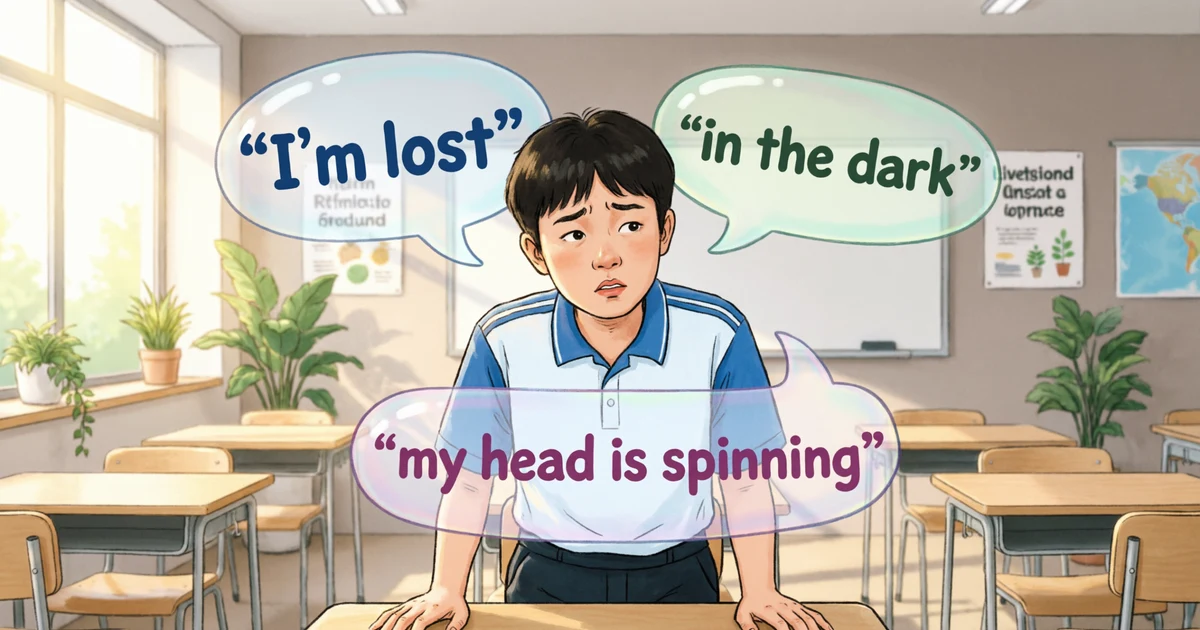
English has many ways to say someone is confused. You can say, “I don’t understand,” but sometimes that sounds too plain. In real conversations, stories, essays, and creative writing, people often use idioms to make confusion sound more natural, expressive, or memorable.
That is why learners search for idioms for confused. They want phrases that show uncertainty, mixed thoughts, mental fog, surprise, or a lack of understanding. Some idioms sound casual, such as I’m lost. Others sound more colorful, such as my head is spinning or I can’t make heads or tails of it.
The main difference is simple: confused is a direct adjective, while idioms for confused are figurative phrases that describe confusion in a more vivid way. “Confused” tells the reader the feeling. An idiom helps the reader imagine the feeling.
This guide explains what idioms mean, what confused means, how they overlap, and how to use common confusion idioms correctly.
What Idioms Mean
An idiom is a phrase whose meaning is different from the literal meaning of its individual words. You usually cannot understand an idiom by translating each word separately.
For example, “I’m in the dark” does not always mean someone is standing in a dark room. As an idiom, it means the person does not have enough information.
Purpose: Idioms help speakers express ideas in a natural, colorful, and often emotional way.
How it works: An idiom uses figurative meaning. The words create an image, but the real meaning comes from common usage.
Short example:
“I’m completely in the dark about the new policy.”
This means the speaker does not know or understand the policy.
Why it gets confused with “confused”: Many idioms describe emotions or mental states, so learners may think the idiom and the direct adjective mean exactly the same thing. They often overlap, but they do not always work in the same tone or context.
What Confused Means
Confused means unable to understand something clearly. A confused person may feel uncertain, mixed up, puzzled, or unsure about what is happening.
The word can describe a person, a thought, a situation, an explanation, or a feeling.
Purpose: The word “confused” gives a direct and clear description of misunderstanding or uncertainty.
How it works: It functions as an adjective. You can use it before a noun or after verbs like “be,” “seem,” “feel,” or “look.”
Short example:
“I’m confused about the instructions.”
This means the speaker does not understand the instructions clearly.
Why it gets confused with idioms: Idioms for confusion often mean “confused,” but they add tone, imagery, or emotion. For example, “I’m confused” sounds direct. “My head is spinning” sounds stronger and more dramatic.
Idioms vs Confused: The Core Difference
The core difference is that confused states the meaning directly, while an idiom for confused expresses the same idea indirectly through figurative language.
Say “confused” when you want clarity. Use an idiom when you want expression, personality, or a more natural conversational tone.
For example:
“I’m confused” is direct.
“I’m lost” is idiomatic and conversational.
“I can’t make heads or tails of it” is more colorful and shows strong confusion.
“My mind went blank” shows a specific type of confusion, often caused by pressure or nervousness.
So, “confused” is broader and more neutral. Idioms are more specific, expressive, and tone-dependent.
Quick Comparison Table
| Point | Idioms for Confused | Confused |
|---|---|---|
| Definition | Figurative phrases that express confusion | A direct adjective meaning unable to understand |
| Scope | Narrower phrases used for specific situations | Broad word for many kinds of uncertainty |
| Purpose | To make confusion vivid, natural, or emotional | To state confusion clearly |
| Length | Usually a phrase | Usually one word |
| Structure | Fixed or semi-fixed expression | Normal adjective |
| Meaning | Often indirect or figurative | Direct and literal |
| Use in writing | Good for dialogue, creative writing, informal explanation, and expressive style | Good for academic writing, instructions, clear communication, and simple sentences |
| Example | “I’m at a loss.” | “I’m confused.” |
How Idioms Work
Idioms work by using shared meaning. Native speakers understand the phrase because they have heard it many times in similar situations.
For example, “I’m at sea” may sound like someone is on a boat. In idiomatic English, it means the person feels confused, lost, or unsure.
Idioms often work through images. Confusion idioms may use images of darkness, fog, spinning, losing direction, or tangled thoughts. These images help the listener feel the confusion instead of only reading the word.
Common images in idioms for confusion include:
- Darkness: “in the dark”
- Loss of direction: “lost”
- Mental overload: “my head is spinning”
- Unclear meaning: “can’t make heads or tails of it”
- Lack of words or ideas: “at a loss”
These idioms do not all mean the exact same thing. Some describe not knowing information. Some describe not understanding. Others describe surprise, shock, or mental pressure.
How Confused Works
The word confused works in a simple and direct way. You can use it in formal, informal, academic, and everyday English.
Common patterns include:
“I am confused.”
“She looks confused.”
“They felt confused after the lecture.”
“The explanation was confusing.”
“I’m confused about what to do next.”
Notice the difference between confused and confusing.
A person feels confused.
A thing, situation, lesson, rule, or explanation can be confusing.
Correct: “I am confused.”
Correct: “The map is confusing.”
Incorrect: “I am confusing” if you mean you do not understand.
This mistake is common among ESL learners because many English adjectives ending in -ed describe feelings, while adjectives ending in -ing describe the thing that causes the feeling.
Key Differences in Simple Language
Use confused when you want to say the meaning clearly.
Use an idiom for confused when you want the sentence to sound more natural, expressive, or conversational.
For example, in a school essay, you might write:
“The character feels confused after hearing the news.”
In a story or dialogue, you might write:
“After hearing the news, he was completely lost.”
Both sentences show confusion, but the second one sounds more vivid and emotional.
The word confused gives the basic idea. Idioms add color, tone, and situation.
Can Idioms and Confused Overlap?
Yes, they can overlap. Many idioms for confused mean almost the same thing as “confused,” but they usually carry extra meaning.
For example:
“I’m confused” means you do not understand.
“I’m lost” also means you do not understand, but it sounds more conversational.
Or, “I’m in the dark” means you lack information, not necessarily that you cannot think clearly.
“My mind went blank” means you suddenly forgot or could not think.
“I’m at a loss” means you do not know what to say or do.
So, idioms and “confused” overlap because both can describe uncertainty. They differ because idioms often show the type, cause, or intensity of confusion.
Examples of Idioms for Confused
Below are common idioms and expressions you can use when someone feels confused.
1. I’m lost
Meaning: I do not understand what is happening or what someone is explaining.
Example:
“I was following the lesson at first, but now I’m lost.”
This idiom works well in classrooms, conversations, and meetings.
2. I’m in the dark
Meaning: I do not have enough information.
Example:
“The manager changed the plan, but the team is still in the dark.”
This phrase focuses more on missing information than mental confusion.
3. I can’t make heads or tails of it
Meaning: I cannot understand it at all.
Example:
“I read the report twice, but I can’t make heads or tails of it.”
This idiom shows strong confusion.
4. My head is spinning
Meaning: I feel mentally overwhelmed or confused by too much information.
Example:
“After three hours of legal terms, my head was spinning.”
This phrase works well when confusion comes from too many details.
5. I’m at a loss
Meaning: I do not know what to say, think, or do.
Example:
“I’m at a loss. I don’t know how to fix this problem.”
This idiom can show confusion, helplessness, or uncertainty.
6. It went over my head
Meaning: It was too difficult for me to understand.
Example:
“The science lecture went over my head.”
This idiom is useful for difficult lessons, jokes, explanations, or technical topics.
7. I’m all mixed up
Meaning: I am confused because things are not clear in my mind.
Example:
“I’m all mixed up about the dates for the exams.”
This sounds casual and simple.
8. I’m puzzled
Meaning: I am confused because something is strange or hard to explain.
Example:
“I’m puzzled by his sudden change in attitude.”
This is not a strong idiom, but it is a useful near-synonym for confused.
9. I’m baffled
Meaning: I am very confused and cannot explain something.
Example:
“The error message disappeared by itself. I’m baffled.”
This word sounds stronger than “confused.”
10. I don’t know whether I’m coming or going
Meaning: I feel extremely confused, busy, or disorganized.
Example:
“With all these deadlines, I don’t know whether I’m coming or going.”
This idiom works best when confusion comes from stress or too many responsibilities.
Examples of Confused
The word confused is easier to use than most idioms because it has a direct meaning.
Simple everyday examples
“I’m confused about the homework.”
“She looked confused during the meeting.”
“The directions were confusing.”
“He felt confused after reading the message.”
“Many students get confused by similar grammar rules.”
More formal examples
“The results confused the researchers.”
“The witness gave a confused account of the event.”
“The new policy caused confusion among employees.”
“The explanation confused several learners.”
Writing examples
“The character feels confused because she receives two different versions of the truth.”
“The poem creates a confused atmosphere through broken images and uncertain speakers.”
“The narrator’s confused thoughts reflect his fear and guilt.”
In most cases, “confused” works when you want a clear and neutral word. Idioms work when you want the sentence to feel more alive.
Idioms for Confused in Literature and Writing
In literature and creative writing, idioms can reveal a character’s voice, mood, education, culture, or emotional state. A character who says “I’m lost” may sound casual and modern. A character who says “I am confused” may sound more direct or formal.
Writers also use confusion idioms to show emotion without overexplaining.
Compare these two lines:
“She was confused by the letter.”
“She read the letter again, but she could not make heads or tails of it.”
The second line gives the reader a stronger sense of struggle. It shows the character trying and failing to understand.
However, writers should not overuse idioms. Too many idioms can make writing sound crowded or unnatural. Use them when they fit the voice and situation.
In academic writing, use direct language more often. In stories, dialogue, personal essays, and informal articles, idioms can make the writing more human.
Idioms for Confused for Students and ESL Learners
Students and ESL learners should learn idioms for confusion in groups because each one has a slightly different use.
1-Use “I’m lost” when you do not understand a lesson, explanation, or conversation.
2-Use “I’m in the dark” when you do not have enough information.
3-Use “It went over my head” when the topic was too difficult.
4-Use “My head is spinning” when you received too much information at once.
5-Use “I’m at a loss” when you do not know what to say or do.
6-Use “I can’t make heads or tails of it” when something makes no sense at all.
A helpful learning tip is to memorize idioms in short example sentences, not as isolated phrases. That way, you learn the meaning and the grammar together.
For example, learn:
“I’m lost. Can you explain that again?”
not only
“lost = confused”
This helps you sound more natural when you speak or write.
Common Mistakes and Confusion
Many learners understand the meaning of confusion idioms but use them in the wrong situation. Here are the most common mistakes.
Mistake 1: Using idioms in very formal writing
In academic essays, “I am confused by the argument” usually works better than “I can’t make heads or tails of the argument.” The idiom may sound too informal unless the essay allows a conversational tone.
Mistake 2: Translating idioms word by word
Idioms rarely translate directly. For example, “in the dark” does not always mean physical darkness. It can mean lacking information.
Mistake 3: Mixing similar idioms
Incorrect: “I can’t make head or tail from it.”
Correct: “I can’t make heads or tails of it.”
Idioms often have fixed wording. Small changes can sound unnatural.
Mistake 4: Confusing “confused” and “confusing”
Correct: “I am confused.”
Correct: “This question is confusing.”
Incorrect: “I am confusing” when you mean you do not understand.
Mistake 5: Using strong idioms for small confusion
If you missed one small detail, “I’m a little confused” sounds natural. “I don’t know whether I’m coming or going” sounds too strong unless you feel very stressed or overwhelmed.
When to Use Idioms and When to Use Confused
Use confused when you need direct, clear, and neutral language.
Good situations for “confused” include:
- school answers
- grammar explanations
- workplace communication
- formal writing
- instructions
- simple descriptions
Example:
“I’m confused about the deadline.”
Use idioms for confused when you want more expression, natural speech, or emotional detail.
Good situations for idioms include:
- conversations
- dialogue
- creative writing
- personal stories
- informal emails
- blog writing
- character description
Example:
“I’m completely lost. Can you walk me through it again?”
A simple rule: use “confused” for clarity and idioms for color.
Related Terms People Often Confuse With Them
Confusing
Confusing describes the thing that causes confusion.
Example:
“The instructions are confusing.”
Confusion
Confusion is the noun form.
Example:
“There was confusion about the schedule.”
Puzzled
Puzzled means confused because something is strange, unclear, or difficult to explain.
Example:
“She looked puzzled by the question.”
Baffled
Baffled means very confused.
Example:
“I’m baffled by this result.”
Bewildered
Bewildered means deeply confused, often because something feels sudden, strange, or overwhelming.
Example:
“He looked bewildered in the crowded station.”
Perplexed
Perplexed means confused in a thoughtful or serious way.
Example:
“The scientist seemed perplexed by the data.”
Misunderstood
Misunderstood means someone understood something incorrectly. It does not always mean confused.
Example:
“I misunderstood the instructions.”
Unclear
Unclear describes something that lacks clarity.
Example:
“The message is unclear.”
Conclusion
Confused is a direct word that means you do not understand something clearly. Idioms for confused express that same idea in a more natural, vivid, or emotional way.
The difference matters because not every confusion phrase works in every situation. “I’m confused” sounds simple and clear. “I’m lost” sounds casual, “I’m in the dark” means you lack information. “My head is spinning” shows mental overload. “I can’t make heads or tails of it” shows strong confusion.
For students and ESL learners, the best approach is to learn each idiom with its situation. For writers, idioms can make characters and scenes feel more alive. The key is to choose the phrase that matches the tone, context, and level of confusion.
FAQs
What is the best idiom for confused?
One of the most common idioms is “I’m lost.” It means you do not understand what someone is saying or explaining. For stronger confusion, you can say “I can’t make heads or tails of it.”
Is “I’m confused” an idiom?
No. “I’m confused” is a direct sentence, not an idiom. It uses the adjective “confused” in a literal way. Idioms use figurative meaning, such as “I’m in the dark” or “my head is spinning.”
What does “I’m in the dark” mean?
“I’m in the dark” means you do not have enough information. It does not always mean you are confused because something is difficult. It often means someone has not told you what you need to know.
What does “it went over my head” mean?
“It went over my head” means something was too difficult to understand. People often use this idiom for lessons, jokes, technical explanations, or complex ideas.
Which is more formal: “confused” or “I’m lost”?
“Confused” is more formal and neutral. “I’m lost” is more conversational. In academic or professional writing, “confused” often works better. In speech or dialogue, “I’m lost” sounds natural.
Can I use idioms for confused in essays?
Yes, but use them carefully. In formal essays, direct words like confused, unclear, puzzled, or uncertain often work better. In creative essays, personal writing, or dialogue, idioms can make the writing more expressive.
What is a strong word for confused?
Strong words for confused include baffled, bewildered, perplexed, and disoriented. Each word has a slightly different tone, so choose the one that fits the situation.