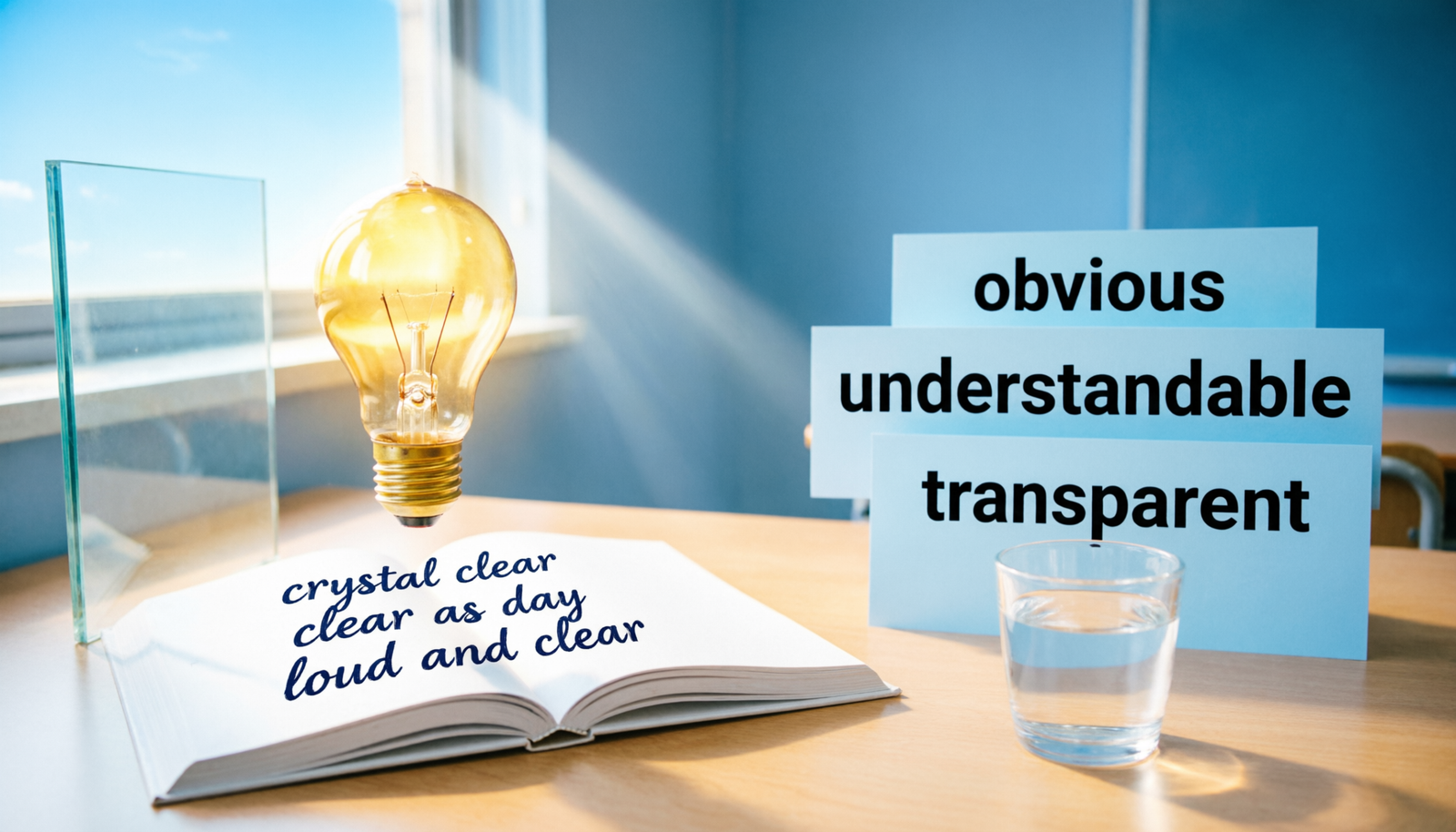
People often search for idioms for clear when they want a more expressive way to describe something that is easy to understand, obvious, transparent, or free from confusion. However, idioms and ordinary synonyms do not work in exactly the same way.
A synonym for clear, such as obvious, understandable, or transparent, communicates the meaning directly. An idiom such as clear as day or crystal clear expresses the same general idea in a more vivid and memorable way.
The main difference is simple: synonyms state the meaning directly, while idioms express it through a fixed or figurative phrase.
Both can improve writing, but the best choice depends on your audience, tone, and purpose. Students and ESL learners may prefer direct synonyms when accuracy matters. Writers and speakers may choose idioms when they want stronger imagery, personality, or emphasis.
This guide explains idioms for clear, synonyms for clear, how they differ, where they overlap, and how to use each one naturally.
What Idioms for Clear Mean
Idioms for clear are fixed or commonly recognized expressions that communicate ideas such as clarity, certainty, obviousness, transparency, or easy understanding.
Their meanings may be figurative, partly figurative, or strongly based on imagery.
For example:
The instructions were crystal clear.
The phrase crystal clear does not literally mean that the instructions were made of crystal. It means they were extremely easy to understand.
Simple definition
An idiom for clear is an expressive phrase used to show that something is obvious, understandable, certain, or easy to see.
Purpose
Writers and speakers use these idioms to:
- add emphasis
- create a vivid mental image
- make language sound more natural
- show confidence or certainty
- avoid plain or repetitive wording
How it works
The idiom connects clarity with a familiar image or situation, such as daylight, crystal, writing on a wall, or seeing something with your own eyes.
Short example
Her message was clear as day.
Why it gets confused with synonyms
Many idioms for clear can replace adjectives such as obvious or understandable. Because they serve a similar purpose in a sentence, learners may assume they are ordinary synonyms. However, idioms usually have a fixed structure and a more figurative tone.
What Synonyms for Clear Mean
Synonyms for clear are individual words or direct phrases that have the same or a closely related meaning as clear.
Examples include:
- obvious
- understandable
- plain
- transparent
- definite
- certain
- unambiguous
- visible
- straightforward
Not every synonym fits every context. For example, a clear explanation may be understandable, while a clear sky may be cloudless. A clear answer may be definite, while a clear container may be transparent.
Simple definition
A synonym for clear is a word or direct expression that communicates a similar meaning without relying on a figurative phrase.
Purpose
Synonyms help writers:
- choose precise meanings
- avoid unnecessary repetition
- match formal or informal tone
- communicate directly
- improve sentence variety
How it works
The writer selects a word based on the exact meaning of clear in the sentence.
Short example
The teacher gave an understandable explanation.
Why it gets confused with idioms
Synonyms and idioms can communicate the same general idea. For example, obvious and plain as day both show that something is easy to recognize. The difference lies mainly in structure, tone, and directness.
Idioms for Clear vs Synonyms for Clear: The Core Difference
The core difference is that a synonym gives the meaning directly, while an idiom presents the meaning through a recognized expression or image.
Compare these sentences:
The answer was obvious.
The answer was clear as day.
Both sentences suggest that the answer was easy to recognize. However, obvious is a direct adjective, while clear as day is an idiomatic comparison that adds emphasis and imagery.
Synonyms usually provide more precision. Idioms usually provide more color.
A synonym may suit an academic report, formal explanation, or technical guide. An idiom may work better in conversation, storytelling, journalism, or persuasive writing.
Quick Comparison Table
| Point | Idioms for Clear | Synonyms for Clear |
|---|---|---|
| Definition | Fixed or figurative expressions that communicate clarity | Words with the same or a similar meaning as clear |
| Scope | Usually narrower and tied to a recognized phrase | Broader because many words fit different meanings of clear |
| Purpose | To add imagery, emphasis, or personality | To communicate accurately and directly |
| Length | Usually several words | Usually one word or a short direct phrase |
| Structure | Often fixed and cannot be changed freely | Flexible within normal grammar |
| Meaning | May be figurative or image-based | Usually literal and direct |
| Use in writing | Best for creative, conversational, or persuasive writing | Best for academic, professional, technical, and general writing |
| Example | “The message was crystal clear.” | “The message was understandable.” |
| Tone | Expressive and often informal | Neutral, formal, or informal depending on the word |
| Flexibility | Limited because the phrase usually has a standard form | High because different synonyms can match different contexts |
How Idioms for Clear Work
Idioms for clear work by connecting an abstract idea with a familiar image.
Clarity itself cannot always be touched or seen. An idiom makes it easier to imagine by comparing it to something bright, transparent, visible, or impossible to miss.
For instance, daylight allows people to see things easily. That is why expressions such as clear as day and plain as day suggest that something is completely obvious.
Crystal is transparent and visually clean. Therefore, crystal clear suggests perfect clarity.
Idioms can describe several types of clarity:
Mental clarity
These expressions describe understanding or comprehension.
After the demonstration, the process became crystal clear.
Visual clarity
Some idioms describe something that is easy to see.
From the hilltop, the coastline was clear as day.
Certainty
Certain idioms show that the truth or result leaves no room for doubt.
The evidence made the answer plain as day.
Honest communication
Some expressions describe direct, open, or transparent speech.
She laid her cards on the table and explained her concerns.
This idiom does not contain the word clear, but it communicates openness and honesty.
How Synonyms for Clear Work
Synonyms work by replacing clear with a word that matches the exact intended meaning.
The word clear has several meanings, so choosing the right synonym requires attention to context.
Clear meaning easy to understand
Suitable synonyms include:
- understandable
- straightforward
- coherent
- lucid
- intelligible
- unambiguous
Example:
The guide gives a straightforward explanation of the process.
Clear meaning obvious
Suitable synonyms include:
- obvious
- evident
- apparent
- unmistakable
- plain
Example:
It became obvious that the plan needed revision.
Clear meaning transparent
Suitable synonyms include:
- transparent
- see-through
- translucent, in some contexts
Example:
The liquid remained transparent after cooling.
Clear meaning certain
Suitable synonyms include:
- definite
- certain
- conclusive
- decisive
Example:
We need a definite answer by Friday.
Clear meaning free from obstacles
Suitable synonyms include:
- open
- unobstructed
- empty
- free
Example:
Keep the emergency exit unobstructed.
A synonym must match the specific meaning. Replacing clear carelessly can make a sentence inaccurate.
Key Differences in Simple Language
Idioms and synonyms differ in several practical ways.
Idioms are usually more expressive
An idiom creates a stronger image.
His disappointment was written all over his face.
A direct version would be:
His disappointment was obvious.
The first sounds more vivid. The second sounds more direct.
Synonyms are usually more precise
A synonym can identify the exact type of clarity.
For example, transparent describes material that light can pass through, while unambiguous describes language with only one reasonable meaning.
An idiom may communicate a broad impression, but a precise synonym often works better in formal explanations.
Idioms often have fixed wording
You can say crystal clear, but changing it to diamond clear would sound unnatural.
Synonyms allow more grammatical flexibility:
- a clear explanation
- an understandable explanation
- an explanation that is easy to follow
Idioms depend more on cultural familiarity
Native speakers may immediately understand plain as day. ESL learners may need to learn it as a complete expression.
Direct words such as obvious or understandable are usually easier to look up and apply.
Synonyms suit more formal situations
A technical report might say:
The test produced conclusive evidence.
A conversational speaker might say:
The evidence made it clear as day.
Both versions work, but they create different tones.
Can Idioms for Clear and Synonyms for Clear Overlap?
Yes. Idioms and synonyms often overlap in meaning even though they differ in form.
Consider these pairs:
- crystal clear — completely understandable
- plain as day — obvious
- in black and white — written or formally documented
- loud and clear — fully understood
- see the light — finally understand
- written all over your face — emotionally obvious
Each idiom can often be replaced by a direct synonym or explanation.
For example:
I heard your instructions loud and clear.
This means:
I understood your instructions completely.
The overlap does not make the two forms identical. The idiom carries more tone, emphasis, and personality.
Writers may even use both together:
The evidence was unmistakable, making the truth clear as day.
This combination can work when emphasis feels natural, but overusing both may sound repetitive.
Examples of Idioms for Clear
The following idioms express clarity, obviousness, understanding, certainty, or openness.
1. Crystal clear
Meaning: Extremely easy to understand or see.
The new diagram made the process crystal clear.
This is one of the most common idioms for clear. It works in conversation, business writing, teaching, and general communication.
2. Clear as day
Meaning: Completely obvious or easy to recognize.
It was clear as day that she had prepared carefully.
The expression compares obviousness with the visibility of daylight.
3. Plain as day
Meaning: Very obvious.
The mistake was plain as day once we checked the numbers.
This idiom strongly emphasizes that something should be easy to notice.
4. Loud and clear
Meaning: Fully heard and understood.
Your concerns came through loud and clear.
People often use this phrase when acknowledging a message, warning, instruction, or opinion.
5. In black and white
Meaning: Clearly written, printed, or documented.
The refund policy appears in black and white on the receipt.
This expression usually refers to written proof rather than general understanding.
6. Spell something out
Meaning: Explain something in a very clear and detailed way.
Please spell out the steps for new employees.
This idiom often appears when someone needs a simpler or more detailed explanation.
7. Make something plain
Meaning: Explain or show something clearly.
The manager made it plain that safety came first.
This phrase can sound firm or serious.
8. Lay your cards on the table
Meaning: Speak openly and honestly about your intentions or situation.
He laid his cards on the table and explained the budget problem.
This idiom focuses on transparency rather than easy understanding.
9. Come clean
Meaning: Admit the truth openly.
She finally came clean about the missing documents.
It relates to honesty and disclosure, not visual clarity.
10. See the light
Meaning: Finally understand or accept something.
After reviewing the evidence, he finally saw the light.
This idiom describes a movement from confusion to understanding.
11. Open someone’s eyes
Meaning: Help someone understand an important truth.
The documentary opened my eyes to the scale of the problem.
It suggests gaining new awareness.
12. Put things into perspective
Meaning: Help someone understand a situation more clearly by seeing it in context.
Comparing the figures put the problem into perspective.
This phrase focuses on balanced understanding.
13. Read between the lines
Meaning: Understand a hidden or indirect meaning.
If you read between the lines, the message is clear.
Interestingly, this idiom describes discovering meaning that was not stated clearly.
14. Written all over someone’s face
Meaning: Very easy to recognize from a person’s expression.
Her excitement was written all over her face.
This idiom makes an emotion appear visible and obvious.
15. Leave no room for doubt
Meaning: Make something completely certain.
The final test results left no room for doubt.
This expression suits formal and informal writing.
16. Shed light on something
Meaning: Make a confusing subject easier to understand.
The report sheds light on the causes of the decline.
This idiom appears frequently in academic, professional, and journalistic writing.
17. Clear the air
Meaning: Remove tension or misunderstanding through honest discussion.
We met to clear the air after the disagreement.
The phrase focuses on restoring understanding between people.
18. Get the picture
Meaning: Understand a situation.
You do not need to explain further. I get the picture.
This idiom sounds informal and conversational.
19. Put two and two together
Meaning: Use available information to understand what happened.
She put two and two together and realized why the meeting had been cancelled.
The expression suggests reaching a clear conclusion from clues.
20. See something with your own eyes
Meaning: Confirm something by observing it personally.
I did not believe the damage until I saw it with my own eyes.
This phrase emphasizes direct evidence.
Examples of Synonyms for Clear
Synonyms for clear depend on what the sentence means.
Understandable
The teacher gave an understandable explanation.
Use understandable when information is easy to comprehend.
Obvious
The answer became obvious after the final clue.
Use obvious when something is easy to recognize or notice.
Plain
The meaning is plain from the context.
Use plain for something direct, simple, or obvious.
Transparent
The organization needs a transparent decision-making process.
Use transparent for openness, honesty, or material that can be seen through.
Straightforward
The application process is straightforward.
Use straightforward when something lacks unnecessary difficulty or complexity.
Unambiguous
The contract should use unambiguous language.
Use unambiguous when a statement has only one reasonable interpretation.
Lucid
She gave a lucid explanation of the theory.
Use lucid for writing or speech that is clear and logically organized. It sounds more formal than clear.
Coherent
His argument was clear and coherent.
Use coherent when ideas connect logically and form a meaningful whole.
Intelligible
The recording was barely intelligible.
Use intelligible when speech, writing, or information can be understood.
Evident
Her confidence was evident during the presentation.
Use evident when something can be easily noticed or concluded.
Apparent
The cause of the error was not immediately apparent.
Use apparent when something seems visible or understandable, though it may not always be fully certain.
Unmistakable
There was an unmistakable sense of relief in the room.
Use unmistakable when something is so clear that it cannot reasonably be confused with anything else.
Definite
We need a definite answer before making the booking.
Use definite for certainty, firmness, or a final decision.
Conclusive
The investigation found no conclusive proof.
Use conclusive when evidence settles a question decisively.
Visible
The damage was visible from the road.
Use visible when something can be physically seen.
Cloudless
They enjoyed a cloudless sky.
Use cloudless when clear describes weather or the sky.
Unobstructed
The room offers an unobstructed view of the stage.
Use unobstructed when nothing blocks movement, sight, or access.
Idioms for Clear vs Synonyms for Clear in Literature and Writing
Writers choose between idioms and synonyms based on tone, voice, character, and genre.
Idioms add voice and personality
Idioms can make dialogue sound natural.
“You have made your opinion loud and clear,” she replied.
This sentence carries more emotion than:
“I understand your opinion,” she replied.
The idiom suggests firmness and perhaps frustration.
Synonyms support precision
Academic and informational writing often requires exact language.
The researcher provided a coherent explanation of the results.
Using coherent tells the reader that the explanation was logically connected, not merely easy to read.
Idioms create imagery
Creative writing often benefits from figurative language.
The truth stood before him, plain as day.
The sentence gives the truth a strong sense of visibility.
Synonyms control tone
Different synonyms create different levels of formality.
Informal:
The steps are easy to follow.
Neutral:
The steps are clear.
Formal:
The steps are unambiguous.
Highly formal:
The procedure is expressed with sufficient precision to prevent misinterpretation.
Good writers select the form that matches the reader and situation.
Idioms can strengthen themes
Expressions involving light, sight, fog, or darkness can support a literary theme of knowledge and ignorance.
For example, a writer may describe understanding as seeing the light. The image connects knowledge with brightness and confusion with darkness.
Too many idioms can weaken writing
Idioms lose power when every sentence contains one. They may also make serious writing sound casual or predictable.
A balanced paragraph might use mostly direct language and one carefully chosen idiom for emphasis.
Idioms for Clear vs Synonyms for Clear for Students and ESL Learners
Students and ESL learners should learn both forms, but they should use them differently.
Start with the direct meaning
Before learning crystal clear, make sure you understand words such as:
- obvious
- understandable
- certain
- transparent
- visible
Direct vocabulary creates a strong foundation.
Learn idioms as complete units
Do not translate each word separately.
For example, loud and clear means fully understood. It does not always describe physical volume.
Treat the whole phrase as one vocabulary item.
Notice the context
Compare:
The glass is clear.
1-Here, clear means transparent.
The instructions are clear.
2-Here, clear means understandable.
Her intention is clear.
3-Here, clear means obvious.
The road is clear.
4-Here, clear means open or free from obstruction.
No single synonym can replace clear in every sentence.
Avoid idioms in highly formal assignments unless appropriate
An academic paper may prefer:
The findings provide conclusive evidence.
Rather than:
The findings make the answer clear as day.
The second sentence is understandable, but its conversational tone may not suit formal research.
Use idioms carefully in exams
An idiom can demonstrate vocabulary skill, but only when used naturally.
Incorrect:
The transparent answer was loud and day.
Correct:
The answer was clear as day.
Correct:
The instructions came through loud and clear.
Memorizing both the meaning and the normal sentence pattern will reduce mistakes.
Common Mistakes and Confusion
Using one synonym for every meaning of clear
Incorrect:
We walked under an understandable sky.
Correct:
We walked under a clear, cloudless sky.
The word understandable only works when something can be mentally understood.
Changing the wording of a fixed idiom
Incorrect:
The message was diamond clear.
Correct:
The message was crystal clear.
Idioms usually have established wording.
Taking idioms literally
See the light does not always refer to actual light. It often means to understand or accept the truth.
He finally saw the light and changed his approach.
Using an idiom in an unsuitable formal context
Less suitable:
The medical report made the diagnosis clear as day.
More formal:
The medical report provided conclusive evidence for the diagnosis.
The idiomatic version is not grammatically wrong, but the direct version sounds more professional.
Confusing transparent with understandable
A transparent object allows light to pass through.
A transparent process is open and honest.
An understandable explanation is easy to comprehend.
These meanings overlap only in the broad idea of clarity.
Using obvious in a rude way
Telling someone that an answer is obvious can sound dismissive.
The answer is obvious.
This may suggest that the listener should already understand it.
A softer alternative is:
The answer becomes clearer when we look at the final example.
Mixing similar idioms
Incorrect:
The answer was written in clear as day.
Correct:
The answer was clear as day.
Correct:
The answer was written in black and white.
Each idiom has its own grammatical pattern.
Overusing crystal clear
Crystal clear is useful, but repeating it throughout an article can sound dull.
Alternatives include:
- perfectly understandable
- unmistakable
- straightforward
- plain as day
- easy to follow
- unambiguous
When to Use Idioms for Clear and When to Use Synonyms for Clear
Use an idiom when you want to:
- create a vivid image
- add conversational energy
- emphasize certainty
- make dialogue sound natural
- express emotion or attitude
- make a phrase more memorable
Example:
The warning came through loud and clear.
Use a synonym when you want to:
- communicate precisely
- maintain a formal tone
- explain a technical idea
- avoid cultural confusion
- choose the exact meaning
- write for an international audience
Example:
The warning was unambiguous.
Choose based on the context
1-For casual conversation:
I get the picture.
2-For a classroom explanation:
I understand the main idea.
3-For business communication:
Your requirements are clear.
4-For a legal document:
The requirement must be stated in unambiguous language.
5-For creative writing:
The truth became plain as day.
The best expression is not always the most colorful one. It is the one that fits the audience and purpose.
Related Terms People Often Confuse With Them
Idiom
An idiom is a fixed expression whose full meaning may differ from the literal meanings of its words.
Example:
Clear the air.
This means to resolve tension or misunderstanding.
Synonym
A synonym is a word with the same or a similar meaning as another word.
Example:
Obvious is a synonym for clear in some contexts.
Simile
A simile compares two things using like or as.
Example:
The water was as clear as glass.
Some common similes become idiomatic expressions over time.
Metaphor
A metaphor describes one thing as another to create a comparison.
Example:
Understanding is a light in the darkness.
Unlike a synonym, a metaphor creates meaning through comparison.
Cliché
A cliché is an expression that has become overly familiar through frequent use.
Expressions such as crystal clear may feel clichéd in some creative contexts, though they remain useful in ordinary communication.
Collocation
A collocation is a group of words that commonly appear together.
Examples include:
- clear explanation
- clear evidence
- clear distinction
- clear intention
- clear message
These are common word partnerships, but they are not necessarily idioms.
Proverb
A proverb is a traditional saying that expresses advice or general wisdom.
Example:
Honesty is the best policy.
A proverb usually communicates a complete lesson, while an idiom normally functions as part of a sentence.
Figurative language
Figurative language uses imagery, comparison, or nonliteral meaning.
Idioms often belong to figurative language, while direct synonyms usually do not.
Euphemism
A euphemism replaces a harsh or uncomfortable expression with a softer one.
It does not necessarily make a statement clearer. In fact, a euphemism may make meaning less direct.
Conclusion
Idioms for clear and synonyms for clear often communicate similar ideas, but they do so in different ways.
A synonym such as obvious, understandable, transparent, or unambiguous states the meaning directly. An idiom such as crystal clear, plain as day, or loud and clear adds imagery, emphasis, and personality.
Idioms work especially well in conversation, storytelling, persuasive writing, and expressive descriptions. Synonyms usually work better when precision, formality, or easy international understanding matters.
The most important step is to identify what clear means in the sentence. It may refer to understanding, visibility, certainty, honesty, weather, or freedom from obstruction. Once you know the intended meaning, you can choose either a precise synonym or a natural idiom that suits the context.
FAQs
What is the best idiom for something that is very clear?
Crystal clear is one of the most common expressions for something that is extremely easy to understand or see.
The teacher’s explanation was crystal clear.
Is “clear as day” an idiom or a simile?
It has the structure of a simile because it uses as, but it also functions as a familiar idiomatic expression. It means completely obvious.
What is another way to say “make it clear”?
You can say:
- explain it plainly
- spell it out
- clarify it
- make it understandable
- make it explicit
- leave no room for doubt
The best option depends on the tone and context.
Is “obvious” always a synonym for “clear”?
No. Obvious works when clear means easy to recognize. It does not work when clear means transparent, cloudless, or unobstructed.
For example, you cannot normally replace clear glass with obvious glass.
Can I use idioms for clear in formal writing?
Yes, but use them sparingly. Expressions such as shed light on often appear in formal writing, while phrases such as get the picture sound more conversational.
What does “loud and clear” mean?
It means that a message has been fully heard and understood.
We heard your concerns loud and clear.
Which is better: an idiom or a direct synonym?
Neither is always better. Use an idiom for imagery and emphasis. Use a direct synonym for precision, formality, and easy understanding.