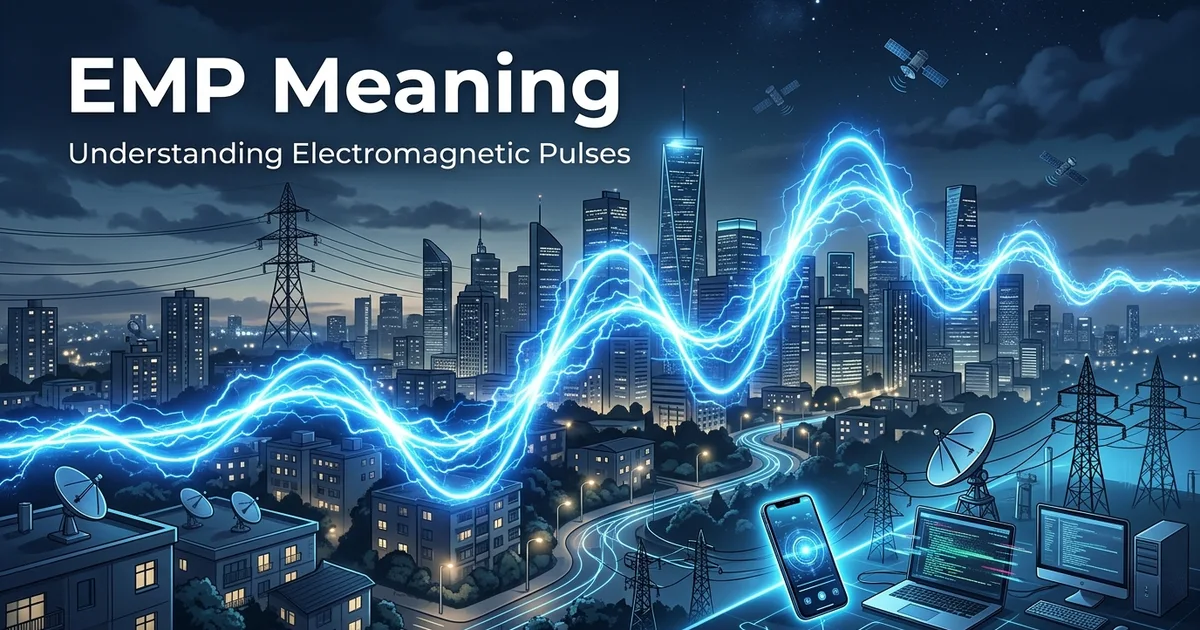
Quick Answer
EMP most commonly stands for Electromagnetic Pulse, a burst of electromagnetic energy that can disrupt or damage electronic devices and power systems. It is widely discussed in military, scientific, emergency preparedness, and technology contexts. Depending on where you see it, EMP can also stand for terms such as Employee, Enterprise Management Platform, or Emergency Management Program. The correct meaning depends on the context in which the abbreviation appears.
Introduction
The abbreviation EMP appears in many different industries, which is why people often search for its meaning. You may come across it while reading a news article about national security, watching a movie about a large power outage, filling out workplace documents, or using business software. Because it has several meanings, understanding the context is the key to knowing what someone is referring to.
For most readers, the primary meaning of EMP is Electromagnetic Pulse. This topic often appears in discussions about military technology, solar storms, disaster preparedness, and the protection of electronic equipment. However, business professionals, students, and office workers may encounter EMP in completely different ways, such as referring to employees or enterprise management systems.
This guide explains the most common meaning first while also covering other widely used definitions. You will learn what an electromagnetic pulse is, how it affects electronics, where the term is used, and how to avoid confusing it with other meanings.
| Meaning | Where It Is Used | Simple Explanation | Example |
|---|---|---|---|
| Electromagnetic Pulse | Science, military, emergency planning | A burst of electromagnetic energy that can affect electronics | An EMP could disable unprotected electronic devices. |
| Employee | Human resources, workplaces | A person who works for an employer | The company hired a new EMP for customer support. |
| Enterprise Management Platform | Business software | A system that helps manage business operations | The company upgraded its EMP software. |
| Emergency Management Program | Public safety | A program that prepares organizations for emergencies | The hospital reviewed its EMP before hurricane season. |
What Does EMP Mean?
The most recognized meaning of EMP is Electromagnetic Pulse. An electromagnetic pulse is a sudden release of electromagnetic energy that can interfere with electrical systems and electronic devices. Depending on its strength and the level of protection available, an EMP can temporarily interrupt electronics or permanently damage sensitive equipment.
An EMP can come from different sources. Some are naturally occurring, while others are created by human activity. Scientists often discuss solar storms as a natural source, while military experts may discuss specialized weapons capable of generating an electromagnetic pulse.
Not every EMP has the same strength. Small electromagnetic pulses can occur during certain electrical events and may have only limited effects. Large scale EMP events receive the most attention because they have the potential to disrupt communications, transportation, and power systems across a wide area.
Outside science and technology, EMP has several other meanings. Businesses may use it as shorthand for employee or enterprise management platform, while government agencies may use it to describe an emergency management program. Because these meanings are unrelated, readers should always look at the surrounding sentence before deciding which definition applies.
How an Electromagnetic Pulse Works
An electromagnetic pulse spreads energy through the air in an extremely short amount of time. When that energy reaches electronic equipment, it can create unexpected electrical currents inside circuits and wiring.
Modern electronics often rely on delicate components that operate with very small electrical signals. A strong electromagnetic pulse can overwhelm those components, causing temporary malfunctions or permanent damage if the equipment is not properly protected.
The effects depend on several factors, including:
- The strength of the pulse
- The distance from the source
- The design of the electronic device
- Whether protective shielding is in place
- The length of connected cables or power lines
Large infrastructure such as power grids, communication networks, and transportation systems may face greater risks because they contain extensive electrical wiring that can carry induced currents over long distances.
Common Sources of an EMP
Nuclear EMP
A high altitude nuclear explosion can produce a powerful electromagnetic pulse over a very large area. This type receives significant attention in national security planning because of its potential impact on critical infrastructure.
Solar Storms
The Sun occasionally releases powerful eruptions that interact with Earth’s magnetic field. Extremely strong solar events can disturb power systems and satellite communications, although they are different from nuclear generated EMP events.
Non Nuclear Devices
Some specialized devices are designed to generate localized electromagnetic pulses for testing or military purposes. Their range and effects are generally much smaller than those associated with large scale nuclear events.
Practical Usage of EMP
The term EMP appears in many real world situations.
Emergency planners may discuss ways to improve the resilience of critical infrastructure.
Engineers may design equipment with additional shielding to reduce vulnerability.
Military organizations study EMP effects as part of defense planning.
Researchers analyze solar activity to better understand space weather and its possible impact on electrical systems.
Businesses may also use the abbreviation in internal documents where it refers to employees or management software instead of electromagnetic pulses.
Examples of EMP in Everyday Contexts
Understanding the surrounding sentence makes the meaning much clearer.
Electromagnetic Pulse
- Engineers tested the backup communication equipment against a simulated EMP.
- The documentary explained how an EMP could affect electrical infrastructure.
Employee
- Every EMP must complete workplace safety training before starting work.
- The HR department updated the EMP records.
Enterprise Management Platform
- The company migrated its data to a new EMP for better workflow management.
- Managers used the EMP to monitor business operations.
Emergency Management Program
- The school reviewed its EMP before the start of the storm season.
- Local officials updated the EMP after the emergency exercise.
Common Use Cases of EMP
Although EMP has several meanings, the intended definition usually becomes clear from the situation. Here are the most common ways the abbreviation is used.
Science and Technology
Scientists and engineers use EMP when discussing electromagnetic energy and its effects on electronic systems. Research in this field helps improve the reliability of communication networks, satellites, medical equipment, and critical infrastructure.
Emergency Preparedness
Emergency management organizations include EMP scenarios when planning for disasters that could disrupt electricity or communications. These plans often focus on maintaining essential services and restoring systems as quickly as possible.
Military and Defense
Military experts study electromagnetic pulse technology to understand how it could affect communications, radar systems, navigation equipment, and other electronic devices. They also develop protective measures to reduce potential damage.
Business and Human Resources
In some companies, EMP is simply an abbreviation for employee. You might see it in spreadsheets, payroll reports, attendance records, or internal documents where space is limited.
Business Software
Technology companies may use EMP to mean Enterprise Management Platform. These systems help organizations manage daily operations such as projects, customer information, reporting, inventory, and employee tasks.
Similar Terms and Related Phrases
Many readers confuse EMP with other technical terms. Understanding the differences helps prevent misunderstandings.
| Term | Meaning | Best Use | Example |
|---|---|---|---|
| EMP | Electromagnetic Pulse | Science, defense, emergency planning | A strong EMP may disrupt electronics. |
| EMI | Electromagnetic Interference | Electronic devices | A nearby motor caused EMI in the audio system. |
| EMC | Electromagnetic Compatibility | Product design | The device passed EMC testing. |
| Surge | Sudden increase in voltage | Home and office electronics | A power surge damaged the router. |
| Geomagnetic Storm | Disturbance caused by solar activity | Space weather | A geomagnetic storm affected satellite communications. |
While these terms are related to electricity and electronics, they are not interchangeable. An EMP is a specific type of electromagnetic event, while EMI and surges usually involve different causes and effects.
Common Mistakes
Many people misunderstand what EMP means or assume every reference points to the same definition. Here are some of the most common mistakes.
- Assuming EMP always means Electromagnetic Pulse. In business documents, it may simply mean employee or another organization specific term.
- Believing every electronic device would automatically stop working after any EMP. The effects depend on the strength of the pulse, the device, and the level of protection.
- Confusing EMP with a normal power outage. A blackout is a loss of electricity, while an electromagnetic pulse involves electromagnetic energy that may damage or disrupt electronic equipment.
- Mixing EMP with electromagnetic interference. Although both involve electromagnetic energy, they describe different situations.
- Assuming movies always portray EMP accurately. Entertainment often exaggerates the speed, scale, or effects for dramatic purposes.
Conclusion
EMP is an abbreviation with several meanings, but the most widely recognized is Electromagnetic Pulse. It describes a burst of electromagnetic energy that can affect electronic devices and electrical systems. In other settings, EMP may refer to an employee, an enterprise management platform, or an emergency management program. Understanding the context is the easiest way to identify the correct meaning. Whether you encounter the term in a news report, workplace document, or technical discussion, knowing its different uses will help you interpret it accurately.
FAQs
What does EMP stand for?
The most common meaning of EMP is Electromagnetic Pulse. However, it can also stand for Employee, Enterprise Management Platform, Emergency Management Program, and several other terms depending on the context.
Can an EMP damage electronics?
A strong electromagnetic pulse can damage or disrupt electronic equipment, especially devices that are not designed with protective shielding. The level of impact depends on the strength of the pulse and the equipment involved.
Is an EMP the same as a power outage?
No. A power outage simply means electricity is unavailable. An EMP is an electromagnetic event that can interfere with or damage electronic systems and may also lead to power outages.
Can a solar storm create EMP like effects?
Very strong solar storms can affect power grids, satellites, and communication systems. While they are different from a nuclear generated electromagnetic pulse, both can impact electrical infrastructure.
Why do businesses use the abbreviation EMP?
Many organizations shorten the word employee to EMP in internal records, payroll systems, databases, or human resources documents to save space.
How do I know which EMP meaning is correct?
Look at the surrounding context. If the discussion involves electronics, defense, or science, EMP usually means Electromagnetic Pulse. In workplace or software documents, it may refer to employee or a business management platform.