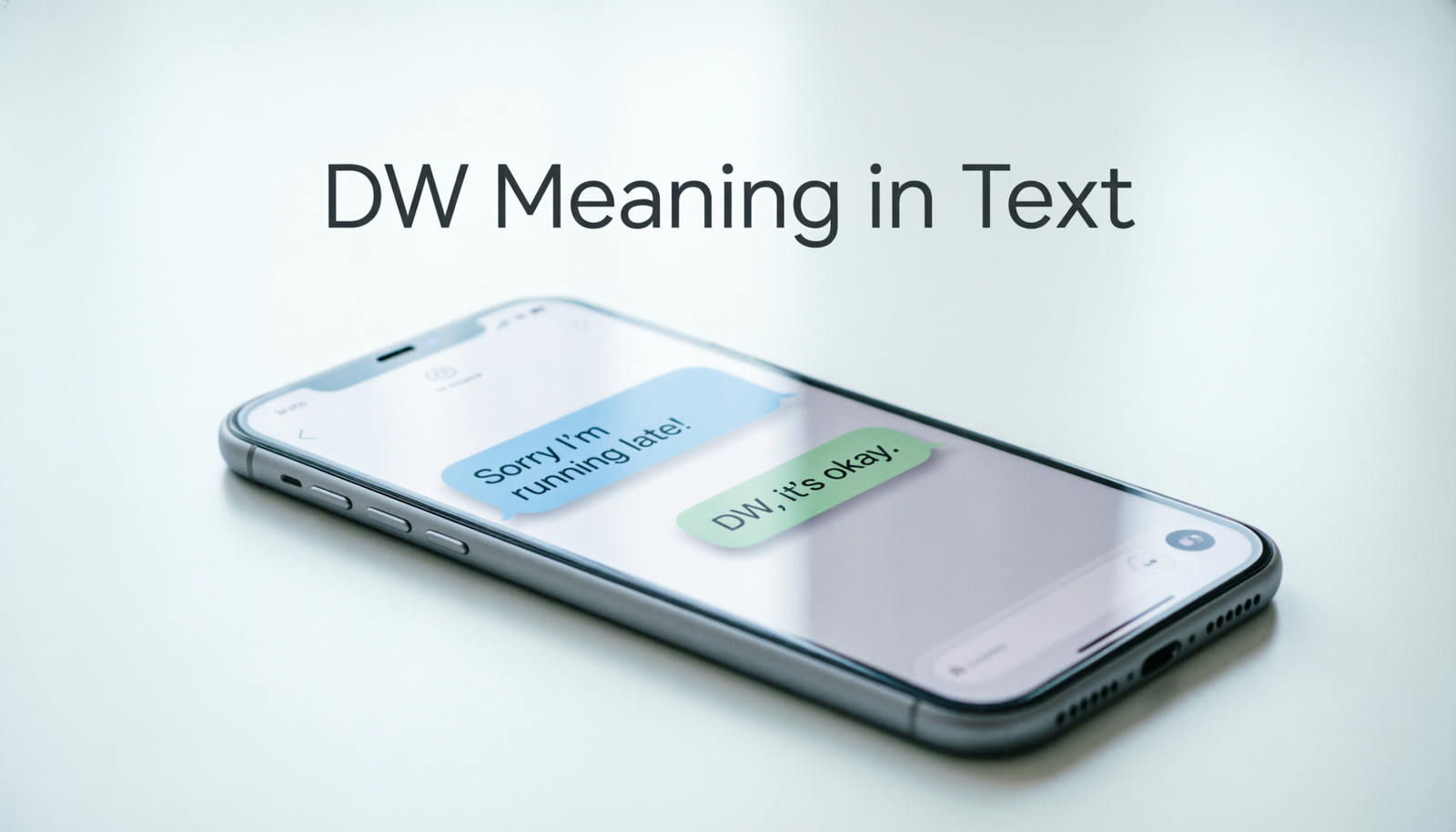
Quick Answer
DW in text usually means don’t worry. People use it to reassure someone, reduce stress, or say that a situation is not a problem. For example, if someone apologizes for replying late, you might answer, “dw, it’s fine.”
Depending on the conversation, DW can also mean:
- Don’t worry, the most common meaning in texting
- Dear wife, usually in family forums or personal posts
- Doctor Who, when discussing the television series
- Data warehouse, in business or technology conversations
- Dishwasher, in property listings or appliance discussions
In ordinary texts, direct messages, and social media comments, don’t worry is usually the correct interpretation.
People often see DW in a message and wonder whether it sounds caring, dismissive, friendly, or sarcastic. The meaning is simple, but the tone depends on the conversation.
In most casual messages, DW is a quick way to tell someone that everything is okay. A friend might use it after you apologize, ask for help, admit a mistake, or express concern. It commonly appears on texting apps, group chats, gaming platforms, and social media.
This guide explains the main DW meaning in text, how people use it, what tone it can carry, and how to respond. It also covers less common meanings so you can understand the abbreviation correctly in different situations.
| Term | Meaning | Tone | Example |
|---|---|---|---|
| DW | Don’t worry | Reassuring and casual | DW, I already handled it |
| DWAI | Don’t worry about it | Relaxed and reassuring | DWAI, it was not your fault |
| NW | No worries | Friendly and casual | NW, we can meet tomorrow |
| NBD | No big deal | Relaxed and informal | NBD, I can fix it |
| It’s all good | There is no problem | Friendly and conversational | It’s all good, no need to apologize |
What Does DW Mean in Text?
In texting, DW means don’t worry. It is used to reassure someone that a problem is minor, a situation is under control, or an apology is unnecessary.
For example:
Person 1: Sorry, I forgot to send the photo.
Person 2: Dw, send it whenever you can.
Here, DW tells the first person not to feel stressed or guilty. It makes the response shorter while keeping the conversation friendly.
DW can appear at the beginning or end of a message:
- DW, I will take care of it.
- I found your keys, dw.
- DW about being late.
- You can pay me tomorrow, dw.
Lowercase “dw” is more common in casual texting, but uppercase “DW” has the same meaning. Capitalization usually does not change the message.
Online slang references consistently identify don’t worry as the main meaning of DW in internet conversations, although less common definitions can appear in specialized contexts.
What Does DW Stand For?
The complete form of DW is usually don’t worry.
People shorten it because texting often favors quick, convenient responses. Instead of writing a full sentence such as “Don’t worry about it,” a person can type “dw” and communicate the same basic idea.
The abbreviation may express several related messages:
- Everything is okay.
- You do not need to apologize.
- I can handle the situation.
- The problem is not serious.
- You do not need to feel nervous.
- There is no need to keep thinking about it.
The surrounding words help reveal the exact intention. In “dw, I finished the assignment,” it means the task is under control. In “dw about yesterday,” it means the sender is not upset, In “dw, you will do great,” it offers emotional reassurance.
How DW Is Used in Conversations
DW is most natural in casual communication. People use it with friends, classmates, relatives, coworkers they know well, and other people with whom they have a relaxed relationship.
To Accept an Apology
A person may send DW to show that they are not angry.
Example:
Alex: Sorry I missed your call.
Jordan: DW, I was just checking in.
The response removes pressure and tells Alex that the missed call was not a serious issue.
To Reassure Someone
DW can comfort someone who feels nervous or uncertain.
Example:
Mia: I think I answered one question incorrectly.
Chris: DW, you probably did better than you think.
Here, the abbreviation works like a brief message of encouragement.
To Show That Something Is Handled
People also use DW when they have already solved a problem.
Example:
Sam: Do we still need someone to reserve the table?
Taylor: DW, I booked it this morning.
This means there is no need for further action.
To Reduce Pressure
DW may tell someone that a task is not urgent.
Example:
Lee: I cannot send the file until tonight.
Morgan: DW, tomorrow morning is fine too.
The sender is giving the other person more time and reducing stress.
Examples of DW in Text Messages
The meaning becomes easier to understand when you see it in realistic conversations.
Example 1: After an Apology
Person 1: Sorry for the late reply.
Person 2: Dw, I know you were busy.
Meaning: There is no need to apologize.
Example 2: Before an Event
Person 1: I am nervous about the interview.
Person 2: DW, you prepared well.
Meaning: Try not to feel anxious.
Example 3: Fixing a Mistake
Person 1: I entered the wrong date on the form.
Person 2: Dw, we can update it.
Meaning: The mistake can be corrected.
Example 4: Making Plans
Person 1: I might arrive ten minutes late.
Person 2: DW, we will wait inside.
Meaning: Being late is not a serious problem.
Example 5: Offering Help
Person 1: I still have not finished setting everything up.
Person 2: DW, I am coming early to help.
Meaning: You do not have to handle everything alone.
Example 6: Online Gaming
Player 1: Sorry, I missed that shot.
Player 2: Dw, we still have another round.
Meaning: Do not feel bad about the mistake.
Example 7: School or College
Student 1: I forgot to bring my notes.
Student 2: DW, you can use mine.
Meaning: A simple solution is available.
Example 8: Work Chat
Coworker 1: I may need another hour to finish the report.
Coworker 2: DW, the meeting was moved to tomorrow.
Meaning: The delay is acceptable.
What Does DW Mean on Social Media?
On social media, DW still usually means don’t worry. It may appear in comments, direct messages, captions, replies, or private group conversations.
For example:
- DW, I will post the pictures later.
- You did nothing wrong, dw.
- DW everyone, the account is back.
- I deleted it already, dw.
On platforms where people communicate quickly, abbreviations help keep messages brief. However, a very short response can sometimes appear less emotional than a complete sentence.
For example, “dw” may feel casual, while “Don’t worry, I completely understand” feels warmer and more thoughtful. Both can communicate reassurance, but the longer version provides more emotional clarity.
What Does DW Mean From a Girl or Guy?
DW has the same basic meaning regardless of who sends it. It normally means don’t worry.
A girl or guy might use it to:
- Accept your apology
- Reassure you
- Show that they are not upset
- Tell you that a problem has been handled
- End a discussion about a minor concern
The abbreviation alone does not prove romantic interest, anger, or emotional distance. You need to consider the complete conversation.
For example:
Sorry I could not come today.
Dw, maybe next time.
This response is polite and accepting. It does not automatically reveal whether the sender is disappointed, uninterested, or completely fine. Their usual texting style and the surrounding messages provide more information.
Is DW Friendly or Rude?
DW is usually friendly or neutral. It is commonly intended to calm someone or show that there is no problem.
However, tone can change based on punctuation, context, and the relationship between the people.
| Message | Likely Tone | Possible Meaning |
|---|---|---|
| Dw, it’s completely fine | Warm | No apology is needed |
| DW! You will be great | Encouraging | Try not to feel nervous |
| dw lol | Very casual | The situation is not serious |
| Dw about it | Neutral | Stop worrying about the issue |
| DW. | Brief or possibly cold | The sender may want to end the topic |
| I said dw | Impatient | The sender may be frustrated |
A period does not always indicate anger, but very short messages can feel more serious because they provide little emotional context.
When the situation is sensitive, a complete sentence is often better. “Don’t worry, I understand why that happened” sounds more supportive than a two letter response.
How to Respond to DW
Your response depends on why the person said it.
When someone reassures you, simple replies include:
- Thanks, I appreciate it.
- Okay, thank you.
- That makes me feel better.
- Got it.
- Thanks for understanding.
- I appreciate your help.
- Okay, I will stop stressing about it.
You do not always need to respond. If DW naturally ends the conversation, leaving it without a reply is usually fine.
For example:
You: Sorry again for the delay.
Them: DW, everything is sorted.
The conversation can end there because the concern has been resolved.
Other Possible Meanings of DW
Although don’t worry is the main DW meaning in text, context can give it another definition.
| Meaning | Where It Is Used | Simple Explanation | Example |
|---|---|---|---|
| Don’t worry | Texting and social media | There is no need to be concerned | DW, I fixed it |
| Dear wife | Family forums and personal posts | An affectionate reference to a wife | My DW planned the trip |
| Doctor Who | Entertainment discussions | The British science fiction series | We watched DW last night |
| Data warehouse | Business and technology | A system that stores data for analysis | The reports pull data from the DW |
| Dishwasher | Property and appliance notes | A kitchen appliance | The apartment includes a DW |
| Disney World | Travel conversations | A shortened reference to the resort | We are visiting DW this summer |
These alternate meanings are less likely in an ordinary personal text. The subject of the conversation usually makes the intended meaning clear.
For example, “My DW and I went out for dinner” probably means dear wife. “The DW needs a new data source” likely refers to a data warehouse. “DW, I already called them” means don’t worry.
DW Compared With Similar Texting Terms
Several abbreviations and phrases communicate a message similar to DW, but they are not always interchangeable.
DW and NW
DW means don’t worry.
NW means no worries.
Both can reassure someone, but NW is especially common as a response to an apology or request.
Example:
Sorry I forgot to reply.
NW, it happens.
DW and NBD
NBD means no big deal.
It emphasizes that a situation is not serious.
Example:
I spilled a little water on the table.
NBD, I will clean it.
DW would also work, but it focuses more directly on the person’s concern.
DW and DWAI
DWAI means don’t worry about it. It is essentially a longer version of DW.
Example:
I am sorry I could not help.
DWAI, we finished everything.
DW and It’s All Good
“It’s all good” is a complete casual phrase that means there is no problem. It often sounds slightly warmer because it is not shortened.
Example:
Sorry about the confusion.
It’s all good. We figured it out.
When You Should Avoid Using DW
DW works well in casual conversation, but it may not suit every situation.
Avoid relying only on DW when:
- Someone is describing a serious personal problem
- You are responding to grief, illness, or major distress
- The conversation is formal
- You are speaking with a customer or senior manager
- The person needs a detailed explanation
- Your response could sound dismissive
For example, if a friend says they are extremely worried about a family emergency, replying only with “dw” may feel insensitive. A more caring response would be:
“I’m sorry you are dealing with this. I’m here if you need anything.”
In professional communication, write the full phrase or provide specific reassurance:
“Please do not worry about the delay. We have adjusted the deadline.”
Common Mistakes When Using DW
Assuming It Always Means Don’t Worry
Don’t worry is the most common texting meaning, but DW may represent dear wife, Doctor Who, data warehouse, dishwasher, or another context specific term.
Read the complete message before deciding.
Using It in a Serious Conversation
DW can sound too casual when someone needs empathy. It reassures effectively in small everyday situations, but serious concerns deserve a fuller response.
Thinking Capital Letters Change the Meaning
DW and dw normally mean the same thing. Uppercase letters do not automatically indicate anger or excitement.
Assuming It Shows Romantic Interest
Someone using DW may be kind or supportive, but the abbreviation does not have an inherently romantic meaning.
Using It in Formal Writing
Avoid DW in essays, applications, reports, customer messages, and formal emails. Write “do not worry” or explain the situation more professionally.
Confusing DW With DWAI
DW means don’t worry, while DWAI means don’t worry about it. Their purpose is almost identical, but DWAI states the complete idea more clearly.
Conclusion
The most common DW meaning in text is don’t worry. It is a casual way to reassure someone, accept an apology, reduce pressure, or show that a situation is under control.
Context still matters because DW can also mean dear wife, Doctor Who, data warehouse, dishwasher, or Disney World. In an ordinary text or social media message, however, don’t worry is usually the intended meaning.
Use DW for relaxed conversations and minor concerns. When the situation is emotional, professional, or serious, choose a complete and more thoughtful response.
FAQs
What does DW mean in texting?
DW usually means don’t worry. It tells someone that they do not need to feel concerned, nervous, or sorry.
What does DW mean on Snapchat?
On Snapchat, DW normally means don’t worry. People use it in snaps and chats to reassure friends or respond casually to an apology.
What does DW mean on Instagram?
DW generally means don’t worry in Instagram comments and direct messages. Less common meanings depend on the topic being discussed.
Is DW a rude response?
DW is not normally rude. It is usually friendly or reassuring. However, replying only with “dw” during a serious conversation can sound dismissive.
What does lowercase dw mean?
Lowercase “dw” means the same thing as uppercase “DW.” Both commonly stand for don’t worry.
Can DW mean dear wife?
Yes. DW can mean dear wife in family forums, personal stories, or relationship discussions. The sentence usually makes this meaning clear.
What is the difference between DW and DWAI?
DW means don’t worry. DWAI means don’t worry about it. Both reassure someone, but DWAI expresses the complete phrase.
How should I reply when someone says DW?
You can respond with “Thanks,” “Okay,” “I appreciate it,” or “Thanks for understanding.” A reply is not always necessary if the conversation has naturally ended.