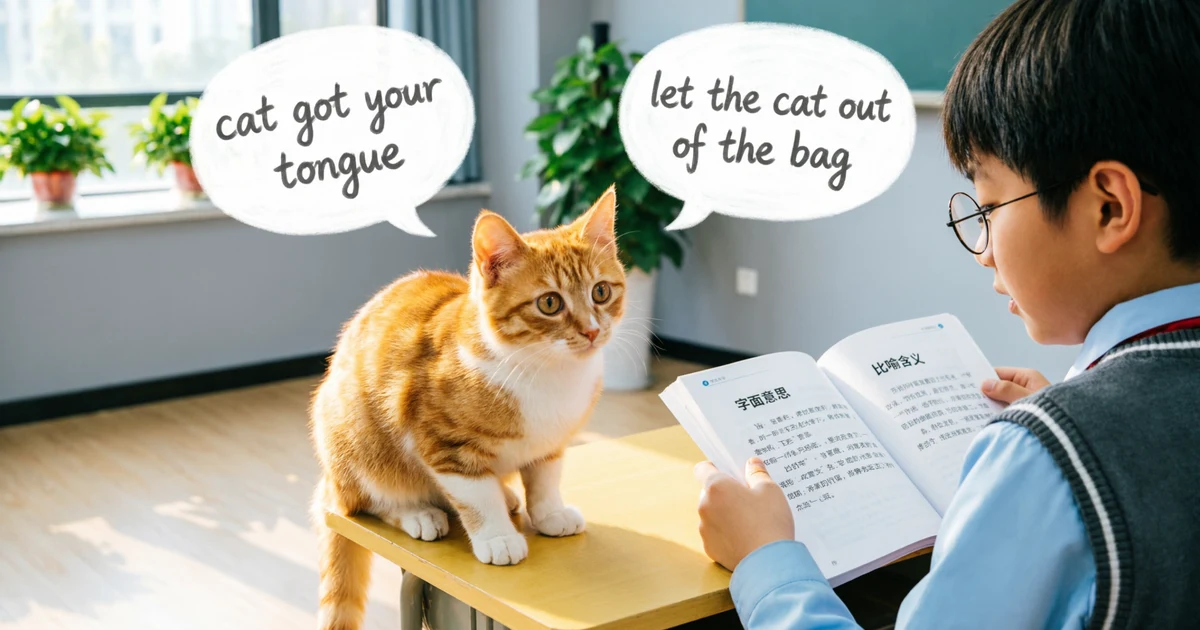
People searching for idioms for cat usually want expressions such as “let the cat out of the bag,” “cat got your tongue,” or “curiosity killed the cat.” These phrases mention cats, but they are rarely about real animals.
This can create confusion for students and ESL learners. A sentence such as “The cat is out of the bag” may describe an escaped pet in one situation and a revealed secret in another. The words look almost identical, but the intended meanings are completely different.
The main difference is simple:
A cat idiom has a figurative meaning that cannot always be understood from the individual words. A literal cat expression describes an actual cat, its behavior, or something directly connected to cats.
Cat idioms make speech and writing more colorful, memorable, and expressive. Literal cat expressions communicate direct facts. Understanding the difference helps learners interpret conversations accurately and use figurative language without sounding unnatural.
What Cat Idioms Mean
A cat idiom is a fixed or commonly recognized expression that includes the word “cat” or refers to cats but carries a figurative meaning.
For example:
Maya let the cat out of the bag about the surprise party.
No real cat or bag appears in this situation. The idiom means that Maya accidentally revealed a secret.
Simple definition
A cat idiom is a figurative expression involving cats whose full meaning differs from the ordinary meaning of its words.
Purpose
Writers and speakers use cat idioms to:
- express ideas vividly
- make conversations sound natural
- describe emotions or behavior creatively
- communicate familiar cultural meanings quickly
- add humor, personality, or emphasis
How cat idioms work
Cat idioms work through shared understanding. Native or experienced speakers recognize the expression as a complete unit rather than interpreting every word literally.
When someone asks, “Has the cat got your tongue?” the listener understands that the speaker is asking why someone has become silent. The sentence does not suggest that a cat physically took anyone’s tongue.
Short example
Don’t let the cat out of the bag before her birthday.
This means, “Do not reveal the secret.”
Why cat idioms get confused with literal expressions
Many cat idioms contain ordinary nouns and verbs. Because the grammar often looks normal, learners may interpret the sentence literally unless the surrounding context makes the figurative meaning clear.
What Literal Cat Expressions Mean
A literal cat expression is a phrase or sentence that directly refers to a real cat, its actions, its appearance, or its environment.
For example:
The cat jumped out of the bag.
This sentence describes an actual animal leaving a bag. The meaning comes directly from the words.
Simple definition
A literal cat expression describes a real cat or something genuinely related to cats.
Purpose
Literal expressions help speakers and writers:
- describe animals accurately
- report actions or events
- give instructions
- explain pet behavior
- communicate direct information
How literal cat expressions work
Literal language uses words according to their basic dictionary meanings. The reader does not need to search for a hidden, symbolic, or cultural interpretation.
In the sentence “The cat is sleeping under the table,” each word means exactly what it normally means.
Short example
Our cat sleeps beside the window every afternoon.
This sentence describes a real animal and a real routine.
Why literal expressions get confused with idioms
A literal sentence may use the same words as an idiom. Context determines whether the speaker means an actual cat or a figurative idea.
Compare:
The cat is out of the bag and running across the kitchen.
This is probably literal.
Now that the announcement has been published, the cat is out of the bag.
This is figurative.
Cat Idioms vs Literal Cat Expressions: The Core Difference
The core difference lies in meaning.
Cat idioms communicate an indirect or figurative idea. Literal cat expressions communicate a direct fact about a real cat.
Consider these two sentences:
The cat got your tongue.
The cat scratched your hand.
The first is an idiom asking why someone is silent. The second describes something an animal actually did.
A useful test is to ask:
Does the sentence truly involve a cat, or does the cat-related wording represent another idea?
When the cat is real, the expression is usually literal. When the wording represents secrecy, nervousness, curiosity, competition, or another human experience, it is probably idiomatic.
Quick Comparison Table
| Point | Cat Idioms | Literal Cat Expressions |
|---|---|---|
| Definition | Fixed expressions involving cats with figurative meanings | Direct statements about real cats |
| Scope | Part of figurative language | Part of ordinary literal language |
| Purpose | Adds color, emphasis, humor, or cultural meaning | Communicates facts, actions, or descriptions |
| Length | Often a short phrase or complete saying | Can be a phrase, sentence, or longer description |
| Structure | Usually follows a familiar, established wording | Can be written freely |
| Meaning | Often indirect or nonliteral | Direct and exact |
| Use in writing | Useful in dialogue, informal writing, stories, and creative descriptions | Useful in factual writing, instructions, reports, and descriptions |
| Interpretation | Requires context or cultural knowledge | Usually understood from the words themselves |
| Example | “Curiosity killed the cat.” | “The curious cat climbed the shelf.” |
How Cat Idioms Work
Cat idioms connect familiar animal qualities with human experiences. Cats often appear in idioms because people associate them with curiosity, secrecy, independence, agility, alertness, and conflict.
However, the modern meaning of an idiom does not always match a real cat’s behavior. Idioms develop through history, culture, repetition, and shared usage.
Fixed wording
Many idioms have a recognized form. Changing too many words can make the expression sound unnatural.
Standard:
Let the cat out of the bag.
Unnatural variation:
Release the kitten from the shopping sack.
The second sentence may communicate a similar image, but English speakers will not normally recognize it as the same idiom.
Figurative interpretation
Listeners interpret the complete phrase rather than its individual words.
For example:
They were fighting like cats and dogs.
The expression does not necessarily involve animals. It means that people were arguing fiercely and repeatedly.
Context
Context reveals whether an expression is idiomatic.
After weeks of secrecy, the cat is finally out of the bag.
Words such as “secrecy” signal a figurative meaning.
The bag opened, and the cat ran into the garden.
The physical details signal a literal meaning.
Cultural familiarity
Some cat idioms are common across English-speaking regions. Others may sound dated, informal, or more familiar in certain countries.
Learners should focus first on widely recognized expressions and observe how native speakers use them in real conversations, books, films, and articles.
How Literal Cat Expressions Work
Literal cat expressions follow ordinary rules of meaning. They describe what a cat is, has, does, or experiences.
Common literal patterns include:
1-Describing appearance
The cat has soft gray fur and bright green eyes.
2-Describing action
The cat climbed onto the fence.
3-Describing location
A cat is hiding beneath the car.
Describing behavior
My cat becomes nervous around strangers.
Giving instructions
Keep the cat indoors during the storm.
Literal expressions do not depend on shared cultural knowledge. A learner can usually understand them by knowing the vocabulary and grammar.
They can still include vivid or creative details, but the central meaning remains direct.
For example:
The black cat moved silently through the garden.
This sentence creates an image, but it still describes a real cat.
Key Differences in Simple Language
Cat idioms are figurative
Their meaning goes beyond the ordinary meanings of the words.
He is a copycat.
This means that he copies another person.
Literal cat expressions are direct
They describe an actual animal or cat-related fact.
The kitten copied the older cat’s movement.
This describes real animal behavior.
Idioms are usually fixed
An idiom often needs familiar wording to remain recognizable.
While the cat’s away, the mice will play.
Changing the structure too much may weaken or destroy the established meaning.
Literal expressions are flexible
You can change the vocabulary and sentence structure as long as the facts remain clear.
The cat slept on the chair.
A small tabby was sleeping peacefully on the old chair.
Both sentences remain literal.
Idioms may require explanation
An ESL learner might not understand “fat cat” without cultural context. The phrase often refers to a wealthy or powerful person, especially one viewed critically.
Literal expressions rarely need hidden interpretation.
The fat cat struggled to fit through the opening.
This simply describes the animal’s size.
Idioms often describe people or situations
Although they mention cats, their real subjects are frequently human behavior, secrets, risks, conflict, or social situations.
Literal expressions keep the animal at the center of the meaning.
Can Cat Idioms and Literal Cat Expressions Overlap?
Yes. The same wording can sometimes work literally or idiomatically.
Consider:
The cat is out of the bag.
As an idiom, it means that a secret has become known.
In a literal story, it could mean that an actual cat has escaped from a bag.
The surrounding sentence usually clarifies the meaning:
Everyone now knows about the engagement, so the cat is out of the bag.
This is idiomatic.
I opened the carrier, and within seconds the cat was out of the bag.
This is literal.
Writers can also use this overlap deliberately for humor or wordplay.
For example, a pet shop advertisement might say:
The cat is out of the bag: our adoption event starts Saturday.
The expression announces news while maintaining a playful connection to real cats.
This technique is called a pun because it uses two possible meanings at once.
Examples of Cat Idioms
1. Let the cat out of the bag
Meaning: Reveal a secret, often accidentally.
Example:
Daniel let the cat out of the bag about the planned promotion.
Best used for: Surprises, confidential plans, or hidden information.
2. Cat got your tongue?
Meaning: Why are you silent?
Example:
You were talking a moment ago. Has the cat got your tongue?
Best used for: Informal conversations, often with a teasing tone.
3. Curiosity killed the cat
Meaning: Too much curiosity can lead to trouble.
Example:
Stop opening files that do not belong to you. Curiosity killed the cat.
Best used for: Warning someone against unnecessary investigation.
4. Like a cat on a hot tin roof
Meaning: Extremely nervous, restless, or uncomfortable.
Example:
He paced around the waiting room like a cat on a hot tin roof.
Best used for: Describing visible anxiety or restlessness.
5. Fight like cats and dogs
Meaning: Argue constantly or fiercely.
Example:
The two brothers fight like cats and dogs but still care about each other.
Best used for: Frequent personal conflict.
6. When the cat’s away, the mice will play
Meaning: People may misbehave when the person in authority is absent.
Example:
The manager left early, and the office became noisy. When the cat’s away, the mice will play.
Best used for: Workplaces, classrooms, homes, or other situations involving authority.
7. Look what the cat dragged in
Meaning: A humorous or rude way to greet someone who looks untidy or arrives unexpectedly.
Example:
Well, look what the cat dragged in! We have not seen you for months.
Best used for: Informal teasing among people who know each other well.
Usage warning: This expression can sound insulting if used with strangers.
8. There is more than one way to skin a cat
Meaning: A problem can have several possible solutions.
Example:
We can revise the plan instead of cancelling it. There is more than one way to skin a cat.
Best used for: Problem-solving discussions.
Usage note: Some speakers avoid this idiom because its imagery sounds unpleasant. “There is more than one way to solve the problem” is a neutral alternative.
9. A cat nap
Meaning: A short, light sleep.
Example:
I took a quick cat nap before the evening meeting.
Best used for: Casual conversation about rest.
10. A copycat
Meaning: A person who copies someone else’s ideas, behavior, or appearance.
Example:
Stop being a copycat and create your own design.
Best used for: Informal criticism, especially among children.
11. A scaredy-cat
Meaning: A person who becomes frightened easily.
Example:
I will not enter that abandoned building. Call me a scaredy-cat if you like.
Best used for: Playful or informal speech.
Usage warning: It may sound childish or insulting.
12. A fat cat
Meaning: A wealthy and powerful person, often viewed as privileged or selfish.
Example:
Critics claimed the policy mainly benefited corporate fat cats.
Best used for: Political, financial, or critical commentary.
13. Play cat and mouse
Meaning: Engage in a repeated struggle in which one side chases, tricks, or controls the other.
Example:
The detective and the suspect played cat and mouse for weeks.
Best used for: Crime stories, competition, strategy, or tense negotiations.
14. Like herding cats
Meaning: Extremely difficult to organize because people act independently.
Example:
Coordinating twelve creative freelancers felt like herding cats.
Best used for: Group projects, events, teams, or chaotic situations.
15. Grin like a Cheshire cat
Meaning: Smile very broadly, often with obvious satisfaction.
Example:
She grinned like a Cheshire cat after winning the competition.
Best used for: Stories and informal descriptions.
16. The cat’s whiskers
Meaning: An excellent or impressive person or thing.
Example:
He thinks his new sports car is the cat’s whiskers.
Best used for: Playful or old-fashioned speech.
17. Not enough room to swing a cat
Meaning: A place is extremely small or crowded.
Example:
The apartment was so tiny that there was not enough room to swing a cat.
Best used for: Informal descriptions of cramped spaces.
Usage note: The phrase is figurative and does not suggest harming an animal.
18. Put the cat among the pigeons
Meaning: Cause trouble, alarm, or controversy.
Example:
Her unexpected announcement put the cat among the pigeons.
Best used for: Situations where one action creates confusion or strong reactions.
This expression appears more commonly in British English than in everyday American English.
19. Rain cats and dogs
Meaning: Rain very heavily.
Example:
It was raining cats and dogs when we left the theater.
Best used for: Informal descriptions of heavy rain.
20. Like the cat that got the cream
Meaning: Look extremely pleased or self-satisfied.
Example:
He looked like the cat that got the cream after receiving the award.
Best used for: Describing visible satisfaction, especially in British English.
Examples of Literal Cat Expressions
Literal cat expressions describe genuine animals and situations.
Appearance
The cat has a white patch beneath its chin.
Her orange cat has long, thick fur.
Movement
The cat jumped onto the windowsill.
A kitten chased a leaf across the yard.
Sound
The cat meowed outside the bedroom door.
We heard a cat purring beneath the table.
Behavior
My cat hides whenever visitors arrive.
The mother cat carefully carried her kittens.
Health and care
The cat needs fresh water every day.
We took our cat to the veterinarian for a checkup.
Location
A stray cat was sleeping near the garage.
The cat is sitting inside the cardboard box.
Literal versions of idiom-like wording
The cat dragged a sock into the kitchen.
This is literal because a real cat moved an object.
The cats and dogs were fighting in the yard.
This may be literal if actual animals were fighting.
The cat climbed out of the bag.
This describes a real physical action.
Cat Idioms vs Literal Cat Expressions in Literature and Writing
Writers use cat idioms and literal cat descriptions for different purposes.
Cat idioms in dialogue
Idioms can make dialogue sound natural and reveal a character’s personality.
“Are you going to answer me, or has the cat got your tongue?”
This line may show impatience, humor, or teasing.
However, writers should not overload dialogue with idioms. Too many familiar expressions can make characters sound artificial or clichéd.
Cat idioms in narration
An idiom can summarize an emotional state quickly.
Marcus waited like a cat on a hot tin roof.
The reader immediately imagines restlessness and discomfort.
Literal cats as characters
A literal cat can play an important role in a story.
The cat watched the empty road from the window, its tail moving slowly from side to side.
The animal may contribute to the setting, mood, plot, or characterization.
Symbolic cats
A cat can be literal and symbolic at the same time.
For example, a real black cat in a story may represent mystery, independence, superstition, or danger. The animal physically exists in the narrative, but the writer also gives it a deeper meaning.
That does not automatically make the sentence an idiom. An idiom is a conventional expression shared by speakers. A symbol receives its meaning from the particular story or cultural setting.
Wordplay
Writers sometimes combine literal and idiomatic meanings:
After the kitten escaped from the birthday box, the cat was literally out of the bag and the surprise was ruined.
The sentence plays with both meanings of the expression.
Cat Idioms vs Literal Cat Expressions for Students and ESL Learners
Cat idioms can be challenging because translating each word separately usually does not reveal the intended meaning.
A learner might read:
We need to let the cat out of the bag.
A literal translation may create a confusing image. The learner needs to understand that the phrase functions as one complete expression meaning “reveal the secret.”
Learn the whole phrase
Do not memorize only the word “cat.” Learn the complete expression:
- let the cat out of the bag
- play cat and mouse
- fight like cats and dogs
- take a cat nap
Learn meaning and context together
Knowing the definition is not enough. Observe where the idiom sounds natural.
For example, “cat got your tongue?” is informal. It would usually sound inappropriate in a serious professional email.
Notice tone
Some cat idioms sound:
- playful
- old-fashioned
- critical
- teasing
- rude
- informal
“Copycat” can sound playful among children but dismissive in a professional discussion.
Use context clues
Look for words related to secrecy, behavior, authority, fear, or conflict.
Someone leaked the plan, so the cat is out of the bag.
The reference to leaked information supports the idiomatic meaning.
Do not force idioms into every conversation
Idioms can make English sound natural, but incorrect or excessive use has the opposite effect. Use expressions that fit the situation and tone.
Compare literal and idiomatic pairs
Studying pairs helps learners understand the difference.
Idiomatic:
The reporters finally let the cat out of the bag.
Literal:
The child gently let the cat out of its carrier.
Idiomatic:
Our negotiations became a game of cat and mouse.
Literal:
The cat watched the mouse from behind the cupboard.
Common Mistakes and Confusion
Mistake 1: Interpreting every cat phrase literally
Not every sentence involving a cat describes an animal.
Incorrect interpretation:
“The cat is out of the bag” means a pet escaped.
Correct idiomatic interpretation:
A secret has been revealed.
Always check the context.
Mistake 2: Assuming every cat reference is an idiom
A creative description is not necessarily idiomatic.
She moved as quietly as a cat.
This is a simile because it uses “as” to compare her movement with a cat’s movement. It is not a fixed cat idiom in the same sense as “let the cat out of the bag.”
Mistake 3: Changing fixed wording
Incorrect:
He released the cat from the secret bag.
Correct:
He let the cat out of the bag.
Idioms often lose their recognized meaning when their wording changes too much.
Mistake 4: Using informal idioms in formal writing
Expressions such as “scaredy-cat” and “look what the cat dragged in” rarely belong in academic reports or formal business documents.
A formal alternative may work better:
He appeared reluctant to take the risk.
Instead of:
He was a scaredy-cat.
Mistake 5: Using culturally unfamiliar idioms without context
Some readers may not know regional or old-fashioned expressions such as “the cat’s whiskers.”
When clarity matters, use a direct phrase or briefly explain the meaning.
Mistake 6: Confusing idioms with proverbs
“Let the cat out of the bag” is an idiom because it functions as a figurative expression.
“Curiosity killed the cat” can also function as a proverb because it communicates a general warning or lesson.
Some expressions belong to more than one category.
Mistake 7: Confusing idioms with similes
He fought like a cornered cat.
This is a simile because it makes a direct comparison using “like.”
The two managers fought like cats and dogs.
This expression functions as a conventional idiom and also contains a comparison structure.
The categories can overlap, but they are not identical.
Mistake 8: Ignoring tone
“Look what the cat dragged in” can sound friendly among close friends but offensive in a workplace or formal gathering.
Correct grammar does not always mean appropriate usage.
When to Use Cat Idioms and When to Use Literal Cat Expressions
Use a cat idiom when you want to:
- describe a human situation figuratively
- make dialogue sound conversational
- add humor or personality
- create a memorable comparison
- communicate a familiar cultural idea
- avoid a plain or repetitive description
Example:
Organizing the volunteers was like herding cats.
Use a literal cat expression when you want to:
- describe a real animal
- provide clear factual information
- explain pet behavior
- write instructions
- report an event accurately
- avoid ambiguity
Example:
Keep the cat away from the open window.
In formal or international communication, direct wording is often safer because some readers may not recognize the idiom.
Instead of:
We should not let the cat out of the bag yet.
You could write:
We should not announce the information yet.
The second version is clearer for a broad audience.
Related Terms People Often Confuse With Cat Idioms
Metaphor
A metaphor describes one thing as another to create a comparison.
She is a tiger in the courtroom.
This is a metaphor. It suggests that she is fierce or powerful.
Some idioms contain metaphorical ideas, but not every metaphor is an idiom. An idiom is usually conventional and widely recognized. A writer can create a new metaphor.
Simile
A simile compares two things using words such as “like” or “as.”
He moved as silently as a cat.
This is a simile.
Some expressions, such as “fight like cats and dogs,” may function as both familiar idioms and simile-like comparisons.
Proverb
A proverb expresses general advice, wisdom, or a lesson.
Curiosity killed the cat.
This statement warns that unnecessary curiosity can cause trouble. It often functions as both a proverb and an idiomatic expression.
Saying
A saying is a broad category for familiar expressions people repeat.
Many idioms and proverbs are sayings, but not all sayings use figurative language.
Cliché
A cliché is an expression or idea that has become overused.
A cat idiom may become clichéd when writers use it too often or in predictable ways.
Pun
A pun uses similar sounds or multiple meanings for humor.
We are not kitten around.
This joke replaces “kidding” with “kitten” because the words sound related.
It is wordplay rather than a traditional idiom.
Symbolism
Symbolism occurs when an object, animal, color, or action represents a deeper idea.
A cat in a story might symbolize independence or mystery. This symbolic meaning depends on the story and does not automatically create an idiom.
Collocation
A collocation is a group of words that commonly appear together.
Examples include:
- stray cat
- domestic cat
- cat food
- cat owner
- cat lover
These are ordinary word combinations, not idioms, because their meanings remain direct.
Conclusion
Cat idioms and literal cat expressions may use similar words, but they communicate meaning in different ways.
A cat idiom uses cat-related language figuratively. Expressions such as “let the cat out of the bag,” “cat got your tongue,” and “like herding cats” describe secrets, silence, or difficult situations rather than real animals.
A literal cat expression directly describes an actual cat, its appearance, actions, behavior, location, or care.
The easiest way to distinguish them is to examine the context. When the sentence truly concerns an animal, the meaning is probably literal. When the cat-related wording represents a human situation or abstract idea, the phrase is probably idiomatic.
For students and ESL learners, the best method is to learn each idiom as a complete expression, study its tone, and compare it with natural examples. Writers should use cat idioms carefully so they add personality without reducing clarity.
FAQs
What are idioms for cats?
Idioms for cats are figurative expressions that mention cats or cat-related behavior. Common examples include “let the cat out of the bag,” “cat got your tongue?” and “fight like cats and dogs.”
What is the most common cat idiom?
“Let the cat out of the bag” is one of the most widely recognized cat idioms. It means to reveal a secret, often accidentally.
Is “curiosity killed the cat” an idiom or a proverb?
It can function as both. It is idiomatic because its meaning is not limited to a real cat, and it is proverbial because it communicates a general warning about excessive curiosity.
Is “as quiet as a cat” an idiom?
It is more accurately described as a simile because it makes a direct comparison using “as.” It may sound familiar, but it does not function like a fixed idiom such as “let the cat out of the bag.”
What does “cat got your tongue?” mean?
It means, “Why are you not speaking?” People usually use it informally when someone becomes unexpectedly silent.
Are cat idioms suitable for formal writing?
Some can appear in articles, speeches, and professional writing, but many sound informal. Direct language is usually better when clarity, seriousness, or international understanding matters.
How can ESL learners remember cat idioms?
Learners should memorize each idiom as a complete phrase, connect it with one clear meaning, study a natural example, and note whether its tone is formal, informal, humorous, or critical.