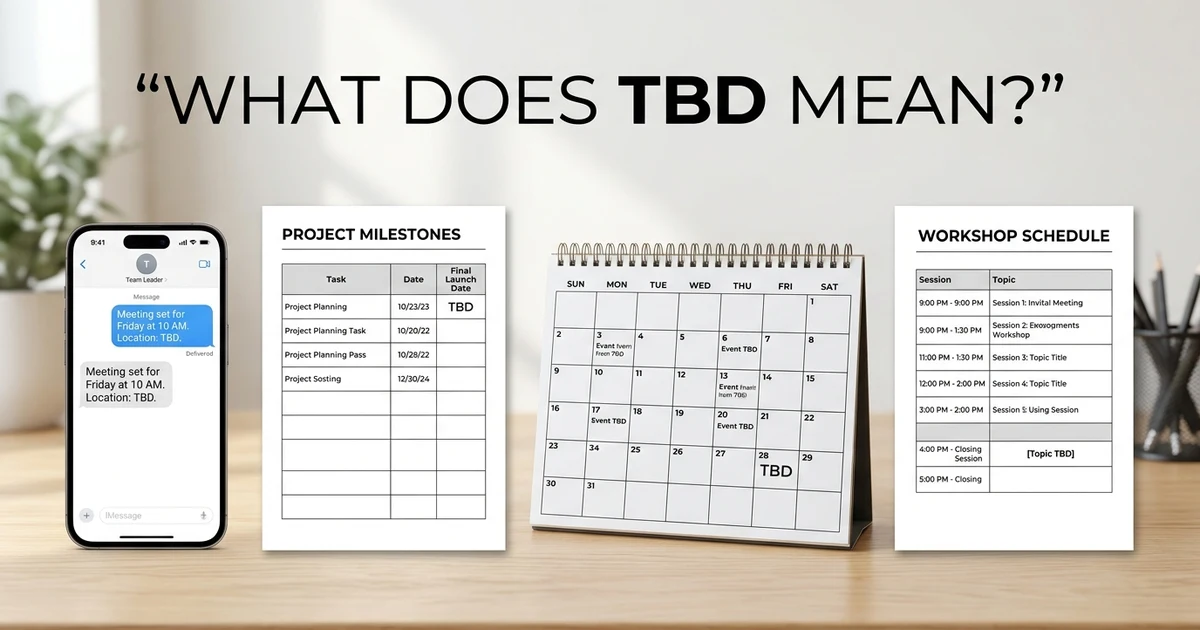
Quick Answer
TBD usually stands for To Be Determined. It tells the reader that a particular detail has not been finalized yet. That detail could be a date, time, location, price, person, or decision. You may see the abbreviation on event schedules, school announcements, workplace documents, sports calendars, websites, and text messages. In some contexts, people also use it to mean To Be Decided, which has a very similar meaning.
Introduction
Short abbreviations can make schedules and messages easier to read, but they can also be confusing when you do not know what they mean. One example is TBD, which appears in many everyday situations. You might see it next to an event date, a meeting location, a sports matchup, or a project deadline. Rather than leaving an empty space, the writer uses the abbreviation to show that the information is still pending.
The term is especially common in planning. A person or organization may know that something is going to happen but may not have worked out every detail yet. For example, an event could already be scheduled while its exact location remains undecided.
Understanding this abbreviation also helps you distinguish between information that is unknown, information that will be announced later, and information that still needs confirmation. This guide explains its main meaning, common uses, examples, related expressions, and mistakes to avoid.
What Does TBD Stand For?
The most common expansion is To Be Determined.
It describes information that has not been established or finalized yet. The decision may happen later, after someone has more information or finishes making arrangements.
For example:
Meeting location: TBD
This means the meeting location has not been finalized.
Another example is:
Release date: TBD
Here, the project may still be planned for release, but there is no confirmed date yet.
Some people also use the same abbreviation for To Be Decided. This version emphasizes that somebody still needs to make a choice.
The difference between the two expressions is small in everyday communication. In most cases, the important message is simply that the information is not final.
How the Meaning Changes With Context
The basic idea stays the same, but the type of pending information can vary considerably.
| Situation | What It Means | Example |
|---|---|---|
| Event | A detail has not been finalized | Venue: TBD |
| School | A date or assignment is pending | Exam date: TBD |
| Workplace | A business decision remains open | Launch date: TBD |
| Sports | A future participant or time is unknown | Opponent: TBD |
| Travel | A reservation or destination detail is undecided | Hotel: TBD |
| Texting | Plans have not been settled | Dinner plans are TBD |
The surrounding words usually make the intended meaning obvious. If you see the abbreviation beside a date, the date is probably the missing information. If it appears beside a location, the venue or meeting place is likely still undecided.
Common Uses in Everyday Life
Events and Schedules
Event organizers often publish information before every detail has been confirmed.
Imagine an announcement that says:
Event: Summer Festival
Date: July 18
Location: TBD
The date is confirmed, but the venue has not been selected or announced yet.
This approach is useful because organizers can share the information they already know without pretending that unfinished details are final.
School and College
Students can encounter the abbreviation in class schedules, field trip announcements, projects, and activities.
For example:
Field trip date: TBD
This tells students that the trip date has not been finalized.
A project notice could also say:
Presentation order: TBD
That means the order will be decided later.
Workplaces and Projects
Teams often use short labels when creating project plans.
For example:
Project manager: TBD
means the person responsible has not been confirmed.
A project timeline could say:
Launch date: TBD
This indicates that the team has not established a final date.
Using the abbreviation can be convenient in spreadsheets and project management documents where space is limited.
Sports
Sports schedules can contain details that depend on earlier results or future decisions.
For example:
Playoff opponent: TBD
means the opponent is not known yet.
You might also see:
Game time: TBD
This means the game has been scheduled in some way, but the exact starting time has not been confirmed.
Travel Plans
Travel arrangements sometimes change while people are still planning.
For example:
Hotel: TBD
means the traveler has not selected or confirmed the hotel.
Likewise:
Departure time: TBD
shows that the exact time is still being worked out.
This does not automatically indicate a problem. It simply means the plan is incomplete.
What Does TBD Mean in Texting?
In text messages, people normally use it as a quick way to say that plans are not settled.
For example:
“What time should we meet?”
“Not sure yet. Time is TBD.”
The person has not chosen a time.
Another example:
“Where are we eating tonight?”
“Place is TBD.”
That means nobody has settled on a restaurant or location yet.
The expression is generally neutral. It does not necessarily communicate uncertainty about whether something will happen. It often refers only to one unfinished detail.
Examples of Natural Usage
Here are some situations where the abbreviation sounds natural:
The meeting date is TBD.
Our weekend plans are still TBD.
The final price has not been announced yet.
The venue is TBD while the organizers finish planning.
The next game time is TBD.
The exact deadline will be shared later.
Notice that not every sentence needs the abbreviation. When a full explanation sounds clearer, it is better to write the information normally.
For example:
The exact meeting time has not been decided yet.
That can be more natural in a longer paragraph than repeatedly using shorthand.
TBD vs TBA vs TBC
Three abbreviations often appear in similar situations: TBD, TBA, and TBC. Although they can overlap, each one has a slightly different emphasis.
| Term | Full Form | Typical Meaning | Example |
|---|---|---|---|
| TBD | To Be Determined | A detail has not been decided or finalized | Location: TBD |
| TBA | To Be Announced | Information will be announced later | Speaker: TBA |
| TBC | To Be Confirmed | A detail still needs confirmation | Date: TBC |
Consider a conference as an example.
If organizers have not chosen the speaker yet, they might use TBD.
And if they have already selected the speaker but have not revealed the name publicly, TBA may fit better.
If they have a proposed date but are waiting for final confirmation, TBC can be appropriate.
In casual communication, people sometimes use these terms loosely. The exact distinction therefore depends on the person or organization using them.
Does TBD Mean Canceled?
No. It normally does not mean canceled.
Suppose a website says:
Event date: TBD
The event may still be going ahead. The organizers simply have not selected or confirmed the date.
That is very different from:
Event: Canceled
The second statement clearly says that the event will not take place.
This distinction is important when reading schedules. A missing detail should not automatically be interpreted as a cancellation.
Can TBD Mean To Be Decided?
Yes. Some people use the abbreviation for To Be Decided instead of To Be Determined.
For example:
Dinner location: TBD
could mean that the group has not chosen where to eat.
The two phrases communicate almost the same idea. In ordinary conversations, readers usually understand the intended meaning from context.
If precision matters, especially in formal writing, you can simply spell out the exact phrase instead of relying on the abbreviation.
When Should You Use the Abbreviation?
It works particularly well in compact formats such as:
• Calendars
• Schedules
• Spreadsheets
• Event listings
• Project plans
• Short messages
• Planning documents
• Online announcements
For example, a schedule can efficiently show:
Date: June 15
Time: 7 PM
Venue: TBD
A blank venue field might look incomplete, while this notation clearly communicates that the information is intentionally pending.
In formal prose, however, writing the phrase in full may be easier for readers.
Instead of:
The deadline is TBD.
you could write:
The deadline has not yet been determined.
The second version fits better in many reports and formal explanations.
Common Mistakes to Avoid
One mistake is assuming that the abbreviation means someone forgot to provide information. Usually, it indicates that the information genuinely has not been finalized.
Another mistake is treating a pending detail as confirmed. If a schedule says the time is undecided, you should not assume a particular start time.
It is also easy to confuse this expression with TBA or TBC. The three terms are related, but they can describe different stages of planning.
Finally, do not assume that every occurrence has the same meaning in every specialized field. Abbreviations can have industry specific definitions. Context should always guide your interpretation.
Conclusion
TBD is a common abbreviation used to show that information has not been finalized. It most often means To Be Determined, although To Be Decided is also used.
You can encounter it in event schedules, school notices, project plans, sports information, travel arrangements, and everyday messages. The key is to look at the surrounding information to understand exactly what remains pending.
When you see these three letters, the safest assumption is simple: that particular detail is not final yet.
Frequently Asked Questions
What does TBD mean?
It usually means To Be Determined. It indicates that a piece of information has not been finalized yet.
What does TBD mean on a schedule?
It means the information beside it is still pending. For example, a venue marked this way has not been finalized or confirmed.
Is TBD the same as TBA?
No. TBA means To Be Announced, while TBD usually indicates that a detail still needs to be determined. The terms can overlap in casual use.
What does TBD mean in a text message?
It usually means that plans or details have not been settled. Someone might use it when discussing a meeting time, destination, or weekend plan.
Does TBD mean canceled?
No. It normally means that one or more details remain undecided. A canceled event would usually be labeled as canceled or postponed.
Can TBD mean To Be Decided?
Yes. Some people use it as a shortened form of To Be Decided. The meaning is very close to To Be Determined.
Is it okay to use TBD in formal writing?
It can work well in schedules, tables, and planning documents. In formal paragraphs, spelling out the phrase can make the writing clearer.
What is the difference between TBD and TBC?
TBD generally indicates that a detail still needs to be determined, while TBC usually means a proposed detail still needs confirmation.