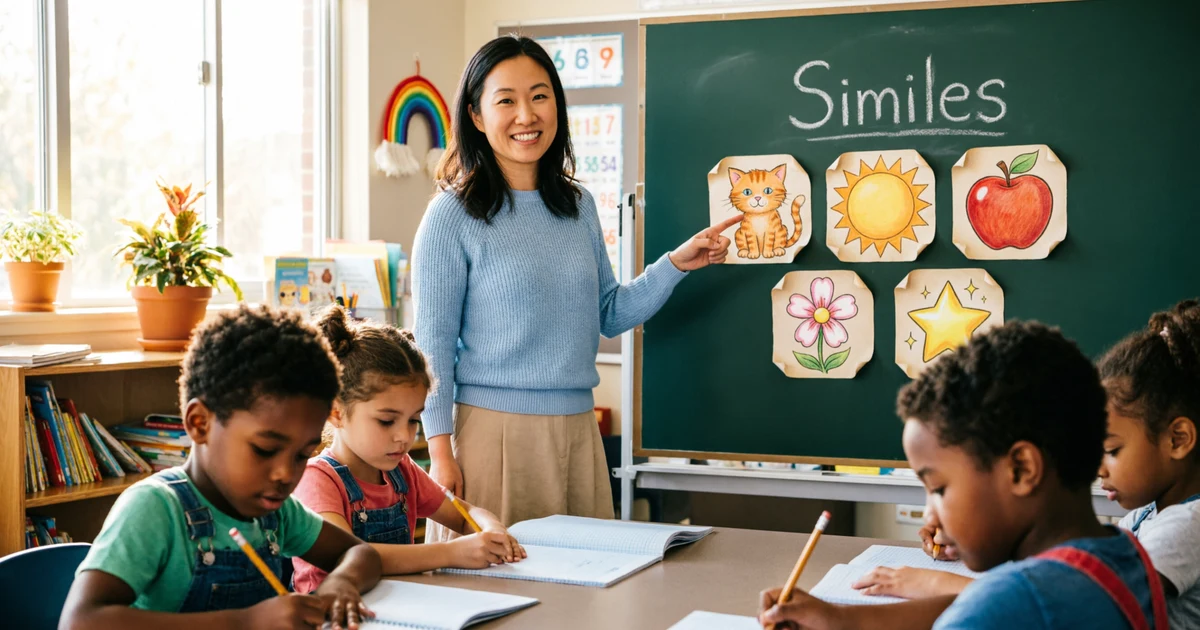
A first grader learns best when language feels clear, fun, and close to daily life. Similes help children compare one thing with another, so they can describe people, animals, objects, and feelings in a more colorful way.
In this guide, students, parents, and teachers will learn what a simile means, how to explain it simply, and how to practice it through easy examples, picture activities, fill in the blank tasks, worksheets, and a quick quiz.
What a Simile Means for Grade 1 Students
A simile compares two different things by using like or as. It helps a child explain something in a clear and creative way.
A simple example:
The sun is like a big yellow ball.
This sentence compares the sun with a ball because both look round and bright.
Another example:
Her smile is as bright as the sun.
This sentence compares a smile with the sun because both can feel bright and happy.
For grade 1 students, a simile should stay short and easy. Children should compare things they already know, such as animals, colors, food, toys, weather, and classroom items.
Simple Way to Explain Similes to First Graders
Tell children that a simile works like a small comparison. It answers this simple question:
What does this thing remind you of?
For example, ask a child to look at a soft pillow. Then ask:
What else feels soft?
The child might say a cloud, cotton, or a teddy bear.
Now turn that idea into a simile:
The pillow is as soft as cotton.
This method helps children understand similes without confusion. Start with things they can see, touch, hear, smell, or taste.
Good beginner questions include:
- What does it look like?
- What does it feel like?
- What does it sound like?
- What does it remind you of?
- What else has the same color, shape, or feeling?
Easy Simile Examples for Grade 1
Grade 1 students need simple similes with familiar words. These examples work well for reading practice, writing practice, and classroom discussion.
- The baby is as cute as a kitten.
- The ball is as round as an orange.
- The blanket is as warm as sunshine.
- The boy runs like a rabbit.
- The girl sings like a bird.
- The stars shine like tiny lights.
- The dog sleeps like a baby.
- The apple is as red as a rose.
- The snow is as white as milk.
- The classroom is as busy as a beehive.
Each sentence compares two things. The comparison helps the reader picture the idea quickly.
Similes Using Like for Young Learners
A simile with like compares an action or thing to something else. Young learners often understand like more easily because it sounds natural in spoken language.
Examples:
- He jumps like a frog.
- She swims like a fish.
- The leaves dance like butterflies.
- The rain falls like tiny beads.
- The puppy follows me like a shadow.
- The car moves like a rocket.
- The baby crawls like a turtle.
- The kite flies like a bird.
Teachers can ask students to act out some of these similes. When a child jumps like a frog or swims like a fish with hand motions, the idea becomes easier to remember.
Similes Using As for First Grade Students
A simile with as often follows a simple pattern:
as describing word as object
This pattern helps first graders build clear sentences.
Examples:
- as brave as a lion
- as quiet as a mouse
- as busy as a bee
- as light as a feather
- as cold as ice
- as sweet as candy
- as fast as a cheetah
- as soft as a pillow
- as bright as the moon
- as happy as a child at play
Students can use this pattern to make their own sentences.
Example:
My kitten is as quiet as a mouse.
The phrase gives the sentence more detail and makes the writing stronger.
Animal Similes for Grade 1
Animal similes help children learn quickly because animals feel familiar and exciting. These similes also help students connect actions with animal behavior.
Examples:
- He is as brave as a lion.
- She is as gentle as a lamb.
- The boy runs like a deer.
- The girl climbs like a monkey.
- The puppy eats like a hungry bear.
- The child hops like a rabbit.
- The bird sings like a tiny flute.
- The kitten sleeps like a baby.
- The turtle walks as slowly as a snail.
- The bee moves as busy as a worker.
Animal similes work well for stories. A child can describe a character by comparing that character with an animal.
Example:
Tom ran like a deer across the playground.
This sentence helps the reader imagine fast movement.
Color Similes for Grade 1 Writing
Color similes help children describe objects in a bright and simple way. First graders often notice colors before they notice deeper details, so color comparisons make writing easier.
Examples:
- The apple is as red as a rose.
- The sky is as blue as the sea.
- The banana is as yellow as the sun.
- The grass is as green as an emerald.
- The snow is as white as milk.
- The night is as black as ink.
- The pumpkin is as orange as a sunset.
- The flower is as pink as cotton candy.
Students can practice by choosing a crayon and naming something with the same color.
For example:
My crayon is green like grass.
This activity builds both vocabulary and observation skills.
Food Similes That First Graders Understand
Food similes feel fun because children already know many foods through taste, smell, and color. These similes help them describe sweetness, softness, shape, and size.
Examples:
- The cake is as sweet as honey.
- The ball is as round as a cookie.
- The baby cheeks are like apples.
- The moon looks like a pancake.
- The candy is as colorful as a rainbow.
- The soup is as hot as fire.
- The bread is as soft as a cloud.
- The lemon is as sour as a funny face.
Food similes also help children write about taste.
Example:
The mango tastes as sweet as honey.
This gives the sentence more detail than saying the mango tastes good.
Nature Similes for Grade 1 Students
Nature gives children many simple comparison ideas. They can describe the sun, moon, stars, flowers, trees, rain, wind, clouds, and rivers.
Examples:
- The sun shines like a golden lamp.
- The moon glows like a night light.
- The stars sparkle like tiny diamonds.
- The clouds float like cotton.
- The wind whispers like a soft song.
- The flowers smile like happy faces.
- The river moves like a silver ribbon.
- The rain taps like little fingers.
- The tree stands as tall as a giant.
- The grass feels as soft as a carpet.
Nature similes help children write better descriptions of outdoor scenes.
Example:
The clouds floated like cotton in the blue sky.
This sentence creates a clear picture.
Funny Similes for First Grade Practice
Funny similes keep children interested. They also help shy students enjoy writing because the activity feels like play.
Examples:
- My hair looks like a bird nest.
- He eats like a hungry dinosaur.
- My backpack feels as heavy as an elephant.
- The baby laughs like a little monkey.
- The puppy runs like a rolling ball.
- My brother snores like a sleepy bear.
- The classroom sounds like a zoo.
- My shoes squeak like tiny mice.
Children often remember funny examples faster than plain ones. Teachers can ask students to draw one funny simile and then read it aloud.
Short Simile Sentences for Grade 1
Short sentences help first graders practice without feeling overwhelmed. A clear simile can fit into one small sentence.
Examples:
- I am as happy as a bird.
- The cat is as soft as fur.
- The sun is like a lamp.
- The snow is like sugar.
- The dog runs like the wind.
- The baby sleeps like a doll.
- The star shines like a light.
- The flower smells as sweet as candy.
- The room is as quiet as a mouse.
- The ball bounces like a frog.
These sentences work well for handwriting practice and early grammar lessons.
Simile Examples About People and Feelings
Similes can help children describe how people look, act, or feel. This supports emotional vocabulary and creative writing.
Examples:
- She is as happy as a child with a new toy.
- He feels as sad as a rainy day.
- My mother is as kind as an angel.
- My father is as strong as a lion.
- My friend is as funny as a clown.
- The baby is as cute as a kitten.
- The teacher smiles like sunshine.
- The boy stood as proud as a king.
- The girl felt as light as a feather.
- My sister sings like a bird.
These similes help children move beyond simple words like happy, sad, good, and nice.
Classroom Objects Used in Simple Similes
Classroom objects make simile practice easy because students can look around and find ideas. This keeps the lesson practical and active.
Examples:
- The pencil is as sharp as a needle.
- The eraser is as soft as rubber.
- The desk is as hard as a rock.
- The book is as heavy as a brick.
- The board is as white as snow.
- The ruler is as straight as a line.
- The bell rings like a loud bird.
- The crayons shine like tiny rainbows.
- The glue feels as sticky as honey.
- The paper is as light as a feather.
A teacher can ask students to choose one classroom object and complete this sentence:
My object is like…
This quick task helps children create their own similes.
Picture Based Simile Practice for Grade 1
Pictures help first graders understand similes because they can see the comparison. A picture based task works well for visual learners.
Use pictures of:
- A lion
- A feather
- A sun
- A rabbit
- A flower
- A cloud
- A star
- A fish
- A bee
- A pillow
Then ask students to match each picture with a describing word.
Examples:
- brave and lion
- light and feather
- bright and sun
- fast and rabbit
- soft and pillow
After matching, students can write full similes:
The boy is as brave as a lion.
The pillow is as soft as a cloud.
Picture practice also helps children who still struggle with long written instructions.
Fill in the Blank Simile Activities
Fill in the blank activities give students a simple structure. They only need to choose the missing comparison.
Examples:
- The snow is as white as a…
- The boy runs like a…
- The pillow is as soft as a…
- The sun is as bright as a…
- The kitten is as cute as a…
- The bee is as busy as a…
- The water is as clear as…
- The baby sleeps like a…
Possible answers:
- milk
- rabbit
- cloud
- lamp
- doll
- worker
- glass
- baby
Teachers can also give word banks to make the task easier. A word bank helps grade 1 students focus on comparison rather than spelling.
How Teachers Can Teach Similes in Grade 1
Teachers can teach similes through objects, movement, drawing, and short writing tasks. First graders need simple steps and lots of examples.
A useful classroom method:
- Show an object, such as a feather.
- Ask students to describe it.
- Write the word light on the board.
- Ask what else feels light.
- Help students form the sentence: The feather is as light as air.
Good teaching activities include:
- Simile picture matching
- Acting out animal similes
- Drawing a funny simile
- Completing sentence starters
- Reading short simile poems
- Finding similes in picture books
- Creating a class simile chart
Teachers should praise creative answers as long as the comparison makes sense.
How Parents Can Practice Similes at Home
Parents can practice similes during normal daily routines. Children do not need a long lesson at home. A few fun questions each day can build strong understanding.
Simple home practice ideas:
- During breakfast, ask: What is as round as your pancake?
- During playtime, ask: Can you run like an animal?
- During bedtime, ask: What feels as soft as your pillow?
- During a walk, ask: What shines like the sun?
- During reading time, ask: Did this sentence compare two things?
Parents can also ask children to complete simple sentence starters:
- My toy is like…
- The moon is like…
- My blanket is as soft as…
- I feel as happy as…
This practice helps children use similes naturally in speech and writing.
Common Simile Mistakes First Graders Make
First graders often make simple mistakes while learning similes. These mistakes show that they still need practice, not that they lack understanding.
Common mistakes include:
- Forgetting to use like or as
- Comparing things that do not share a clear quality
- Writing only one word instead of a full sentence
- Mixing up similes and plain descriptions
- Choosing hard words they cannot explain
- Repeating the same simile many times
Example of a weak simile:
The pencil is like a dog.
This comparison does not make clear sense unless the child explains why.
Better example:
The pencil is as sharp as a needle.
This works because both things can feel sharp.
Teach children to ask:
What do these two things have in common?
Grade 1 Simile Worksheet Ideas
A good grade 1 simile worksheet should look simple, clear, and fun. It should not contain too many tasks on one page.
Useful worksheet ideas include:
- Match the simile to the picture
- Circle like or as in each sentence
- Complete the simile with a word bank
- Draw a picture of a simile
- Choose the best ending for each simile
- Write one animal simile
- Write one color simile
- Fix the silly simile
- Sort similes with like and as
- Create your own simile sentence
Sample worksheet questions:
- The bee is as busy as a…
- The snow is as white as…
- The boy jumps like a…
- The star shines like a…
- My blanket is as soft as…
A worksheet should give students enough help so they can succeed on their own.
Quick Simile Quiz for First Grade Students
A short quiz helps students review what they learned. Keep the questions simple and friendly.
Choose the correct answer.
- Which sentence has a simile?
A. The cat sleeps.
B. The cat sleeps like a baby.
Answer: B
- Complete the simile.
The sun is as bright as a…
A. lamp
B. shoe
Answer: A
- Which word often appears in a simile?
A. like
B. because
Answer: A
- Complete the sentence.
The rabbit runs like a…
A. turtle
B. race car
Answer: B
- Which simile makes sense?
A. The pillow is as soft as cotton.
B. The pillow is as loud as thunder.
Answer: A
This kind of quiz helps children check their understanding without pressure.
Conclusion
A simile for grade 1 should stay simple, clear, and connected to a child’s world. First graders understand similes best when they compare familiar things like animals, food, colors, toys, weather, and classroom objects.
The main idea stays easy: a simile compares two things using like or as. Once children learn that pattern, they can write better sentences, describe feelings, and enjoy creative language. With pictures, fill in the blank tasks, short examples, and playful practice, similes become a fun part of early writing.
FAQs
What is a simile for grade 1?
A simile compares two different things using like or as. Example: The baby is as cute as a kitten.
What is an easy simile example for grade 1?
The sun is like a bright lamp. This example works well because children know both the sun and a lamp.
How do you teach similes to first graders?
Use real objects, pictures, animal examples, and short sentence starters. Ask children what one thing reminds them of.
What words do similes use?
Similes usually use like or as. These words help show the comparison.
What is a simile using like?
A simile using like compares one thing to another. Example: She sings like a bird.
What is a simile using as?
A simile using as often follows this pattern: as soft as a pillow, as fast as a rabbit, or as bright as the sun.
Why do grade 1 students learn similes?
Similes help young students write better descriptions and understand comparisons in stories and poems.
What are animal similes for grade 1?
Animal similes include as brave as a lion, as quiet as a mouse, runs like a deer, and hops like a rabbit.
What is a simple simile worksheet idea?
Give students a word bank and ask them to complete sentences such as The snow is as white as…
How can parents practice similes at home?
Parents can ask simple questions during daily routines, such as What is as soft as your blanket? or What shines like the sun?